
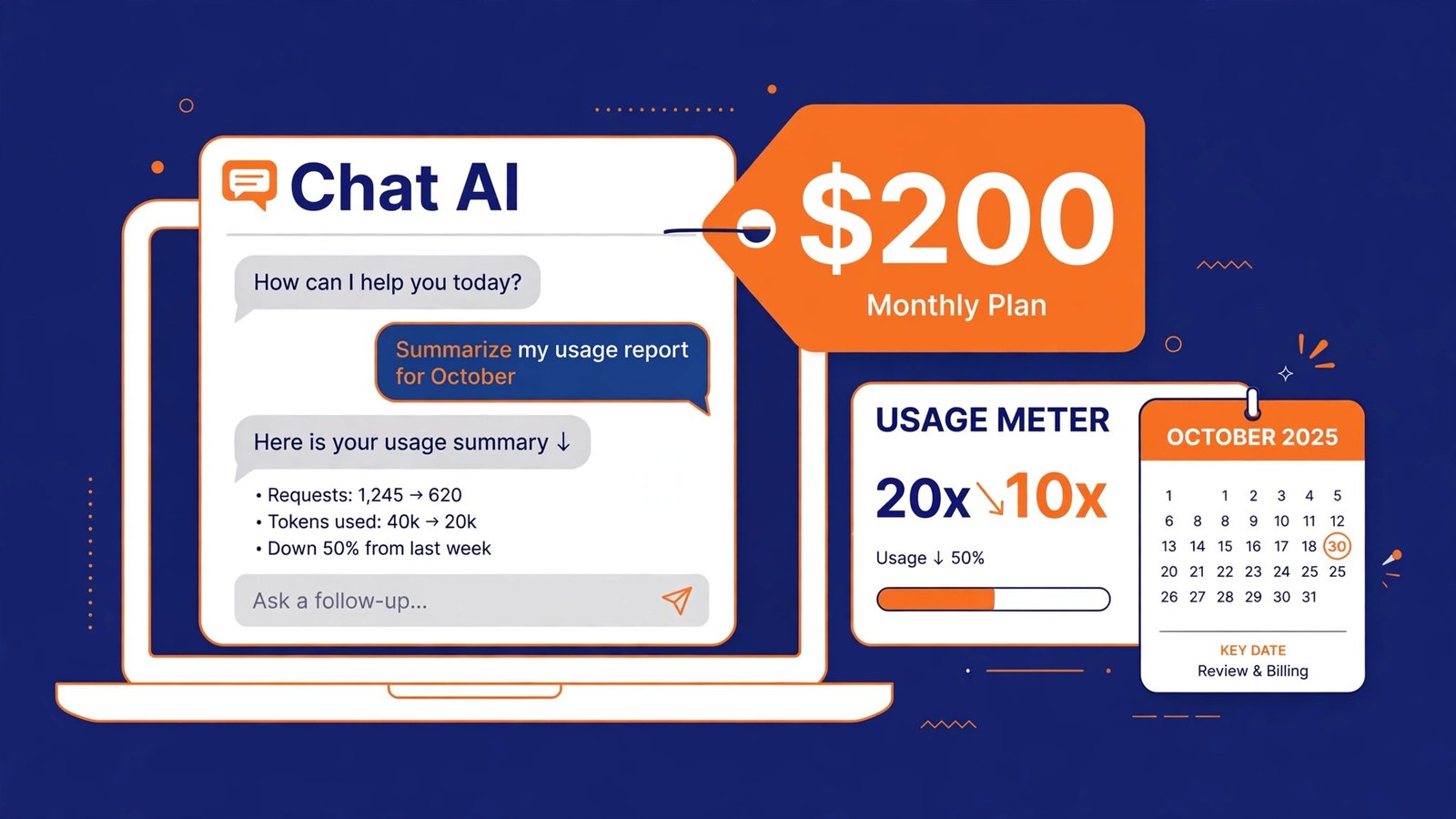
If you pay OpenAI $200 a month for ChatGPT Pro, your plan gets half as generous on October 30, 2026 — and the price does not move. Included usage in ChatGPT Work and Codex drops from 20 times the ChatGPT Plus allowance to 10 times, and the GPT-6 Pro message limit in Chat falls from 200 messages per week to 100. Existing subscribers keep their old limits through October 29, and OpenAI is softening the change with a one-time grant of 62,500 usage credits it values at $2,500, expiring December 31, 2026. Whether that trade is a minor adjustment or a dealbreaker depends entirely on which model you actually use — and most coverage of this change has skipped that part.
This is not a rumor. OpenAI told subscribers by email after its DevDay event on September 29, 2026, and the details have since been confirmed across multiple independent reports of that email and OpenAI’s own help documentation. The change arrives alongside a brand-new $500-a-month Pro 500 tier. If you are on Pro 200, you have two weeks to re-price the seat before the new math takes effect. Here is exactly what changes, who it hits hardest, and the decision tree for staying, downgrading, upgrading, or moving to the API. (Source: OpenAI subscriber email as reported by Hardware Busters)
What exactly changes on October 30
Three things happen to the $200 Pro plan, and one thing does not.
| What | Before Oct 30 | From Oct 30 |
|---|---|---|
| ChatGPT Work + Codex included usage | 20x the Plus allowance | 10x the Plus allowance |
| GPT-6 Pro messages in Chat | 200 per week | 100 per week |
| Price | $200/month | $200/month (unchanged) |
| One-time credit for existing subscribers | — | 62,500 usage credits, expiring Dec 31, 2026 |
The cut applies to existing subscribers on October 30. New sign-ups who joined after OpenAI reopened the plan on September 30 are already on the smaller allowance. OpenAI had paused new Pro sign-ups for roughly three weeks before the reopening, reportedly because demand for its most powerful model, GPT-6 Astra, had surged after its September 3 launch. The reopening and the cut landed on the same day.
Two reassurances came with the announcement. First, OpenAI has committed not to bring back the old 5-hour usage window on Pro, so the weekly allowance remains a budget you can spend in one sitting rather than a rolling cap. Second, the one-time credits show up in Settings → Usage for eligible existing subscribers. They are a genuine cushion — worth, by OpenAI’s own valuation, more than a year of the old plan’s implied subsidy — but they expire at the end of the year, and they do not change the permanent monthly math.
Why OpenAI says it’s doing this — and why the math doesn’t add up for everyone
OpenAI’s explanation, as relayed by Codex and ChatGPT Work lead Thibault Sottiaux, is that newer models do more with less. The company’s newer models are cheaper to run per unit of work, so the old 20x allowance was, in effect, a subsidy that no longer matches the cost of serving it. There is a real kernel of truth here — but it only holds if you use the models that got cheaper.
Here is the part that decides whether you personally lose anything: OpenAI cut API prices for two of its three GPT-6 models by roughly half, and left the flagship untouched.
- GPT-6 Sol dropped from $4 input / $20 output per million tokens to $2 / $10 — a 50% cut.
- GPT-6 Luna dropped from $0.20 / $1.20 to $0.10 / $0.50 — also roughly a 50% cut.
- GPT-6 Astra, the flagship model heavy users actually subscribe for, kept its price at $10 input / $50 output per million tokens.
If your work mostly runs on Sol or Luna, the halved allowance and the halved unit price roughly cancel out, and your usable token volume stays about the same. If your work runs on Astra — long coding sessions, deep agentic research, the hardest reasoning tasks — nothing got cheaper, and you lose roughly half your usable capacity overnight. That is the split the headline numbers hide, and it is the first question to answer about your own usage: which model is eating your allowance?
There is also a structural change worth understanding. Under the old pricing, Pro 200 bought 20x Plus usage for $200, which worked out to about $10 per unit of Plus-equivalent usage — a genuine volume discount versus Plus at $20 for 1x. Under the new structure, every tier prices out at exactly $20 per unit: Plus is $20 for 1x, Pro 200 is $200 for 10x, and Pro 500 is $500 for 25x. The volume discount is gone. Bigger plans now buy you features and speed, not cheaper work. That is a deliberate shift in how OpenAI prices its subscriptions, and it is the reason this change matters beyond one plan.
The one-time credits: what 62,500 credits actually buy
The headline — 62,500 credits worth $2,500 — sounds generous, and for a light user it is. But treat it as a bridge, not a refund. The credits expire December 31, 2026, and they exist to cushion a permanent cut, not to offset it. A one-time grant cannot make up for a monthly halving that repeats every month after it is gone.
How far the credits stretch depends on the same model split. On Sol or Luna, where unit prices halved, the credits go roughly twice as far as the same dollar figure would have a month ago. On Astra, they buy exactly what $2,500 of Astra API usage buys — substantial for a weekend project, gone fast for a team running daily agentic coding sessions. If you are an existing subscriber, check Settings → Usage now to confirm the grant landed on your account, and plan to spend it on work you would otherwise pay for in November and December, not on experiments you could run in January.
One more detail from the subscriber email, reported by ExplainX: Dots — OpenAI’s always-on agents — are included in Pro, and conversations and work a Dot does directly do not draw on the ChatGPT allowance. But the moment a Dot starts a Work or Codex job, that job bills against the same meters being halved. If you set up Dots to run overnight coding or research jobs, those jobs eat the new, smaller allowance. Budget for that before you leave a Dot unattended.
The new lineup: Plus vs Pro 200 vs Pro 500
| Plan | Price | Work / Codex vs Plus | Chat limit | Ultrafast | Dots |
|---|---|---|---|---|---|
| Plus | $20/month | 1x | Standard | No | Not in first wave |
| Pro 200 (after Oct 30) | $200/month | 10x | 100 GPT-6 Pro msgs/week | No | First Dot included |
| Pro 500 | $500/month | 25x | Highest limits | Yes | First Dot included |
Pro 500 is the genuinely new product here. For $500 a month — $6,000 a year — it offers 25x the Plus allowance and exclusive access to Ultrafast, which OpenAI says generates tokens up to eight times faster. For heavy Codex and ChatGPT Work users, the pitch is not just more allowance but faster turnaround on long agentic jobs. The honest framing, though, is that Pro 500 is the only way to buy back something close to what Pro 200 used to offer, at two and a half times the price. Under the old plan you got 20x for $200; under the new structure, 25x costs $500. OpenAI is not hiding this — it is the new pricing ladder, and every rung now costs the same $20 per unit of usage. (See OpenAI’s current ChatGPT pricing for the live tier list.)
That ladder also reframes Plus. At $20 for 1x, Plus remains the best value per dollar for casual and moderate users, and it keeps the 5-hour usage window Pro users escape. If you rarely hit Plus limits, the Pro cut is not your problem. If you hit them weekly, the question is whether you need 10x or 25x — and whether the API is a better deal than either.
Who gets hurt most
The cut is not evenly felt. Four groups should take it seriously:
Heavy Astra users. If you subscribe to Pro specifically for GPT-6 Astra — and most heavy users do, since Astra is the reason the plan existed at this price — you lose about half your usable capacity. Your per-token costs did not fall, so there is no offset. You are the person this change is priced for, in the worst way.
Daily Codex users. Developers running Codex for hours a day are the heaviest consumers of Work/Codex allowance. One subscriber quoted on OpenAI’s developer forum said that even under the old 20x quota, his allowance was exhausted after about three days of heavy work, and called the change “bait-and-switch, plain and simple.” The frustration is real and widespread: this is the group that built businesses on the assumption that 20x was the deal. If that is you, the one-time credits buy you roughly two months to find an alternative — use them.
Dots users. Always-on agents sound free until their jobs bill against your meters. A Dot running nightly research or coding jobs will chew through a 10x allowance far faster than interactive chat ever did. If you deploy Dots, set explicit budgets and check usage weekly.
Small teams sharing seats. Pro is a per-seat plan, and teams that informally shared one Pro seat across two or three people were already stretching it. At 10x, that arrangement breaks first. If your team shares a seat, the honest move is to price out separate Plus seats or an API setup rather than upgrading one seat to Pro 500 and sharing it again.
Who barely notices: casual users who picked Pro for the higher chat limits but rarely approach them, and Sol/Luna-heavy users whose unit prices halved. If that is you, the October 30 change is a footnote.
Your decision before October 30: stay, downgrade, upgrade, or go API
Work through this in order. Do not decide on vibes — decide on your last 30 days of usage.
Step 1: Check your actual usage
Open ChatGPT → Settings → Usage. Look at three things: how much of your Work/Codex allowance you used in the last month, which model consumed most of it, and whether you hit the chat message limit at all. If you used under 40% of the old 20x allowance, the new 10x allowance still covers you with room to spare. Stay, and stop worrying. If you used 50–100%, keep reading.
Step 2: Identify your model mix
If most of your usage is Sol or Luna, the price cuts likely offset the allowance cut. You can stay on Pro 200 and expect roughly the same usable volume. If most of your usage is Astra, you need a real plan, because you are losing half your capacity with no offset.
Step 3: Run the four-way comparison
Stay on Pro 200 ($200/month). Right if you use 10x or less, mostly Sol/Luna, or mostly chat with occasional Work/Codex jobs. You keep Dots, no 5-hour window, and the expiring credits cushion the transition. Revisit in January once the credits are gone and you have two months of data on the new allowance.
Downgrade to Plus ($20/month). Right if your usage was mostly chat and you rarely touched Work/Codex, or if you bought Pro for the idea of unlimited use rather than actual consumption. You save $2,160 a year. The cost is the 5-hour window and no Dots. For a lot of subscribers who never came close to 20x, this is the correct answer, and the cut is the nudge to take it.
Upgrade to Pro 500 ($500/month). Right only if you genuinely need more than 10x and you value Ultrafast speed for long jobs. Be honest about the math: you are paying $300 more per month than before to get 25% more allowance than the old plan gave you. For a business where a Codex agent replaces billable contractor hours, that can still pencil out. For an individual, it rarely does.
Move heavy work to the API. This is the option OpenAI’s pricing now pushes toward. API usage is pay-per-token, with no subscription allowance to exhaust: Sol at $2/$10 per million tokens and Luna at $0.10/$0.50 make API-based workflows dramatically cheaper than a subscription for bursty, batchable work. Keep a Plus subscription for interactive chat, and run your heavy Codex-style jobs through the API where you control the budget precisely. The trade-off is setup effort and no Dots, but for teams, the API’s per-key budgeting and usage tracking are actually better governance than a shared subscription seat.
Step 4: If you stay, set a guardrail
Whatever you choose, set a calendar reminder for mid-November to re-check Settings → Usage. The first month under the new allowance is the one that will surprise you, and catching it in week three beats discovering it on a deadline.
What to do this week
- Confirm your credit grant. Settings → Usage — verify the 62,500 credits are there and note the December 31 expiry.
- Export anything you care about. If you have long-running projects or Dots configurations, make sure you know how to recreate them under a different plan.
- Audit your model mix. One week of Astra-heavy work tells you more than any article can.
- Decide by October 29. Your old limits run through October 29. Make the call before the 30th, not after you hit the new cap mid-task.
- If you run a team, talk about shadow AI now. When a sanctioned tool gets rationed, people route around it with personal accounts and other vendors. One IBM finding cited in coverage of this change put breaches involving shadow AI at $670,000 more expensive on average. A clear policy — which tools are approved, who pays, where data can go — costs nothing and prevents the workaround from becoming the breach.
The bigger picture
Zoom out, and this is the end of an era that was never going to last. When ChatGPT Pro launched at $200, even OpenAI’s CEO acknowledged the company was losing money on its heaviest subscribers — people simply used it far more than the price assumed. A flat fee for near-unlimited frontier compute was always a subsidy, and subsidies end. The same repricing is rippling across the industry: Gemini’s free tier was quietly downgraded this month, and frontier-model pricing is being re-cut across the board, as our comparison of the new flagship models shows.
That does not make the halving fair to subscribers who built workflows around the old deal, and the anger on the forums is understandable. But it does make it predictable. The practical response is not to argue with the pricing ladder — it is to measure your usage, pick the rung that fits, and stop paying for capacity you do not use. Do that before October 30, and the cut becomes a bookkeeping exercise instead of a mid-project surprise.
Frequently Asked Questions
When exactly does the ChatGPT Pro $200 cut take effect?
October 30, 2026. Existing subscribers keep the old 20x Work/Codex allowance and 200 weekly GPT-6 Pro messages through October 29, then move to 10x and 100 messages per week. New sign-ups after the September 30 reopening are already on the new allowance.
Does the price of ChatGPT Pro change?
No. Pro 200 stays $200 per month. The allowance halves while the price stays the same, which is why subscribers have reacted so strongly.
What are the 62,500 usage credits, and when do they expire?
Eligible existing Pro 200 subscribers received a one-time grant of 62,500 usage credits, which OpenAI values at $2,500. They appear in Settings → Usage and expire December 31, 2026. They cushion the transition but do not change the permanent monthly allowance.
Will Sol and Luna users actually lose anything?
Probably not much. OpenAI cut GPT-6 Sol’s API price from $4/$20 to $2/$10 per million tokens and Luna’s from $0.20/$1.20 to $0.10/$0.50, so the halved allowance and halved unit prices roughly cancel out for users who mostly run those models. Astra users, whose model price did not change, feel the full halving.
What is Pro 500, and is it worth $500 a month?
Pro 500 is a new $500/month tier with 25x the Plus allowance and Ultrafast, which OpenAI says generates tokens up to eight times faster. It is worth it only if you genuinely need more than 10x and value the speed for long Codex or Work jobs. For most individuals, Plus plus API usage is the better deal.
Do Dots jobs count against the new allowance?
Dot conversations and work a Dot does directly do not draw the ChatGPT allowance, but Work or Codex jobs a Dot starts do bill against the same meters. Budget for overnight Dot jobs under the new 10x allowance.