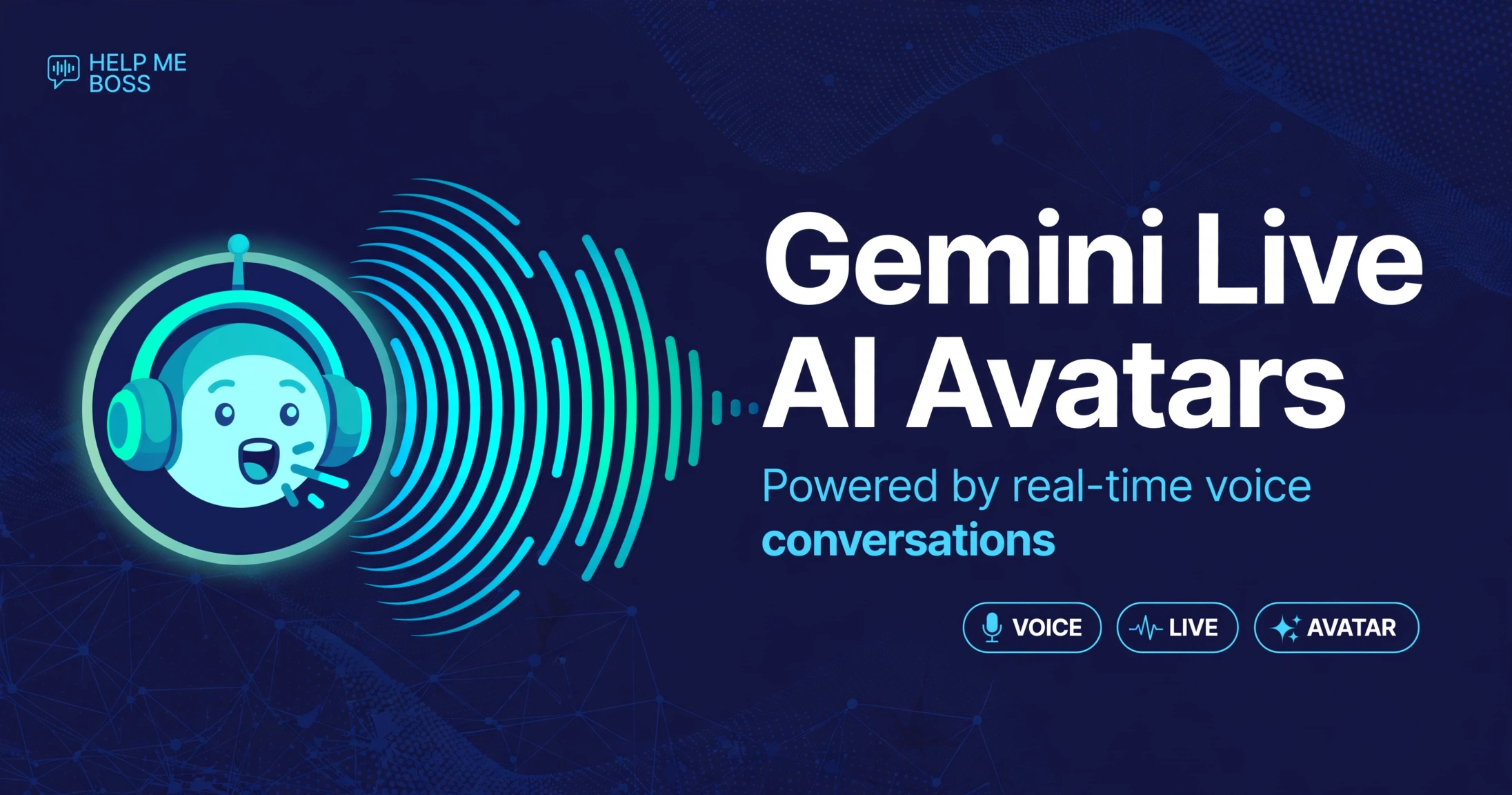
Gemini Live Now Has a Face
On September 24, 2026, Google rolled out Gemini 3.8 Live with Live Avatar, a feature that gives its real-time conversational AI a talking face. The system pairs near real-time video generation with speech, producing an animated persona that listens, speaks, and reacts with synchronized lip movements and facial expressions while the conversation flows.
This is not a voice assistant with a static picture attached. The model processes audio, live camera feeds, and screen shares simultaneously, and answers with generated video at 24 frames per second alongside 24-kilohertz audio. The face you see is generated in the same pass as the voice — there’s no separate lip-sync step bolted on afterward.
The catch, and it’s a big one for most readers: Live Avatar is available only in Gemini Enterprise. There is no consumer version in the Gemini app, and Google has announced none.
What Live Avatar Actually Does
A Persona That Talks, Listens, and Sees
Google describes the experience as one that “listens, sees, and speaks with a dynamic visual persona.” In practice that means:
- Precise lip syncing and natural expressions matched to the spoken response, with fluid turn-taking that feels closer to a video call than a voice bot.
- Visual understanding. The agent takes live camera feeds and screen shares as input, so a support session can watch what the customer is pointing at while the avatar responds.
- Interruption recovery. Callers can cut the avatar off mid-sentence, and the conversation recovers naturally — a small detail that matters enormously in real customer interactions.
97 Languages, Switched Mid-Conversation
One of the headline capabilities: Live Avatar can transition across 97 languages without degrading video fidelity or introducing visual drift, and it detects the language being used automatically. The lip movements and expressions follow the language switch rather than lagging behind it.
For multinational customer service, this is the feature that justifies the enterprise framing. One avatar deployment can serve callers in dozens of languages without separate pipelines per language.
It Works While It Talks
Behind the visual layer, Gemini’s reasoning engine handles asynchronous tool calls. The avatar can trigger background data fetches or API calls while continuing the conversation. Google’s worked example: a hotel guest chats about dinner plans while the avatar quietly completes the check-in through backend APIs. A customer service avatar can pull up an order record without pausing the spoken exchange.
This matters more than the face. The history of voice agents is full of dead air while the system “thinks.” An agent that keeps talking while it works eliminates the most annoying failure mode of automated support.
The Enterprise-Only Reality
Let’s be direct about availability, because the headlines can mislead:
- Gemini Enterprise only. Live Avatar runs in Gemini Enterprise and nowhere else. Google Cloud’s announcement says it is generally available there, with US and EU endpoints.
- No consumer version. You cannot switch this on in the Gemini app on your phone.
- Custom avatars are gated. Organizations can choose from a library of preset avatars today. Building an avatar from your own reference photo — preserving likeness, brand styling, or character identity — requires enterprise allowlisting and a verification step.
Google’s positioning is deliberate: Live Avatar is something a company puts in front of its own customers, not a toy for individual users. The launch use cases are customer service desks, product tutorials, digital kiosks, virtual receptionists, and employee training.
What About Pricing?
Google’s launch materials point to a pricing page without stating Live Avatar-specific pricing in the announcement itself. Third-party tracking puts video output at around $1.00 per million video output tokens on top of the audio costs. Treat that as a directional figure from industry coverage, not an official price list — confirm current pricing in Google Cloud’s console before planning a deployment.
Safety and Misuse Controls
Google built in several guardrails, and they’re worth knowing because they shape what you can actually deploy:
- SynthID watermarks. Every second of generated audio and video carries Google’s imperceptible SynthID watermark, designed to make AI-generated content detectable and verifiable. This is Google’s answer to the misinformation and misattribution risk as synthetic faces get more convincing.
- Curated avatar library. The preset avatars limit the impersonation surface at launch.
- Allowlisted custom likenesses. You can’t freely generate an avatar of a real person; custom creation goes through verification.
- Enterprise compliance. Provisioned throughput, data governance features, and regional endpoints (US and EU) address the procurement checklist.
These controls are also a moat. The verification requirements for custom avatars mean Live Avatar won’t be a deepfake free-for-all, but they also mean smaller companies face more friction than large enterprises with existing Google Cloud relationships.
Early Adoption Signals
Google Cloud names Cox Automotive as an early builder, with an AI shopping assistant for Autotrader built on the feature. That’s a sensible first use case: car shopping involves long, meandering conversations where a face and persistent visual presence beat a disembodied voice.
Expect the next wave in the usual places: telecom support, banking virtual assistants, healthcare scheduling, and retail kiosks. Anywhere a company already pays for human agents to be visibly present, a synthetic face becomes economically interesting.
What This Means for Creators and Small Businesses
Honestly? Not much yet. Live Avatar is enterprise infrastructure with enterprise pricing and enterprise procurement. If you’re a creator or small business owner, the relevant takeaway is directional:
- Talking avatars are becoming a commodity capability. What ships enterprise-only today tends to reach prosumer tools within a year or two. The avatar features in today’s creator tools will keep improving.
- The watermark norm is spreading. SynthID on every frame is Google normalizing verifiable AI content. Expect disclosure and watermarking requirements to keep tightening across platforms — relevant if you publish AI-generated video.
- Multilingual support is the real unlock. 97 languages with automatic switching is the kind of capability that eventually reaches customer-facing tools for smaller businesses. Watch for it.
If you’re evaluating conversational AI for a business deployment today, the question isn’t whether avatars are cool — it’s whether your customers will trust and use a synthetic face, and whether your Google Cloud spend justifies it. Pilot with a narrow use case before committing.
Source: WebProNews coverage of the Gemini 3.8 Live Avatar launch, based on Google’s official announcement. Availability and pricing should be confirmed in the Google Cloud console.
Related: Google Made AI Video Free in Vids — What You Get (2026) · ChatGPT Images 2.5 Does Precise AI Editing Now (2026)
Official source: Google Research
Frequently Asked Questions
What is Gemini Live Avatar?
Live Avatar is a feature of Gemini 3.8 Live, announced September 24, 2026. It pairs near real-time video generation with speech to create an animated AI persona with synchronized lip movements and expressions, available in Gemini Enterprise.
Can I use Gemini Live Avatar in the Gemini app?
No. Live Avatar is available only through Gemini Enterprise. Google has announced no consumer version for the Gemini app.
How many languages does Gemini Live Avatar support?
97 languages, with automatic language detection and switching mid-conversation. Google says lip sync and video fidelity hold up across the switch.
How much does Gemini Live Avatar cost?
Google hasn’t published Live Avatar-specific pricing in its launch materials. Industry coverage points to roughly $1.00 per million video output tokens on top of audio costs. Confirm current pricing in the Google Cloud console.
Can I create a custom avatar of myself or my brand?
Custom avatars from a reference photo require enterprise allowlisting and verification. At general availability, organizations choose from Google’s library of preset avatars.
How does Google prevent misuse of the avatars?
All generated audio and video carries imperceptible SynthID watermarks, custom likenesses require allowlisted verification, and the launch avatar library is curated. Enterprise deployments also include compliance and data governance controls.