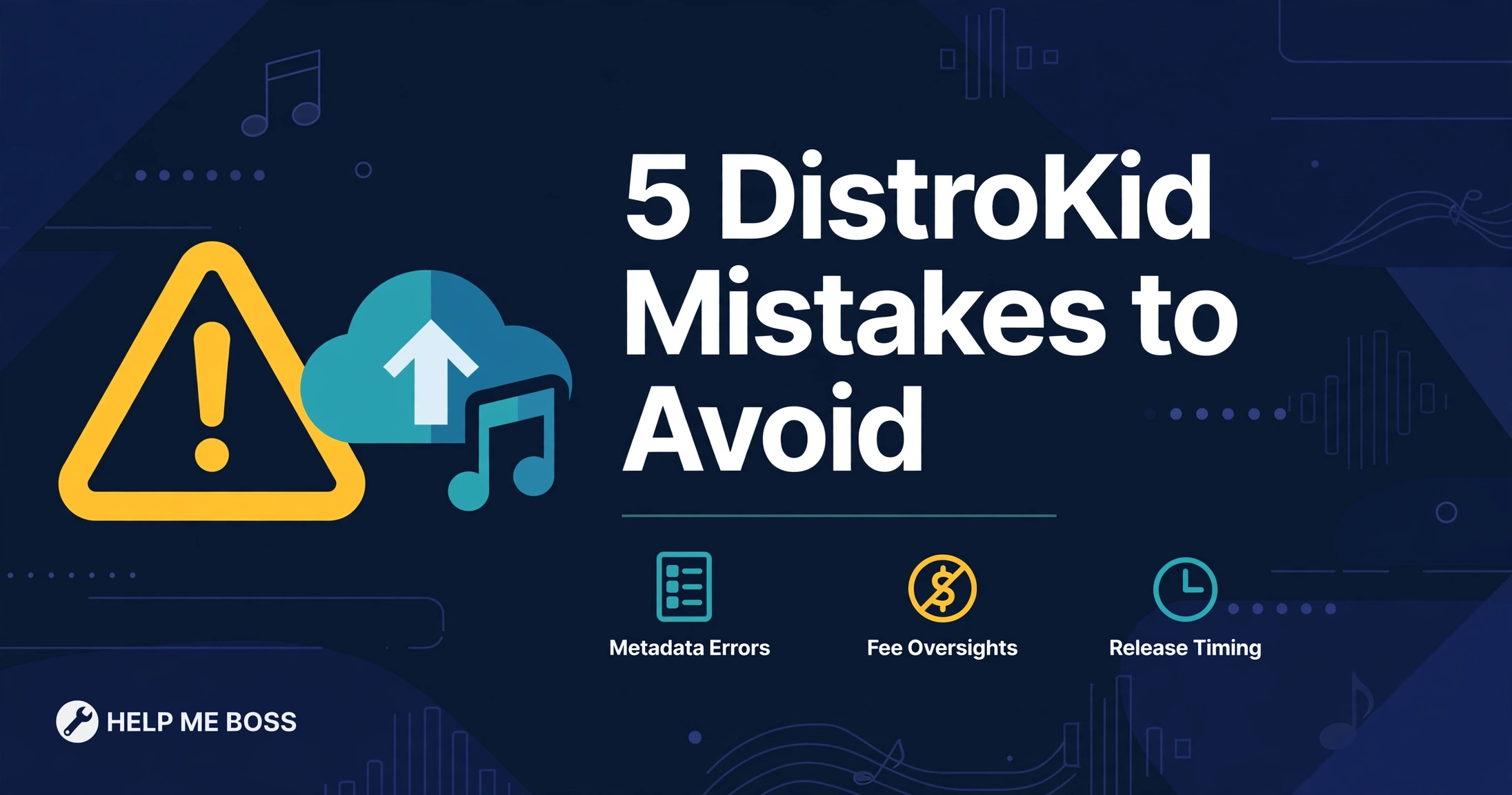
Uploading to DistroKid looks simple — and that’s exactly why beginners get burned. The upload form takes ten minutes; the mistakes it lets you make can cost you playlist placements, split royalties, or your entire release. These are the five I see most often, each with the fix.
Mistake 1: Setting the release date too soon (killing your Spotify pitch)
The classic beginner move: finish a song Friday night, set the release date for next Friday, and wonder why Spotify never playlisted it. Here’s the mechanics: Spotify only lets you pitch an unreleased track for editorial playlists after your distributor has delivered it — and Spotify asks for roughly a 7-day minimum lead time once it’s in their system. DistroKid typically delivers to Spotify in 1–3 days, but “delivered” plus “pitched” plus “7 days” means a one-week release window is already dead on arrival.
The fix: set your DistroKid release date 3–4 weeks out. Upload now, let it deliver, then pitch through Spotify for Artists with a real runway. The Suno-to-Spotify walkthrough “Suno AI Part 4: Release & Get Paid” flags exactly this among the four mistakes that stop most creators — rushing the release date is the silent killer because nothing errors out; you just never get considered.
Mistake 2: Sloppy metadata that splits your royalties and identity
Metadata is forever, and DistroKid’s form makes it easy to be careless:
- Artist name inconsistencies (“Luna Ray” vs “LunaRay” vs “LUNA RAY”) create separate artist profiles on Spotify. Good luck merging them later.
- Featured artists in the wrong field — dumping “feat. X” into the song title instead of the dedicated featured-artist field breaks proper crediting and royalty splits.
- Songwriter/composer fields left blank or guessed — this is the data publishing royalties depend on. If DistroKid later flags your songs as eligible for its Publishing feature, dirty songwriter data is what blocks collection.
- Re-uploading the same recording through DistroKid after already delivering it elsewhere (or vice versa) with a new ISRC. Streaming services match recordings by ISRC — duplicates split your stream counts and playlist placements across two listings.
The fix: decide your exact artist name spelling once and never deviate. Fill every credit field deliberately. And never deliver the same recording through two distributors — if you’re switching, upload with the same ISRC and identical metadata at the new distributor, wait until it’s live, then take down the old one.
Mistake 3: Opting into Content ID without being eligible
DistroKid offers YouTube Content ID through its Social Media Pack, and beginners treat it as free protection money. It’s neither free ($4.95 per single or $14.95 per album per year, plus DistroKid keeps 20% of the revenue) nor automatic protection — it’s a fingerprinting system with strict eligibility.
The eligibility line, per DistroKid’s own terms: you must have created all of the sounds. Tracks containing non-exclusive beats, loops, sample-library material, or public-domain audio are ineligible. As one creator commented on Medium: with dozens of tracks, the per-song yearly cost adds up fast “without guarantee they will generate money.”
Worse, ineligible opt-ins actively harm you: duplicate Content ID submissions can generate copyright claims against your own YouTube channel and your collaborators’ videos.
The fix: only opt in tracks where every sound is 100% yours. For beat-lease or loop-based tracks, skip Content ID — distribution to YouTube Music still works fine without it.
Mistake 4: Artwork that gets the release rejected
DistroKid enforces the stores’ artwork specs, and rejections here delay your release date — the one you carefully set 3 weeks out (see Mistake 1). The standard requirements:
- 3000×3000 pixels, JPG or PNG, RGB color mode
- No blurry, pixelated, or stretched images
- No URLs, social media handles, email addresses, or pricing on the cover
- No misleading “Parental Advisory” logos unless the track actually needs one, and no store logos (no Spotify/Apple badges on your art)
AI-generated cover art is fine as long as it’s high-resolution and original — but upscale it properly; a 1024px AI image stretched to 3000px is exactly the kind of thing that gets flagged for quality.
The fix: export at exactly 3000×3000 before you start the upload. Check the art at full size on a big screen, not your phone. One rejected upload can cost you a week.
Mistake 5: Choosing the wrong plan — and forgetting what happens when you stop paying
DistroKid’s tiers look similar until they bite:
- Musician ($24.99/yr) covers one artist name. Releasing a side project or a collaboration under a second name? That’s a second artist — you need Musician Plus ($44.99/yr, two artists) or your release gets tangled.
- Musician Plus also adds daily streaming stats, scheduled release dates, and a custom label name — the scheduled-release feature alone is worth it if you run a content calendar.
- The big one: DistroKid is a subscription, not a purchase. If you stop paying, your music comes down within weeks — unless you bought Leave a Legacy ($29 per single, $49 per album, one-time) for each release. Beginners discover this the year they let the card expire.
The fix: count your artist names before choosing a tier, and decide on Leave a Legacy per release based on whether that track is catalog or disposable. For a serious catalog, the Legacy fees are cheap insurance.
Bonus: the 60-second pre-upload checklist
Run through this before you hit submit on any DistroKid release:
- [ ] Release date is 3–4 weeks out (Spotify pitch window protected)
- [ ] Artist name spelling matches every previous release exactly
- [ ] Featured artists in the featured-artist field, not the title
- [ ] Songwriter/composer fields filled with real, consistent names
- [ ] Artwork is exactly 3000×3000, no URLs/handles/logos
- [ ] Content ID opted in only for 100%-original-sound tracks
- [ ] Plan tier covers all artist names on the release
- [ ] Leave a Legacy decided per release (catalog vs. disposable)
- [ ] AI use disclosed truthfully if applicable
Nine checkboxes, one minute, and you avoid every mistake in this article.
The pattern behind all five
Every one of these mistakes comes from treating distribution as the finish line instead of the starting line. The upload is ten minutes; the release lives for years. Slow down on the form, and the royalties take care of themselves. And one final habit worth building: after every release goes live, spot-check it on Spotify and Apple Music within 48 hours — wrong artist profile, wrong artwork, wrong date. Catching errors in the first two days is a quick fix; catching them in month six is a support ticket.
Ready to release? Join DistroKid here (affiliate link) and keep 100% of your royalties. And if you’re distributing AI music, read our AI music rules and Content ID guide first — the disclosure checkboxes matter more than ever in 2026.
Frequently Asked Questions
How far in advance should I set my DistroKid release date?
3–4 weeks. Spotify needs your track delivered before you can pitch it for editorial playlists, and asks for about 7 days’ lead time after that. DistroKid delivers to Spotify in roughly 1–3 days.
Can I change my artist name spelling after release?
Not cleanly — inconsistent spellings create separate artist profiles on streaming services. Pick one exact spelling and use it on every release.
Is DistroKid’s Content ID worth the cost?
Only for tracks where you created 100% of the sounds. At $4.95 per single per year (plus DistroKid’s 20% cut of the revenue), ineligible tracks cost you money and can trigger claims against your own channel.
What are DistroKid’s artwork requirements?
3000×3000 pixels, JPG/PNG, no blur, no URLs or social handles, no store logos. Rejected artwork delays your release.
What happens to my music if I cancel DistroKid?
It comes down within weeks unless you purchased Leave a Legacy ($29/single, $49/album) for each release you want to keep live permanently.