
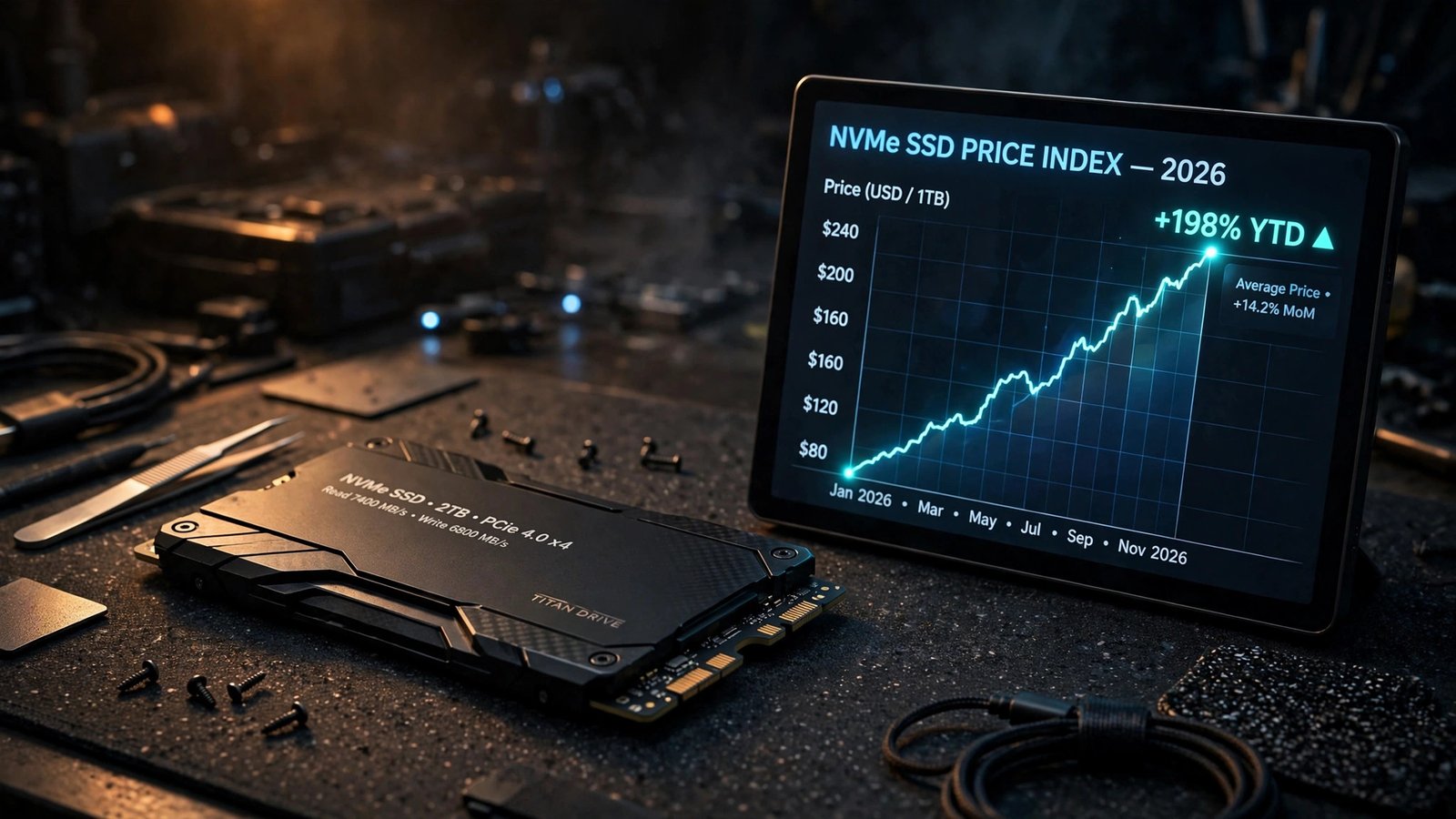
A year ago, a Samsung 990 Pro 2TB was a $119 drive. As of November 10-11, 2026, that same drive was selling for $389. That’s more than triple the price for the exact same piece of hardware — no new version, no spec bump, no redesign. If you’ve been putting off a storage upgrade, you’ve watched the cheapest upgrade in PC building turn into one of the most expensive.
The short answer: if your current drive is failing, nearly full, or so slow it’s costing you time every day, buy now — but buy a mid-tier drive instead of a flagship. If your storage works fine and you’re just chasing a deal, wait. Below are the numbers, the causes, and a concrete decision framework so you can make that call with confidence.
How bad is it, really? The numbers
Let’s start with the headline figure, because it’s the one that stops people mid-scroll. The Samsung 990 Pro 2TB — arguably the most popular high-end consumer SSD of the last few years — hit $389 in November 2026, according to Tom’s Hardware coverage via Aliteq, with PC Guide listing it at $389.99 with prices correct as of November 5, 2026. Its lowest-ever price was $119. That’s a 227% increase from the low.
The 990 Pro isn’t an outlier. Tom’s Hardware tracked the Samsung 990 Pro 1TB going from $109.99 in November 2025 to $199.99 in January 2026 — an 83% jump in about two months. The Samsung 990 Evo Plus 2TB went from $113 to $363.49, a 221.5% increase. When the budget-oriented Evo Plus costs more than the flagship 990 Pro used to, you know the whole market has moved.
GamersNexus put the broader trend in hard numbers in March 2026 in a piece bluntly titled “SSDs: WTF?” The average 2TB NVMe drive rose from $168.75 in November 2025 to $357.50 in March 2026 — up 113.7% in four months. The 990 Pro 2TB went from $190 to $400 in that window, a 110.5% increase. Even 2TB SATA drives, the slowest and cheapest category, averaged $150 in November 2025 and roughly $350 by March 2026.
Then vs. now: the price table
Here’s the comparison in one place. All prices are US retail, in dollars, and every figure below comes from the sources cited — not from memory or guesswork.
| Drive | Then | Now | Change |
|---|---|---|---|
| Samsung 990 Pro 2TB | $119 (lowest ever) | $389 (Nov 10-11, 2026) | +227% |
| Samsung 990 Pro 1TB | $109.99 (Nov 2025) | $199.99 (Jan 2026) | +83% |
| Samsung 990 Evo Plus 2TB | $113 | $363.49 (2026) | +221.5% |
| Average 2TB NVMe | $168.75 (Nov 2025) | $357.50 (Mar 2026) | +113.7% |
| Average 2TB SATA | ~$150 (Nov 2025) | ~$350 (Mar 2026) | +133% |
Three things worth noticing. First, the 1TB 990 Pro “only” rose 83% while the 2TB version rose 227% from its low — partly because the figures are different snapshots (January vs. November 2026). But larger drives have also been hit harder, because data centers buy high-capacity flash in bulk and that demand eats the supply of the bigger NAND packages first.
Second, the average 2TB NVMe price in March 2026 ($357.50) was already close to where the flagship 990 Pro 2TB sits in November ($389). When an average drive costs nearly as much as the best drive, the value calculation changes — more on that in the tier guide below. Third, the dates matter: a price from March is ancient history. Before you buy anything, check the current price yourself — it may have moved since November 10-11, 2026, in either direction.
What a dollar buys now: the per-terabyte math
Percentages are abstract. Dollars per terabyte make the change concrete, because storage is one of the few things in tech where you can measure exactly what your money buys.
At its $119 low, the 990 Pro 2TB cost about $59.50 per terabyte. At $389, it costs $194.50 per terabyte. Same drive, same 2TB of space, same 7,450 MB/s read speed — you’re paying more than three times as much per terabyte.
Run the same math on the average 2TB NVMe from GamersNexus’s tracking: $168.75 worked out to about $84 per terabyte in November 2025. By March 2026, $357.50 meant about $179 per terabyte. The market average more than doubled in four months. The 990 Evo Plus 2TB tells the same story: $113 meant $56.50 per terabyte; $363.49 means about $182 per terabyte. The budget drive now costs more per terabyte than the flagship did at its low.
Here’s why this math matters. For years, the advice was simple: buy the biggest drive you can afford, because the per-terabyte cost drops as capacity rises. That still holds — a 2TB drive still costs less per terabyte than a 1TB drive — but the old rules of thumb about what’s “cheap” are useless. A drive that would have been a screaming deal at $180 per terabyte a year ago is now the market rate. Compare drives against today’s per-terabyte prices, not what you remember paying last year: anchoring to 2025 prices will make every option look like a rip-off, and you’ll end up buying nothing while your 500GB boot drive gasps for air.
For reference, the 990 Pro 1TB at $199.99 works out to about $200 per terabyte — slightly worse per terabyte than the 2TB model at $389. If you do buy now, the 2TB size is still the better value.
Why SSD prices surged: AI data centers ate the NAND
The cause isn’t mysterious, and it isn’t a single company raising prices for fun. It’s a supply-and-demand story, and the demand side is dominated by one customer: AI data centers.
NAND flash is the memory inside every SSD. The same factories that make the NAND chips in your gaming PC’s drive also make the NAND that goes into enterprise SSDs for data centers. When data centers started buying NAND at unprecedented scale to feed AI training and inference workloads, they didn’t just buy more — they bought the output of entire production lines, and they were willing to pay enterprise prices to get it.
TrendForce’s forecast from September 30, 2026, lays out the scale of it: NAND flash contract prices are expected to rise another 15-20% in the fourth quarter of 2026, enterprise SSDs are the only category where price growth is speeding up, and enterprise SSD bit demand is up more than 80% year over year in 2026. TrendForce doesn’t expect meaningful new NAND capacity before late 2027 or 2028. That’s the key point: the factories that could relieve this shortage don’t exist yet, and building them takes years, not months.
The supply side is just as tight. Phison’s CEO has said a 1-terabit TLC NAND chip cost $4.80 in July 2025 and $10.70 by November 2025 — more than double in four months at the chip level, before any drive maker adds margin, packaging, or distribution costs. Phison also said 2026 production capacity is already sold out. When chip makers have sold everything they can produce for the year, there’s no spare supply to bring consumer prices back down.
And the pressure isn’t coming only from AI. A hard-drive shortage pushed data centers toward flash storage as well, adding a second wave of enterprise demand on top of the AI wave. Enterprise contracts are bigger, longer, and more profitable, so consumer buyers — you and me — are the lowest priority customer. Consumer drives get what’s left.
Silicon Motion vice president Nelson Duann put it bluntly to Tom’s Hardware: “The retail SSD market has almost disappeared.” That’s not a prediction. That’s a description of what’s already happening — NAND output is being allocated to enterprise buyers first, and the retail channel is getting the remainder.
Contract prices vs. retail prices: don’t confuse the two
You’ve probably seen a shocking number floating around social media: SSD prices up 303%. That figure is real, but it’s widely misunderstood, and it’s worth being precise about it because the distinction changes what you should expect.
The 303% figure comes from Notebookcheck’s October 25, 2026 coverage, citing SellGPU data, and it refers to SSD contract prices — the prices that manufacturers and large buyers negotiate for bulk NAND supply — over the past year. Contract prices are not retail prices. They’re the wholesale cost of the underlying flash memory, and they move faster and further than the price you see on a store page.
Think of it like the price of wheat and the price of bread. When wheat prices triple, bread gets more expensive — but it doesn’t triple, because the bakery’s other costs didn’t triple. The same logic applies here: a 303% jump in contract NAND prices has translated into retail increases in the 100-230% range. That’s still enormous, but it’s not 303%.
Keep three prices straight: contract prices (bulk NAND deals, which moved first and furthest); retail prices (what you pay on Amazon, Newegg, or Best Buy — the numbers in this article); and spot prices (short-term NAND trades, which swing wildly and mostly matter to traders). When you see a headline about SSD prices, check which of the three it’s citing before you panic or assume the worst is over.
Buy now or wait? The decision framework
This is the question everyone actually wants answered, and the honest answer is that it depends on your situation — not on a prediction about where prices go next, because nobody can predict that reliably.
Buy now if any of these are true:
- Your current drive is failing. Clicking sounds, SMART errors, files that won’t open, blue screens that point at storage — don’t gamble with your data to save $50. Buy a replacement today, back up first, and sort out the price later.
- You’re out of space and it’s costing you time. If you’re uninstalling games every week, deleting footage to make room, or you can’t install the software you need for work, the cost of waiting is real. It’s measured in hours, not dollars.
- You need the drive for work that pays. If slow or full storage is slowing down work that earns money — video editing, development, photography — a $389 drive that saves you an hour a week pays for itself fast.
Wait if all of these are true:
- Your current storage works fine. You’ve got space, your drive is healthy, and nothing you do is bottlenecked by storage speed.
- The upgrade is a nice-to-have, not a need. A faster load screen or snappier boot time is pleasant, but not worth triple the old price.
- You can wait at least until after Black Friday. There may be modest relief, and you’ll have lost nothing by waiting a few weeks.
The middle ground most people should take:
If you need storage soon but not today, drop one tier. Instead of the flagship 2TB at $389, consider a 1TB mid-tier drive for your operating system and most-used apps and keep your old drive for bulk storage — or a 2TB mid-tier drive instead of the flagship. The real-world difference between a good mid-tier NVMe and a flagship is small for most people, and the price gap is still real money.
One more consideration: don’t buy two drives “just in case” prices go higher. Stockpiling is how shortages get worse, and if prices do fall back, you’ll be stuck with extra hardware you bought at the peak. Buy what you need. That’s it.
What to buy instead: the tier guide
The old buying advice — “just get the 990 Pro, it’s the best value” — doesn’t survive contact with a $389 price tag. Here’s how to think about tiers in November 2026.
Budget tier: DRAM-less NVMe drives. These are the cheapest NVMe drives on the market. They skip the DRAM cache flagship drives use to manage data, which makes them slower at sustained writes and heavy multitasking. But for a typical user — browsing, office work, casual gaming, media storage — a DRAM-less NVMe is still dramatically faster than a SATA drive or a hard drive, and it’s the cheapest way into NVMe storage right now.
Mid-tier: good PCIe 4.0 drives with DRAM. This is the sweet spot for most buyers in this market. A mid-tier PCIe 4.0 drive with a DRAM cache gets you most of the real-world performance of a flagship — fast boots, fast game loads, smooth large-file work — at a meaningfully lower price. If you’re building a new PC or replacing a boot drive, start here.
Flagship tier: the 990 Pro and its peers. The 990 Pro 2TB is a superb drive: PCIe 4.0 x4, up to 7,450 MB/s sequential read, 6,900 MB/s sequential write, a 2GB DRAM cache, 1,200 TBW endurance rating, and a 5-year warranty. But at $389, you’re paying a premium for performance most people will never feel — the difference between 7,450 MB/s and 5,000 MB/s is invisible when you’re opening a browser or loading a game level. Buy a flagship only if you do sustained heavy writes, like professional video editing or constant large-file transfers. For everyone else, the mid-tier is the smarter buy at today’s prices.
What about SATA? Don’t buy a new SATA SSD for a primary drive in 2026 unless your machine genuinely can’t take an NVMe drive. SATA drives averaged around $350 for 2TB by March 2026 — nearly the price of an NVMe drive, at a fraction of the speed. The only reason to buy SATA now is an older machine with no M.2 slot. Otherwise, spend the same money on NVMe.
Capacity vs. speed: which matters more?
In this market, capacity wins. A 2TB mid-tier drive will make you happier than a 1TB flagship, because running out of space is a daily annoyance while the speed difference between tiers is something you’d only notice in a benchmark. If your budget forces a choice, take the bigger, slower drive.
Black Friday 2026 outlook: will there be deals?
Black Friday falls on November 27, 2026, with Cyber Monday following on November 30. Normally, this would be the best time of year to buy storage. This year is not normal, and it’s important to set expectations honestly.
As of this writing, no storage brand has announced a Black Friday 2026 price for its SSDs. That’s a sign of how tight supply is — brands don’t announce discounts when they aren’t sure they’ll have stock to sell.
Gaurav Tiwari’s Black Friday deals roundup gives useful context: the 990 Pro 2TB was $170 last Black Friday, and his 2026 target price for the drive is $330-360. That target is below today’s $389, but it’s still roughly double last year’s Black Friday price. His expectation is that sale prices may dip 10-20% from today’s level — meaningful, but not a return to anything like normal pricing.
If you’re planning to buy, Black Friday is worth waiting the couple of weeks for — a 10-20% discount on a $389 drive saves you $40-80. But don’t expect a miracle: there will be no $119 990 Pro this Black Friday, and most likely no $170 one either. The realistic best case is a drive in the low-to-mid $300s, if the deals materialize at all.
Two practical tips: check prices now and write them down, so you can tell a real discount from a fake one — some retailers raise the “original” price before a sale so the discount looks bigger than it is. And if you see a drive at or near Tiwari’s $330-360 target range during Black Friday week, that’s a genuine deal in this market. Don’t hold out for $200. It isn’t coming this year.
For broader Black Friday context, see Shopify Black Friday 2026 seller fees and the Amazon and Walmart BFCM landscape.
The RAM surge is the same story
The same thing is happening to memory: RAM prices have surged because AI data centers are absorbing supply. I covered that side in DDR5 RAM price surge: 32GB for $450, buy now or wait. If you’re planning a PC build, read it alongside this one — a new build needs both RAM and storage, and both are at peak prices right now. For a decade, storage and memory got cheaper almost every year. That assumption is broken for now: prices stay high until new NAND and DRAM capacity comes online — per TrendForce, late 2027 or 2028.
How long will this last?
Nobody knows for certain, and you should be skeptical of anyone who claims otherwise. But the structural facts point to a long squeeze rather than a quick spike: building a NAND fabrication plant takes years and billions of dollars, and the fabs under construction now were planned before the AI demand surge. Until those plants open, supply is essentially fixed while demand keeps growing, and AI infrastructure spending shows no sign of slowing.
That said, markets don’t move in straight lines. Contract prices could stabilize even while they stay high, retail prices could drift down from panic peaks, and Black Friday could bring the 10-20% relief deal trackers expect. If AI spending cools, demand could ease faster than anyone expects.
The most honest forecast is this: prices are unlikely to return to 2025 levels any time soon. A gradual easing from today’s peaks is plausible over the next year, but a return to $119 for a 2TB flagship is not on the horizon. If you’re waiting for the old prices to come back, you may be waiting until 2028.
Sources worth reading: GamersNexus’s March 2026 analysis, SSDs: WTF?, Aliteq’s coverage of the SSD and RAM price surge, and Samsung’s official 990 Pro 2TB product page.
Frequently Asked Questions
Why did SSD prices go up so much in 2026?
AI data centers are buying NAND flash — the memory inside every SSD — at massive scale, and enterprise SSD demand is up more than 80% year over year. NAND factories can’t increase output quickly, and 2026 production capacity is already sold out, according to Phison’s CEO. With enterprise buyers taking priority, consumer supply shrank and retail prices surged. A hard-drive shortage also pushed data centers toward flash, adding more demand. New NAND capacity isn’t expected before late 2027 or 2028, per TrendForce’s September 30, 2026 forecast.
Is the Samsung 990 Pro 2TB really $389?
Yes, as of November 10-11, 2026. Tom’s Hardware reported the $389 price via Aliteq, and PC Guide listed it at $389.99 with prices correct as of November 5, 2026. Its lowest-ever price was $119. Prices move daily, so check the current price before buying.
Should I buy an SSD now or wait until Black Friday?
If your drive is failing or you’re out of space, buy now — don’t risk your data to save money. If your storage works fine, waiting until Black Friday on November 27, 2026 is worth it: sale prices may dip 10-20% from today’s level, with a realistic target of $330-360 for the 990 Pro 2TB. But no brand has announced Black Friday prices yet, and a return to 2025 prices isn’t expected. Don’t hold out for $119 or $170 — those prices are gone for now.
What’s the difference between contract prices and retail prices?
Contract prices are the bulk prices manufacturers pay for NAND flash chips — those rose as much as 303% over the past year in some categories, per Notebookcheck’s October 2026 coverage of SellGPU data. Retail prices are what you pay in a store, and those rose roughly 110-230% depending on the drive. The percentages differ because retail prices include manufacturing, packaging, distribution, and retailer margins that didn’t triple. Always check which price a headline is citing.
Is a DRAM-less SSD worth buying to save money?
For most everyday uses — browsing, office work, casual gaming, media storage — yes. A DRAM-less NVMe drive is still far faster than a SATA drive or hard drive, and it’s the cheapest path to NVMe storage right now. You’ll notice the missing DRAM mainly during sustained heavy writes, like copying very large files. If you’re on a tight budget and need capacity, it’s a sensible compromise. If you edit video or move large files daily, spend the extra for a drive with DRAM.
Will SSD prices come back down in 2027?
Probably not to 2025 levels. TrendForce forecasts NAND contract prices rising another 15-20% in Q4 2026, and meaningful new NAND capacity isn’t expected before late 2027 or 2028. A gradual easing from today’s peaks is possible, but the structural cause — AI data center demand absorbing supply — isn’t going away soon. If you’re waiting for $119 2TB flagship drives to return, expect a long wait. Buy mid-tier capacity when you need it and stop anchoring to old prices.