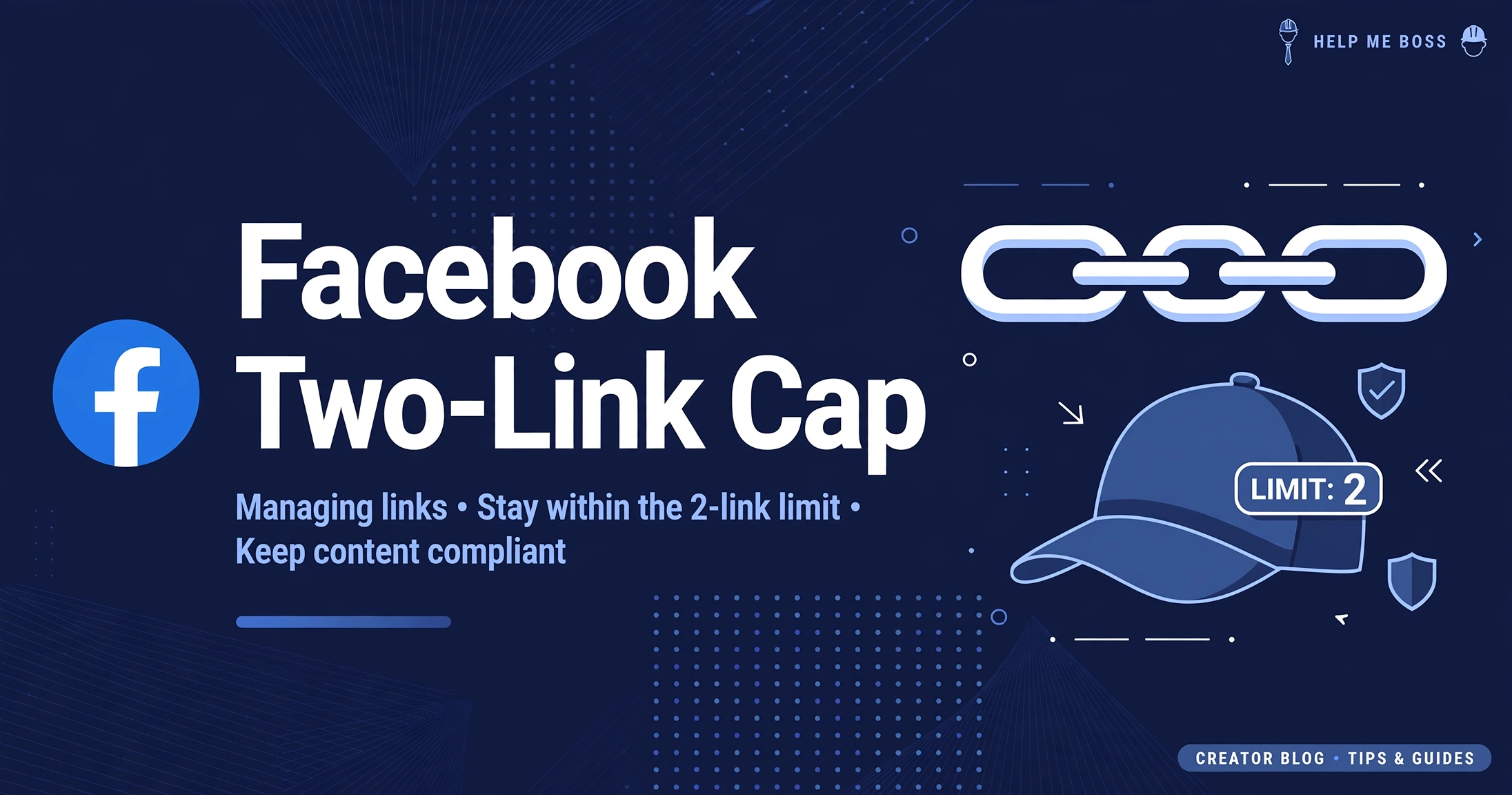
For the first time in Facebook’s history, posting a link isn’t free. Meta is rolling out a cap that limits free Facebook Pages to two link posts per month — and if you want more, you pay. Here’s exactly how it works and what to do about it.
What Changed
Meta ran a limited test back in December 2025 restricting some Pages to two link posts per month. In 2026, alongside the launch of the Meta One subscription, that test has been expanding in waves to more Pages and professional-mode profiles.
The key detail: this is a wave rollout, not a single switch. Some Pages already have the cap enforced; others don’t have it at all yet. So the question isn’t “when is this happening” — it’s “has it reached my Pages.” Check your composer: affected Pages see a notification when their link allowance is spent.
What counts against the cap: link posts and links in comments both draw from the allowance on affected Pages. What doesn’t count: links to Meta’s own apps (Instagram, WhatsApp), catalog product links, and links in paid ads. And reportedly, links pasted in the first comment are increasingly posting as plain non-clickable text — the old workaround is closing.
Meta One Pricing: What Links Cost Now
Meta publishes the allowances per plan (US pricing; varies by region):
| Meta One plan | Price/month | Link posts/month |
|---|---|---|
| Free | $0 | 2 |
| Essential | $14.99 | 2 |
| Advanced | $49.99 | 8 |
| Expert | $149.99 | 20 |
| Max | $499.99 | Unlimited |
Read that table carefully, because there’s a trap in it: the $14.99 Essential plan doesn’t add any links. You pay fifteen bucks a month and still get exactly 2. The first plan that actually buys you more links is Advanced at $49.99/month — which works out to roughly $6 per link post.
Other catches: plans are charged per Page, so an agency managing five client Pages pays five times. Unused links don’t roll over month to month. And some Page owners have reported being told they aren’t eligible to subscribe at all.
Why Meta Is Doing This
Follow the money. Meta earns when users stay on Facebook scrolling past ads — every click to an external website ends that session. Meta’s own data showed only about 1.3% of widely-viewed US Facebook content contained an external link in early 2026, down from nearly 10% in 2022. Link posts have been quietly losing reach for years; now Meta has turned the remaining trickle into a paid feature.
It’s also a spam filter that pays for itself. The cap clears out high-volume link-spraying operations and years-old spam Pages at the same time it inconveniences legitimate publishers. Whether that’s the intent or a side effect, it’s the outcome.
How to Adapt: The Practical Playbook
1. Treat your 2 links like gold. If you’re on the free tier, those two monthly link posts should go to your highest-value content only — the post most likely to convert, not just your latest article. Everything else gets the native treatment.
2. Go native-first. Facebook has always rewarded content that keeps users on Facebook: native video, text posts, images. A Page that posts engaging native content daily and links twice a month will outperform a Page that sprays links nobody clicks. This was already true before the cap — the cap just made it mandatory.
3. Build the email list. This is the real lesson. Every platform eventually meters the thing you took for granted. An email list is the one audience no platform can put behind a paywall. If Facebook drives meaningful traffic for you, some of that traffic should be converting to subscribers now.
4. Do the per-link math before subscribing. Monthly Facebook-referred revenue divided by the link posts that produced it = your revenue per link. If that number is well above $6, Advanced pays for itself. If it’s below, the subscription is a donation to Meta. Calculate it per Page, not per portfolio.
5. Don’t try to dodge it. Link-in-first-comment workarounds are being neutered, and trying to game a metered system is how Pages earn restrictions. Play it straight.
What Smart Publishers Are Doing
Talk to Page operators who’ve been living under the cap for months and a pattern emerges:
- The “link in bio” migration. Pages are training their audiences to check the Page’s website link or a link hub instead of expecting links in every post. It converts worse per post but it compounds — followers learn the habit once.
- Content tiering. Two link posts a month go to money content (product launches, high-converting articles). Everything else becomes native video and discussion posts that build the audience the links will later harvest.
- Cross-posting to groups and profiles. The cap applies to Pages and professional-mode profiles in the rollout — operators are diversifying where they publish, not just how.
- Testing the math honestly. Several publishers report that after the initial panic, they discovered most of their link posts were earning near-zero clicks anyway. The cap forced them to identify the 2–3 posts per month that actually mattered — and those are the only ones they now pay to boost.
The uncomfortable truth in that last point: if losing 28 of your 30 monthly link posts doesn’t dent your traffic, those 28 posts were never working. The cap is a harsh editor, but it’s an editor.
For creators monetizing on Facebook more broadly, our guide to fixing Facebook monetization eligibility covers the other policy traps that catch Pages off guard.
The Bigger Picture
Zoom out and the pattern is clear: links are becoming a paid channel on social platforms, the same way organic reach became pay-to-play a decade ago. The creators and businesses that survive each of these shifts are the ones who never built their entire distribution on one platform’s free tier.
The durable strategy is the boring one: a website you own, an email list you control, and a presence on multiple platforms so no single policy change can zero out your traffic. Facebook’s link cap is just the latest reminder.
Related: Meta One Subscription: All Tiers and Prices (2026)
Frequently Asked Questions
How many free link posts do Facebook Pages get?
Two per month on Pages where the cap has rolled out. The rollout is happening in waves, so not all Pages are affected yet.
Does the $14.99 Meta One Essential plan add more links?
No — Essential keeps you at 2 link posts per month. Advanced ($49.99/month) is the first tier that increases the allowance, to 8 per month.
Do links in comments count against the cap?
On affected Pages, yes — posts and comments with links both draw from the monthly allowance. Links in first comments are also increasingly rendering as non-clickable plain text.
Are any links exempt?
Yes: links to Meta’s own apps (Instagram, WhatsApp), catalog product links, and links in paid advertisements don’t count against the cap.
Is this permanent?
Meta describes it as an expanding test rather than settled global policy, and details could change. But the direction — links as a paid feature — is consistent with Meta’s broader monetization push, so plan as if it’s here to stay.
Sources: Meta One link-limit reporting via contentmonetizing.com (updated Oct 6, 2026), blotato.com, and decodedigital.com.au.