
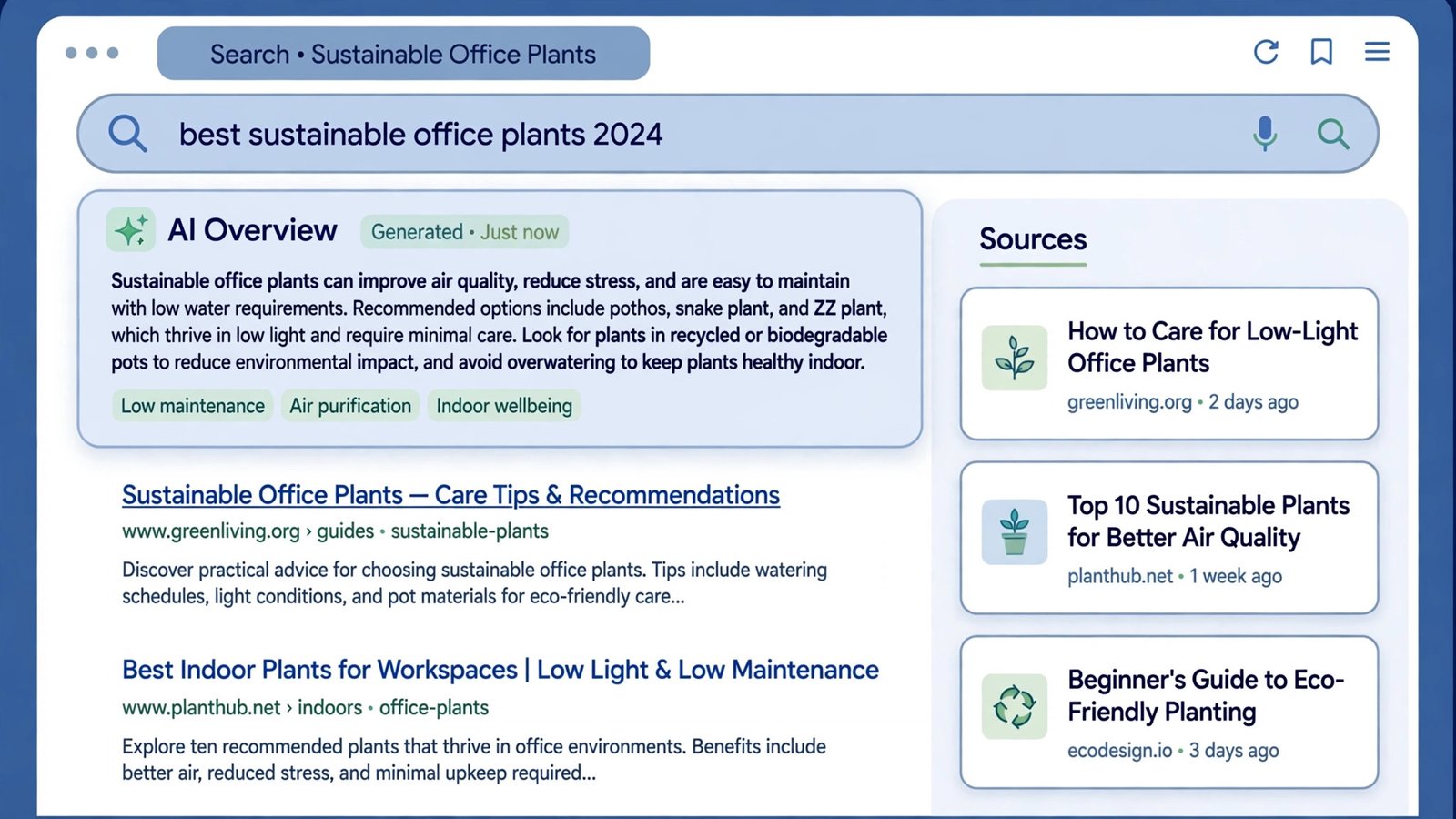
Google just made the links inside its AI answers easier to see — and if you run a website, that changes which search positions are worth fighting for. On November 17, 2026, Google appears to have rolled out a new default display for desktop AI Overviews: three citation cards, fully visible, with no fade on the lower ones. A week earlier, a test had pushed the source icons to the very bottom of the answer. The direction flipped within days, and that whiplash is the real story of November’s AI Overview changes.
This matters because AI Overviews now sit above the organic results on most informational searches, and the links inside them are the only way a cited site gets a click from the answer itself. When the display changes, the value of being cited changes with it — sometimes in the opposite direction from the headlines. Here’s what actually happened in November, what the click data says, and how to measure your own citations instead of guessing.
What changed on November 17
SEO consultant Brodie Clark spotted the change first and posted it on X. Search Engine Roundtable wrote it up on November 17, 2026, under the headline “Google AI Overviews With Unfaded Citation Cards.” The short version: on desktop, the citation cards on the right side of an AI Overview are no longer faded out. Three citations show by default, fully readable, without opening the overview. A “Show All” control can expand the full list.
Clark called it “the first time in a while that they have made an update that actually makes the citations more visible compared to the default display.” His full note is worth reading, because it captures how fast this has moved:
“Normally, the first citation would display as clear, then a fade would be applied to lower citations. And then, last month, Google removed the citations from desktop completely. It looks like Google has now reversed this change and is enforcing a default state of having three citations, with there being no fade at the bottom (making the third citation more visible).”
That last sentence is the one to remember. The third citation used to be the one readers never saw. Now it sits in plain view next to the answer, as readable as the first.
Three things to keep straight about this change. First, it was observed, not announced. Google has said nothing about it publicly, and Search Engine Roundtable’s report uses the careful word “seems” — the layout appears to be rolling out, and rollouts can be partial or reversed. Second, the report describes desktop search. Mobile AI Overviews have their own layout history, and nothing in the November 17 report covers phones. Third, it is a display change, not a ranking change. Nothing in the reporting suggests Google changed how it picks which pages to cite. The same pages get cited; they are simply easier to see once cited.
The full 2026 timeline: Google has moved these links five times
The November 17 change is only the latest move in a year of shuffling. Search Engine Roundtable’s Barry Schwartz has tracked at least five distinct citation layouts since the start of 2026, each spotted by a different tester, none confirmed by Google. Put together, they show a platform still actively reworking the one part of the page that decides whether a cited site gets noticed at all.
| Date reported | What changed | Who spotted it | Status |
|---|---|---|---|
| June 1, 2026 | Mobile citation bubbles opened a swipeable carousel of cards at the bottom of the screen | Gagan Ghotra | Test |
| September 29, 2026 | Desktop citation cards moved from the right-hand rail to the bottom of the answer, with a “show all” option | Glenn Gabe | Test |
| October 23, 2026 | An AI-written one-line summary sometimes replaced the page’s own text inside the citation card | Brodie Clark | Test |
| November 11, 2026 | The small source icons that normally sit above the answer moved to the very bottom; the full list only appeared on hover | Brodie Clark | Test |
| November 17, 2026 | Desktop cards unfaded: three citations fully visible by default, with a Show All control | Brodie Clark | Appears rolled out |
Read the table as a pattern, not a list of isolated tweaks. Google has tried hiding citations at the bottom, fading them, removing them from desktop entirely, and now showing three of them in full. The October 23 test is the one that should worry publishers most in the long run: when the line next to your link is an AI paraphrase of your page rather than a quote from it, the words a searcher reads before deciding to click are Google’s, not yours — and they can change from query to query, because the summary is built for that specific search.
The practical takeaway is simple: treat any single AI Overview layout as temporary. If you build a traffic strategy that depends on the current display — say, optimizing for the third citation slot because it is suddenly visible — build it knowing Google has changed this display four times in about fourteen months. What you should build instead is the underlying asset: pages that get cited in the first place.
Why the “Google is burying the links” story got it backwards
If you saw headlines in late November saying Google was burying AI Overview links deeper, you were reading about the November 11 test, not the November 17 rollout. Search Engine Roundtable’s daily recap on November 24 carried the November 11 item: the source icons had moved to the bottom of the answer, with the full citation list only appearing when a reader hovered over the icon strip. That was real — Clark documented it, and it would have made sources harder to find.
But six days later, the display went the other way. The November 17 change restored three fully visible cards and made the third citation more visible than it had been in months. Anyone who wrote “Google is burying links” from the November 11 test and never updated the story ended up describing a layout Google had already reversed.
This is not a small detail. It is the difference between telling site owners to brace for fewer clicks and telling them the top three citation slots just got more valuable. Both stories were true on the day they were written, and only one of them is true today. If your SEO news diet is a week old, check the date before you act on it — and if you run a site, verify the layout yourself on your own money queries before you change anything. Open an incognito window, search your top five informational queries on desktop, and look at what the AI Overview actually shows. That takes ninety seconds and beats any second-hand report.
The click problem: being cited is not the same as being clicked
A more visible citation is good news. It is not, by itself, a traffic recovery. The uncomfortable data behind AI Overviews has not changed: when Google answers the question on the results page, far fewer people click anything at all.
Pew Research, tracking the browsing of 900 U.S. adults in March 2025, found that only 8% clicked an organic result when an AI Overview appeared, against 15% when no overview was present. Only about 1% clicked a link inside the AI summary itself. Ahrefs, working from Search Console data, found the top organic result’s click-through rate is about 58% lower when an AI Overview appears above it. Three independent datasets — Pew, Ahrefs, and Seer Interactive — agree that an AI Overview cuts clicks on the results beneath it by roughly a third to well over half, depending on the method.
The most vivid single example this autumn came from Reddit. On its third-quarter earnings call on October 29, 2026, Reddit CEO Steve Huffman said Google search referrals to Reddit had fallen by more than a million visits a week on average during October, and he blamed AI Overviews and AI Mode directly: “AI Mode does not drive traffic.” Reddit’s search visibility actually recovered in October — its rankings went up while its referrals kept falling. The answer was on the results page, so the searcher never needed to visit.
That is the pattern every site owner should check for: rankings holding, clicks falling. It is also why the November 17 change matters more than it looks. If only about 1% of searchers click a link inside an AI Overview, then the fight is not really about whether citations are visible — it is about being one of the three sources a searcher can see without clicking anything, on the queries where your page is the best answer. A visible third citation does not fix a 58% CTR drop. It does make the third slot worth having, which it was not a week earlier.
One more number frames the stakes. Ahrefs’ November 2026 study of more than 3 million U.S. queries found Reddit is the second-most-cited domain in Google AI Overviews, at 18.1% of top-domain citations, behind YouTube at 24.5%. The domains that win AI Overview citations are the ones with clear, quotable, directly answering pages. That is a content problem, not a technical one.
What three visible citations change for your site
Here is the honest, practical read of the November 17 layout, for a site like this one — a blog that lives or dies on informational search traffic.
The top three slots just got more valuable. Before November 17, the second and third citations faded out. A reader had to open the overview to see them properly. Now all three sit in plain view beside the answer. If your page is cited in position two or three, it is now genuinely visible to a reader who never clicks anything. That is a real improvement, and it is the first one in a while.
Position four is now effectively invisible. The flip side of a three-card default is that the fourth citation hides behind the Show All control. Search Engine Roundtable’s reporting notes the Show All button is a test and does not always appear. Being the fourth source is close to being uncited. The gap between cited-and-seen and cited-and-hidden is now one slot wide.
The citation is the click now. With organic CTR down sharply wherever an overview appears, the citation card is doing the job the organic listing used to do: it is the first impression, the headline, and the reason to click, all in one small card. Pages that answer in one quotable sentence, with the key fact up front, are the pages that read well inside a card. Pages that bury the answer in paragraph four do not get quoted cleanly, and a card that quotes them badly will not earn the click.
Nothing about eligibility changed. Google says there are no additional requirements for appearing in AI Overviews: a page must be indexed and eligible to show with a snippet. That has not changed, and none of the November reporting suggests a new eligibility rule. Do not buy a tool that promises “AI Overview optimization” as a separate discipline. The work is the same work it has always been: indexed pages, direct answers, clear headings, verifiable facts.
How to check your own AI Overview citations in 15 minutes
No rank tracker I have seen gives you a clean “AI Overview citations” report yet, and Google Search Console does not provide a dedicated AI Overview click line. So measure it yourself, with a repeatable routine you can run monthly.
Step 1: Pick your 20 money queries. These are the informational queries that bring your traffic — the “how to” and “what is” searches where an AI Overview is most likely to appear. Pull them from Search Console’s Performance report, sorted by impressions over the last 28 days. Write them down in a spreadsheet with today’s date.
Step 2: Search each one on desktop, signed out. Use an incognito window and a US location. Note three things for each query: does an AI Overview appear at all, is your site cited, and in which slot (1, 2, 3, or behind Show All). Screenshot the overview for the queries where you are cited. Screenshots matter because the layout changes — your November 17 screenshot is your evidence if the display moves again.
Step 3: Compare CTR against position in Search Console. For the same queries, look at average CTR over the last 28 days versus the previous 28 days. If CTR fell while average position held steady, you have the Reddit pattern: rankings holding, clicks falling, and the AI Overview is the likely cause. That is the number to watch month over month, not any single day’s layout.
Step 4: Record citation position, not just citation presence. A citation in slot one and a citation behind Show All are different outcomes. Track the slot. If you are consistently fourth, the fix is not “get cited” — it is “get cited higher,” which usually means a sharper direct answer in the first 100 words of the page.
Step 5: Repeat monthly, same queries, same method. Google has changed this display four times in about fourteen months. A single check tells you about today. A monthly log tells you whether the change is durable and whether your citation slots are moving. If the unfaded three-card layout is still there in January, treat it as the new normal. If it reverses, you will have the screenshots to prove when.
What to do this week
Seven actions, in order of impact, for any site that depends on informational search traffic.
1. Rewrite your top 10 pages’ first 100 words as a direct answer. The citation card quotes the part of your page that answers the query. If your opening is throat-clearing — “In today’s fast-paced world, many people wonder…” — the card will quote something vague, or quote a competitor instead. Put the direct answer first, with the key number or fact in the first two sentences.
2. Add a quotable fact block to your highest-traffic explainers. One short paragraph or table that states the answer with a verifiable number, a date, and a named source. AI Overviews cite pages that make verification easy. A page that says “rates rose recently” is hard to quote; a page that says “the rate rose to 4.65% APY on November 23, 2026, according to Bankrate” is easy to quote.
3. Check that your pages are actually indexed and snippet-eligible. This is the unglamorous baseline Google itself states: no extra requirements, but the page must be indexed and eligible to show a snippet. Run a site: search on your domain, check Search Console’s indexing report, and fix anything excluded by accident. A page Google cannot index cannot be cited.
4. Stop watching rankings alone. Add a monthly CTR-vs-position check to whatever reporting you already do. If you only watch rank, you will miss the exact problem Reddit found: position two, traffic down, and no alarm going off. Search Console’s Performance report already has everything you need.
5. Build direct channels for your best queries. Email, RSS, a YouTube channel, a community — anything that does not depend on Google showing your link. The November 17 change is good news, but it is one layout decision by one company, and it has been reversed before. The sites that survive AI search are the ones whose readers can find them without it.
6. Do not chase the layout. Resist the urge to redesign your content around the current three-card display. Google has tested a carousel, a bottom stack, an AI-written summary, bottom icons, and now three unfaded cards — all in under a year. Optimize for being cited, not for the shape of the card.
7. Watch the December data, not the November headlines. The November core update completed on November 24, 2026, the same week as these citation changes, and the first post-update comparison week lands on Thanksgiving, Black Friday, and Cyber Monday — traffic that week is distorted by the holidays. Do not judge winners and losers from it. Wait for clean January data before you conclude anything about what the update or the citation change did to your traffic. For the full picture on the update itself, see our November 2026 core update completion guide.
One last note on timing: this piece was written the week the change appeared. If you are reading it in 2027, open an incognito window and check the layout before you act on any of it. The one prediction I will make with confidence is that it will have changed again.
Frequently Asked Questions
Did Google announce the three-citation change?
No. Google has not announced or confirmed it. SEO consultant Brodie Clark spotted it and posted about it on X on November 18, 2026, and Search Engine Roundtable reported it on November 17. Treat it as an observed rollout, not a confirmed product change, and verify it yourself on desktop before acting on it.
How many citations do AI Overviews show by default now?
Three, on desktop, fully visible with no fade on the lower cards, according to the November 17, 2026 report. A Show All control can expand the full list. Mobile layouts differ, and the display has changed repeatedly, so check your own queries rather than assuming three is permanent.
Does being cited in an AI Overview bring traffic?
Sometimes, and much less than a top organic ranking used to. Pew Research found only about 1% of searchers clicked a link inside an AI summary, and Ahrefs found the top organic result’s click-through rate drops about 58% when an AI Overview appears. A visible citation helps, but it does not replace the clicks the overview itself absorbs. Reddit’s experience — rankings recovering while referrals fell by more than a million a week — is the cautionary case.
What are the requirements to be cited in an AI Overview?
Google says there are no additional requirements beyond the page being indexed and eligible to show with a snippet. There is no separate AI Overview submission, no special markup, and no paid placement. Pages that answer directly, with verifiable facts and clear headings, are the ones that get quoted.
Why did some reports say Google was burying AI Overview links?
Those reports described a real test from November 11, 2026, in which the source icons moved to the bottom of the answer and the full list only appeared on hover. Six days later, the November 17 change went the other way and made three citations fully visible by default. The “burying” story was true about the test and out of date about the rollout.
Should I optimize my content specifically for AI Overviews?
Optimize for being cited, not for the current card layout. That means direct answers in the first 100 words, verifiable numbers with named sources, clear H2/H3 headings that work as standalone answers, and pages that are indexed and snippet-eligible. The layout has changed five times in about a year; the citation criteria have not. For context on how AI Mode itself is changing search, see our GPT-6.2 Sol default guide.
Sources: Search Engine Roundtable, “Google AI Overviews With Unfaded Citation Cards,” November 17, 2026; Search Engine Roundtable citation-layout timeline via rexultz.com; Pew Research (March 2025 browsing data) and Ahrefs CTR analysis via vinggle.com; Reddit Q3 2026 earnings call, October 29, 2026.