
Why this matters more than you think
Here’s a truth most freelancers learn the hard way: the clients who refuse to sign a contract are almost always the ones who cause problems. A client’s willingness to sign isn’t just paperwork — it’s a filter. The serious ones sign without blinking. The ones planning to ghost you on payment will squirm.
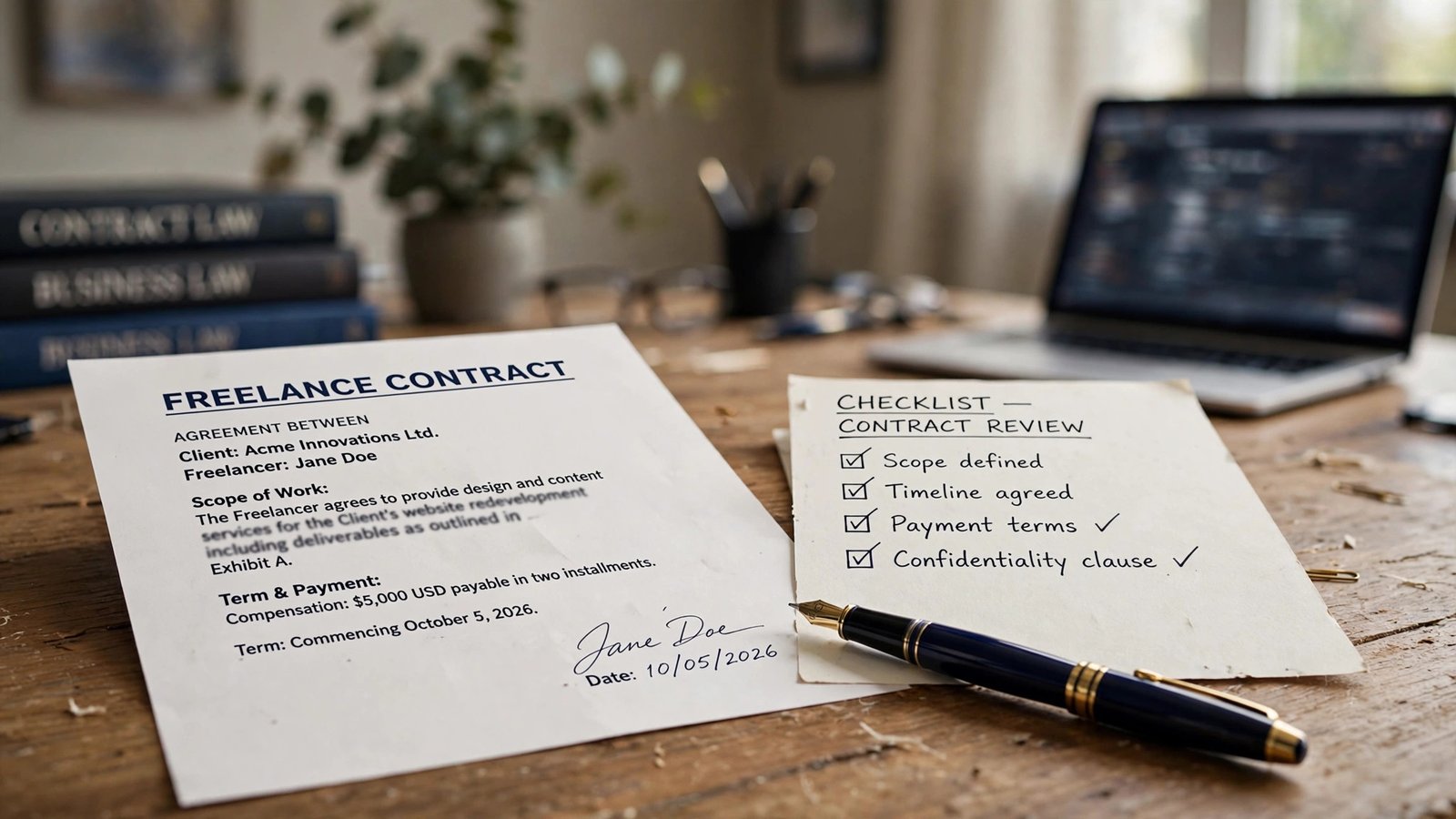
A freelance contract doesn’t need to be a 20-page legal document. A clear one-to-two-page agreement covering the right clauses prevents the vast majority of disputes: unpaid invoices, endless revisions, cancelled projects, and fights over who owns the work. Below are the 10 clauses every freelance agreement needs, in plain English.
Quick note: this is practical guidance, not legal advice. For high-value projects, have a local attorney review your template.
1. Scope of work
The most important clause in the entire contract. It describes exactly what you’ll deliver — the specific deliverables, in detail. Vague scope is the number-one cause of freelancer disputes.
Bad: “Design a website.” Good: “Design a 5-page WordPress website (Home, About, Services, Blog, Contact), including mobile-responsive layouts, delivered as a staged site for review by [date].”
If it isn’t written down, the client will assume it’s included. Write it down.
2. Payment terms
State the total fee, how it’s calculated (fixed project fee, hourly rate, or retainer), the payment schedule, and accepted payment methods. Remove every ambiguity: “Total project fee: $1,500, payable 50% ($750) on signing and 50% ($750) on final delivery, via bank transfer or PayPal.”
If you bill hourly, include a minimum/maximum hours clause so neither side gets surprised. And add a line for extra work: “Additional work beyond the scope above is billed at $X/hour.”
3. Deposit / upfront payment
For new clients, 50% upfront is standard. For trusted returning clients, 25% may be enough. The deposit should cover at least your first week or two of work — so if the project dies early, you haven’t worked for free.
Make the deposit non-refundable once work begins, and state clearly that work starts after the deposit clears, not before. “I’ll start as soon as the deposit lands” also quietly filters out non-serious clients.
4. Revision policy
Unlimited revisions is how $500 projects become 60-hour nightmares. Your contract should include 2–3 revision rounds, with a clear definition of what counts as a revision (client feedback on delivered work — not new features or direction changes).
Additional revisions get billed at your hourly rate. Write it plainly: “Two revision rounds are included. Further revisions are billed at $X/hour.” Clients who know revisions cost money give better feedback the first time. Funny how that works.
5. Timeline and milestones
Include start date, milestone dates, and final delivery date — with a buffer for you, not just the client. But here’s the clause-within-the-clause most freelancers forget: client responsibilities and feedback deadlines.
Your timeline should say something like: “Client to provide feedback within 3 business days of each delivery. Delays in feedback extend the delivery date accordingly.” Without this, a client who vanishes for three weeks can still blame you for missing the deadline.
6. Kill fee and termination
Projects get cancelled. Budgets freeze. Clients change direction. Your contract needs to say what happens then: either party can terminate with written notice (14–30 days is typical), and if the client cancels mid-project, they pay for all work completed plus a kill fee — commonly 25–50% of the remaining project value.
Without a kill fee clause, a cancelled project means you eat the hours. With one, cancellation is merely annoying instead of devastating.
7. Intellectual property ownership
This one causes more fights than almost any other clause. The safe standard for freelancers: you retain full copyright until final payment clears, and ownership transfers to the client only after they’re paid in full.
Why this matters: if a client ghosts on the final invoice, you still own the work — which gives you real leverage and the right to reuse or resell it. State it explicitly: “All intellectual property rights remain with the Freelancer until full payment is received, at which point ownership transfers to the Client.”
Also clarify what the client can and can’t do with the work (usage scope), and whether you can show it in your portfolio.
8. Confidentiality
A simple mutual non-disclosure clause: both sides agree not to share the other’s confidential information — business data, customer lists, unreleased products, and the terms of the agreement itself. This is standard in professional relationships and clients expect to see it.
Keep it reasonable in duration (1–2 years is typical) and make it mutual rather than one-sided. A client asking you to sign a harsh one-way NDA while offering nothing in return is a yellow flag.
9. Independent contractor status
This clause states the obvious but legally important: you’re an independent contractor, not an employee. No exclusivity (you can serve other clients), you control how the work gets done, you supply your own tools, and you handle your own taxes — no employee benefits are provided.
This protects both sides. For you, it preserves your freedom to take other work. For the client, it keeps the relationship clearly outside employment law — which matters because misclassification carries real penalties, and some states (California’s ABC test, for example) are strict about it.
10. Late payment and dispute resolution
Two protections in one clause. First, late payment: invoices unpaid after 30 days accrue interest or a late fee. Many freelancers use 1–1.5% per month. You may never enforce it — but its presence gets invoices paid on time.
Second, disputes: spell out what happens if you disagree. Start with good-faith negotiation, then mediation before anyone mentions lawyers, and name the governing law and jurisdiction (usually your state). Mediation-first clauses save both sides thousands compared to jumping straight to litigation.
How to actually use this
You don’t need a lawyer to start. Take the 10 clauses above, write them into a clean one-or-two-page template, and customize the names, dates, amounts, and deliverables per project. Free starting templates exist from providers like HoneyBook — their guide to writing a freelance contract covers the same essential clauses — grab one, then shape it with the list above.
Send the contract before any work begins, and get it signed — a digital signature counts. The freelancers who get burned are almost never the ones with contracts. They’re the ones who “didn’t want to make it awkward.” Awkward is sending three follow-up emails about an unpaid invoice with nothing signed.
Pair your contract with professional invoicing and, as you grow, consider whether a DBA or LLC fits your freelance business.
Frequently Asked Questions
Do freelancers really need a contract for every project?
Yes — even small ones. A simple one-page agreement prevents most disputes over payment, scope, and ownership. Clients who refuse to sign are a red flag in themselves.
How much deposit should I ask for?
50% upfront is standard for new clients; 25% is common for trusted returning ones. The deposit should cover at least your first week or two of work.
Who owns the work I create for a client?
Whatever your contract says — which is why the IP clause matters. The freelancer-friendly standard: you keep copyright until final payment clears, then ownership transfers to the client.
What is a kill fee?
A fee the client pays if they cancel mid-project — typically 25–50% of the remaining project value, on top of payment for work already completed. It ensures cancelled projects don’t mean unpaid hours.
Can I use a free contract template?
Yes, as a starting point. Customize it with the 10 clauses above for your specific services, and have an attorney review it before using it on high-value projects.
What should I do if a client won’t sign?
Walk away. A client’s willingness to sign a reasonable contract is itself a filter — those who refuse are statistically the ones who cause payment and scope problems.