
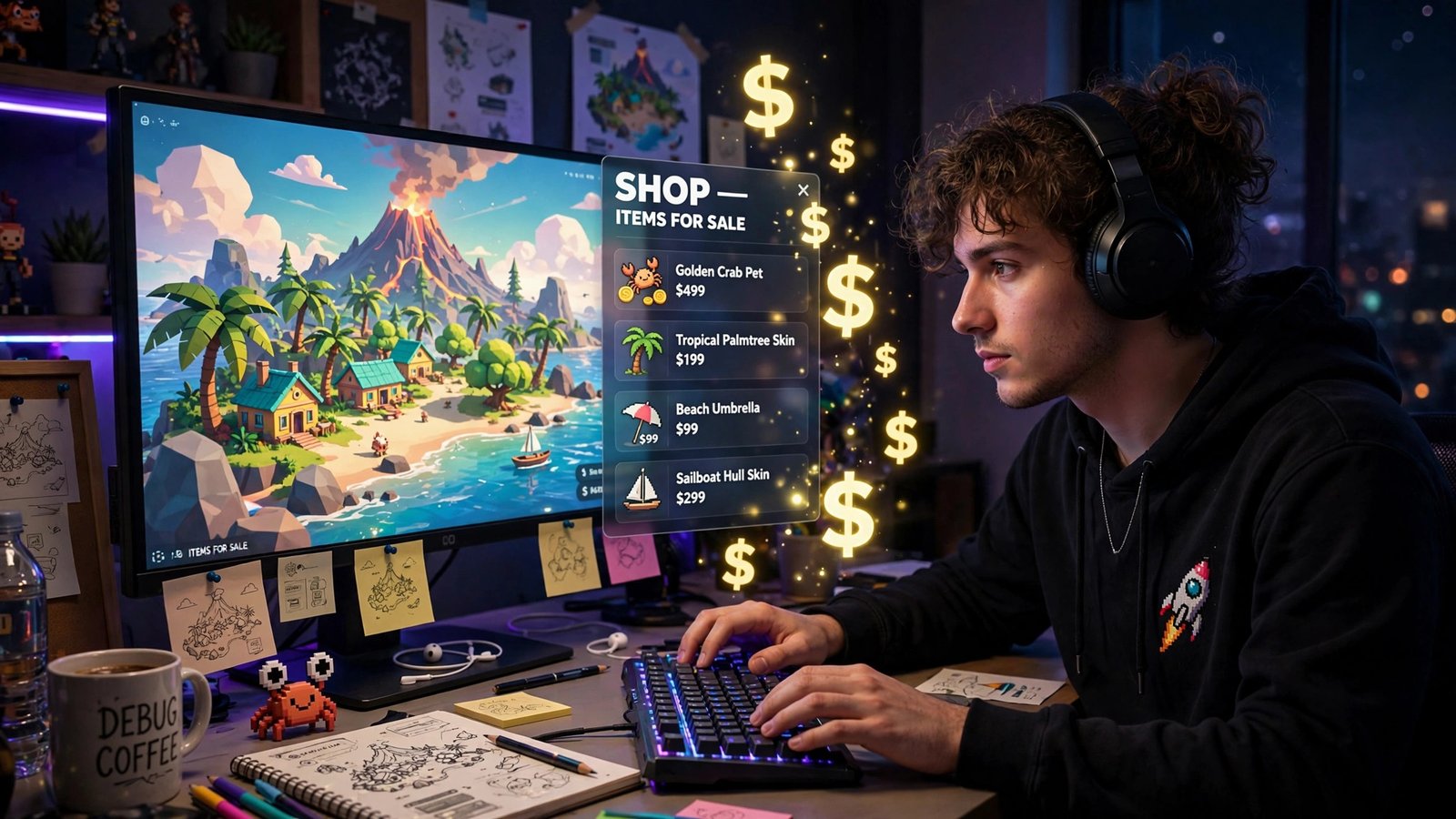
Fortnite pays creators two ways in 2026: engagement payouts from a monthly pool funded by 40% of Fortnite’s net revenue, and direct in-island item sales where you keep 100% of the V-Bucks value through the current promotional window. That window is the whole story right now — it reportedly runs through January 31, 2027, then the split drops to 50%. If you’ve ever thought about building in Fortnite’s Unreal Editor for Fortnite (UEFN), there’s never been a more generous time to start.
I’ll be straight with you: this isn’t a “get rich quick” system. Epic doesn’t publish a fixed per-view or per-player rate, and your payout floats against every other island that month. But the mechanics are unusually transparent for a creator platform, Epic passed $1 billion in total creator payouts in 2026, and the current terms genuinely favor new creators more than anything before them. Here’s exactly how it all works, what changed, and how to get in.
The two ways UEFN creators get paid in 2026
Epic’s creator economy runs on two separate money streams, and you want both if you’re serious about this.
1. Engagement payouts: your share of the 40% pool
Under what’s officially called Creator Economy 2.0, Epic allocates roughly 40% of Fortnite’s net revenue from the Item Shop and most real-money purchases into a monthly engagement payout pool. That pool is then divided among eligible islands based on engagement.
Read that carefully, because people get it wrong constantly: 40% is the size of the pool, not your cut. Your individual share is your island’s engagement score relative to every other eligible island that month. If Fortnite has a huge month and thousands of islands compete for attention, the pool is big but your slice depends on how your engagement stacks up against everyone else’s.
Since total engagement varies, the effective rate floats. Third-party creator guides estimate established islands have historically seen on the order of $0.02 to $0.05 per engaged hour — treat that as a rough planning number, not a promise, because your real number is only known after the month closes.
2. In-island item sales: the 100% window
This is the newer stream and the reason 2026 is the moment to pay attention. Since early January 2026 (when publishing went live after an experimental phase), UEFN creators can sell digital items directly inside their islands, paid for with V-Bucks — and through the promotional window, creators keep 100% of the V-Bucks value of those sales.
What does “V-Bucks value” actually mean in dollars? Epic calculates it each month: take all real-money player spending on V-Bucks (converted to USD), subtract platform and store fees (which range from 12% on the Epic Games Store to 30% on consoles, averaging about 26%), and divide by the total V-Bucks players spent. At today’s fee levels, keeping 100% of the V-Bucks value works out to roughly 74% of the retail spending behind those sales. When the promotional window ends and the standard 50% split kicks in, that translates to roughly 37% of retail spending.
Even at 37%, that’s dramatically better than the alternatives: Roblox’s DevEx program pays developers roughly 25% of retail revenue on standard balances, and Apple’s App Store gives developers 30%. Epic’s whole pitch here is that it takes less than everyone else — and during the promotional window, it takes nothing at all.
One timing note you should know: Epic originally announced the 100% rate would run “through the end of 2026.” Several 2026 creator guides now report the promotional window was extended through January 31, 2027, with the 50/50 split starting February 1, 2027. Terms like this can move, so confirm the current rate in the Fortnite Creator Portal before you plan a launch around it. The direction is clear either way: the most generous terms are right now.
What changed on November 1, 2025 (and why some creators saw payouts drop)
If you follow creator communities, you’ve probably heard complaints about 2026 payouts shrinking. There’s a real reason behind it, and it’s worth understanding because it shapes what kind of islands earn now.
On November 1, 2025, Epic updated the engagement payout formula to weigh five factors: active playtime, island retention, playtime that surrounds Item Shop spending, and two separate rewards for attracting new and returning players. The retention component also changed — it now rewards island-specific retention rather than ecosystem-wide retention, so you’re credited for players who keep coming back to your island specifically.
The headline change, and the controversial one: only playtime from players who have actually made purchases on their accounts now counts toward engagement payouts. Epic framed this as anti-fraud — it stops people from spinning up fake accounts to farm engagement. But it also means islands whose audiences skew toward players who never spend money in Fortnite saw their counted engagement fall. Creator reports in early 2026 described 50–70% drops for some islands. That’s a reported range from creator discussions, not an official figure — but the mechanic behind it is real and official.
There’s a flip side that favors growth-minded creators: if you bring in a new player or re-engage a lapsed one, you earn 75% of that player’s contribution to the engagement pool for their first six months. Epic identifies these players through signals like direct links, in-game search usage, and first-day playtime patterns. In other words, the formula now rewards creators who grow Fortnite, not just those who hold existing players’ attention.
What you can actually sell in your island
Not everything goes. The items you can sell fall into two categories: consumables (single- or limited-use items like speed boosts or abilities) and durables (persistent items, bundles, collections, paid access to areas, custom passes and progression systems). You build them with UEFN’s tools and a Verse-based API, and players buy them with V-Bucks right inside your island.
Epic’s developer rules draw hard lines on what you cannot sell, and crossing them risks your island:
- Outfits, emotes, cars, or anything that duplicates Item Shop cosmetics
- Purely cosmetic items with no gameplay value
- Anything that implies XP rewards
- Physical merchandise
- External or custom checkout systems — all purchases must go through Fortnite
The philosophy is consistent: Epic protects its Item Shop business while letting you monetize gameplay systems. Build paid advantages that feel fair and transparent, and players will pay. Build systems that feel like traps aimed at kids, and you’ll get reported — players can report offers, and high report rates trigger notifications from Epic. The 2026 creator consensus is simple: the islands that monetize respectfully last; the ones that squeeze burn their reputation fast.
How to start: the actual steps
No follower count requirement, no application lottery. Here’s the path:
- Join the Fortnite Creator Program at create.fortnite.com with your Epic Games account. Complete the tax documentation and agree to the program terms.
- Accept the updated Fortnite Developer Terms in the Creator Portal before publishing anything with transactions.
- Build in UEFN, not just the in-game Creative editor. UEFN gives you the full Unreal Engine toolset — better mechanics, better optimization, and in practice, the islands earning serious money are overwhelmingly UEFN-built. (One 2026 creator guide notes that over 80% of creators earning $100K+ annually build with UEFN rather than Creative-only maps.)
- Use the In-Island Transactions Feature Example project — it’s right in UEFN’s Project Browser and demonstrates item definitions, offers, bundles, and purchase testing so you don’t start from a blank page.
- Test your purchase flows with UEFN’s preview tools before launch: item behavior, UI clarity, and edge cases around restrictions.
- Publish. Your revenue shows up in monthly reports in the Creator Portal alongside engagement payouts, with tools to track unique buyers, revenue by offer, and purchasing trends.
Payouts are calculated monthly and typically land roughly 30 to 60 days after the month closes, paid through Epic’s payment partner once you’ve completed your tax and banking setup and cleared the payout threshold. Expect a real lag between the engagement happening and the money arriving — plan your cash flow around it. (Creators comparing payout models across platforms may also want to read our breakdown of how YouTube Shorts monetization requirements work in 2026 and TikTok’s monetization requirements — Fortnite’s monthly pool behaves very differently from ad-revenue platforms.)
The honest math: what can you realistically earn?
Let’s put the two streams together with real numbers so you can think about this like a business.
Engagement side: there’s no fixed rate, but using the reported planning estimate of roughly $0.02–$0.05 per engaged hour, an island holding a few hundred concurrent players can generate a few hundred dollars a month, while top islands with thousands of concurrent players scale into five and six figures. The seven-figure stories exist too — Epic reported that seven individual creators have each earned more than $10 million from creator payouts. But remember the two caveats: only paying players’ engagement counts now, and your share floats against every other island each month.
Item-sales side: this is where the math gets exciting during the promotional window. If your island sells $1,000 worth of items at retail, roughly $740 reaches you at the 100% V-Bucks rate (after platform fees). That’s a direct-commerce margin almost unheard of in gaming. After the split drops to 50%, the same sales pay roughly $370 — still better than Roblox’s standard rate, but the difference is the entire reason the next several months matter.
The strategic read: engagement payouts reward you for attention; item sales reward you for designing economies players want to spend inside. The creators winning in 2026 are building islands where both reinforce each other — engaging experiences that naturally create demand for the items sold within them.
Don’t sleep on the Sponsored Row either
One more 2026 revenue lever worth knowing: Epic’s Sponsored Row lets creators buy advertising campaigns to feature their islands in Fortnite’s Discover section, bidding against other creators in transparent auctions. During the launch period through 2026, 100% of ad spend goes back into the engagement payout pool (dropping to 50% later). Even if you never buy an ad yourself, that mechanism grows the pool everyone shares — another reason the 2026 economics are unusually favorable.
Fortnite UEFN vs. Roblox: the quick comparison
Since these are the two giants of creator gaming economies, here’s how they stack up for a US creator choosing where to invest build time:
- Revenue share: Fortnite pays 100% of V-Bucks value during the promo (roughly 74% of retail), then ~37% of retail at the standard split. Roblox’s DevEx pays roughly $0.0038 per earned Robux on standard balances — about 25% of retail — with a higher rate of $0.0054 for qualifying sales to verified US players 18+ introduced in 2026.
- Payout minimums: Roblox requires 30,000 earned Robux (about $114) to cash out, and only earned Robux count — never purchased ones. Fortnite pays through its monthly cycle once you clear the threshold in the Creator Portal.
- Formula transparency: both are pool-based and relative, so neither gives you a fixed rate. Fortnite’s five-factor formula is publicly documented; Roblox’s rates are fixed numbers but your earnings still depend on engagement.
- Tooling: UEFN is a real Unreal Engine workflow — heavier to learn, but it produces richer experiences. Roblox Studio is easier to start with and has a younger, enormous audience.
Neither is “better” in the abstract. But right now, purely on economics, Fortnite’s promotional window is the most generous deal in creator gaming — and windows close.
Frequently Asked Questions
How much does Fortnite UEFN actually pay creators?
There’s no fixed rate. Engagement payouts come from a monthly pool funded by roughly 40% of Fortnite’s net revenue, split among islands by engagement share — reported planning estimates run about $0.02–$0.05 per engaged hour, but your real number floats monthly. In-island item sales pay 100% of the V-Bucks value (roughly 74% of retail spending) during the promotional window, dropping to 50% (roughly 37% of retail) when the standard split resumes. Your total depends on your island’s engagement, your audience’s spending behavior, and how well your item economy is designed.
When does the 100% V-Bucks revenue share end?
Epic originally announced the 100% promotional rate would run through the end of 2026, with the standard 50% split starting January 1, 2027. Several 2026 creator guides now report the window runs through January 31, 2027, with the 50/50 split beginning February 1, 2027. Confirm the current terms in the Fortnite Creator Portal, since promotional terms can be adjusted.
Do I need a lot of followers to monetize Fortnite islands?
No. There is no follower count requirement to join the Fortnite Creator Program and earn from engagement payouts or item sales. You need an Epic Games account, completed tax documentation, and acceptance of the program terms. What matters is engagement quality — and since the November 2025 formula update, engagement from players who have made purchases, plus your ability to attract new or returning players.
What items am I not allowed to sell in my Fortnite island?
You can’t sell anything that duplicates Item Shop cosmetics (outfits, emotes, cars), purely cosmetic items with no gameplay value, anything implying XP rewards, physical merchandise, or items processed through external checkout systems. All purchases must happen inside Fortnite with V-Bucks. Stick to consumables and durables with real gameplay value — speed boosts, abilities, bundles, passes, paid area access.
How and when do Fortnite creator payouts arrive?
Payouts are calculated monthly and typically paid about 30 to 60 days after the month closes, through Epic’s payment partner, after you’ve completed tax and banking setup and met the payout threshold. Item-sale revenue appears in your monthly Creator Portal reports alongside engagement payouts, with breakdowns by offer, unique buyers, and purchasing trends.
Is building in UEFN better than Creative mode for earning?
For monetization, yes in practice. UEFN unlocks the Verse API and full Unreal toolset needed for in-island item sales and richer game systems, and islands built in UEFN dominate the top earners — one 2026 creator guide reports over 80% of creators earning $100K+ annually build with UEFN rather than the in-game Creative editor. Creative mode is faster to learn, but UEFN is where the serious money is.
Sources: Epic Games creator announcements via gamesindustry.biz, TechRadar, and Outlook Respawn’s UEFN payouts coverage (June 2026); in-island transaction rules via the creator guides cited above. Promotional terms change — verify current rates in the Fortnite Creator Portal before launching.