
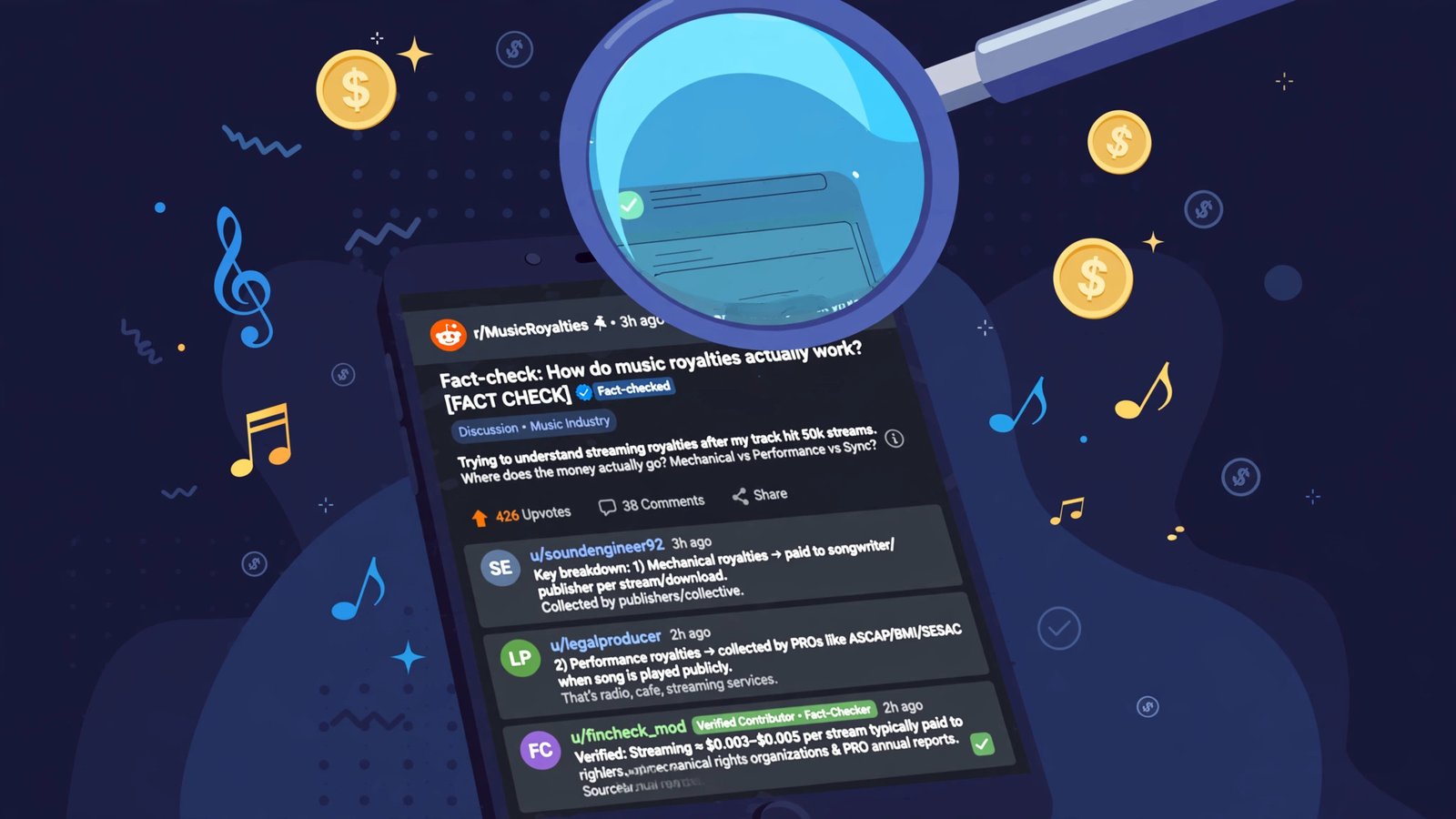
A post in r/MusicDistribution lit up this week. A user wrote that DistroKid told them their July and August YouTube royalties — including Vevo video royalties — would arrive on October 15th. Fifty-five comments later, the thread had turned into something more interesting than the announcement itself: a debate about whether any of it was true.
Because here’s the thing — the most devastating reply in that thread wasn’t about royalties at all. It was this: “I’m curious how you managed to speak directly with DistroKid’s royalty department over the phone. As far as I’m aware, DistroKid doesn’t offer phone support to customers.”
Ouch. So we did what the thread couldn’t: checked every claim against real sources. Here’s what’s true, what’s plausible, and what falls apart.
Claim #1: “July and August YouTube royalties will come on October 15th”
Verdict: Unverified — but plausible.
Let’s start with what we can confirm. YouTube royalty delays through DistroKid in 2026 are not a rumor; they’re one of the most widely reported problems in independent music right now. Multiple creators have documented that their July and August YouTube earnings still hadn’t landed well into the fall. DistroKid itself attributed the July delay to YouTube, not to its own systems.
So the delay is real. The date — October 15th — comes from a single Reddit user’s report of what DistroKid supposedly told them. No official DistroKid announcement names October 15th as a payout date for July/August YouTube royalties. That doesn’t make it false; support agents do give individual timelines in tickets. But it’s one person’s account, not a confirmed company-wide date. Treat it as a hopeful data point, not a promise.
Here’s why the date is at least plausible: music royalties normally take 2–3 months to travel from stream to your DistroKid bank. Streaming platforms report earnings 30–90 days after the month the music was played. July streams showing up in mid-October is roughly 2.5 months — right inside the normal window, before you even account for the extra YouTube-specific delay everyone experienced this year. If DistroKid told this user October 15th, the math doesn’t raise eyebrows.
(We covered the delay itself in detail — what happened, why YouTube was blamed, and what artists were seeing — in our July and August earnings delay explainer. This article is about the claim, not the delay.)
Claim #2: “DistroKid told me” — over the phone
Verdict: Questionable. This is the thread’s weak spot.
The commenter who pushed back was right: DistroKid does not offer phone support to customers. This is confirmed across every support guide written about the company — support runs through the online help center and email tickets. There is no customer service telephone number. No royalty department hotline. Nothing to call.
So how did the original poster “speak directly with DistroKid’s royalty department over the phone”? A few possibilities, ranked by likelihood:
- They got the information via email or a support ticket and misspoke when writing the post. “DistroKid told me” becomes “told me over the phone” in casual retelling. This is the most charitable — and most likely — explanation.
- They spoke to someone who isn’t DistroKid support — a distributor rep at an event, a label contact — and attributed it loosely.
- The detail is embellished, which would cast doubt on the October 15th date too.
This doesn’t automatically kill the October 15th claim — support tickets absolutely do contain payout timelines — but it means the thread’s central evidence arrives with a credibility dent. When the messenger’s details don’t check out, smart readers discount the message proportionally. That’s not cynicism; it’s basic source evaluation, and it’s exactly what the comment section did.
What’s genuinely true underneath the thread
Strip away the disputed details and the thread is pointing at three real things:
1. YouTube royalties were genuinely delayed in 2026. This isn’t one Reddit user’s imagination. Creators across YouTube documented missing July and August YouTube earnings, and DistroKid publicly pointed at YouTube as the cause of the July holdup. When your distributor blames the platform, that’s about as official as delay confirmation gets.
2. The normal timeline makes October reasonable. The royalty chain has unavoidable lag: you get streamed in July, YouTube tallies and reports weeks later, DistroKid processes the report, your bank balance updates, then you withdraw (which itself takes up to 14 days). Expecting July money in October isn’t a scandal — it’s the system working as designed, just slower than artists want. The frustration is real, but so is the plumbing.
3. Vevo royalties are a separate, slower animal. The thread mentions Vevo video royalties arriving with the same payout. Vevo operates its own reporting cycle on top of YouTube’s, and video royalties have historically lagged audio streaming royalties. If your catalog includes Vevo-distributed videos, expect their timeline to trail even the regular YouTube money — and to arrive in lumps, not steadily.
A twist: the “15th” might not be about YouTube at all
Here’s a detail that reframes the whole thread. DistroKid’s referral program — the one that pays you when someone signs up through your link — typically reports its earnings around the 15th of every month. That’s a separate pipeline from streaming royalties, with its own rhythm.
Now re-read the original post with that in mind: “distrokid youtube royalty for July and August will come on 15th of October.” Is it possible wires got crossed — either by the support agent or in the retelling — between the referral program’s mid-month reporting date and YouTube royalty payouts? It’s plausible. The 15th is a real DistroKid date; it just belongs to a different ledger.
This doesn’t prove the October 15th YouTube claim wrong. But it offers a cleaner explanation for why that specific date surfaced than “YouTube happens to pay on the 15th” — because YouTube royalty reporting doesn’t follow a neat monthly date the way the referral program does. When a precise-sounding date comes from a fuzzy source, check whether the date is real but attached to the wrong thing. Here, it might be.
If you run a referral link yourself, you already know the drill: signups convert to reported earnings around mid-month, and they land in the same DistroKid bank as everything else — which is exactly how the two pipelines get confused in conversation.
Why YouTube royalties are always the problem child
If you’ve ever wondered why it’s always YouTube that’s delayed — never Spotify, never Apple Music — there’s a structural reason. YouTube royalties through DistroKid come through multiple pipes: YouTube Music streaming, Content ID claims on user uploads, and the Social Media Pack’s UGC identification. Each has its own reporting rhythm, and Content ID revenue specifically passes through more hands before it reaches your bank.
DistroKid’s own documentation notes that revenue from its YouTube Content ID feature is paid out minus 20% — DistroKid keeps a fifth for operating the claiming infrastructure. (It’s part of the Social Media Pack — worth understanding before you opt in.) That’s the price of the automation, and it’s worth knowing before you do the math on what “should” have arrived.
The broader context matters too. 2026 has been DistroKid’s hardest year reputationally: a federal lawsuit from Universal Music Group over copyright infringement, public fights about AI-generated music flooding the platform, and artists openly questioning payout timelines. None of that proves any individual delay is nefarious — royalty pipelines really are slow — but it explains why every delay now gets read as suspicious. Trust, once spent, makes everything look like a pattern.
How to read your DistroKid bank like a forensic accountant
Most artists open their DistroKid bank, see a single balance, and either celebrate or panic. The useful information is one click deeper — in the per-store breakdown. Here’s how to interrogate it when YouTube money is the question:
Separate the YouTube line items. Your bank doesn’t show one “YouTube” number. You’ll typically see YouTube Music (streaming, behaves like Spotify reporting), YouTube Content ID / UGC (claims on other people’s uploads — the slowest pipe), and sometimes Vevo separately. When someone says “my YouTube royalties are delayed,” the first diagnostic question is which YouTube. Content ID revenue trailing by an extra month behind YouTube Music is normal, not a glitch.
Compare the same store across months. Don’t compare YouTube’s July to Spotify’s July — different pipes, different schedules. Compare YouTube’s July to YouTube’s May and June. If every YouTube line item stops at the same month, that’s a reporting halt (what happened in 2026). If only one line item is missing, that’s usually a single pipeline’s normal lag.
Check the Social Media Pack status. Content ID revenue only flows if the release was opted into YouTube monetization. If you uploaded tracks before enabling it, or if a takedown-and-reupload broke the linkage, the absence of Content ID money isn’t a delay — it’s a configuration gap. This is the single most common “my YouTube royalties never arrived” support ticket, and it has nothing to do with payout dates.
Screenshot everything monthly. When dates slip and you end up in a support ticket (see above — in writing), a month-by-month record of what your bank showed beats “I feel like it should have arrived by now” every time. The artists who got the clearest answers in 2026 were the ones who could point at exact line items and dates.
What to do if you’re still waiting on YouTube royalties
Practical steps, in order:
- Check your DistroKid bank, not your assumptions. Log in and look at the actual earnings reports by store. YouTube royalties appear under their own line items — confirm what’s reported versus what you expected before assuming the worst.
- Do the timeline math. Take the month the streams happened, add 2–3 months for normal reporting, then add the known 2026 YouTube delay on top. If you’re inside that window, waiting is the correct action.
- Open a support ticket — in writing. Since there’s no phone support (as the thread established), go through DistroKid’s help center and submit a ticket. Get any timeline they give you in writing. Screenshots of ticket responses are worth more than memory when dates slip.
- Don’t withdraw and re-withdraw in a panic. Withdrawals take up to 14 days on their own; stacking requests doesn’t speed up reporting.
- Diversify mentally. The creators weathering this best are the ones whose income doesn’t depend on a single platform’s reporting cycle. Apple Music, Spotify, and direct sales report on different schedules — a catalog earning across all of them smooths out any one delay.
If you’re not distributing your music yet and want to test the waters yourself, you can sign up for DistroKid here — that link gets you a discount on your first year.
Disclosure: the link above is an affiliate link. If you sign up through it, I may earn a commission at no extra cost to you.
For the video version of what’s been happening with DistroKid’s YouTube delays — including real dashboard footage of missing July and August earnings — this walkthrough is worth watching:
Frequently asked questions
Is DistroKid paying July and August 2026 YouTube royalties on October 15?
One Reddit user reported that DistroKid gave them this date, but it hasn’t been confirmed by any official DistroKid announcement. YouTube royalty delays in 2026 are real and widely documented, and mid-October fits the normal 2–3 month reporting lag — but treat the specific date as one user’s report, not a guarantee.
Does DistroKid have phone support?
No. DistroKid does not offer customer service by telephone. Support is handled through the online help center and email support tickets. Any claim of speaking to DistroKid’s royalty department “over the phone” should be treated skeptically.
Why are YouTube royalties always delayed compared to Spotify?
YouTube royalties flow through multiple systems — YouTube Music streaming, Content ID claims, and UGC identification — each with its own reporting cycle. They also pass through more intermediaries than a straightforward Spotify stream report, and DistroKid takes a 20% share on Content ID revenue for operating the claiming infrastructure.
How long do DistroKid payouts normally take?
Streaming platforms typically report earnings 2–3 months after the music was played. Once royalties reach your DistroKid bank and you request a withdrawal, delivery usually takes up to 14 days. So a July stream becoming spendable money in October is within the normal range.
What are Vevo royalties and why are they slower?
Vevo distributes official music videos and operates its own reporting cycle on top of YouTube’s. Video royalties have historically lagged audio streaming royalties and tend to arrive in lumps rather than steadily.
Should I be worried DistroKid is withholding my royalties?
Delayed reporting and withheld royalties are different things. The 2026 YouTube delays are widely documented and DistroKid attributed them to YouTube’s reporting. If your earnings are reported in your DistroKid bank but a withdrawal is stuck, that’s a separate issue worth a support ticket. Conflating the two is the most common mistake in these threads.
Why does the 15th keep coming up in DistroKid discussions?
Because DistroKid’s referral program typically reports earnings around the 15th of each month — a separate pipeline from streaming royalties with its own rhythm. When someone cites “the 15th” for YouTube royalties, check whether the date actually belongs to referral reporting. Precise-sounding dates from fuzzy sources deserve that extra look.