
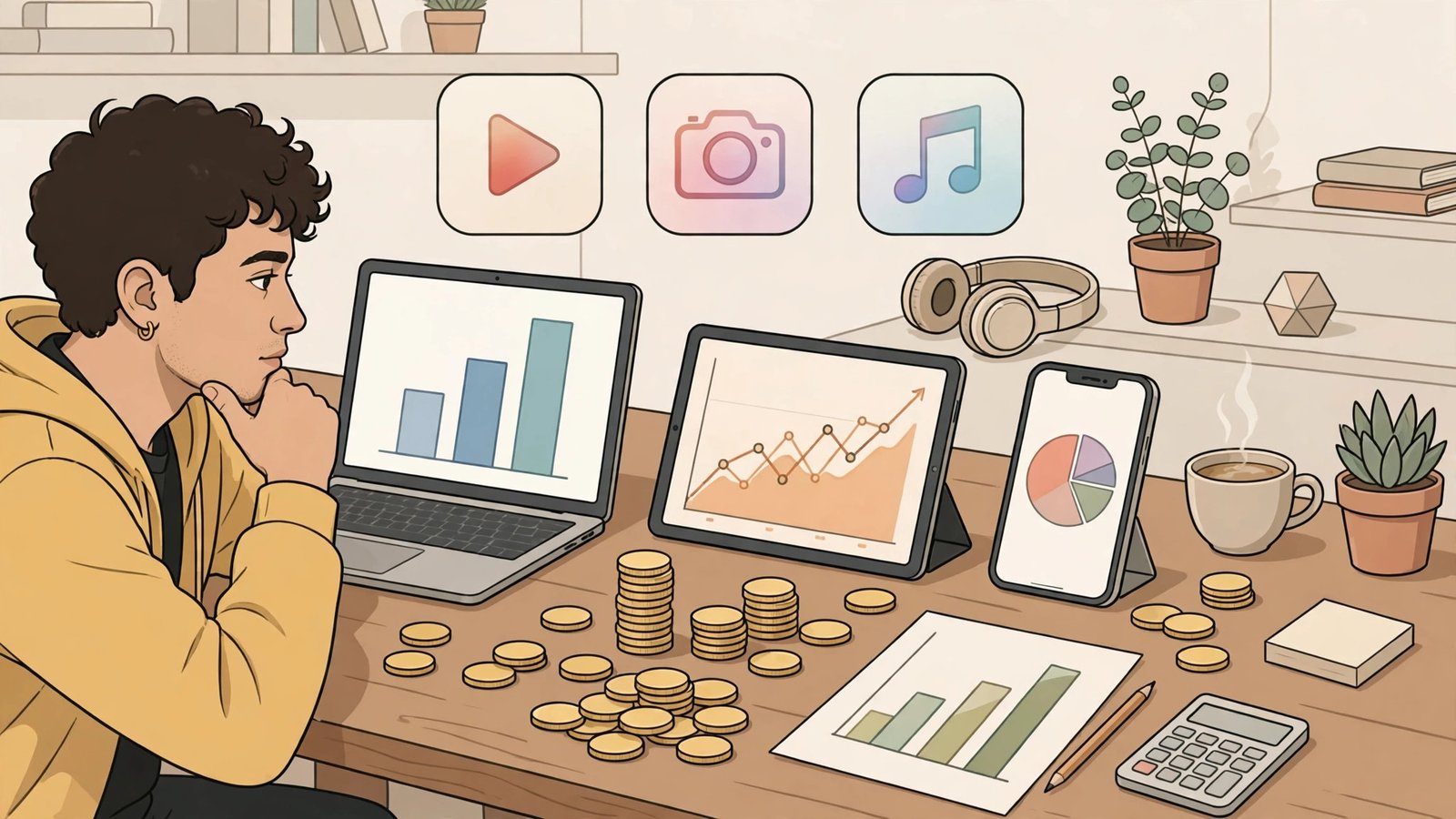
The short answer: the same $100 is worth $50 on one platform and $97 on another
Every creator platform publishes a percentage, and every percentage hides a different stack of fees underneath it. A platform that advertises “10%” can quietly take 16% once processing, payout, and currency fees pile on. A platform that advertises “50%” can be the better deal if it brings you the audience you could never reach alone.
So instead of comparing percentages, this article does something nobody in the October 2026 coverage had done: it runs the exact same $100 through six major creator platforms and shows what actually lands in your bank account. The headline result is stark. On a $100 fan payment, LinkedIn’s new Advice Sessions keep about $96.80 at launch, Substack keeps about $87, Patreon keeps about $84, YouTube memberships keep about $70, and a Twitch subscription keeps about $50. And on TikTok’s Creator Rewards Program, $100 is not a fan payment at all — it is 100,000 to 250,000 qualified views.
If you are building passive or semi-passive income — the kind that keeps paying after the work is done — the platform you pick matters as much as the content you make. This is the math to pick with.
First, what “$100” means here (because platforms count differently)
Creator income comes in two fundamentally different forms, and mixing them up is how bad comparisons happen.
Fan money is a payment a fan makes directly for you: a subscription, a membership, a tip, a consultation booking. The platform takes a cut, the payment processor takes a fee, and the rest is yours. Substack, Patreon, Twitch subscriptions, YouTube memberships, and LinkedIn Advice Sessions all work this way.
Ad money is revenue from advertisers, shared with you based on views or watch time. YouTube long-form ads, YouTube Shorts, TikTok Creator Rewards, and TikTok Pulse work this way. Nobody hands you $100; the platform earns ad revenue and pays you a share of it.
This article runs both, but never blends them. Section 2 handles $100 of fan money. Section 3 handles $100 of ad revenue. Section 4 handles TikTok’s view-based pay, where the right question is not “what cut?” but “how many views buy $100?”
One more honesty note before the tables: every figure below is the platform fee plus payment processing on a standard US card payment, using rates published in October 2026 guides and platform fee pages. Your exact take-home moves with pledge size, payout method, currency, and whether fans pay inside an app store. Where a rate varies, the article says so instead of pretending the table is a promise.
The $100 fan-money table: six platforms, one payment
Here is the core result. Each row assumes $100 in fan payments, paid by US card on the web, before income tax:
| Platform | What the fan pays for | Platform cut | Processing and payout | You keep (approx.) |
|---|---|---|---|---|
| LinkedIn Advice Sessions | One $100 consultation | 0% at launch | Stripe 2.9% + $0.30 | $96.80 |
| Substack | Paid newsletter subscription | 10% | Stripe card 2.9% + $0.30, plus 0.7% Stripe Billing on recurring payments | $86.30–$87.00 |
| Patreon (standard plan) | Membership pledges | 10% | 2.9% + $0.30 per pledge, $0.25 payout | $83.85–$84.10 |
| YouTube memberships | Channel membership | 30% (you keep 70%) | Included in YouTube’s net revenue calculation | $70.00 |
| Twitch subscription | Channel subscription | 50% default (you keep 50%) | Varies; Bits and ads have separate splits | $50.00 |
| TikTok | Not fan money | n/a | Creator Rewards pays per view, not per payment | See Section 4 |
Let us walk through each row, because the footnotes are where the real money hides.
LinkedIn Advice Sessions: $96.80 — the new outlier
LinkedIn’s October 15, 2026 launch lets US Business Premium subscribers sell paid one-on-one consultations, booked and paid inside LinkedIn through Stripe, with LinkedIn taking no cut at launch. On a single $100 session, the only deduction is Stripe’s standard 2.9% plus 30 cents, which is $3.20. You keep $96.80.
Two caveats keep this honest. First, the 0% cut is a launch term, not a constitutional right — every platform that has opened with a zero cut has eventually introduced one, and you should price as if a 10 to 15% cut may arrive someday. Second, access is still limited to US Business Premium subscribers in testing, and that subscription costs $69.99 per month for new subscribers in 2026. If you sell one $100 session a month, the subscription eats most of the advantage; if you sell four, it barely dents it. The take-home rate is the best in this table, but the gate is the subscription and the waitlist.
Substack: about $87 — the cleanest split in newsletters
Substack takes 10% of paid subscription revenue, and Stripe takes about 3% on top. On $100 of subscriptions, that leaves roughly $87 in your pocket. The precise figure depends on how you count Stripe’s recurring-billing fee: Substack’s own help page lists a 0.7% Stripe Billing fee on recurring payments alongside the 2.9% plus 30-cent card fee, which puts the all-in cost at 13.6% plus 30 cents per transaction and the take-home at about $86.30 on a single $100 payment, or closer to $87 when the fixed fee spreads across multiple smaller payments.
Either way, Substack’s split is genuinely clean. There is no tier maze, no legacy plan to lose, and no app-store cut when fans subscribe on the web. The cost of that cleanliness is discovery: Substack does not bring you an audience the way YouTube or TikTok does. You bring the readers; Substack keeps the checkout simple. For passive income, that trade is often worth it — a newsletter archive keeps earning from subscribers who joined months ago — but only if you already have somewhere to find those subscribers.
Patreon: about $84 — and the pledge size trap
Patreon’s standard plan, for pages published after August 4, 2025, charges a flat 10% platform fee, plus payment processing of 2.9% plus 30 cents per US card payment. On $100 spread across ten $10 pledges, the math is: $10.00 platform fee plus $5.90 in processing (ten times 29 cents plus 30 cents), leaving $84.10, minus a $0.25 direct-deposit payout fee, for $83.85 in your account.
Here is the trap that the headline 10% hides: processing is charged per pledge, so small tiers bleed. The same $100 spread across one hundred $1 pledges would lose $33 in processing alone on top of the $10 platform fee. A $1 tier is a community gesture, not an income strategy. If you run Patreon, price your entry tier at $5 or above, push annual billing (which collapses twelve charges into one and slashes the fixed-fee damage), and send fans to the web to subscribe — memberships bought inside Patreon’s iOS app run through Apple’s in-app purchase, where Apple takes 30% on top of Patreon’s fee.
Creators on legacy plans (5%, 8%, or 12% from before August 2025) keep their old rate as long as the page stays published. Unpublish it, even briefly, and you come back on 10% permanently. That is a small administrative fact worth a lot of money, and it is exactly the kind of detail that disappears from percentage-only comparisons.
YouTube memberships: $70 — the worst headline split, often the best deal
YouTube pays creators 70% of net revenue from channel memberships, Super Chat, Super Stickers, and Super Thanks. On $100 of membership revenue, you keep $70. That looks bad next to Substack’s $87 — until you remember what YouTube gives you in return: the largest video audience on earth, a recommendation engine that finds your next hundred members for free, and an archive where a video made two years ago still recruits members today.
That last point is the passive-income argument for YouTube. A membership is recurring revenue attached to an evergreen library. The 30% YouTube keeps buys distribution that no newsletter platform offers. If your content is video-first and searchable — tutorials, explainers, reviews — the $70 that comes with a built-in audience often beats the $87 that comes with an audience you must build yourself.
Twitch subscriptions: $50 — and the ladder that changes it
Twitch’s default subscription split is 50/50. On a $4.99 subscription, the streamer keeps about $2.50, so $100 of subscription revenue becomes $50. Streamers with 100 Plus Points move to 60/40, and those with 300 Plus Points reach 70/30, with the old $100,000 annual cap on the better split now removed. At 70/30, the same $100 becomes $70.
Twitch is also the least passive platform in this table, and that matters for a passive-income article. Subscriptions on Twitch reward live hours: stop streaming, and the income decays fast. A Twitch subscription is a great income stream for a live creator, but it is a job with a chat room, not an asset that pays while you sleep. Compare that with a Substack archive or a YouTube library, where old work keeps earning, and the 50% headline starts to look like the wrong number to optimize.
The fee that nobody puts in the headline: currency and app stores
Two charges sit outside every table above and can move your take-home by several points. The first is currency conversion: Patreon adds 2.5% when a fan pays in a different currency from your payout currency, and similar conversion costs apply elsewhere. If your audience is international, budget for it. The second is the app store: Apple takes 30% of memberships bought inside an iOS app, which is why every smart creator puts “subscribe on the web” in their videos and posts. A fan who subscribes on the web instead of in the app hands you roughly 30% more money for the same content, at zero extra effort from you.
The $100 ad-revenue table: a different game entirely
Now the other kind of $100. Here, $100 is the ad revenue generated by your content, and the platform pays you a share:
| Platform and format | Creator share | You keep on $100 of ad revenue |
|---|---|---|
| YouTube long-form ads | 55% | $55.00 |
| YouTube Shorts | 45% of the Creator Pool allocation | Not $45 — see below |
| TikTok Pulse | 50% | $50.00 |
| Facebook in-stream ads | Varies by program | Roughly $50–$55 in most reports |
YouTube’s 55% long-form split has been the benchmark for over a decade, and it is the most honest number in advertising: for every $100 advertisers pay for ads on your long videos, $55 goes to you. YouTube Shorts is different and widely misunderstood. Creators get 45% of the revenue allocated to the Shorts Creator Pool — not 45% of the ad revenue on their own Shorts. The pool is shared across all Shorts creators based on views, so your per-view pay depends on the size of the pool and everyone else’s views that month. Quoting “45%” as your personal rate is wrong, and it is why Shorts RPMs land in cents per thousand views while long-form RPMs land in dollars.
TikTok Pulse splits premium ad inventory 50/50 with eligible creators, which is a cleaner number — but Pulse eligibility is narrower than the Creator Rewards Program, and most TikTok creators earn through Rewards, not Pulse.
The passive-income lesson from ad revenue is about shelf life. A long-form YouTube video can earn ad revenue for years, because search keeps sending it viewers. A Short or a TikTok can spike and vanish in days. If you want income that outlives the upload week, long-form searchable video beats short-form virality, even at the same percentage.
TikTok Creator Rewards: how many views buy $100?
TikTok’s Creator Rewards Program does not pay a share of anything. It pays a variable rate per 1,000 qualified views, most often quoted at $0.40 to $1.00. At those rates, $100 requires:
- At $1.00 per 1,000 views: 100,000 qualified views
- At $0.70 per 1,000 views: about 143,000 qualified views
- At $0.40 per 1,000 views: 250,000 qualified views
“Qualified” does a lot of work in that sentence. Not every view counts — videos must meet length, originality, and engagement requirements, and only a slice of views qualify. That is why two creators with the same view count can earn very different amounts, and why TikTok income is the hardest in this article to forecast.
TikTok also pays through TikTok Shop commissions and LIVE gifts, where creators typically keep 40 to 50% of what fans spend on gifts after TikTok’s cut. Those are real income streams, but they are active income — live hours, shop videos, affiliate hustle — not the set-it-and-earn-it kind. For a passive-income plan, treat TikTok as the top of your funnel: the place that finds people, who then subscribe to you on Substack, Patreon, or YouTube, where the recurring money lives.
The realistic-audience math: what 1,000 followers actually converts to
Percentages flatter everyone. Audience math humbles everyone. A widely cited September 2026 benchmark puts the median Patreon creator at about $55 per month, with roughly 0.62% of their audience paying. Read that slowly: if you have 10,000 followers, the median outcome is about 62 paying fans. At a $10 tier, that is $620 gross — about $520 after Patreon’s fees. At a $5 tier, it is $310 gross, and the fixed processing fees eat a bigger share.
That is not a reason to quit. It is a reason to pick your platform by your actual audience, not by the best percentage in the table:
- Under 1,000 true fans: LinkedIn Advice Sessions and YouTube memberships punch above their weight, because one $150 consultation or a handful of members beats a subscription page with twelve patrons.
- 1,000 to 10,000 engaged followers: Substack and Patreon start to work, because even a 1% conversion rate produces a real monthly number — and recurring revenue compounds as you keep the subscribers you already won.
- Over 10,000 followers with search-friendly content: YouTube long-form becomes the engine, because the archive effect means every new video adds to a library that already earns.
- Viral reach, low conversion: TikTok is your discovery layer, not your bank. Convert the audience somewhere with a subscription before the algorithm moves on.
The recurring-revenue trap to avoid is churn. A platform that keeps 87% but loses 10% of subscribers a month is worse than a platform that keeps 70% and loses 3%. Retention is a platform feature too: Substack’s email habit, YouTube’s recommendation loop, and Patreon’s community tools all hold subscribers differently, and none of that shows up in a fee table.
A decision framework: pick by your bottleneck, not by the percentage
Here is the framework this comparison points to. Find your bottleneck first, then pick the platform that solves it.
If your bottleneck is audience: pick YouTube or TikTok. YouTube’s 55% ad split and 70% membership share cost more than Substack’s 87%, but they buy you viewers you do not have yet. Paying for distribution with a revenue share is a fair trade when you have no distribution.
If your bottleneck is conversion: pick Substack or Patreon. You already have people who will pay; now you need the highest take-home and the lowest friction. Substack wins on simplicity, Patreon wins on tiers and community features. Price above $5, push annual billing, and route fans to the web.
If your bottleneck is price: pick LinkedIn Advice Sessions while the 0% cut lasts. One $150 consultation out-earns a month of small subscriptions, and it converts into project work that no platform takes a cut of at all. Just remember the subscription cost and the testing limits.
If your bottleneck is time: pick the archive. Long-form YouTube videos and Substack posts keep earning after publication; Twitch streams and TikTok Lives mostly do not. Passive income is a property of the format, not just the fee.
If your bottleneck is trust: pick the platform where your audience already pays for things. A finance audience converts on Substack; a gaming audience converts on Twitch; a professional audience converts on LinkedIn. The best percentage on the wrong platform is worth less than a mediocre percentage where your buyers already live.
And one rule that holds on every platform: never build your entire income on a single revenue share you do not control. Platforms change splits — Patreon consolidated its tiers in August 2025, Twitch removed its cap in 2024, LinkedIn’s 0% is explicitly a launch term. Diversify across at least two platforms, own your email list, and treat every platform percentage as a lease, not a deed.
The bottom line
Run the same $100 through the creator economy and the spread is almost two-to-one: about $97 on LinkedIn’s launch terms, $87 on Substack, $84 on Patreon, $70 on YouTube memberships, $55 on YouTube long-form ads, $50 on a default Twitch subscription, and 100,000 to 250,000 TikTok views to reach $100 at all. But the highest percentage is not automatically the best home for your work. LinkedIn’s $97 comes with a subscription gate and a testing waitlist. Substack’s $87 comes with no built-in audience. YouTube’s $70 comes with the largest audience on earth and an archive that keeps paying.
The right question is not “which platform takes the least?” It is “which platform turns my audience, my format, and my time into the most money over the next two years?” Answer that with the tables above, price above the fixed-fee trap, route fans to the web, and keep your email list as the one asset no platform can reprice.
For the fee math on the tools freelancers actually invoice with, see our freelancer payment rails comparison. For a newsletter-first take on the same question, our beehiiv ad network breakdown shows how paid recommendations stack up against subscriptions.
Sources: creator revenue-split data as published in Everything-PR’s October 2026 creator revenue guide and Ruzuku’s Patreon fee breakdown, checked against platform fee pages in this run.
Frequently Asked Questions
Which creator platform keeps the most of a $100 fan payment?
LinkedIn Advice Sessions at launch, at about $96.80 after Stripe processing, because LinkedIn takes a 0% cut. Substack is next at about $87, then Patreon at about $84. LinkedIn’s rate is a launch term and may change.
Why does Patreon take more than its advertised 10%?
Because the 10% platform fee sits on top of payment processing (2.9% plus 30 cents per pledge) and a payout fee. On ten $10 pledges, that adds $5.90 in processing plus $0.25 for payout, taking the all-in cost to about 16%.
Is YouTube’s 45% Shorts rate the same as its 55% long-form rate?
No. Long-form creators get 55% of net ad revenue on their videos. Shorts creators get 45% of the Creator Pool allocation, which is shared across all Shorts creators — so your personal Shorts rate depends on total pool size and total views, not just your own.
How many TikTok views do you need to earn $100?
At the commonly quoted Creator Rewards rate of $0.40 to $1.00 per 1,000 qualified views, $100 takes 100,000 to 250,000 qualified views — and not every view qualifies, so the real view count is usually higher.
Does subscribing in an app cost the creator money?
Yes, significantly. Memberships bought inside an iOS app run through Apple’s in-app purchase, where Apple takes 30%. Fans who subscribe on the web instead hand the creator roughly 30% more for the same content.
What is the single biggest lever for keeping more of fan money?
Pledge size and billing channel. Price tiers at $5 or above, offer annual billing to collapse twelve processing charges into one, and route fans to web checkout instead of in-app purchase. Those three moves beat switching platforms for most small creators.