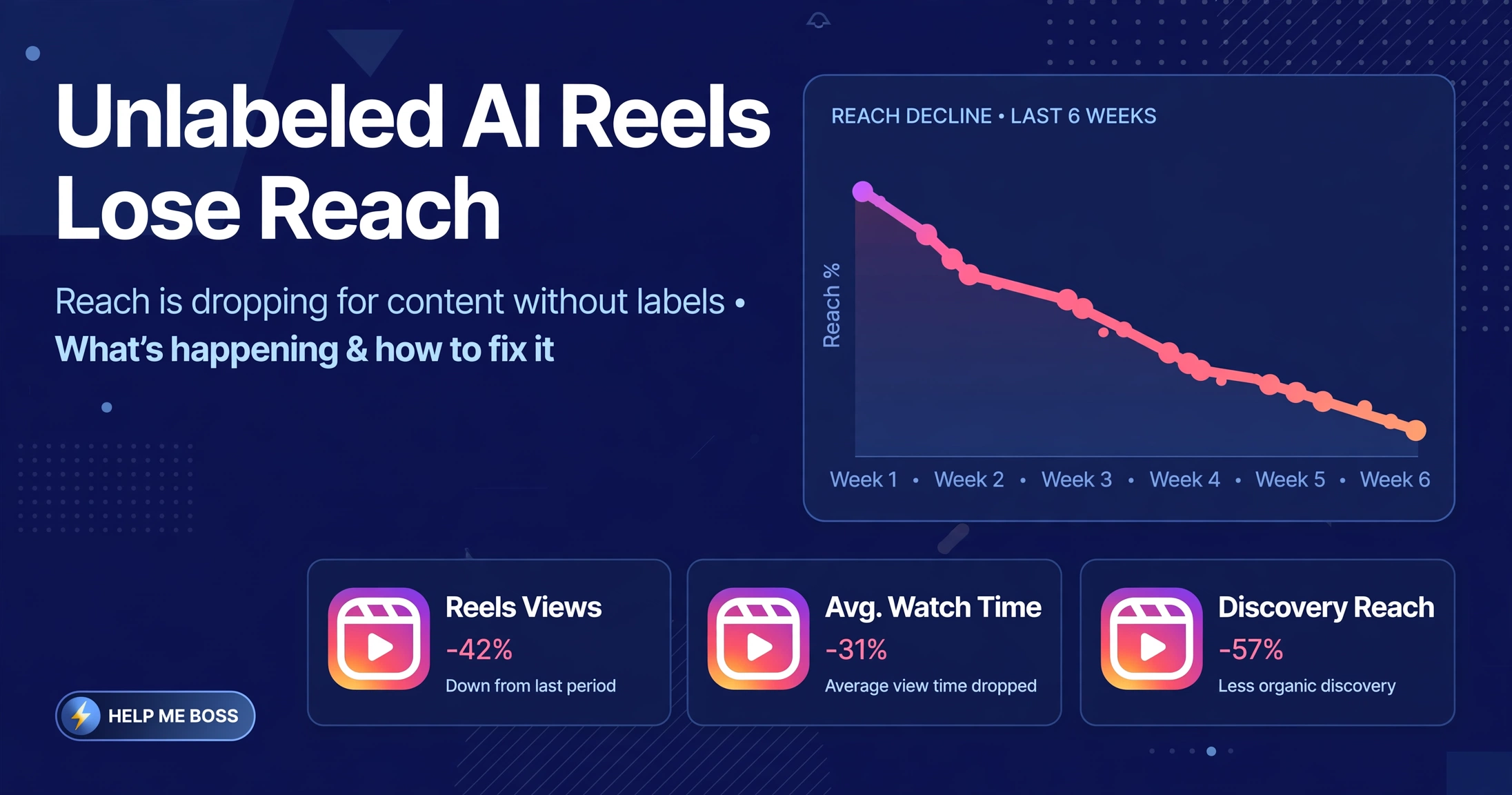
Instagram has put a real price on fake-human accounts: label the AI persona, or lose the recommendation channels that make those profiles grow. Since late August 2026, Instagram has been limiting the reach of profiles built around AI-generated people that don’t carry its “AI-generated profile” label — their posts stop being recommended to non-followers in Reels, Explore, and feed suggestions.
This is the penalty that matters. No ban, no takedown — just a quieter account. And for AI influencer pages whose entire business is discovery, quiet is fatal.
What exactly changed
Instagram renamed its old “AI creator” label to “AI-generated profile” — because “AI creator” confused people into thinking it meant a human who uses AI tools. The new wording is unambiguous: the person featured on this profile was generated or substantially created with AI.
The enforcement side is new too. Instagram’s systems scan for signs of AI-generated people. When they detect an unlabeled profile, the account loses eligibility for recommendations: posts stop surfacing to non-followers across Reels, Explore, and suggested feeds. A notification lands in the account’s Account Status, and owners can either add the label or appeal if they were flagged wrongly.
Instagram’s own line, quoted in TechCrunch’s August 31, 2026 reporting: “Creators who proactively add the AI-generated profile label will not see a change to their profile’s reach.” The label isn’t the penalty. Hiding is.
Who this actually affects (and who it doesn’t)
This is the part most coverage gets wrong. The rule targets profiles where the featured person is AI-generated — virtual influencers, AI models, synthetic personas presented as people. It does not target:
- A real creator who uses AI to edit photos or video
- A business that uses AI for graphics or ad creative
- A creator who uses AI for captions, scripts, or voice cleanup
- A human on camera in every post
The test is the person the profile claims to be, not whether a model touched a file this week. If you’re a real human and AI only assisted your production, you’re outside this penalty entirely.
Why the crackdown? Virtual influencer agencies have built profitable businesses passing hyper-realistic AI personas off as real people — selling fashion, fitness plans, even health advice. Public reaction turned: people felt tricked, engagement dropped when the truth came out, and regulators (including the EU, with disclosure deadlines) started leaning on platforms. Instagram chose disclosure plus demotion over bans — compliant AI profiles can still grow; deceptive ones can’t.
What to do if you run an AI persona account
Add the label now. Go to Edit Profile and switch on the AI-generated profile option. Per Instagram, labeled profiles see no reach change — you keep your existing audience and stay eligible for recommendations.
Check Account Status regularly. If Instagram’s detection flagged you, the notification and appeal path live there. Detection isn’t flawless, and successful appeals restore recommendability.
Rethink the business model. The era of undisclosed AI influencers quietly siphoning brand deals is ending. Advertisers are already pulling budgets from undisclosed synthetic media. Labeled, transparent AI personas can still work — some audiences enjoy them knowingly — but the arbitrage of pretending is over.
What human creators should take away
If you’re a real creator using AI tools, nothing changes for you — but the episode clarifies the broader 2026 pattern: the AI label is not a ranking penalty; unoriginal, templated content is. Instagram’s originality enforcement is a separate system, and it’s the one that affects most creators.
The practical lessons:
- Disclose AI personas, not AI assistance. Know which bucket you’re in.
- Originality still wins. Facebook’s 2026 algorithm changes doubled down on original production — AI-assisted original content is fine; re-uploaded or templated content isn’t.
- Don’t confuse the two penalties. If your reach dropped, it’s far more likely an originality or quality issue than an AI-label issue — unless your profile features an AI-generated person.
For creators building a personal brand, the UGC creator path remains wide open: real humans making original content have never been more differentiated from synthetic accounts.
2026 is the year AI transparency went mainstream
Zoom out and the Instagram move is one piece of a much bigger pattern. In 2026, disclosure stopped being a nice-to-have across the entire ecosystem:
- The EU’s AI Act transparency obligations took effect in August 2026, requiring AI-generated content to be clearly labeled.
- New York now fines advertisers for undisclosed synthetic performers in ads.
- Meta’s Oversight Board demanded lower thresholds for “High Risk” AI labels and tougher penalties for repeat offenders.
- TikTok reports over three billion content items already carry AI labels through its tools and detection.
The direction is unmistakable: every platform, and increasingly the law, is converging on “disclose by default.” Creators building long-term businesses should treat transparency as infrastructure — like having a privacy policy or business license — not as a tactic to optimize around.
There’s also a competitive angle most creators miss. As undisclosed AI accounts get squeezed out of recommendations, the supply of deceptive competition drops. Real creators and transparent AI creators both benefit from a cleaner field. Disclosure isn’t just compliance; it’s a moat.
How to check if you’ve been affected
If you run any account featuring an AI-generated person and your reach has mysteriously declined, here’s how to confirm:
- Open Instagram → Settings → Account Status. This is where Instagram surfaces recommendation-eligibility issues. If your account was flagged as an unlabeled AI-generated profile, the notice and next steps appear here.
- Look for the recommendation notice specifically. Account Status distinguishes between different restriction types. You’re looking for anything about AI-generated profile labeling or recommendation eligibility — not a generic “content not recommended” flag, which has other causes.
- Add the label or appeal. If the flag is correct, go to Edit Profile and switch on the AI-generated profile label. If it’s wrong — you’re a real human, or the featured person is real — file the appeal from Account Status. Instagram acknowledges its detection isn’t perfect.
- Wait and re-check. Recommendation eligibility doesn’t always restore instantly after a fix. Give it several days of normal posting, then check Account Status again.
If Account Status shows no issues, your reach drop has another cause — most likely content quality, originality, or simple audience fatigue. Don’t chase an AI-label explanation when the data points elsewhere.
Official source: Meta
Frequently Asked Questions
Will using AI captions or editing get my account labeled?
No. The “AI-generated profile” label applies only to profiles centered on an AI-generated person. AI-assisted production by a real human doesn’t trigger it.
I was flagged incorrectly. What now?
Check Account Status for the notification — Instagram provides an appeal path, and the company acknowledges its detection isn’t perfect. Successful appeals restore recommendation eligibility.
Does the label itself reduce reach?
According to Instagram, no: “Creators who proactively add the AI-generated profile label will not see a change to their profile’s reach.” The reach loss hits unlabeled profiles only.
Can labeled AI influencers still get brand deals?
Yes, but the market is shifting. Brands are moving budgets toward disclosed partnerships as regulators tighten rules. Transparency is becoming a selling point rather than a cost.
Does this apply to Facebook too?
The profile-label enforcement is Instagram-specific, but Meta’s broader AI disclosure rules apply across Facebook, Instagram, and Threads for realistic AI content.