
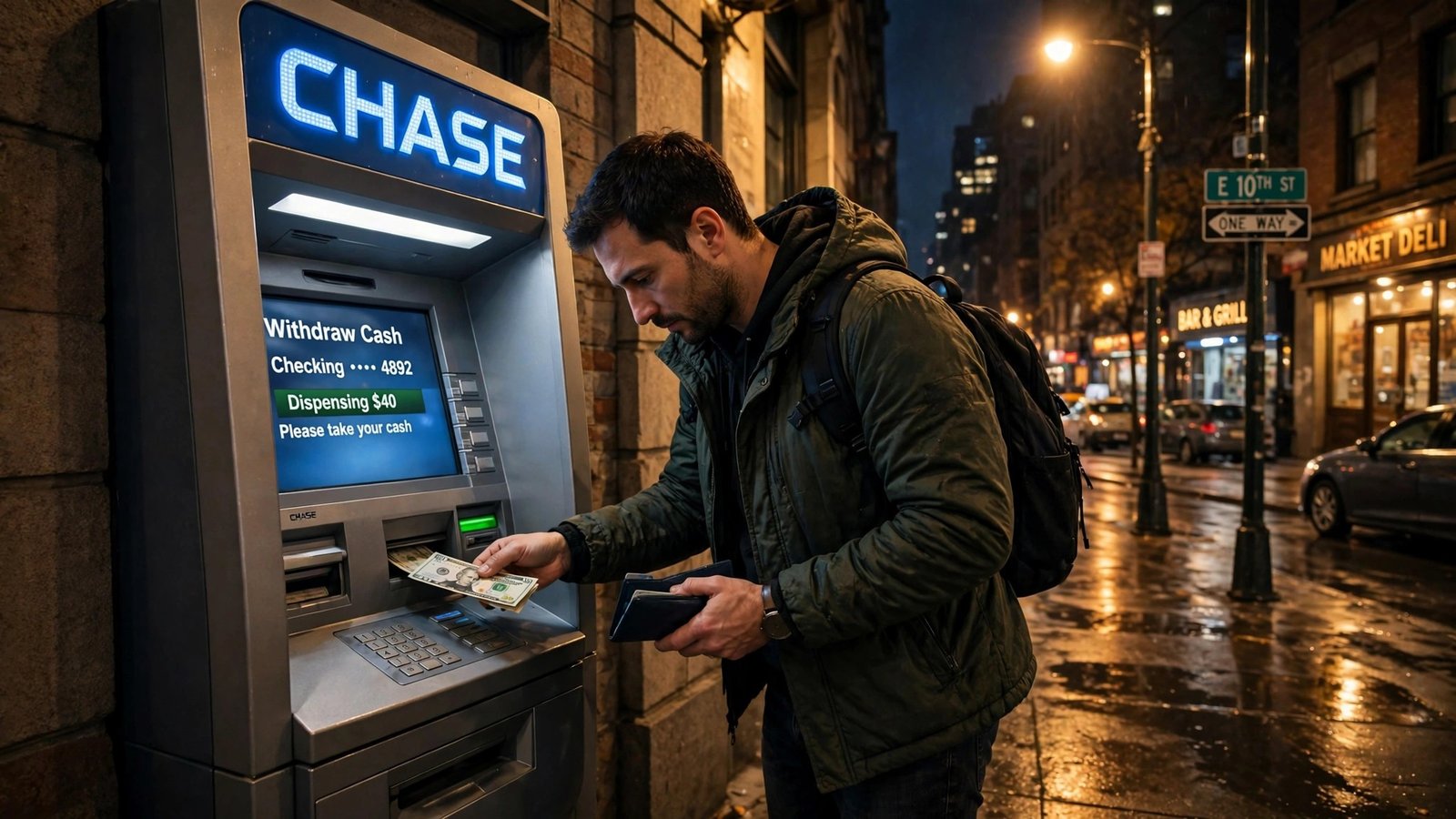
Grabbing $40 from the nearest ATM now costs $4.86 on average — a record high, and the third straight year the number has climbed. That $4.86 is actually two fees stacked on one withdrawal, and most people only notice one of them. The good news: you can get to zero. This guide breaks down exactly where the money goes, what it costs you over a year, and the three free ways to get cash without paying for the privilege.
What the $4.86 Actually Is
Here’s the part that trips people up: an out-of-network ATM withdrawal is not one fee. It’s two, charged by two different companies, and they show up in two different places.
Fee 1: the surcharge — $3.22. This is charged by the bank or company that owns the ATM you’re standing in front of. It’s the number you see on the screen before you confirm the withdrawal. It hit a record high for the fourth year in a row, up from $3.19 the year before.
Fee 2: your own bank’s out-of-network fee — $1.64. This is charged by your bank for the crime of using someone else’s machine. You won’t see it on the ATM screen. It shows up later, quietly, on your statement. It’s the highest it’s been since 2018, up 3.8% from the year before.
| Fee | Charged by | Average | Where you see it |
|---|---|---|---|
| ATM surcharge | The ATM’s owner | $3.22 | On screen, before you confirm |
| Out-of-network fee | Your own bank | $1.64 | Later, on your statement |
| Total per withdrawal | Both | $4.86 | — |
Add them together and you get $4.86. That’s up 1.9% from $4.77 the year before, according to Bankrate’s annual Checking Account and ATM Fee Study.
The two-fee structure is why the cost feels sneaky. You agree to $3.22 on the screen and think that’s the damage. Then your bank takes another $1.64 behind your back. If you only ever check the screen, you’re undercounting what you’re paying by a third.
A short video from YouTube breaks the same stack down in plain language — That ATM Fee Isn’t Just One Fee. It’s Three. — and it’s worth a watch if you want to see where each dollar goes.
How We Got Here: From $1.97 to $4.86
This didn’t happen overnight. When Bankrate first started tracking these fees in 1998, the average combined cost of an out-of-network withdrawal was $1.97. Today it’s $4.86 — an increase of nearly 150%.
Think about that for a second. The machines got cheaper to run, the transactions got faster, and the fee more than doubled. Cash is used less than ever, which means fewer withdrawals spread across the same network of machines — and the operators make up the difference by charging more per transaction.
The recent climb has been steady, not sudden:
- 2024: $4.77 average total
- 2025: $4.86 average total — record high, third straight year
The surcharge side of the equation has now set a record four years running. The only part of the fee that isn’t at a record is your own bank’s charge, and that’s only because it was higher back in 2018. The direction of travel is obvious, and nothing in the data suggests it reverses on its own.
Meanwhile, the rest of checking-account fees tell a mixed story. The average overdraft fee actually fell to $26.77, and the average nonsufficient funds (NSF) fee dropped to $16.82, a record low. Banks are under pressure on overdrafts — regulators and public attention have pushed them down. ATM fees, by contrast, get almost no attention, so they keep creeping up.
What $4.86 Costs You in a Year
Four dollars and eighty-six cents sounds like nothing. That’s exactly why it works. Nobody budgets for it, nobody notices it, and it quietly drains hundreds of dollars a year. Run the numbers for your own habits:
| How often you use an out-of-network ATM | Cost per withdrawal | What you pay in a year |
|---|---|---|
| Once a week | $4.86 | ~$253 |
| Twice a month | $4.86 | ~$117 |
| Once a month | $4.86 | ~$58 |
| Once a week at a flat $5 machine | $5.00 | ~$260 |
Once a week is the habit that hurts. At $253 a year, you’re paying more than a streaming subscription, a gym membership, or a decent dinner out — for the right to hold your own money.
And that’s at the average. If you live in a high-fee city, the math gets worse. Atlanta has the highest average ATM fee of any major metro in the study at $5.37 per withdrawal — that’s about $279 a year at once-a-week pace. Boston has the lowest of the major hubs at $4.37, which still works out to roughly $227 a year weekly.
Then there are the machines that make $4.86 look cheap. ATMs in casinos, nightclubs, and stadiums regularly charge $5 or more, and some Las Vegas casino machines have been reported at $9.99 per withdrawal. At that price, pulling out $100 costs you a tenth of it before you’ve even left the building.
Where You Pay the Most (and the Least)
Not all ATMs are created equal, and not all cities are either. Here’s how the cost varies across the country:
| Metro | Average total ATM fee |
|---|---|
| Atlanta | $5.37 |
| Boston | $4.37 |
| National average | $4.86 |
The gap between the most expensive and cheapest major hubs is a full dollar per withdrawal. Over a year of weekly withdrawals, that’s $52 — just for living in the wrong city.
The location of the machine matters even more than the city. A bank-owned ATM in a branch lobby is usually the cheapest option of all — free if it’s your bank, and often a modest surcharge if it isn’t. The worst offenders are the machines in places where you have no alternative: casinos, bars, nightclubs, stadiums, concert venues, and airports. Those machines know you’re stuck, and their owners price accordingly.
The practical rule: the more captive the audience, the higher the fee. If you can walk two blocks to a grocery store or a bank branch, do it.
What the $4.86 Doesn’t Include
Before you decide $4.86 is the worst case, know that it only covers a standard domestic debit-card withdrawal. Plenty of cash-access costs sit outside that number:
Foreign ATM fees
Use an ATM overseas and you’ll typically pay the out-of-network fee plus a foreign transaction fee on top — often 1% to 3% of the withdrawal amount. Some banks charge a flat international ATM fee on top of that. A $200 withdrawal abroad can easily cost $10 or more in combined fees. If you travel, this is the fee that deserves a check of your bank’s policy before you leave, not after you land.
Credit card cash advances
This is the expensive one, and it’s the mistake to avoid at all costs. Taking cash from an ATM with a credit card is not a withdrawal — it’s a cash advance, and it’s priced like one:
- A fee of 3% to 5% of the amount, charged immediately.
- Interest starts accruing the same day. There is no grace period on cash advances, unlike purchases.
- The interest rate is usually higher than your card’s purchase APR.
A $200 cash advance at a 5% fee costs you $10 upfront, and then interest piles on from day one until you pay the balance off. Compare that to a $4.86 debit withdrawal and the difference is stark. If you need cash and only have a credit card, the ATM is the most expensive way to get it.
The fee you never see
There’s a third cost hiding in the background: the interchange fee that moves between banks behind the scenes. You don’t pay it directly, so it doesn’t show up in the $4.86 — but it’s part of why the system is built the way it is. You don’t need to understand it to avoid it. You just need to know the $4.86 on your statement is the visible part, not the whole story.
The Three Free Ways to Get Cash, Ranked
You don’t need a new bank, a new app, or a spreadsheet to stop paying ATM fees. There are three reliable ways to get cash for free, and they work for almost everyone. Here’s how they rank.
1. Use your bank’s own network — and its partners
This is the simplest fix and the one most people skip. Your bank almost certainly has more free ATMs than you think, because “your bank’s network” usually includes partner machines it doesn’t own.
Many banks and credit unions belong to surcharge-free networks:
- Allpoint — more than 55,000 ATMs worldwide, inside stores like Target, CVS, and Walgreens.
- MoneyPass — around 40,000 ATMs nationally.
If your bank participates in one of these networks, those machines are free to you — no surcharge, no out-of-network fee. Check your bank’s app for an ATM locator, or look on the back of your debit card for the network logos. The Allpoint and MoneyPass apps will also show you the nearest free machine.
The catch: your bank has to be a member. Most credit unions and many online banks are. If yours isn’t, the next two options still work.
2. Get cash back at checkout
This is the easiest method of all, and it’s hiding in your weekly grocery run. When you pay with your debit card at most big retailers, the register will ask if you want cash back. Take it. There’s no ATM involved, so there’s no ATM fee.
The Consumer Financial Protection Bureau reviewed eight big chains in 2024 and found cash back is free at five of them:
| Store | Cash-back fee | Cash-back limit |
|---|---|---|
| Walmart | Free | Up to $100 |
| Target | Free | Up to $40 |
| CVS | Free | Up to $60 |
| Walgreens | Free | Up to $20 |
| Albertsons | Free | Up to $200 |
But three chains in the CFPB’s review do charge:
| Store | Cash-back fee |
|---|---|
| Kroger | 50–75 cents |
| Dollar General | $1–$2.50 |
| Dollar Tree / Family Dollar | $1–$2.50 |
The CFPB estimated those three chains collect more than $90 million a year in cash-back fees. The fee is smaller than an ATM surcharge, but it adds up — and it’s worth knowing that a $1.50 fee on a $20 cash-back request is a 7.5% charge on your own money.
The habit that makes this work: take cash when you’re already buying groceries, not as a separate trip. If you need $40 and you’re at Walmart anyway, get it at the register. It’s free, it’s fast, and you never touch an ATM.
3. Switch to an account that reimburses ATM fees
If you use ATMs a lot — or you travel, or you live somewhere with thin ATM coverage — the cleanest solution is a checking account that pays the fees back for you. Several well-known accounts do this:
| Account | ATM fee reimbursement | What to know |
|---|---|---|
| Charles Schwab Bank Investor Checking | Unlimited, worldwide | Requires a linked Schwab One brokerage account |
| Alliant Credit Union | Up to $20/month | Credit union membership required |
| Ally Bank Spending Account | Up to $10 per statement cycle | Also free at Allpoint and MoneyPass ATMs |
| Fidelity | Reimburses ATM fees | Check current terms before opening |
Schwab’s unlimited worldwide refunds are the gold standard here, especially for travelers — but note the requirement: you need a linked Schwab One brokerage account, which is free to open but is an extra step. Alliant’s $20 a month covers four average withdrawals, which is plenty for most people. Ally’s $10 per statement cycle covers about two.
The point isn’t that you need to switch banks tomorrow. It’s that the account you already have may be the most expensive way to access your own cash, and the fix might be a single application.
The Checking-Account Fees Hiding Next to ATM Fees
ATM fees don’t exist in isolation. Bankrate’s study found the rest of the checking-account fee landscape is quietly getting more expensive too — and the numbers are worth knowing, because they shape whether your account is actually free.
The average monthly fee for an interest-bearing checking account is now $15.65. To avoid it, you’d need to keep an average minimum balance of $10,704 — up nearly 5% from the year before. That’s a lot of money to park in a checking account just to dodge a $15.65 charge.
On the brighter side, nearly half of non-interest checking accounts (47%) are completely free, and 95% of regular checking accounts are free or can become free by signing up for direct deposit. The free account exists. The question is whether yours is one of them.
For context, here’s where the other big checking fees stand:
| Fee | Average | Trend |
|---|---|---|
| Interest-checking monthly fee | $15.65 | Minimum balance to avoid it: $10,704 |
| Overdraft fee | $26.77 | Down slightly |
| NSF fee | $16.82 | Record low |
Overdraft fees deserve their own mention. At $26.77, a single overdraft costs more than five out-of-network ATM withdrawals combined — and unlike ATM fees, one mistake can trigger several in a day. If you want to stop bleeding money to your bank, overdrafts are the bigger leak. Our guide to overdraft fees in 2026 — and how to opt out and stop paying them walks through exactly how to shut them off.
The pattern across all of this is consistent: the fees that get public attention and regulatory pressure go down. The fees nobody talks about go up. ATM fees are in the second category, which is why the only reliable fix is changing your own habits — or your own bank.
Your Legal Right to Walk Away
Here’s something most people don’t know: the ATM has to tell you the surcharge before you commit, and you can cancel without paying a cent.
Under federal law — Regulation E, 12 CFR 1005.16 — an ATM operator must disclose its surcharge on the screen or on paper before the transaction is completed. You have to see the fee and actively agree to it. If the number on the screen is higher than you’re willing to pay, hit cancel. You walk away, no charge, no withdrawal.
The catch is that this only covers the surcharge — the fee the machine’s owner charges. Your own bank’s $1.64 out-of-network fee has no such disclosure. There’s no screen that warns you about it, and no cancel button that saves you from it. The only way to avoid that half of the cost is to not use an out-of-network ATM in the first place, or to bank somewhere that doesn’t charge it.
So the practical rule is simple: read the screen every time. If the surcharge is $3, $4, or $9.99, cancel and walk to the next option. The two minutes it costs you are worth more than the fee.
A 30-Day Plan to Stop Paying ATM Fees
Knowing the numbers is one thing. Changing the habit is the actual work. Here’s a simple month-long plan that gets most people to zero.
Week 1: Find out what you’re actually paying.
Open your bank app and search your last three months of statements for ATM fees. Add them up. Most people are surprised — the fees are small individually and large in total. Write the number down. That’s your baseline.
Week 2: Map your free options.
Check whether your bank belongs to Allpoint, MoneyPass, or another surcharge-free network, and find the three free ATMs closest to your home, your work, and your grocery store. Save them in your phone. While you’re at it, note which stores on your regular route offer free cash back — Walmart, Target, CVS, Walgreens, and Albertsons are the reliable ones.
Week 3: Change the default.
For one week, get all your cash at the register during grocery runs or from a free network ATM. Don’t use a random ATM at all. Notice how little changes about your life. The cash is the same cash.
Week 4: Decide whether to switch.
If free ATMs and cash back cover your needs, you’re done — keep the habit and keep the money. If you still hit out-of-network machines regularly (travel, rural area, shift work at odd hours), look at a reimbursement account like the ones in the table above. A single application can end the fee permanently.
For freelancers and side hustlers who juggle business and personal cash, the same logic applies to business checking — and the account choice matters even more when every dollar is yours. Our roundup of the best business checking accounts for freelancers in 2026 covers accounts with low fees and solid ATM access.
The Bottom Line
The $4.86 record isn’t really about $4.86. It’s about a fee that nobody notices, charged twice per transaction, on a service that used to be free — and about a system that counts on you not doing the math.
Do the math once. If you use an out-of-network ATM once a week, that’s about $253 a year. Then pick one of the three free fixes: use your bank’s network, get cash back at the register, or open an account that refunds the fees. Any one of them gets you to zero, and none of them takes more than a few minutes to set up.
One last thing: the fee will keep rising. The surcharge has set a record four years in a row, and nothing in the data suggests year five will be different. The only question is whether you’ll still be paying it.
This article is for general information only and is not professional financial advice. Account terms, fees, and reimbursement limits can change — check your bank’s current fee schedule before opening or switching accounts.
Frequently Asked Questions
How much is the average ATM fee in 2026?
The average total cost of an out-of-network ATM withdrawal is $4.86, according to Bankrate’s Checking Account and ATM Fee Study — a record high for the third straight year. It breaks down into a $3.22 surcharge from the ATM’s owner and a $1.64 fee from your own bank. The year before, the same study put the figure at $4.77.
Why do I get charged twice for one ATM withdrawal?
Because two different companies are involved. The ATM’s owner charges a surcharge for using its machine, and your own bank charges a separate out-of-network fee for going outside its network. The surcharge appears on the ATM screen before you confirm; your bank’s fee only shows up later on your statement.
How can I avoid ATM fees completely?
Use ATMs in your bank’s network (including partner networks like Allpoint and MoneyPass), get cash back for free at the register at stores like Walmart, Target, CVS, Walgreens, or Albertsons, or open a checking account that reimburses ATM fees — Charles Schwab refunds them worldwide with no cap, Alliant Credit Union refunds up to $20 a month, and Ally Bank refunds up to $10 per statement cycle.
Can I cancel an ATM withdrawal after seeing the fee?
Yes. Federal law (Regulation E) requires the ATM operator to disclose the surcharge on screen or on paper before you commit, and you can cancel the transaction without being charged. This only covers the surcharge, though — your own bank’s out-of-network fee is never shown on the ATM screen.
Which ATMs charge the highest fees?
Machines in casinos, nightclubs, stadiums, and other captive-audience locations charge the most — often $5 or more, with some Las Vegas casino ATMs reported at $9.99 per withdrawal. By city, Atlanta has the highest average at $5.37, while Boston has the lowest among major hubs at $4.37.
Does getting cash back at a store cost money?
It depends on the store. Cash back is free at Walmart, Target, CVS, Walgreens, and Albertsons. But Kroger charges 50–75 cents, and Dollar General, Dollar Tree, and Family Dollar charge $1–$2.50, according to a 2024 CFPB review of eight large chains. If you want free cash, pick the register, not the dollar store.