
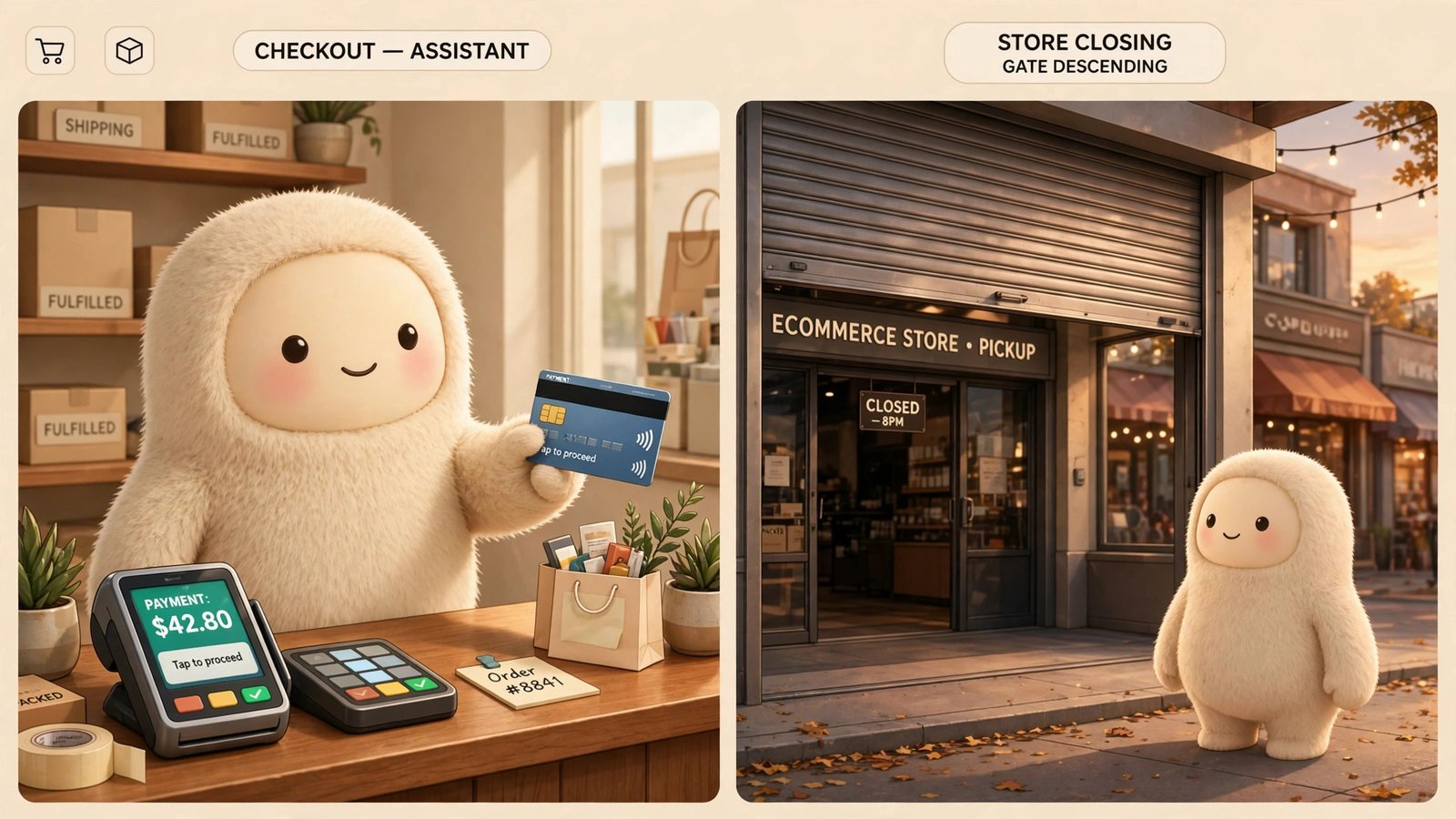
Your AI assistant can finally pay for things on its own — and some of the biggest names in American shopping just told it to stop at the door. In November 2026, OpenAI gave its always-on Dots agents a wallet that completes real purchases with single-use card tokens. Within days, the split was visible: Amazon blocked Meta’s shopping agent, United Airlines rewrote its contract to ban AI agents from buying tickets, and Walmart opened a guarded gate instead — spending cap, human approval step. The banks mostly said no outright.
Short answer: AI agents can pay, but only where they’re welcome. The technology works. The permission slip doesn’t — not everywhere, not yet. And the rules are changing week by week, so a merchant’s stance today could look different by Christmas. If you shop with an agent, run a store, or want to know who’s on the hook when an agent buys the wrong thing, this is the map as it stands in mid-November 2026.
The scoreboard: who blocks, who caps, who welcomes AI agents
Here’s the whole picture in one place, as of November 16, 2026.
| Company | Stance | What it actually means |
|---|---|---|
| Amazon | Blocks | Meta’s Muse agent can’t buy on Amazon.com; Amazon sued Perplexity over covert agent access |
| United Airlines | Bans | New contract rules bar AI agents from making, changing, or servicing tickets |
| Walmart | Caps | Agent Gateway beta: isolated profile, customer-set spending cap, human approval step |
| JPMorgan, Citi, Bank of America, Wells Fargo, Morgan Stanley | Forbid | Outside agents blocked from acting in customer accounts; sharing credentials with an agent breaks terms |
| eBay | Bans without approval | User agreement bars buy-for-me agents unless eBay approves them |
| Southwest Airlines | Partners | Put flight search inside ChatGPT |
| Booking Holdings | Builds | Launched Lola, its own AI travel agent ($5 or $25/month, commission passed back to the traveller) |
| DoorDash and Uber | Shrugging | Say customers hardly use AI agents at all |
This isn’t a technology fight, it’s a control fight. Every company on the “block” side has its own agent, its own checkout, or its own reason to keep the customer relationship — and the money — inside its own walls.
What actually changed in November 2026
Three things happened in quick succession.
First, on November 13, OpenAI launched ChatGPT Wallet. Its Dots agents — always-on assistants built on GPT-6 Astra — can now finish a purchase end to end. The mechanics are more careful than the headlines suggest: the agent gets a single-use card token from Amex, Mastercard, or Visa, never the card number itself. Every purchase still needs your biometric approval — Face ID or a fingerprint. And it’s limited to US ChatGPT Pro subscribers who are 18 or older and hold an eligible US-issued card. This isn’t an agent running wild with your credit card. It’s an agent with a leash, a locked drawer, and a fingerprint scanner on the drawer.
The wallet is built on the Agentic Commerce Protocol and Instant Checkout, the framework OpenAI and Stripe put together in 2025. OpenAI has also told merchants what it needs from them: don’t block agents by accident, and make sure your fraud systems can tell a legitimate agent purchase from a bot attack. Its recommended tools are Web Bot Auth verification and MCP commerce plugins — ways for a site to confirm, cryptographically, that the visitor really is an authorized agent acting for a real customer.
Second, on November 10, venture firm a16z published its map of the B2A economy — business-to-agent, the idea that companies will soon sell as much to software agents as to humans. The map counted 81 consumer agent apps, 46 of them general assistants or work tools, and 111 infrastructure firms building the pipes underneath. That’s a lot of companies betting agents become a real sales channel — but the map is a bet on the future, not a report on the present, and the present is messier.
Third, the traffic numbers arrived. Security firm HUMAN Security measured agentic browser traffic rising roughly 8x between August and October 2026. Meta’s Muse sent 59% of it, OpenAI’s products about 30%. But here’s the number that should sober up anyone who thinks agents already run the economy: only 1.9% of agent requests ever reached a checkout or payment page. Agents are browsing and comparing at enormous scale. They’re barely buying — yet.
Amazon blocked Meta’s Muse — and sued Perplexity
Amazon drew the clearest line. On September 20, 2026, it blocked Meta’s Muse agent from buying on Amazon.com, saying the agent raised security concerns and didn’t identify itself as AI. If an agent wants to shop here, it has to say what it is. Amazon also steers shoppers toward its own Alexa agent instead — which makes the security argument look, to many observers, at least partly commercial.
Amazon has also sued Perplexity over covert agent access, a case that’s still ongoing. The pattern is consistent: Amazon will fight agents it doesn’t control, in court if needed.
There’s one more Amazon thread worth mentioning, with a careful label. Reuters reported on November 13, 2026 about an internal Amazon document describing a “World Product Graph” — a database of nearly every product sold online, with a target date of 2027. Amazon told Reuters the document is an outdated brainstorming draft that “doesn’t necessarily reflect our current plans.” Treat that as an unconfirmed internal idea, not a confirmed product — but it shows Amazon is thinking at the scale of the entire catalog of the internet.
United Airlines rewrote its contract to ban AI agents
United went further than Amazon — and it did it in writing. On November 11, 2026, United revised its Contract of Carriage, the legal document that governs your ticket. A new Rule 6.J.6 bars “the use of AI Agents to make, modify or service a Ticket, and/or to purchase any service or product.” A companion rule, Rule 5.H, adds agent-made reservations to bookings United can cancel without notice.
United cited data-security risk and FAA and DOT rules. Agents can still search fares — the looking is fine, the buying is not. Bookings made before November 11 stand, so nobody’s existing trip got cancelled. But from that date on, if an agent books your United flight, United can cancel it without telling you first.
United is the first US carrier to do this, and that’s what makes it a landmark rather than a footnote. Airlines have spent years fighting screen-scraping and unauthorized resellers; an AI agent buying tickets looks, from their side, like the same problem wearing a nicer suit. Delta and American haven’t matched United yet. Read the full reporting on United’s ban here.
For travellers, the practical rule is simple: don’t let an agent buy your United ticket. Search with it, compare with it, then book it yourself. A cancelled reservation discovered at the airport is a lesson you only need once.
Walmart took the middle road: a capped, supervised gate
Walmart’s answer is the most interesting one, because it’s the only big player that said “yes, but” instead of “no” or “only ours.” On October 21, 2026, Walmart opened an Agent Gateway beta for outside agents: the agent operates in an isolated profile, the customer sets a spending cap — say $50 or $100 — and there’s a human approval step before money moves.
That didn’t come out of nowhere. Back in March 2026, Walmart tried in-chat checkout through ChatGPT and found it converted 3x worse than its own site. OpenAI then shut down Instant Checkout. The lesson Walmart took wasn’t “agents don’t work” — it was “agents don’t work yet, unsupervised, inside someone else’s chat window.” So it built a doorway it controls, with a cap and a human in the loop — and that capped-gate model is probably the template that spreads.
The banks said no — and they mean it
While the retailers argued, the banks moved quietly and together. JPMorgan told customers that external AI agents may not access accounts, and that sharing your credentials with a third-party agent breaks its terms. It’s not just JPMorgan: JPMorgan, Citi, Bank of America, Wells Fargo, and Morgan Stanley are all blocking outside agents from acting in customer accounts, according to American Banker on October 27, 2026.
That’s five of the biggest banks in the country, in lockstep. A bank account isn’t a shopping cart — it’s where your paycheck lands and your mortgage leaves from. An agent with your login is, from a bank’s perspective, indistinguishable from a stranger with your login. Until there’s a standard way to grant an agent limited, revocable, audited access — the way you grant an app access to your Google account without handing over your password — the banks will keep the door shut. eBay is in the same camp: its user agreement bans buy-for-me agents without eBay’s approval.
The other side of the split: partners and builders
Not everyone is building walls. Southwest Airlines put flight search into ChatGPT — a partnership, not a ban. Booking Holdings launched Lola, its own AI travel agent, at $5 or $25 a month, and passes the commission back to the traveller: if agents are going to plan trips, own the agent and share the economics. DoorDash and Uber, meanwhile, say customers hardly use AI agents at all — for food delivery and rides, the app on your phone still wins.
And Meta’s Muse? It’s the elephant in the traffic data. Meta says Muse reached more than 10 million users in the US and Canada in its first six weeks (October 21 earnings call), that more than 25% of weekly active users had shopped through it, and that the average purchase was over $200. Those are company figures, not independently verified. But even discounted, they explain why Amazon blocked Muse specifically: an agent with that many shoppers is a channel Amazon doesn’t control, on a store Amazon does.
The a16z map, in plain English
So what is this “B2A economy” everyone keeps naming? Strip away the jargon and it’s simple: businesses selling to AI agents instead of (or as well as) to people. You ask your agent for running shoes; the agent compares options, checks your size and budget, and buys. In that transaction, the store’s customer is partly the agent — the software that chose, negotiated, and paid.
a16z’s November 10 map counts the early pieces: 81 consumer agent apps, 46 of them general assistants or work tools, and 111 infrastructure companies building the plumbing — payments, identity, product data, verification. The plumbing is what matters most right now, because it’s what’s missing: no settled way for a store to know an agent is who it claims to be, no settled way for you to give an agent a limited budget without handing over your card, and no settled answer to who pays when the agent gets it wrong.
Who pays when your agent goes wrong?
This is the question almost nobody asks until it’s their money on the line — and the answer, right now, is mostly you. The four leading agent platforms — Meta Muse, OpenAI’s Dots, xAI’s Grok Bot, and Instinct — all say the same thing in their terms: the user is responsible for what the agent does.
And each one caps what the company itself will pay if something goes wrong, typically at $100 to $250. Meta’s cap is the greater of $250 or what you paid for the service in the prior 12 months. xAI’s cap is the greater of $100 or what you paid. The cap is tied to what you paid the platform, not to what the agent spent.
Do the math. Your agent misreads a listing and orders a $900 laptop instead of the $90 one, or books a non-refundable hotel for the wrong weekend. The merchant may or may not refund you — that’s the merchant’s policy, not the agent’s. If you turn to the agent maker, the most they’re on the hook for is roughly $100 to $250. On a $900 mistake, a $250 cap leaves you $650 short. The caps were written for small mistakes, not big ones.
That changes how you should use an agent to shop. The biometric approval step in ChatGPT Wallet is your best friend: it forces a pause before money moves, and that pause is where you catch the wrong size, the wrong date, the wrong quantity. Never turn off approval steps to save time. Keep a separate card with a low limit for agent purchases if your bank allows it, and keep every receipt — if a dispute lands, you’ll need the paper trail, because “my AI did it” is not a chargeback category.
Before you let an agent near your money, read Theresa Payton’s guide to letting an AI agent shop for you — the clearest consumer-side fine-print walkthrough I’ve seen. Read the terms sections before your first agent purchase, not after.
If you run a small store, the wallet piece is the one to understand first. Our breakdown of the ChatGPT Wallet launch covers how the single-use tokens and biometric approval work, so you can decide whether your checkout should welcome Dots agents or keep them out. And if you sell internationally, getting paid is its own workflow — here’s how US freelancers receive global payments through Payoneer.
The buyer honesty box: your agent can pay, but only where it’s welcome
Let’s be straight about what you can actually do today — the gap between the demo and the daily reality is wide.
You CAN: let a Dots agent buy from a merchant that supports the Agentic Commerce Protocol and Instant Checkout, with your fingerprint on every purchase. You CAN: set a Walmart spending cap and approve each order. You CAN: search United fares and Southwest flights through ChatGPT.
You CAN’T: check out on Amazon through Muse, let an agent buy, change, or service a United ticket, or hand an outside agent your bank login — your bank treats that as a terms violation. You CAN’T: assume an eBay seller will accept an agent buyer without approval.
And you SHOULDN’T let any agent make a purchase you haven’t reviewed, disable approval steps, or use an agent for a non-refundable booking you haven’t double-checked yourself. The technology is impressive. The safety net underneath it is still thin — a $100 to $250 cap and a terms page that says you’re responsible.
Small-store checklist: what to do when an agent hits your checkout
If you run an online store, agents are already visiting your site — agentic traffic is up about 8x since August, per HUMAN Security. Most of those visits are research, not purchases. But some will reach your checkout, and you need a policy before that happens, not after.
1. Decide your stance, in writing. Open to agent purchases, closed to them, or open with limits? Write it down. “We welcome verified agent checkouts under $200” is a policy. “We’ll see” isn’t.
2. Verify agents instead of blocking them blindly. OpenAI’s recommendation is Web Bot Auth — a way for your site to confirm cryptographically that a visitor is a legitimate, authorized agent rather than a scraper. Blocking all bot traffic also blocks the legitimate agents your customers are starting to use, so turn on bot verification rather than a blanket block.
3. Add an MCP commerce plugin if your platform supports one. MCP — Model Context Protocol — commerce plugins let an agent read your real catalog, real prices, and real stock instead of guessing from scraped pages, which cuts down on wrong-variant, wrong-price orders that turn into refunds.
4. Make sure your fraud system recognises legitimate agent purchases. This is OpenAI’s explicit ask to merchants, and the one most small stores will miss. If your fraud rules flag every agent-shaped order, you’ll decline real customers; if they flag none, you’ll eat the fraud. Ask your payment processor specifically how agent checkouts are scored.
5. Set your own caps and rules. Copy Walmart’s $50 or $100 cap: a per-order limit for agent checkouts, account login required for agent orders, and non-refundable or custom items excluded until you’ve seen how it behaves.
6. Write your agent policy on your site. A short paragraph on your FAQ or terms page — “We accept purchases from verified AI agents up to $X; agents must identify themselves” — tells customers what to expect, tells agent platforms you’re open for business, and gives you something to point to in a dispute.
7. Watch your analytics for agent traffic. A jump in bot-like sessions that browse but never buy is the 1.9% checkout figure playing out on your own store — and useful signal about what products people ask their agents to find. Set your rules now, while agent traffic is still mostly research.
What to watch next (because this will change)
Everything in this article has a short shelf life — these policies are changing weekly. United was first among US carriers; watch whether Delta and American follow or partner. Amazon’s Perplexity lawsuit is ongoing, and its outcome will shape how every marketplace treats covert agent access. The banks’ lockstep block will hold until someone builds a standard for limited, revocable agent access to accounts — and when that standard arrives, it will probably arrive fast.
The numbers to watch are the boring ones: the share of agent requests that reach checkout (1.9% now), the conversion rate of agent checkouts versus normal ones (Walmart found 3x worse in March), and whether Muse’s claimed 25% shopping rate holds up once someone measures it independently. When checkout share climbs and conversion catches up, the blocks will start falling — blocking agents will mean blocking customers. Until then, expect more walls, more capped gates, and more fine print. My honest read: Walmart’s capped-gate model wins in the end, because a hard block annoys customers, a wide-open door scares banks and fraud teams, and a capped, verified, human-approved gate gives everyone something they can live with. That’s a prediction, not a fact — and in a market moving this fast, predictions are the cheapest thing in it.
Frequently Asked Questions
Can my AI agent buy things on Amazon for me?
Not through Meta’s Muse — Amazon blocked it from buying on Amazon.com on September 20, 2026, and steers shoppers to its own Alexa agent instead. You can still shop Amazon yourself in the app or on the site.
Can an AI agent book my United Airlines flight?
No. United revised its Contract of Carriage on November 11, 2026: Rule 6.J.6 bars AI agents from making, modifying, or servicing tickets or buying any service or product, and Rule 5.H lets United cancel agent-made reservations without notice. Agents can still search fares, and bookings made before November 11 stand. Book your United ticket yourself.
What is ChatGPT Wallet, and is it safe to use?
ChatGPT Wallet, launched November 13, 2026, lets OpenAI’s Dots agents complete purchases using single-use card tokens from Amex, Mastercard, and Visa — the agent never sees your card number, and every purchase needs your biometric approval. It’s limited to US ChatGPT Pro subscribers 18+ with eligible US-issued cards. The safety net is thin, though: OpenAI’s terms put responsibility on you, so keep approval steps on and review every order.
Why are banks blocking AI agents from my account?
JPMorgan, Citi, Bank of America, Wells Fargo, and Morgan Stanley are all blocking outside agents from acting in customer accounts. An agent with your login is indistinguishable from a stranger with your login, and sharing credentials with a third-party agent breaks your account terms. Until there’s a standard for limited, revocable agent access, the banks will keep the door shut.
Who pays if my AI agent buys the wrong thing?
Almost certainly you. The four leading agent platforms all say in their terms that the user is responsible for what the agent does, and their liability caps are typically $100 to $250 — Meta’s is the greater of $250 or what you paid in the prior 12 months; xAI’s is the greater of $100 or what you paid. On a big mistake the cap won’t cover you, so review every purchase before you approve it and keep your receipts.
Should my small store allow AI agents to check out?
The middle path works best for most stores: welcome verified agents, set a per-order cap, require account login for agent orders, and make sure your fraud system can tell a legitimate agent purchase from a bot attack. Use Web Bot Auth verification and an MCP commerce plugin if your platform supports them, and publish a short agent policy on your FAQ page.