
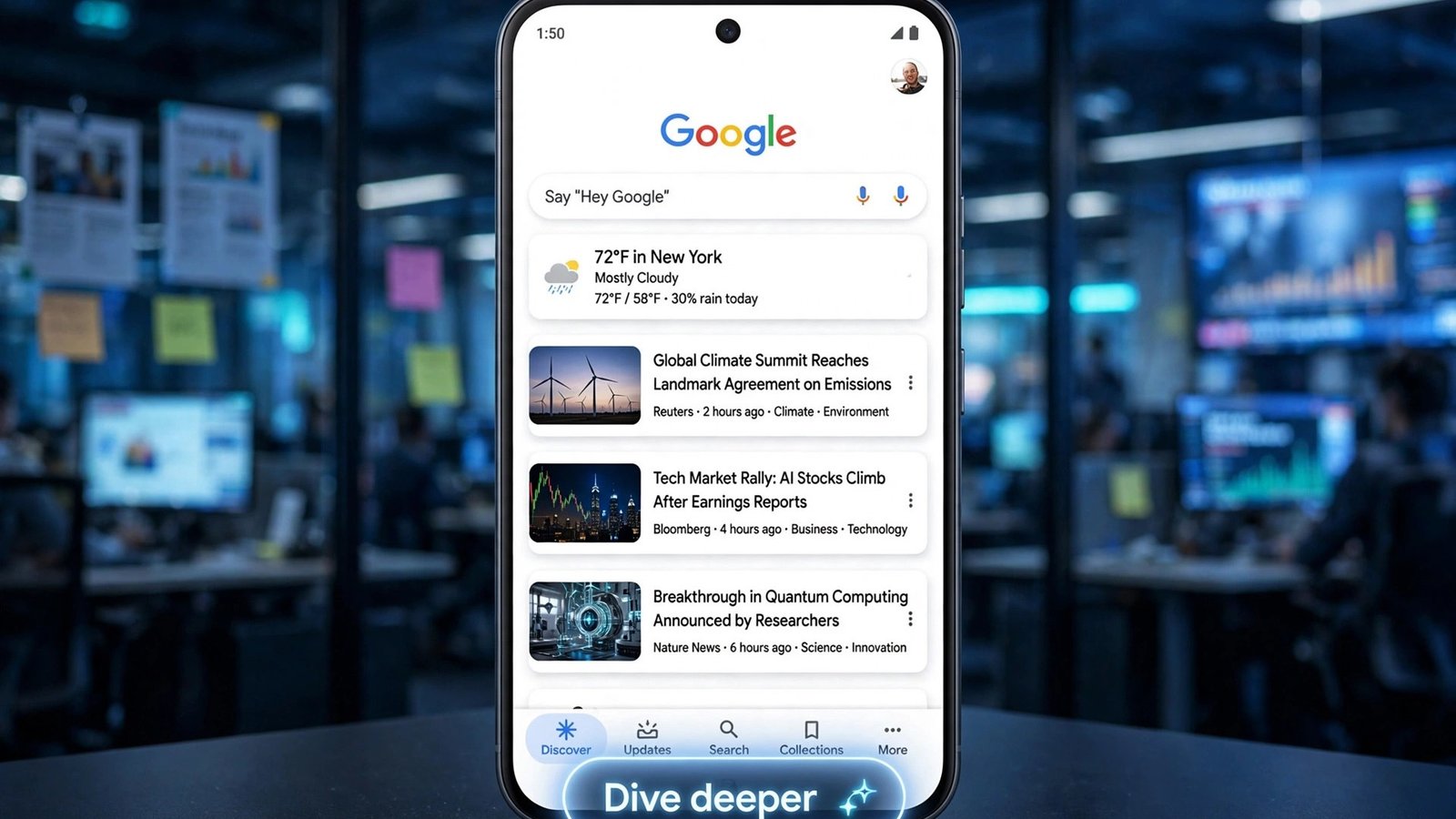
Google confirmed it is testing “Dive deeper” in Discover — an AI-generated overview that sits between a reader and your article — and SEOs say a pre-holiday core ranking update is likely for Q4 2026, centered on user satisfaction and content quality. You don’t need to overhaul your whole site, but you do need a prep checklist: audit your content for real user satisfaction, shore up originality and authorship, and hedge your traffic so you’re not depending on a single Google surface.
Here’s the verified state of play as of mid-October 2026, plus the practical audit steps to finish before the holiday season.
What “Dive Deeper” Actually Is
On September 18, 2026, Robby Stein, Google’s vice president of product for Search, disclosed that Google is testing a “Dive deeper” button on Discover cards — covered in Barry Schwartz’s October 2026 Google Webmaster Report. Tapping it takes the reader to a Google-generated topic overview instead of the publisher’s page: a short AI summary, links to related stories, community reactions, and original reporting.
The test starts with video cards; Google says more designs will follow. Independent researcher Damien Andell found code flags for both video and article AI-summary cards. Google hasn’t named the test markets or audience size.
This is an experiment, not a rollout — it could change shape, narrow, or expand. But the direction is unmistakable: Google keeps inserting its own AI layer between the recommendation feed and the publisher site, the same way AI Overviews changed Search.
Why Publishers Are Worried About It
The concern isn’t that publisher links disappear. They don’t — related stories and original reporting still show up inside the overview. The concern is the click math. When a concise AI summary answers enough of the question, fewer people bother tapping through.
Ahrefs data reported by PPC Land shows AI summaries in Search now capture 58% of clicks that once went to websites. Discover is a different surface, so that number doesn’t transfer directly — but it explains why publishers are anxious. If you run a blog monetized through AdSense, Discover impressions that don’t convert into sessions earn you nothing.
One caution from the SEOs studying the test: Google published three example screenshots (a KCRA weather video) where the top source card pointed to the station’s own domain rather than a syndicated copy, and “Explore more stories” grouped coverage by sub-topic angles. A useful clue — original publishers with distinct angles seem favored — but it’s one example, not a documented ranking factor. Treat examples as hints, not as the formula.
The Q4 Update Signals SEOs Are Flagging
Separately, on October 5, Search Engine Journal published an analysis laying out why a pre-holiday update is likely. Google has a history of at least one core update before the U.S. holiday season, and SEJ notes Google’s updated helpful-content guidance — now with new paragraphs on content quality and user satisfaction — may telegraph what the next update rewards.
SEJ’s Roger Montti listed what to expect if the pattern holds:
- Prioritization of user experience and satisfaction — not just technical UX, but whether the content genuinely satisfies the visitor
- A focus on authentic content — real authorship, real experience, real reporting
- Changes to how Google surfaces fan-out queries — the follow-up questions AI search generates around a topic
- Possibly new algorithms for handling content quality
The September 2026 spam update fits the picture too: started September 24, confirmed complete October 8 — roughly two weeks, the longest spam-update rollout of 2026 (the March one finished in under 20 hours). SEJ’s take: a long spam update can be “clearing the table” before a core update.
Another SEJ piece gathered three expert voices: Marie Haynes predicting a significant core update soon, and Cyrus Shepard’s survey of 130+ SEO experts finding content quality (originality, accuracy, freshness) among the top three ranking drivers — with original research and first-party data highest inside that. One expert put it bluntly: “saying the same thing as everyone else using common facts isn’t a great way to get noticed by AI.” Shepard also flagged new documentation asking publishers to disclose AI automation in content creation.
None of this confirms a core update is coming, or when. Google announces core updates when they start. But the signals line up the way they usually do before one — so October is the month to run the audit.
Your Q4 Blogger Audit Checklist
Do this work now, while the spam update has settled and before any core update rolls out over the holiday season.
1. Run the spam-update audit first
Compare your Search Console performance before September 24 and after October 8. The September spam update improved spam systems against scaled content abuse, cloaking, sneaky redirects, doorway pages, hidden text, and link spam. If you publish AI-assisted content, re-run our September 2026 spam update blog audit. Fix anything questionable now; a spam flag will poison any core-update recovery later.
2. Audit pages for genuine user satisfaction
Google’s updated guidance keeps coming back to one idea: does the content satisfy the person who landed on it? Run your top 20 posts through this pass:
- Kill the throat-clearing. If your intro takes 300 words to get to the point, readers bounce and raters notice. Put the direct answer in the first 100 words.
- Check dwell signals. In Google Analytics, look at pages with high bounce rates from Discover or Search. High bounce plus low time-on-page on your biggest traffic pages is the closest proxy you have to the “satisfaction” signal.
- Cut thin sections. A post with 400 words of substance and 1,100 words of filler is a quality risk in the current climate. Trim or rewrite.
3. Harden authorship and originality
The fake-authorship warning and the AI-disclosure guidance both point the same way: Google is tying quality to who made the content and how.
- Make sure every post has a real author byline with a real bio page — no “Admin,” no generic pen names with no identity behind them.
- Add original material: your own screenshots, test results, data, photos. Shepard’s survey found first-party data and firsthand observation are what get noticed by AI systems now.
- If you use AI assistance, review our AI content fact-check guidance and follow Google’s push for disclosure.
4. Fix the technical basics a core update amplifies
Core updates reward quality signals that are already on the page. Check: one H1 per post, titles under 60 characters, meta descriptions that actually summarize, images with real alt text, and no broken internal links on your top pages. If Core Web Vitals are marginal (LCP over 2.5s, CLS over 0.1, INP over 200ms), a quality-focused update is the wrong time to let them slide.
5. Update your biggest winners
A core update re-evaluates everything. Refresh the facts, dates, prices, and screenshots in the posts that carry your traffic. A post stamped 2024 with dead links and stale numbers is exactly the kind of page a quality-focused update demotes.
6. Log everything
Keep a record of every change and its date. If an update hits in November or December and your traffic moves, you’ll need to separate your own edits from the update’s effect.
How Discover Publishers Can Hedge Against Dive Deeper
What you can do is make your content the kind that survives the overview — and make Discover one channel among several.
Own the original. In Google’s own screenshots, the top source card pointed to the original publisher’s domain, not a syndicated copy. Publish original reporting, footage, and angles — and keep your canonical tags pointing home. If anyone is cited inside the overview, it should be you.
Write distinct angles, not the same story. The test’s “Explore more stories” section grouped coverage by sub-topic. Five posts saying the same thing compete with each other; one post with a distinct angle gets its own cluster. Original data and firsthand testing are the differentiators the experts keep citing.
Make video Discover sees. The test starts with video cards. If you can produce video — even simple explainers — you’re on the surface Google is actively developing.
Build channels Google can’t insert itself into. Email lists, RSS, direct traffic, and social followings convert no matter what buttons Google adds. If Discover is 80% of your traffic, Dive Deeper is an existential risk — if it’s 30%, it’s a traffic-quality question.
Frequently Asked Questions
Is “Dive deeper” live for all Discover users?
No. It’s a test Google disclosed on September 18, 2026, starting with video cards. Google hasn’t said which countries are included or how many users see it, and it says designs will keep changing. Some SEOs in the UK report not seeing it yet.
Will Dive Deeper remove publisher links from Discover?
No — related stories and original reporting still appear inside the overview. The risk is behavioral: users who get enough from the AI summary may never tap through, shrinking click-through even with links present. Google has shared no traffic data on the test.
Is a Google core update confirmed for Q4 2026?
Not confirmed. Google announces core updates when they begin. What’s verified: SEJ’s October 5 analysis says a pre-holiday update is likely based on Google’s historical pattern, Google’s helpful-content guidance gained new user-satisfaction and quality paragraphs, expert analyses converge on quality signals being reweighted, and the September spam update’s long rollout completed October 8 — read by SEJ as possible table-clearing. Treat it as a high-probability prep scenario, not a scheduled event.
What content types should benefit if a quality-focused update rolls out?
User satisfaction, authentic content, originality, accuracy, freshness. The likely winners: original reporting, first-party data and research, firsthand experience with real authorship, and genuinely updated evergreen guides. Thin rewrites of what everyone else published are what the experts say AI systems now ignore.
Should I stop publishing until the update passes?
No — freezing your site doesn’t protect it, and fresh, original content is one of the signals being rewarded. Keep publishing, but raise the bar: every post needs something original in it — your data, your screenshots, your test, your angle. And run the audit above before the holiday season, not after.
How do I know if the September spam update hit my site?
In Search Console, compare your average position and impressions for the two weeks before September 24 against the period after October 8. If you see a sustained drop aligned with that window, check your site against Google’s spam policies — scaled content abuse, cloaking, sneaky redirects, and link spam top the list. Our spam update blog checklist walks through the full diagnosis.