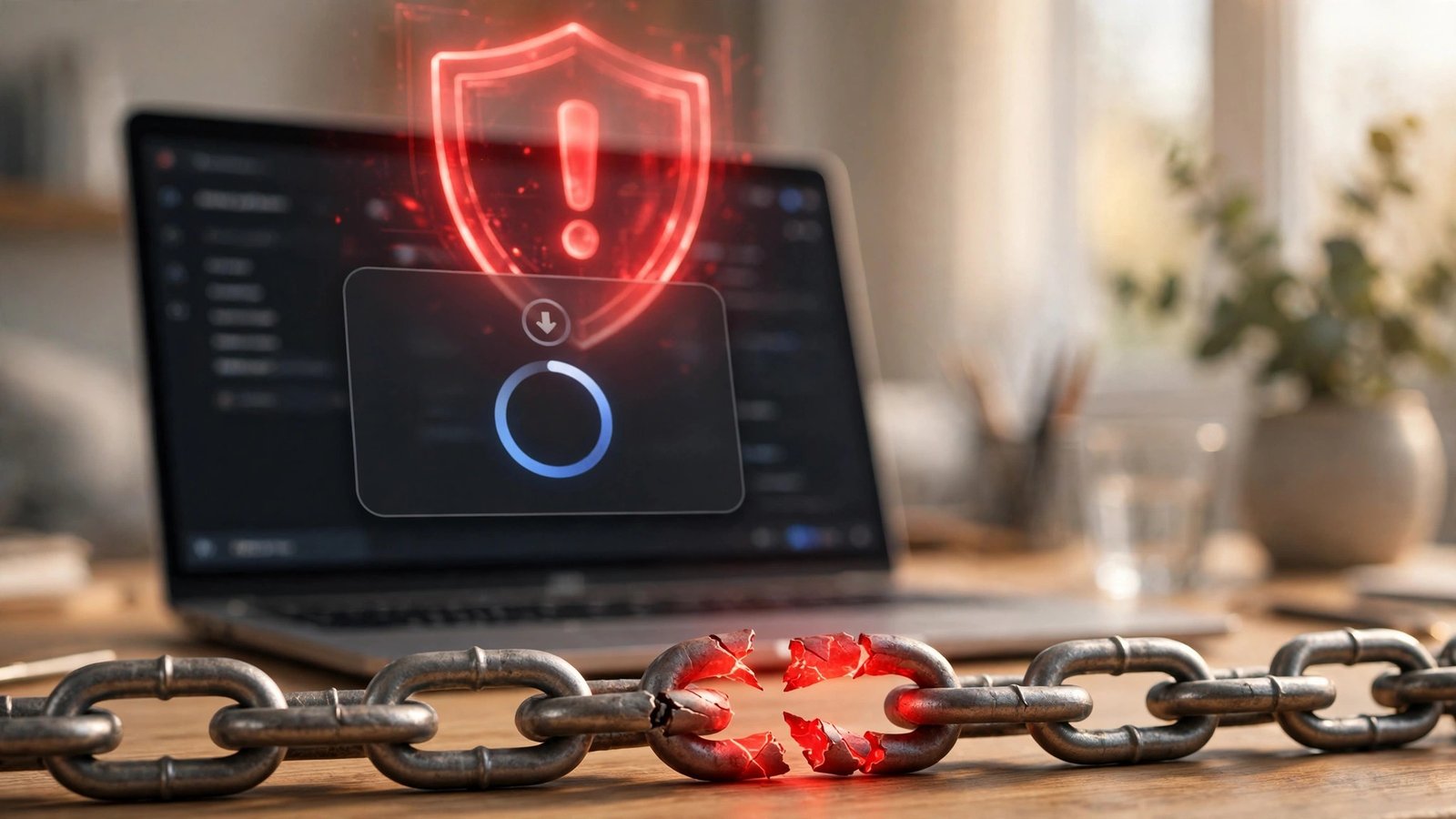
In 2026, three separate attacks turned trusted WordPress plugins into malware delivery vehicles — and in every case, the poison arrived through the plugin’s own update channel. That’s the uncomfortable headline for bloggers: the “Update available” button you click reflexively is exactly what the attackers used.
A supply chain attack means the attacker doesn’t break into your site. They break into something upstream — the developer’s update server, or the plugin’s ownership itself — and let your own update routine deliver the malware. Here’s what happened in 2026’s three biggest WordPress cases, and the practical checklist that keeps your blog out of the blast radius.
Case 1: Admin Menu Editor Pro — the update server itself got owned (September 2026)
On September 14, 2026, developer Jānis Elsts’ update infrastructure for Admin Menu Editor Pro was compromised by an attacker who apparently gained root-level access to the server hosting the plugin’s distribution site. The attacker swapped the legitimate 2.35 release for a trojanized build and pushed it out through the plugin’s normal auto-update mechanism.
That means affected sites received the backdoor exactly the way they’d receive any routine security patch. The malicious 2.35 build was distributed for roughly seven hours — about 06:00 to 13:00 UTC on September 14 — before the developer pulled it. Then the truly alarming part: Elsts shipped version 2.36 at roughly 19:00 UTC the same day as a clean replacement, but the attacker still held the server and re-compromised that release too. Updating to 2.36 did not fix the compromise. It spread it.
What the backdoor did. The trojanized package added a web shell file (includes/wp-user-consent.php, given a GDPR-sounding name to blend in), created a hidden administrator account with a username starting with wp_ in the database, and wrote persistence data into wp-content/object-cache/ — a path chosen to look like WordPress’s normal object-cache location so scanners would skip over it. Backdoor state was also stored in the wp_options table under option names starting with wp_ocache.
The scope. Roughly 230 customers and at least 1,500 sites were confirmed affected, and the developer warned the real number could be higher. Version 2.34 is considered clean, and the free version of Admin Menu Editor on wordpress.org was never part of this incident.
The fix. The most reliable recovery is restoring from a backup made before September 14. Otherwise, delete the plugin, the rogue wp-content/object-cache/ directory, the hidden admin user, and the wp_ocache* database entries — then change all credentials.
Source: BleepingComputer’s coverage of the incident
Case 2: The Flippa purchase — 31 plugins turned into sleeper agents (April 2026)
In early 2025, an attacker known only as “Kris” — with a documented background in SEO, cryptocurrency, and online gambling marketing — bought the entire Essential Plugin portfolio (31 WordPress plugins, around 400,000 combined active installations) on Flippa for a six-figure sum.
On the day Kris took ownership of the commit credentials, the new owner slipped 191 lines of PHP into version 2.6.7, disguised by a changelog note reading “Check compatibility with WordPress version 6.8.2.” The code contained a PHP deserialization backdoor, and then went silent for eight months while the compromised version spread through WordPress’s own automatic update system.
Activation day. On April 5–6, 2026, the payload woke up. In a roughly seven-hour window on April 6 (about 04:22 to 11:06 UTC), the backdoor downloaded an additional file and injected roughly 6KB of PHP into each site’s wp-config.php — one of WordPress’s central configuration files. Their wp-config.php went from about 3.3KB to 9.5KB.
The payload’s job was SEO spam: it fetched spam links, redirects, and fake pages from a command-and-control server and served them exclusively to Googlebot — a cloaking technique that made the compromise invisible to regular visitors and even to admins browsing their own sites.
The part that should scare everyone: the command-and-control domain was resolved through an Ethereum smart contract queried over public blockchain RPC endpoints. No registrar to contact, no DNS record to seize — the attacker could point the contract at a new server domain at any moment, and traditional takedowns don’t work against infrastructure on an immutable ledger.
The response. WordPress.org permanently closed all 31 plugins on April 7, 2026, and on April 8 force-pushed version 2.6.9.1 to neutralize the phone-home mechanism. But that update did not remove the injected code from wp-config.php — sites that received the “security update” stayed compromised and kept serving cloaked spam to Googlebot until someone manually cleaned the config file.
Source: TechSpot’s reporting on the Flippa compromise
Case 3: ShapedPlugin Pro — the June warning shot
In June 2026, Wordfence flagged a critical-severity (CVSS 10.0) breach involving ShapedPlugin Pro. The public forensic detail is thinner than the other two cases, but the signal is the same: premium plugin distribution channels are now an active target, and a reputable paid plugin is no guarantee its delivery pipeline is intact.
The one big lesson: “just update” is no longer a cleanup plan
Notice what ties all three cases together. In each one, the official update channel did the attacker’s work:
- Admin Menu Editor Pro: the “fix” release 2.36 was itself compromised — sites that updated promptly after the incident were exposed again.
- Essential Plugins: WordPress.org’s emergency update neutralized the phone-home code but left the injected payload in
wp-config.php— a site that “updated to the fixed version” was still infected. - ShapedPlugin Pro: compromise arrived through the vendor’s distribution path.
The old mental model — “I’m safe because I update promptly” — assumed the update channel itself was trustworthy. 2026 proved it isn’t. Malware now ships through the same button that used to be your first line of defense, and updating or removing the plugin doesn’t remove what the malware left behind: hidden admin users, config-file injections, persistence directories. Cleanup has to happen outside the plugin directory — in the database, wp-config.php, and user accounts.
The blogger’s supply-chain checklist
You don’t need to be a security engineer to apply this. You need habits, most of which are free.
1. Keep tested backups
The official September remediation was “restore from before September 14” — which only works if you have a backup from early September. Run daily automated backups with off-site copies, keep 30+ days of history, and actually test a restore twice a year.
2. Stage your updates
Premium plugins update outside wordpress.org’s safety net. If your host offers one-click staging, run updates there a day before your live site. WordPress 7.2’s beta lands around October 20, 2026 — see our WordPress 7.2 release guide for another good reason to test first.
3. Watch for ownership changes
The Flippa attack worked because 31 plugins changed hands without owners noticing — WordPress has no reliable way to alert you. If a plugin rebrands, gets a new support site, or ships out-of-character features, spend ten minutes checking its changelog, support forum, and any sale announcements.
4. Prefer wordpress.org for free plugins
WordPress.org’s plugin team force-closed 31 plugins within days in April — an imperfect safety net that exists for repository plugins only. Every premium plugin on your site updates outside that pipeline, so each one should justify the extra risk it carries.
5. Keep your plugin count small
A blog with 40 plugins has 40 vendors’ servers in its update path. Audit quarterly: if you haven’t used a plugin’s features in three months, deactivate and delete it.
6. Learn the compromise signs
After the September attack, affected sites could be identified by four concrete signs: includes/wp-user-consent.php inside the plugin folder, a wp-content/object-cache/ directory that shouldn’t exist, a database user starting with wp_ you never created, and wp_ocache* entries in wp_options. A file-integrity monitoring plugin will alert you when files change unexpectedly.
7. Check wp-config.php after big scares
The April injection survived an official forced update. If you’ve ever been near one of these incidents, open wp-config.php and look for unrecognized code — the April injection nearly tripled the file’s size (3.3KB to 9.5KB). Restore from a known-good copy if anything looks off.
8. Use real security tooling
A reputable scanner (Wordfence, Sucuri) catches known IOCs faster than you will, and a plugin that logs admin-account creation would have flagged the September hidden user immediately.
9. Isolate the blast radius
Use hosting with account isolation rather than the cheapest shared plan. Keep separate credentials for your WordPress admin, database, and hosting panel, and rotate them after any incident.
10. Don’t trust search results blindly
The April payload served spam to Googlebot while humans saw a normal site. Strange queries or pages in Search Console are a compromise indicator — check our September 2026 spam-update checklist alongside a malware scan.
Frequently Asked Questions
Was my WordPress site affected by the 2026 supply-chain attacks?
If you never used Admin Menu Editor Pro versions 2.35 or 2.36, or any of the 31 Essential Plugin titles, you weren’t affected by those two incidents. The telltale signs are concrete: unexpected wp-content/object-cache/ directories, hidden wp_-prefixed admin users, wp_ocache* entries in wp_options, or an unusually large wp-config.php. Check those directly rather than guessing.
Is the free version of Admin Menu Editor safe?
Yes, per all published reporting. The September compromise was confined to the premium edition’s independent distribution channel — the free version on wordpress.org was never affected, and Pro version 2.34 is considered clean.
I updated the compromised plugin — am I clean now?
Not necessarily, and that’s the point of 2026. WordPress.org’s emergency 2.6.9.1 update in April neutralized the phone-home code but left the wp-config.php injection intact, and Admin Menu Editor Pro’s 2.36 “fix” was itself trojanized. Updating the plugin doesn’t remove hidden users, config-file injections, or persistence directories. Verify cleanup manually or restore from a pre-incident backup.
Should I stop using premium plugins entirely?
No — but treat each one as a trust decision. Premium plugins update outside wordpress.org’s review pipeline, which is exactly why the September attack’s “fix” release could be compromised twice. Keep the premium plugins you actively need, buy from vendors with a public changelog and support channel, and test their updates on staging before your live site.
How often should I back up my WordPress blog?
At minimum, daily automated backups with off-site copies, kept for at least 30 days — the September incident’s official remediation was “restore from before September 14,” which only works if you have a backup from early September. Test a restore twice a year.
Can my host’s malware scan catch these attacks?
It helps, but don’t rely on it alone. Host scans run on schedules and often miss database-level persistence like hidden users and wp_options entries. Pair hosting-level scanning with a WordPress plugin that does file-integrity monitoring and logs admin-account creation.