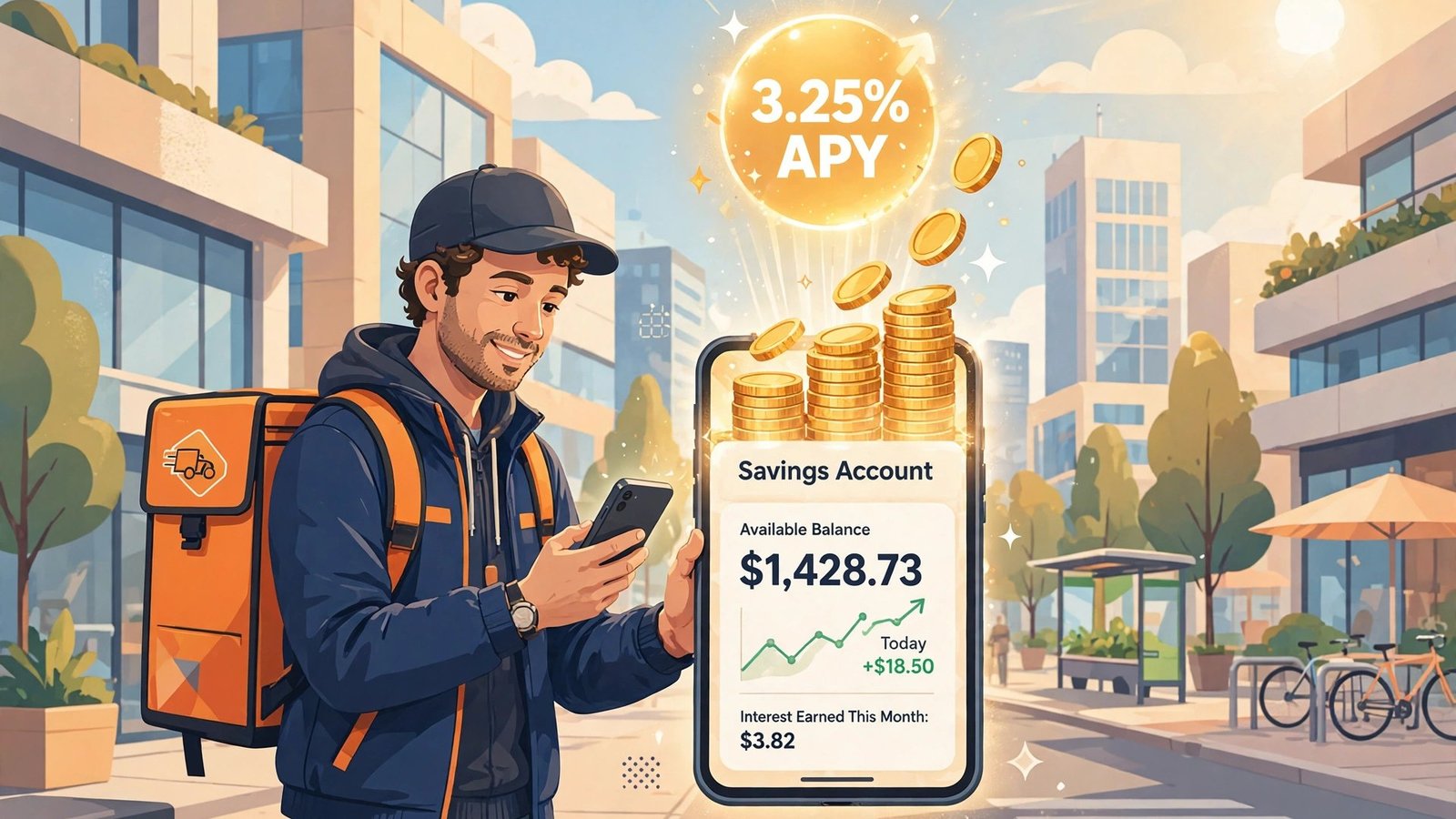
If you earn from gig work, most high-yield savings accounts weren’t built for you. They want a steady direct deposit every two weeks — something an Uber driver, DoorDash courier, or tip-based worker can’t always promise. Branch just fixed that. On October 1, 2026, the embedded financial services company launched High Yield Savings paying up to 3.25% APY with no direct-deposit or card-spending requirement, debuting first on the Uber Pro Card.
Here’s how it works, what the $500 balance rule means in practice, and the honest math on what you’ll actually earn.
What Branch launched (and who gets it first)
Branch builds financial products embedded inside other apps — most visibly the Uber Pro Card, which drivers and couriers already use to receive their payouts. High Yield Savings lives directly in the Branch app and Branch-powered apps like the Uber Pro Card, so workers move money from earnings to savings without opening a separate bank account. (PYMNTS launch report)
The launch starts with Uber drivers and couriers, with Branch planning to extend it to its broader user base and other partner apps afterward. If you’re not on the Uber Pro Card today, you can’t open it yet — but the model is worth understanding now, because it’s a template other gig platforms will copy.
The rate structure: 3.25% APY at a $500 average balance
The deal is simple and tiered:
- 3.25% APY when your average daily balance is $500 or more during the month.
- 1.25% APY on balances below $500 — and it starts at the very first cent, so small savers still earn something.
- No minimum balance to open, no fees, and interest accrues and pays out monthly.
- No direct-deposit requirement and no card-spending threshold to unlock the top rate — just keep the average daily balance at $500+.
That last point is the real story. Most high-yield savings accounts from online banks dangle their headline rate behind a recurring direct deposit or a minimum number of debit transactions per month. Miss one cycle and your rate drops. For a worker whose pay lands on different days each week — or skips a slow week entirely — those requirements are traps. Branch replaced them with a single balance rule you can hit by simply leaving money parked. (Launch coverage)
You can move money in and out at any time, typically without transfer fees, and set up automatic contributions on a daily, weekly, biweekly, or monthly schedule — which matters a lot for irregular earners, as you’ll see below.
Why “no direct deposit required” matters more than the rate
3.25% APY is a genuinely competitive rate in late 2026, but it’s not the highest number on the market — several online banks pay above 4%. The difference is access: those top-rate accounts assume a salaried life. Branch founder and CEO Atif Siddiqi put it plainly when the product launched — workers whose income fluctuates shouldn’t have to worry about a direct deposit just to keep their savings rate.
Think about the typical alternatives for a 1099 worker. A traditional bank savings account pays next to nothing. A mainstream high-yield account may pay more but silently punishes irregular income with tiered rates that collapse when your pay pattern shifts. Branch’s savings lives inside the app where your pay already lands, so saving becomes a one-tap move on a good week rather than a separate financial chore.
For freelancers comparing digital-first banking options, our Mercury vs Relay business banking comparison covers two other fintech favorites — though those are built for business accounts, not gig-pay savings.
The honest math: what you’ll actually earn
Let’s not pretend a savings rate replaces income. At 3.25% APY, a steady $500 balance earns about $16 over a full year. At $2,000 — a more serious emergency buffer — it’s roughly $65 a year, paid out monthly at about $5.40 a month.
That’s not life-changing money. The real value is behavioral:
- Separation. Money in the savings pocket isn’t in your spending balance, so a slow week can’t eat your cushion by accident.
- Compounding habit. Automatic contributions on a weekly schedule — even $25 a week — turn a good stretch of gigs into a buffer without willpower.
- Beating inertia. The alternative for most gig workers is letting earnings sit in a checking-style account earning 0.01%, where inflation quietly eats it.
One tactic that fits irregular income: set a small daily or weekly auto-transfer ($10–$25) and let good weeks push you over the $500 average. On a thin week, pause it — there’s no penalty for stopping, unlike accounts that demand consistent deposits.
The catches (there are a few)
No product is all upside. Here’s what to watch:
- The rate is variable. “Up to 3.25% APY” means Branch can move it with market rates — and after the Fed’s 2026 cuts, savings rates are trending down across the board. Don’t anchor your plans to 3.25% forever.
- Below $500, you earn 1.25%. That’s still fine for small balances, but the gap between the two tiers is large. If your average hovers near $500, watch it — a few withdrawals mid-month can drag your average below the line.
- Availability is limited for now. It launched first on the Uber Pro Card. Other Branch-powered apps and the broader user base come later.
- Read the disclosures before moving serious money. As with any embedded-finance product, check whose name is on the account terms, how your funds are held, and what protections apply before parking an emergency fund there. Branch is a financial services provider, not a bank itself — its savings features run through partner banks, so confirm the current arrangement in the app’s disclosures.
- It’s savings, not a tax strategy. Freelancers still need to handle quarterly estimated taxes — parking money in a high-yield account for your tax reserve is smart, but the savings account doesn’t pay the IRS for you.
This isn’t financial advice — rates, terms, and availability change, so confirm the current numbers in the Branch app before you commit.
How to start
- If you’re an Uber driver or courier, open the Uber Pro Card / Branch app and look for the High Yield Savings feature.
- Move an initial amount into savings — there’s no minimum to open.
- Set up automatic contributions (daily, weekly, biweekly, or monthly) at an amount your slowest week can still handle.
- Aim to keep your average daily balance at $500+ to hold the 3.25% APY tier.
- Withdraw anytime you need it — transfers back are typically free.
Frequently Asked Questions
What is Branch High Yield Savings?
A savings feature launched October 1, 2026, by embedded financial services company Branch, built directly into the Branch app and partner apps like the Uber Pro Card. It pays up to 3.25% APY on savings for hourly, tipped, and 1099 workers, with no direct-deposit or card-spending requirement.
Who can open Branch High Yield Savings right now?
At launch it’s available first to Uber drivers and couriers through the Uber Pro Card. Branch says it will extend the feature to its broader user base and other partner apps over time.
How do I get the 3.25% APY rate?
Keep an average daily balance of $500 or more. Below that, the account pays 1.25% APY starting from your first cent. There is no minimum to open and no fees, and interest accrues and pays out monthly.
Is there really no direct deposit requirement?
Correct. Unlike many high-yield savings accounts, Branch’s top rate doesn’t require a recurring direct deposit or a set amount of card spending — the only requirement is the $500 average daily balance. That’s specifically designed for workers with fluctuating pay.
Can I withdraw my money anytime?
Yes. You can move funds in and out at any time, typically without transfer fees, and you can set up or pause automatic contributions on daily, weekly, biweekly, or monthly schedules.
How much will I earn on $1,000 at 3.25% APY?
Roughly $32.50 over a full year if the rate holds and the balance stays put — about $2.71 a month. The rate is variable and can change with market conditions, so treat published APYs as current snapshots, not guarantees.