You’re Your Own IT Department (Like It or Not)
Here’s an uncomfortable truth about freelancing in 2026: you are the entire IT department. There’s no security team patching your systems, no compliance officer enforcing MFA, no incident response plan beyond you Googling frantically at midnight. And the threats have leveled up — AI-powered phishing crafts messages in your client’s voice, in perfect English, referencing real projects. Old-school antivirus was never designed for this.
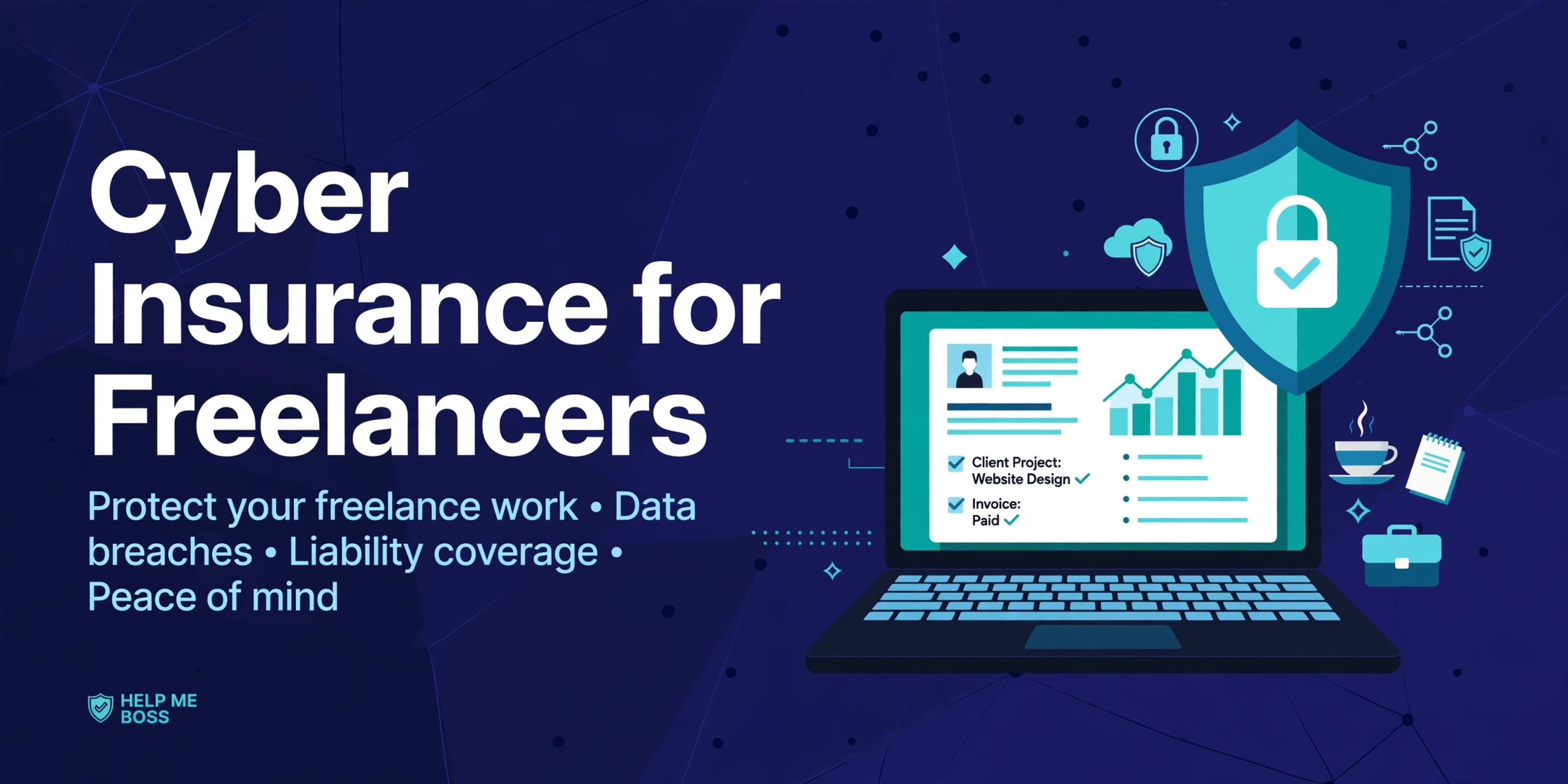
That’s the case for cyber insurance: a policy that covers the costs when something goes wrong digitally — data breach response, legal fees, business interruption, data recovery. For freelancers handling client logins, customer data, payment information, or proprietary files, one incident can cost more than a year of revenue. Entry-level policies start around $19–$30 a month.
This article is educational, not financial advice. Insurance needs vary by profession, state, and client contracts — get actual quotes and read the policy terms before buying.
What Cyber Insurance Actually Covers
Policies vary, but a typical cyber liability policy for a freelancer covers:
- Data breach response — forensic investigation, customer notification costs, credit monitoring for affected individuals.
- Legal fees and liability — defense costs if a client sues over a breach connected to your work.
- Business interruption — lost income while your systems are down after an attack.
- Data recovery — costs to restore or reconstruct lost data.
- Cyber extortion — in many policies, ransomware payment and negotiation costs (with conditions).
And what it typically does not cover:
- Breaches from systems you knew were unpatched and ignored.
- Incidents where you had no MFA or no backups — many insurers now require these as a condition of coverage.
- Intentional acts or fraud by you.
- Future lost profits beyond the defined interruption period.
- Plain infrastructure failure that isn’t a cyberattack.
Read the exclusions before you buy. The cheapest policy that excludes your actual risk profile is the most expensive mistake.
What It Costs: Realistic Price Ranges
These are “starting at” figures from 2026 market coverage — your actual quote depends on your profession, revenue, data handling, and state. Use them to calibrate, then get real quotes.
| Provider | Starting around | Best for |
|---|---|---|
| Next Insurance | ~$19/mo | Freelancers and startups; fully digital, instant quotes |
| Hiscox | ~$22/mo | Solo professionals; strong reputation, customizable |
| Thimble | ~$10–15/mo | Flexible/monthly coverage, seasonal work |
| Travelers | ~$25/mo | Bundling with general liability (10–20% bundle savings) |
| Chubb | ~$30/mo | Growing businesses wanting premium claims support |
For context on the broader market, small business cyber policies for software developers are reported in the $17–$168/month range depending on coverage stack, and tech-focused carriers like Coalition run higher (~$145/mo) but include active security monitoring.
The freelancer sweet spot is usually a standalone cyber policy or a cyber endorsement on a business owner’s policy in the $20–$40/month range. That’s $240–$480 a year — against a single forensic investigation that can run $3,000–$10,000. The math isn’t close.
Do You Actually Need It? A Decision Framework
You probably need it if you:
– Store client or customer data — emails, names, addresses, payment details.
– Have admin access to client systems, websites, or ad accounts.
– Take payments online or handle financial data.
– Have client contracts that require it (increasingly common in RFPs and MSAs).
– Would lose more than a few thousand dollars if you were offline for three days.
You can reasonably defer if you:
– Are a sole operator storing no third-party data at all.
– Already run Cyber Essentials-style hygiene: MFA everywhere, encrypted offline backups, EDR instead of just antivirus.
– Have no contractual requirement and minimal digital attack surface.
Even in the defer case, revisit annually. Your risk profile changes the moment you take on a client with customer data.
How to Get Covered Cheaper
Insurers price risk, so demonstrating lower risk lowers your premium:
- Enable MFA everywhere. Many insurers now require it for coverage at all. It’s also the single highest-ROI security control in existence.
- Keep offline backups. Ransomware without backups is a catastrophe; with backups, it’s an inconvenience. Insurers price accordingly.
- Use EDR, not just antivirus. Endpoint detection and response tools (many have free tiers for individuals) signal seriousness.
- Bundle policies. A business owner’s policy combining general liability with cyber often beats standalone pricing by 10–20%.
- Raise your deductible sensibly. Moving from $500 to $2,500 can cut premiums 10–15% — only if you can actually absorb the deductible.
- Pay annually. Most carriers discount ~10% for paid-in-full versus monthly.
- Use a marketplace. Commercial insurance marketplaces like SimplyBusiness let you compare multiple quotes at once; spreads of 40%+ between carriers are common.
The 5-Step Freelancer Security Baseline (Do This Regardless)
Insurance is the backstop, not the plan. Whether or not you buy a policy, do these five things this week:
- MFA on everything — email, hosting, banking, client accounts, password manager. No exceptions.
- A password manager — unique 20-character passwords everywhere. If you’re reusing passwords, you’re one breach away from a cascade.
- Encrypted backups, offline copy — 3-2-1 rule: three copies, two media types, one offline. Test the restore.
- Separate your finances — a dedicated business checking account limits the blast radius if credentials leak. (See our guide to business checking accounts for freelancers.)
- A written incident plan — one page: who to call (host, bank, clients), what to shut down first, where backups live. You’ll never write it during an incident.
Pair this with solid freelance contracts that define data-handling responsibilities, and you’re ahead of 90% of solo operators.
The Bottom Line
Cyber insurance for freelancers is no longer an enterprise luxury — at $19–$30/month starting prices, it’s priced like any other business utility. If you handle client data, have system access, or sign contracts that require it, get quotes this month. If your risk is genuinely minimal, invest the same money in the five-step baseline above and revisit yearly. Either way, stop relying on antivirus alone against AI-era phishing. That fight is already over.
Sources: MoneyGeek’s 2026 guide to software developer insurance for market rate ranges; MacUser’s cyber insurance explainer for coverage details and claim examples. Prices are starting figures from market coverage — get actual quotes for your situation.
Frequently Asked Questions
How much does cyber insurance cost for freelancers?
Starting prices in 2026 run roughly $19/month (Next Insurance) to $30/month (Chubb), with flexible options like Thimble from $10–15/month. Actual quotes vary by profession, revenue, data handling, and state — these are floors, not guarantees.
What does cyber insurance cover for a freelancer?
Typically: data breach response (forensics, notifications, credit monitoring), legal defense costs, business interruption income, data recovery costs, and often cyber extortion. It generally excludes unpatched known vulnerabilities, incidents where you lacked MFA/backups, and intentional acts.
Do I need cyber insurance if I’m a solo freelancer?
If you store client or customer data, have admin access to client systems, take payments online, or sign contracts requiring it — yes, strongly consider it. If you store no third-party data and practice strong hygiene, it’s reasonable to defer and revisit annually.
Is cyber insurance tax deductible for freelancers?
In the US, business insurance premiums are generally deductible as ordinary business expenses for self-employed individuals. Confirm with a tax professional for your specific situation — this isn’t tax advice.
Will cyber insurance pay a ransomware demand?
Many policies include cyber extortion coverage with conditions, but insurers increasingly prefer funding recovery over payment, and some jurisdictions restrict payments. Check the policy terms and your state’s rules.
How can I lower my cyber insurance premium?
Enable MFA everywhere, maintain offline backups, use EDR tools, bundle with general liability, raise your deductible (if you can absorb it), pay annually, and compare quotes across multiple carriers.