
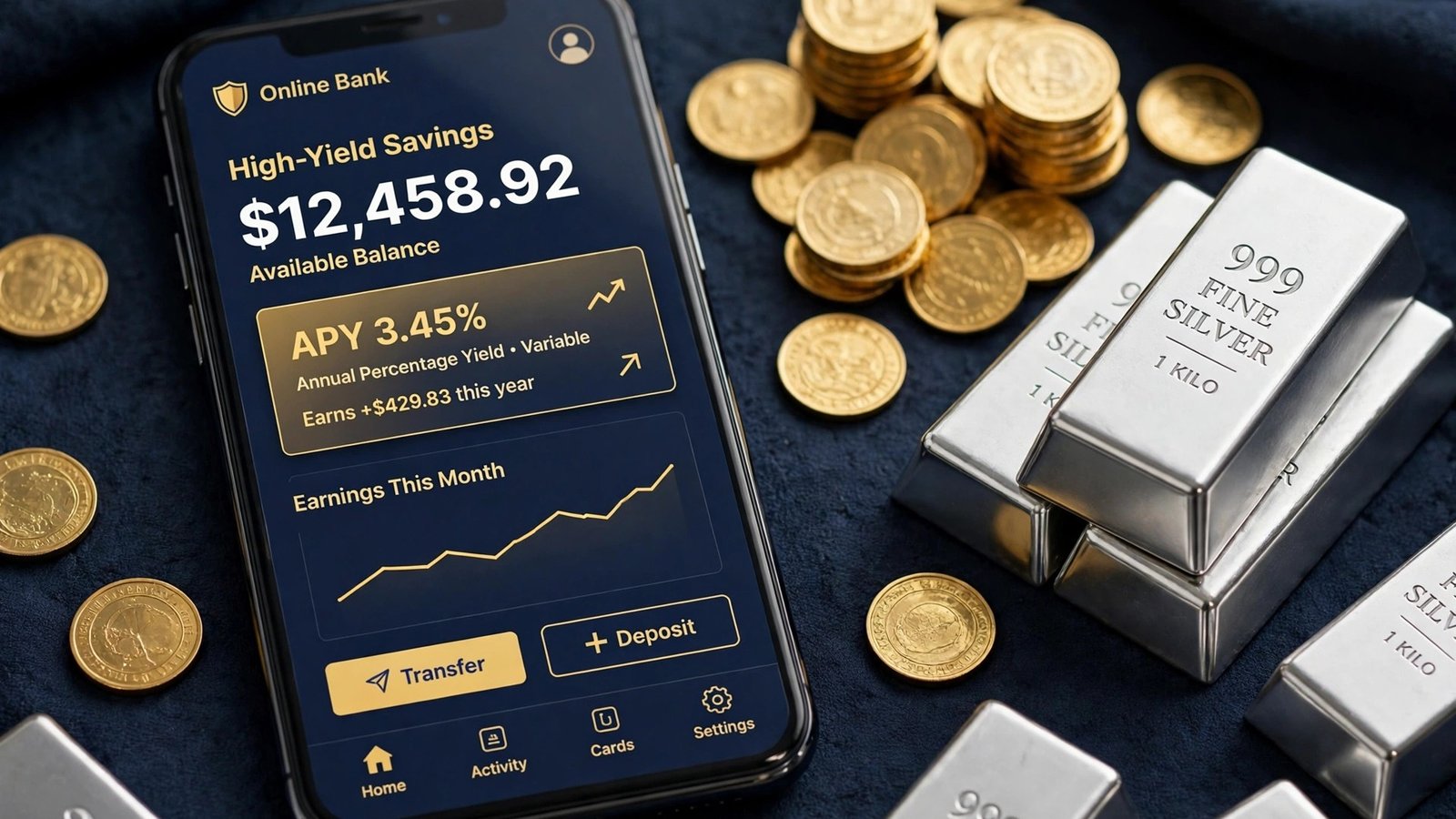
Battle Bank is a brand-new FDIC-insured online bank paying 3.45% APY on both checking and savings, with no direct-deposit requirement and no balance tier to climb. That is real: the bank’s own High Yield Cash Account page advertises “3.45% APY! And that’s in a checking account.” But before you move a dollar, you need the other half of the story. Battle Bank also offers a gold and silver metals account, and that account is not FDIC-insured, not bank-guaranteed, and not the same kind of product as the checking or savings account at all. Below: the rate, the comparison, the math, and the risks.
What Is Battle Bank?
Battle Bank, National Association, is a new online-only bank that went live this week, co-founded by Frank Trotter, who founded EverBank, and Rick Rule, a longtime natural-resources investor. Trotter’s name matters: EverBank built its reputation on high-yield accounts, and Battle Bank looks like a second act in the same playbook, updated for 2026.
The bank is FDIC-insured: deposits in its checking and savings accounts are protected up to the standard $250,000 per depositor, per ownership category. A new bank with an unfamiliar name naturally invites the question — is my money safe here? For the cash accounts, the answer is the same as at any FDIC member bank.
Battle Bank has no branches. Its stated model is to invest mainly in federally guaranteed securities and make very few real-estate loans — a conservative, low-overhead balance sheet, with the savings passed to depositors as higher rates. That is why online banks can pay several times what the big brick-and-mortar banks pay.
One disclosure. The bank was covered in a November 25, 2026 Daily Reckoning column, and the columnist discloses that he is a Battle Bank customer and investor, and that Paradigm Press, the column’s publisher, is a Battle Bank marketing affiliate. That does not make the 3.45% rate any less real — it is on the bank’s own website, and I verified it there. But the loudest early coverage comes from people with a financial interest in the bank’s success. Verify the rate yourself on battlebank.com before opening anything; I show you how near the end.
The 3.45% APY, Explained
Battle Bank pays 3.45% APY on both checking and savings through its High Yield Cash Account. The same rate applies to both — and the fact that it applies to checking is the whole point. At most banks, checking earns next to nothing and savings earns the headline rate. Battle Bank pays the headline rate on the account you actually spend from.
The rate is variable — the single most important fine-print fact about this account. Battle Bank can raise or lower it, and it has already moved once. According to rate-history data from MonitorBankRates, the account paid 3.35% APY from September 14, 2026, rising to 3.45% on October 6, 2026. The bank’s own site lists APYs as of October 1, 2026, and the rate has held for seven weeks. If the Federal Reserve cuts rates, variable-rate accounts like this one tend to follow down, usually with a lag of a few weeks. If you open this account expecting 3.45% forever, you will be disappointed. Treat it as today’s rate, and check it every few months.
What makes the checking rate unusual is not the number — plenty of banks pay more on savings. What is unusual is that checking pays it with no strings attached: no direct-deposit requirement, no minimum balance tier, no debit-card quota, no monthly transaction count. You put money in checking, and it earns 3.45% APY. That is genuinely rare.
Most high-yield checking accounts that pay 4% or 5% come with conditions — a monthly direct deposit, a minimum number of debit transactions, e-statements, sometimes all three. Miss one in a month and your rate drops to a fraction of a percent for that cycle. Battle Bank skips all of that. The trade-off is a lower rate: you give up some yield for simplicity and for spending money that actually earns interest.
One thing I could not verify: the bank’s published materials did not clearly spell out every fee or minimum for the High Yield Cash Account. I found no published monthly fee, minimum opening deposit, or ATM fee list in the sources I checked. That does not mean there are none — I will not invent numbers, so read the account terms on the bank’s site before applying. A bank with no monthly fee and no minimum is a different deal from one that quietly charges $10 a month if your balance dips.
How 3.45% Stacks Up Against the Competition
The honest headline is that Battle Bank does not pay the top savings rate in the country right now. Its edge is the checking account, not the savings rate. Here is the comparison against verified rates as of November 27, 2026, from the Wall Street Journal’s high-yield savings roundup and FinanceRadar’s November 2026 data.
| Account | APY | The catch |
|---|---|---|
| Axos Bank high-yield savings | 5.00% | Requires $1,500 in checking plus $1,500/month in direct deposits |
| ableBanking savings | 4.55% | $2,500 minimum to open |
| GO2bank savings | 4.50% | Rate applies to balances up to $5,000 |
| Pibank savings | 4.40% | No minimum |
| Elevault | 4.34% | Rate applies up to $500,000 |
| EverBank Performance Savings | 4.20% | No minimum |
| Bask Bank Interest Savings | 3.90% | No minimum listed |
| Battle Bank High Yield Cash Account | 3.45% | Same rate on checking and savings; no direct-deposit hoop |
The gap to the top is real: Axos pays 5.00%, 1.55 points more — $155 a year on $10,000. But Axos makes you earn it: $1,500 in an Axos checking account plus $1,500 a month in direct deposits. If your income does not flow through direct deposit, the 5.00% is not actually available to you.
Pibank pays 4.40% with no minimum, and EverBank pays 4.20% with no minimum — both beat Battle Bank’s 3.45% on savings by a wide margin, with no direct deposit required. If your only goal is the highest yield on parked savings, Battle Bank is not your best choice. That is worth saying plainly.
But notice what is missing from the table: a checking column. None of those competitors pay their headline rate on checking — their high rates live in savings, and their checking accounts pay the usual near-zero. Battle Bank is the only one on this list paying 3.45% on the account you spend from. That is the trade being offered.
So the right question is not “is 3.45% the highest rate?” It is not. The right question is “what is my money doing right now?” If most of your cash sits in a big-bank checking account earning 0.01%, Battle Bank’s 3.45% is a dramatic upgrade. If your money already sits in a Pibank or EverBank savings account earning over 4%, moving it to Battle Bank for the savings rate alone would cost you money. The bank only wins when the checking account is the point.
For broader context, our November 2026 roundup of high-yield savings rates covers SoFi, CIT and other banks in the same market — a useful cross-check if you are comparing several accounts at once.
The Worked Math: What 3.45% Actually Pays You
Percentages are abstract; dollars are not. Take $10,000. At 3.45% APY, that earns $345 in a year. At EverBank’s 4.20%, the same $10,000 earns $420. The gap is $75 a year — real money, but not life-changing money, and the price of having your checking account earn the same rate as your savings.
Now take $25,000, a realistic figure for an emergency fund or a freelancer’s tax reserve. At 3.45%, you earn $862.50 a year; at 4.20%, $1,050. The gap is $187.50 a year, or about $937.50 over five years if rates held steady — enough to care about if you are parking a large sum in savings and never touching it.
The comparison that matters most, though, is not Battle Bank versus EverBank. It is Battle Bank versus the big bank you probably use now. A typical big-bank checking account pays 0.01% APY: $1 a year on $10,000. One dollar. Battle Bank pays $345 on the same $10,000 — a difference of $344 a year, every year, on money just sitting in your checking account waiting to be spent. You do not have to do anything clever to capture it: no transfers to remember, no monthly ritual. Just hold your spending money somewhere that pays interest on it.
Smaller version: keep an average of $3,000 in checking for bills and groceries, and at 0.01% that earns about 30 cents a year. At 3.45%, it earns $103.50 a year. Not retirement money — a free tank of gas every few months, for doing nothing at all.
One caveat: the rate is variable. Every number here assumes 3.45% holds for a full year. It might not — if the rate drops to 3.00% six months from now, your earnings drop with it. That is true of every variable-rate account on the table above. The math is a snapshot, not a promise.
The Gold and Silver Account: Read This Part Twice
Alongside its cash accounts, Battle Bank offers an Unallocated Metals Account — gold and silver held through the bank, priced at 0.75% over spot, with no account or storage fees.
Here is what that means. You are not buying physical coins or bars shipped to your house. You are buying an unallocated interest in the bank’s metals holdings — a claim on gold or silver priced 0.75% above spot. If gold trades at $2,000 an ounce, you pay about $2,015, with no storage charges. That is competitive: many retail dealers charge several percent over spot, plus storage fees.
But here is the warning — the most important fact in this entire article: your metals holdings are not FDIC-insured, and they carry no bank guarantee.
The FDIC insures deposits. A checking or savings balance is a deposit. A metals holding is not — it is an investment position, and if the bank failed, the FDIC would not make you whole on your gold and silver the way it would on your cash. The bank says so itself in its own materials. This is not a footnote; it is the defining feature of the metals account.
In practice, if Battle Bank ran into serious trouble, your cash deposits up to $250,000 would be protected by the FDIC. Your metals would not be — they would be a creditor claim against the bank, and you could lose some or all of their value. That is not a prediction the bank will fail; its stated policy, mainly federally guaranteed securities and very few real-estate loans, is conservative. But “conservative” and “guaranteed” are different words, and the metals account is where that difference matters.
There is a second risk that has nothing to do with the bank: the price of gold and silver moves. Buy gold at $2,000 an ounce and watch it fall to $1,800, and you have lost 10% regardless of how sound the bank is. The metals account exposes you to commodity price risk on top of the counterparty risk of holding it through a bank. Both are real, and neither is insured.
So who should consider the metals account? Someone who wants gold or silver exposure, understands it is an investment rather than a deposit, and is comfortable that the FDIC does not back it — someone whose emergency cash is fully covered in insured accounts first, using metals as a separate allocation, not a place to park money they might need next month. If that does not describe you, skip the metals account entirely. The 3.45% cash account is the product here; the metals account is an optional side door to walk through only with your eyes open.
One more note: the account is unallocated, so you own a claim on a pool, not specific bars. Physical gold in your own possession has no counterparty risk, and it is the comparison worth making if you are serious about metals.
Who Battle Bank Fits — and Who Should Skip It
Look closely at Battle Bank if you keep a meaningful amount of cash in checking — freelancers holding a tax buffer, gig workers whose income lands irregularly and sits in checking between payouts, anyone whose checking balance averages a few thousand dollars or more. If your checking account is where your money lives, earning 3.45% instead of 0.01% is the easiest raise you can give yourself this year.
Also look closely if you are tired of rate hoops. If you have ever lost a month of high interest because you forgot a direct deposit or missed a debit-card quota, Battle Bank’s no-conditions structure has real appeal: there is nothing to forget. And if you want one account instead of two — no more shuffling money between checking at one bank and savings at another — Battle Bank lets a single account do both jobs. Small things compound.
Skip Battle Bank if you are a pure rate chaser. If your goal is the highest possible APY on parked savings and you are willing to meet conditions, Pibank at 4.40% or Axos at 5.00% pay you more, and the difference on a large balance is worth having. There is no shame in chasing yield — just do it with your eyes open about the hoops.
Skip it, or wait, if you need branches or a large ATM network. Battle Bank is online-only, and the materials I reviewed did not publish clear details about ATM access or fee reimbursements. I am not saying there is no ATM access — I could not verify it, and you should confirm it before opening an account if it matters to you. If you deposit cash regularly or need in-person help, an online-only bank is a poor fit no matter what rate it pays.
Finally, wait if you are uncomfortable being an early customer of a brand-new bank. Battle Bank went live this week, and its systems, customer service, and app are unproven at scale. FDIC insurance covers your cash if the bank fails, not a bad app, a slow transfer, or an unanswered support ticket. If you would rather let others test the plumbing first, revisit the bank in six months when there are real customer reviews to read.
The Affiliate Disclosure, Stated Plainly
The November 25, 2026 Daily Reckoning column that introduced many people to Battle Bank carries a disclosure: the columnist is a Battle Bank customer and investor, and Paradigm Press, the publisher, is a Battle Bank marketing affiliate. The people writing the most enthusiastic early coverage stand to benefit if you open an account.
Does that make the 3.45% rate fake? No — it is published on battlebank.com, and I checked it there. Does it make the metals account a good idea? That is a separate question, and you should answer it for yourself, not take it from an affiliate. The rule I apply to any new financial product: trust the numbers you can verify yourself, and discount the enthusiasm. The rate, the FDIC insurance, and the metals account’s lack of it are all verifiable facts, and none of them depend on anyone’s opinion.
This article is not a paid promotion, and I am not a Battle Bank customer or investor. I am writing about the bank because a 3.45% checking rate with no conditions is genuinely unusual, and a new bank co-founded by the EverBank founder is newsworthy. If the rate drops, or customer reviews come back bad, that will be worth writing about too.
How to Check the Rate Yourself
Do not take my word for the rate, or the Daily Reckoning’s. Go to battlebank.com and find the High Yield Cash Account page. The rate is displayed prominently — “3.45% APY! And that’s in a checking account.” Check the “as of” date; when I verified it, APYs were listed as of October 1, 2026. If the date or number has changed, the current number on that page is the one that counts, not the one in this article.
Then, before you open an account, read the fee schedule, the account terms, and the metals account disclosure if you are considering metals. I could not verify every fee from published sources, so the fee schedule fills in the gaps in this article. If you cannot find it easily, that is itself useful information about the bank.
Finally, confirm the FDIC insurance yourself on the FDIC’s BankFind tool at fdic.gov — search for Battle Bank, National Association, and confirm it is listed as an FDIC member. That takes thirty seconds, and it is the most important verification you can do before depositing money anywhere.
The Bottom Line
Battle Bank’s offer fits in one sentence: 3.45% APY on checking and savings, no direct-deposit hoop, no balance tier, from a new FDIC-insured bank. The rate is real and verified. The checking account is the product; the metals account is a separate, uninsured investment product to touch only if you understand exactly what it is.
The honest comparison: Battle Bank does not pay the highest savings rate — Pibank, EverBank, and Axos pay more on savings. Its case is that none of them pay their headline rate on checking, and most make you jump through hoops to earn it. If your money lives in checking, that trade is worth making. If it sits untouched in savings, it is not.
One last thought: the most expensive mistake in personal finance is not picking the second-best savings rate. It is leaving your money in an account paying 0.01% for years because switching felt like too much work. On $10,000, that costs $344 a year at Battle Bank’s rate. Whether you choose Battle Bank or a competitor, the move that matters is moving at all.
This is not financial advice. Rates are variable and change without notice. Verify the current rate, fees, and terms on battlebank.com before you open an account, and talk to a qualified financial adviser if the decision affects a large share of your savings.
Frequently Asked Questions
Is Battle Bank FDIC-insured?
Yes. Battle Bank, National Association, is FDIC-insured, so deposits in its checking and savings accounts are protected up to $250,000 per depositor, per ownership category. The metals account is not a deposit and is not FDIC-insured. Confirm it yourself with the FDIC’s BankFind tool at fdic.gov.
Does Battle Bank really pay 3.45% APY on checking?
Yes, as verified November 27, 2026. The bank’s High Yield Cash Account page advertises 3.45% APY on both checking and savings, and rate-history data shows it rose from 3.35% on October 6, 2026. The rate is variable, so it can change — check battlebank.com for the current figure before opening an account.
Is there a direct-deposit requirement to earn the 3.45% rate?
No — that is one of the main things that sets Battle Bank apart. Unlike Axos, which requires $1,500 in checking plus $1,500 a month in direct deposits to earn 5.00%, Battle Bank pays 3.45% with no direct-deposit requirement and no balance tier. I could not verify every fee or minimum from published sources — confirm the account terms on the bank’s site before applying.
Is the gold and silver account FDIC-insured?
No. The Unallocated Metals Account holds gold and silver priced at 0.75% over spot, with no account or storage fees, but metals holdings carry no FDIC insurance and no bank guarantee. If the bank failed, your metals would not be covered the way your cash deposits are. Treat it as an investment, not a deposit, and only use money you can afford to expose to both the metals market and the bank’s credit.
How does Battle Bank compare to EverBank or Pibank?
On savings alone, EverBank pays more at 4.20% APY and Pibank more at 4.40%, both with no minimum. On $10,000, EverBank earns $420 a year versus $345 at Battle Bank — a $75 gap. But neither pays its headline rate on checking. Battle Bank’s advantage is that checking earns 3.45% with no conditions. If your cash sits mostly in checking, Battle Bank wins; if it sits untouched in savings, EverBank or Pibank wins.
Who founded Battle Bank, and why does it matter?
Battle Bank was co-founded by Frank Trotter, who founded EverBank, and Rick Rule, a natural-resources investor. Trotter’s EverBank background matters: Battle Bank follows a similar model — an online-only bank with a conservative investment policy, mainly federally guaranteed securities and very few real-estate loans. Note also that the Daily Reckoning columnist who covered the launch discloses he is a Battle Bank customer and investor and that Paradigm Press is a Battle Bank marketing affiliate.