
Google’s November 2026 core update is finished — marked complete on its Search Status Dashboard on November 24, 2026, at 9:03 a.m. ET, fourteen days after it began on November 10. If you run a blog or a small business site, that date changes what you should do next: mostly, wait — on a specific schedule.
Here is the short version. The update ran November 10 to November 24, 2026. Google calls it a regular update meant to surface more relevant, satisfying content, and it named no specific target, system, or content type. Google’s own guidance is to wait at least one full week after completion before judging anything in Search Console, then compare that week against the week before the rollout started. That puts your first honest read on December 1. Anything you conclude before then — from a rank tracker screenshot, a day-two traffic chart, or a “winners and losers” list — is a guess, and this update gave you worse guesses than usual.
This piece is the follow-up to the ones we published while the update was still rolling — the still-rolling guide and the rank-tracker warning — with the ending they were waiting for: the confirmed timeline, why the usual tools misled people, the calendar to mid-December, and the 30-minute Search Console check for December 1.
The update is done: the facts in one table
| Fact | What Google and the trade press confirmed |
|---|---|
| Name | November 2026 broad core update |
| Started | November 10, 2026, at 10:06 a.m. PT (about 1:07 p.m. ET) |
| Completed | November 24, 2026, at 9:03 a.m. ET (6:03 a.m. PT) |
| Duration | 13 days, 19 hours, 57 minutes, per Search Engine Journal — inside Google’s “up to two weeks” estimate |
| Scope | Global, all languages, all types of sites |
| What Google said it does | “A regular update designed to better surface relevant, satisfying content for searchers from all types of sites” |
| What Google did not say | No named ranking system, no targeted content type, no industry |
| Core update number in 2026 | Third, after March and May 2026 |
| Ranking updates on the dashboard this year | Eight, per Search Engine Journal |
The completion was confirmed on Google’s Search Status Dashboard and reported the same morning by Search Engine Roundtable and Search Engine Journal. You can check the dashboard entry yourself on Google’s Search Status Dashboard summary page — that is the only source that settles whether a rollout is over, and it is the place to look first the next time an update is rumored to be finished.
Two details in that table matter more than they look. First, the update took almost the full two weeks Google allowed, which is normal: the March 2026 update took just over 12 days and the May one just under 12. Second, the visible movement did not start when Google announced it. Search Engine Roundtable’s Barry Schwartz reported that chatter was more muted than usual in the first week, and that visible volatility in tracking tools only picked up noticeably from Saturday, November 14 — three to four days after the official start. If you compared your traffic on November 11 or 12 and concluded nothing had happened, you were measuring before the update had really reached your corner of the index.
Why this update was harder to read than usual
Core updates are always noisy. This one was noisy in a specific, documented way: the instruments most site owners use to judge an update were unreliable at the same time it was rolling out. Three problems stacked up.
1. Rank trackers were reading swapped results. Since September 2026, Google has been answering rank trackers with complete, normal-looking search pages whose results have been swapped out. A study by Derek Perkins at Nozzle, analyzing 42.5 million SERPs through November 3, 2026, defined a page as “poisoned” when fewer than half of a keyword’s usual sites appear anywhere on it. Since September 13, 27.6% of judged SERPs had page 1 or page 2 poisoned, compared with 0.28% before — with a peak of 68.6% on November 2. Page 1 alone was poisoned 15.0% of the time, against 0.17% before. On a poisoned SERP, a project’s own site was missing from the top 10 in 63.7% of cases, against 2.6% before.
That is why we warned during the rollout that rank trackers were reading swapped results. A red line in your tracker during this update was often a statement about a page Google served to a robot, not a statement about your visitors. The good news inside those numbers: 45.1% of poisoned SERPs had their usual sites back within three days, and 89.0% within two weeks — so the distortion fades, but it fades on its own schedule, not yours.
2. One tracker went nearly blind for ten hours. Search Engine Journal reported a technical complication from the same Nozzle data: Google search-result deliveries to Nozzle dropped to roughly a tenth of their normal volume for about 10 hours on November 18, with some searches diverted to a sign-in prompt. Anyone looking at ranking data from that specific day should treat it with caution, because it may reflect a data-collection problem rather than a genuine ranking shift. If your tracker shows a cliff on November 18 and a recovery on November 19, the cliff was probably the instrument, not your site.
3. Search Console itself had a logging glitch at the start. Agencies flagged a brief Search Console logging irregularity around November 9–11, so data from those specific days may be less reliable than usual. That matters because November 9 is exactly the week most people would pick as their “before” baseline. If your baseline includes November 9–11, it is carrying a known error. Use November 3–9 as your pre-update baseline instead — and note that one practitioner summary of the rollout recommends comparing from November 13 rather than November 10, since that is when the update actually started moving rankings.
Add those three together and the picture is clear: during this rollout, the two tools everyone reaches for — the rank tracker and Search Console — were both compromised at different moments, and the third-party “winners and losers” lists built on top of them were built on sand. Glenn Gabe, a well-known SEO consultant, said during the rollout that the visibility tools look unreliable right now and that Search Console is the source of truth. He is right, with one amendment: Search Console is the source of truth only after December 1, once the logging glitch is behind you and a full clean week exists to compare.
What people actually saw (and what nobody should claim yet)
Community reports during the rollout were mixed, as they always are mid-update. Some site owners said rankings and traffic were recovering or improving over the weekend of November 14–15. Others reported sharp drops, including one account of a fall of more than 20% week-on-week. Several commenters flagged YMYL and informational categories, saying older or lower-quality content was outranking pages they considered more helpful. One Reddit thread in r/bigseo described a steep, unexplained traffic and ranking fall in the rollout window.
None of that is a verdict. It is a snapshot of a rollout in progress, taken with broken instruments, during a period when Google itself says not to judge. Two cautions apply before anyone repeats a winners-and-losers claim from this update:
First, early “winners and losers” posts were unreliable for a structural reason: the baseline data was already volatile, and rank trackers were showing poisoned result pages. A practitioner review of more than 35 sources during the rollout made the same point — many of the lists published in the first days were built on data that could not support them.
Second, this year’s earlier updates argue for patience. The March 2026 update hurt intermediaries like YouTube, TripAdvisor, and Yelp while benefiting brands, and some of that movement partially reversed later; the May update boosted Reddit and hit scaled content and YMYL sites harder. Rankings after a core update are a first reading, not a final score — Google says some changes show effect within days, but it can take months for its systems to confirm improvements, and improvements are not guaranteed.
So if someone tells you today that a specific type of site “won” or “lost” the November update, ask them which week they compared, which tool they used, and whether they excluded November 9–11 and November 18. If they cannot answer, they are repeating a rumor, not reporting a result.
Your calendar now: November 24 to mid-December
Google’s guidance for core updates has four steps, and the order matters. Here is what it looks like on a calendar for this update:
| Date | What happens | What you do |
|---|---|---|
| Nov 24, 2026 | Rollout marked complete (9:03 a.m. ET) | Note the end date. Export nothing yet. Change nothing. |
| Nov 25–30 | First week after completion | Let the data accumulate. Do not judge it. Black Friday (Nov 27) and Cyber Monday (Nov 30) land here — see the trap below. |
| Dec 1, 2026 | First clean comparison day | Run the 30-minute Search Console check below. Compare the week of Nov 25–Dec 1 against Nov 3–9. |
| Dec 1–7 | First full clean week | If you saw a real drop, start the diagnosis. Do not rewrite pages yet. |
| Mid to late December | Final assessment | Judge the update’s effect only now, with two clean weeks behind you. If you need to improve pages, start here. |
The single most important date on that calendar is December 1, and the single most important rule is the one Google repeats in its core-update documentation: confirm the rollout has finished, wait at least a full week, then compare. The week you compare against is the week before the update began — November 3–9, not November 10–16, and definitely not a window that includes the November 9–11 logging glitch.
One more timing note for bloggers specifically. If your site earns from holiday traffic, your Black Friday and Cyber Monday numbers will arrive before your first clean comparison does. That collision is the trap this update sets for you, and it deserves its own section.
The Black Friday trap: do not read holiday traffic as update impact
Black Friday is November 27. Cyber Monday is November 30. Google’s recommended analysis window does not open until December 1. That means you will be looking at your biggest traffic days of the year before you have any clean way to tell whether the core update helped or hurt you — and the holiday numbers will lie to you in both directions.
A traffic spike on November 27–30 does not mean the update helped you; a dip does not mean it hurt you. Holiday demand moves search volume so much that it swamps the ranking signal entirely. A shopping post that ranked the same as last week can double its clicks on Black Friday because twice as many people are searching, and a post that gained a position can still lose clicks if an AI Overview above it takes the click.
The practical rule is simple: do not make any content decision based on November 27–30 data. Do not rewrite a page because it “dropped” on Black Friday. Do not celebrate a page because it “won” on Cyber Monday. Put those four days in a separate mental box, labeled seasonal, and do your real comparison on December 1 using the week of November 25–December 1 against November 3–9. If you run an ecommerce store or a deals blog, this matters even more — our Black Friday guide for the update made the same point while the rollout was still running, and the completion date does not change it.
There is one exception to the “change nothing” rule, and it has nothing to do with rankings: fix real faults. A page that fails to load, a slow render, a broken redirect, a missing product attribute — none of that is SEO tuning, it is operations, and it is due before Black Friday anyway. Technical fixes do not muddy your update diagnosis. Content rewrites do.
The 30-minute Search Console check (run it on December 1)
When December 1 arrives, here is the check to run. It takes about half an hour for a small site, and it answers the only question that matters right now: did my rankings change, or did something else take my clicks?
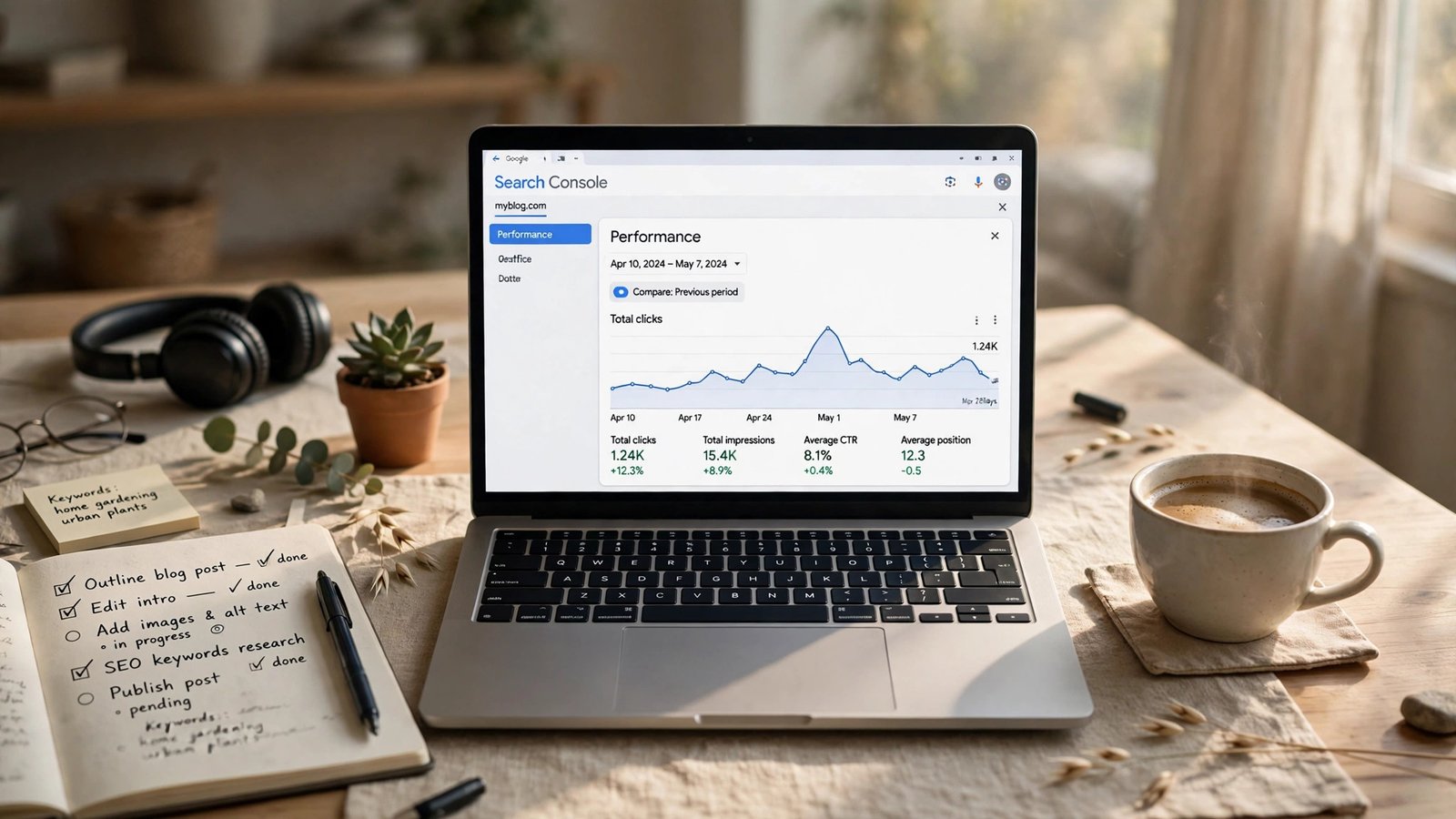
Step 1: Compare the right windows. In the Search Console Performance report, open the date filter, choose Compare, and compare November 25–December 1 against November 3–9 — two windows of the same length and the same weekdays. B2B traffic falls off a cliff on weekends, and that alone can fake a 15% swing. Add a year-over-year view if your site is old enough — it separates a seasonal dip from an algorithmic one.
Step 2: Check position first, clicks second. Open the Queries tab and sort by clicks difference. Then look at the same queries’ average position. The pattern tells you what happened:
| What you see | Most likely cause | What to check next |
|---|---|---|
| Position down, impressions down, clicks down | A ranking change — the core update or a competitor | Which queries lost position, and which pages now rank above you |
| Position steady, impressions steady, CTR down | Something above your result is taking the click, often an AI Overview | Search the query yourself and look at what sits above your result |
| Position steady, clicks down, impressions down | Fewer people searched, or the query changed | Seasonal demand, or a news cycle ending |
| Whole site drops on one day | A technical problem or a reporting glitch | Page indexing report, robots.txt, server errors |
This is the check that separates a ranking loss from a click loss, and it matters more than ever this year because AI Overviews and AI Mode have changed what “position 3” means. A page can hold its position and still lose clicks if an AI Overview above it answers the query. That is not a core-update loss, and rewriting the page will not fix it. What fixes it is being the page the Overview cites — which is a content-quality question, not a ranking emergency.
Step 3: Look at pages, not just the site total. The site chart averages everything, so one strong query can hide ten weak ones. Sort pages by clicks difference to see whether the loss is site-wide or concentrated. A concentrated loss on a handful of pages is a content problem you can work on. A site-wide loss is a site-wide question, and Google’s guidance for that case is to review the whole site against its helpful-content questions — not to rewrite one page and hope.
Step 4: Check which surface moved. In the Performance report, check whether the movement happened on web, images, or video search. A drop concentrated in image search is a different problem from a drop in web search, and it has a different fix.
Step 5: Confirm the page is still indexed. For any page that lost traffic, run URL Inspection. A page that dropped out of the index is not a core-update casualty — it is a technical fault, and it is fixable today.
A reliable diagnosis needs agreement among Search Console, your rank tracker, and your business metrics (sales, sign-ups, ad revenue). If only one says you dropped, believe the other two.
What to do if you dropped, gained, or nothing changed
If you dropped. First, check the size. For a small drop, Google says no drastic action is needed, and it calls deleting content a last resort. Do not delete pages, merge posts in a panic, or change content that already performs well. If the drop is large and sustained — a real fall in average position across your important queries, confirmed on December 1 — Google suggests reviewing the whole site and the most affected pages against its helpful-content questions: written for people or for search engines, showing first-hand experience, adding something no other page has? The recovery path is improving how useful the affected content is across the whole site. Recovery usually shows over months, or at the next core update. There is no quick fix.
If you gained. Do not touch those pages either. A gain after a core update is a signal that Google liked what you were already doing. The worst move after a gain is to “optimize” a winning page and break whatever made it win. Leave it alone, note what those pages have in common — length, structure, original detail, real examples — and apply the pattern to your weaker pages.
If nothing changed. That is a normal outcome and a good one. Most sites see little movement from any single core update. Your job is the same as it was on November 9: keep publishing useful content, keep the site fast and clean, and keep an eye on the next update.
In all three cases, the discipline is the same: measure first, change little, and change only what the data actually supports. The sites that recover fastest from core updates are the ones that waited for clean data, worked out which pages actually dropped and why, and only then changed things.
What not to do this week
A short list, because the mistakes this week are predictable and expensive:
- Do not rewrite pages based on November data. The rollout only finished today. The data is not clean yet, and the Black Friday numbers will make it dirtier.
- Do not delete content. Google calls deletion a last resort. A page that lost a few positions is not a page to kill.
- Do not trust a rank-tracker screenshot. This update’s tracker data was poisoned at rates far above normal, and one tracker went nearly blind for ten hours on November 18. Cross-check everything against Search Console.
- Do not copy a “winners and losers” list into your strategy. The early lists were built on volatile baselines and compromised tools. If a list cannot tell you its comparison windows and its data source, ignore it.
- Do not buy a recovery service that promises a fix before December. Nobody can diagnose an update that finished this morning. Anyone selling a recovery this week is selling urgency, not SEO.
- Do not judge the update by your Black Friday numbers. Seasonal traffic and algorithm impact are two different things, and they arrive in the same week this year.
The bottom line
The November 2026 core update is done: November 10 to November 24, the third core update of the year. The visible movement started late, around November 14, and the tools everyone uses to watch it were less reliable than usual — swapped tracker results, a ten-hour outage on November 18, and a Search Console logging glitch on November 9–11.
Your job now is gloriously boring: note the dates, export your November 3–9 baseline if you have not already, fix any technical faults, and wait. On December 1, run the Search Console check. Compare the week after completion against the week before it began. Then — and only then — decide whether anything needs to change. If it does, improve the content. If it does not, keep going. That is the whole plan, and it is the plan Google itself recommends.
Frequently Asked Questions
When did the Google November 2026 core update finish?
The rollout was marked complete on Google’s Search Status Dashboard on November 24, 2026, at 9:03 a.m. ET (6:03 a.m. PT). It began on November 10, 2026, at 10:06 a.m. PT, so the rollout lasted 13 days, 19 hours, and 57 minutes — inside Google’s estimate of up to two weeks.
How long should I wait before judging the update’s effect on my site?
Google recommends waiting at least one full week after the rollout completes before analyzing your site in Search Console — for this update, December 1, 2026, at the earliest. Then compare that week against the week before the rollout began (November 3–9), not against the rollout period itself.
Why were rank trackers unreliable during this update?
Since September 2026, Google has served rank trackers search pages with swapped results. A Nozzle study of 42.5 million SERPs found 27.6% of judged SERPs had page 1 or page 2 poisoned since September 13, against 0.28% before. On November 18, Nozzle’s Google deliveries also dropped to roughly a tenth of normal volume for about 10 hours. Search Console is the more reliable source — once a clean week of data exists.
My traffic dropped during the update. Should I rewrite my pages?
Not yet. First, confirm the drop in the December 1 Search Console comparison, and check whether your average position actually fell — if position held while clicks fell, an AI Overview or another result above you is likely taking the click, not a ranking loss. For a small drop, Google says no drastic action is needed. For a large, sustained drop, review the affected pages against Google’s helpful-content questions and improve their usefulness. Deleting content is a last resort.
Does the update affect Black Friday and Cyber Monday traffic?
The update itself is finished, so it will not change rankings during Black Friday week. But your Black Friday (November 27) and Cyber Monday (November 30) traffic numbers will arrive before Google’s recommended analysis window opens on December 1, so do not use them to judge the update. Holiday demand moves search volume so much that it swamps the ranking signal.
How many core updates has Google released in 2026?
Three: March, May, and November 2026. Search Engine Journal reports the November update is the eighth ranking update listed on Google’s Search Status Dashboard this year. Google has not said what the November update specifically targeted, describing it only as a regular update to surface more relevant, satisfying content.