
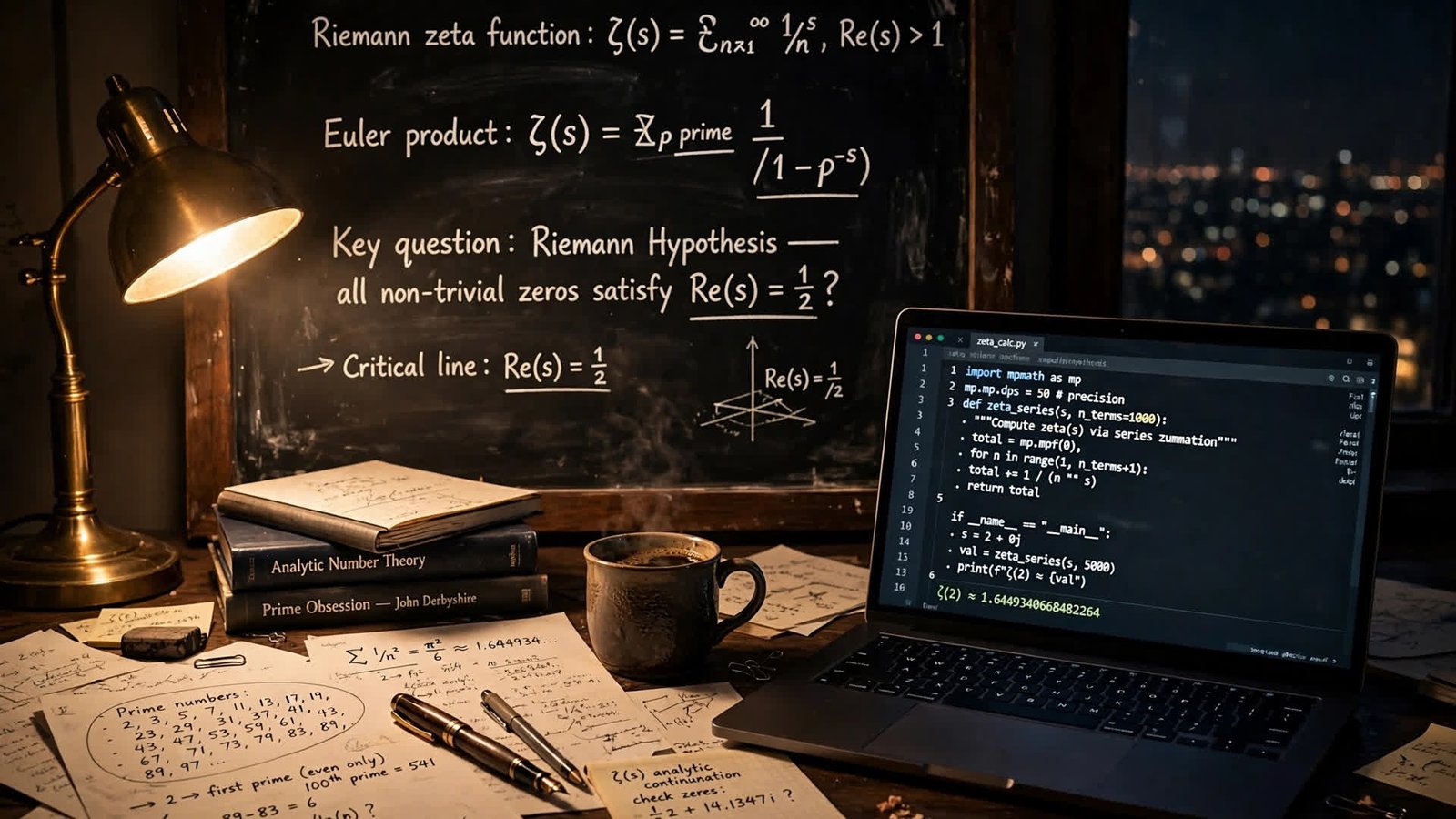
On Friday, November 20, 2026, the most famous unsolved problem in mathematics was claimed solved — twice, in one day. In the morning, Levent Alpöge, a mathematician at Anthropic, announced that he and the company’s AI, Claude, had found a proof of the Riemann hypothesis, released as 17.4 million lines of computer code that no human has fully read. Hours later, a second claim arrived from Stanford: a preprint by Alessandro Maria Masullo, written entirely by a human, with no AI involved at all.
Here is the honest state of play as of today, November 24: the AI-assisted claim has passed a series of demanding machine checks, and the Lean and Mathlib communities said on November 21 that they have “full confidence” the proof is correct. But neither claim is peer-reviewed, neither has been fully digested by mathematicians, and the Clay Mathematics Institute still lists the problem as unsolved.
What the Riemann hypothesis actually says
Bernhard Riemann proposed the hypothesis in 1859, in a paper about how prime numbers are distributed. Primes — 2, 3, 5, 7, 11, and so on — follow no regular pattern, but how many of them sit below any given number stays close to a smooth curve. There are 78,498 primes below one million, and the curve predicts 78,628. Riemann connected the small errors in that prediction to the points where a function called the Riemann zeta function equals zero.
His guess was that every interesting zero of that function lies on one straight vertical line — the “critical line,” where the real part equals exactly one half. If true, it would mean the primes are scattered among the whole numbers in a way that is essentially as random as it could possibly be. It is one of the seven Millennium Prize Problems chosen by the Clay Mathematics Institute, each carrying a $1 million prize for an accepted solution. It is also, by common consent among mathematicians, the most important open problem in the field.
The timing of the claim is poetic, and mathematicians noticed it: Riemann was born 200 years ago this September, in 1826. As Nature put it, confirmation of either solution “would be a spectacular bicentenary present.”
Claim one: Alpöge and Claude
The announcement came as a four-page note posted on Alpöge’s personal website on the morning of November 20. Its first sentence is the one every newsroom quoted: “I believe I have, working with Claude, discovered a proof of the Riemann Hypothesis.” The note goes further. Alpöge says the same method also proves the Generalized Riemann Hypothesis — a broader version covering a whole family of related functions — and that he expects to reach the even broader Extended Riemann Hypothesis with more time.
There is no normal paper. Alpöge did not publish a written argument that a human can read. He says he tried: the prose version ran to more than 250,000 pages, which he called “a huge, unreadable document,” and decided it was “obviously inappropriate to attempt to post some massive unreadable travesty of ‘slop’.” Instead, he released the proof only in Lean, a programming language that lets a computer check every step of a mathematical argument. The archive is split into 14 downloadable parts: 175,187 files, 17,374,215 lines of code, about 239 megabytes in total.
His account of who did what is unusually candid. He says he chose the direction — “I guided us to the right situation analogous to that toy setting, and then Claude began to leave me in awe” — and that near the end, “Claude far outpaced me.” A timeline he says Claude compiled runs from October 6 to November 16, 2026, about six weeks, ending with the single word “GRH.” He is open about not yet understanding all of it, writing that he is “presenting the world with a complete argument before having mastered a massive neighbourhood around its mathematics,” and plans to write it up properly later.
Two details are worth noting because they shape everything that follows. First, the note names no model version — Anthropic has not said which Claude was used, and the company made no statement about the claim when Nature asked. Second, Alpöge says he consulted Anthropic’s chief executive, Dario Amodei, before publishing. The announcement came the day after Anthropic’s stock market debut on November 19, and the company’s valuation had dropped that day.
What “checked in Lean” means — and what it does not
This is the part most coverage gets wrong, in both directions. A computer check is not a rubber stamp, and it is not a proof that mathematicians have accepted. It is a specific, powerful, and limited thing. Here is what has actually happened, step by step.
Lean is a proof assistant: a language in which a mathematician writes definitions, assumptions, and proof steps in a form a small, trusted checking program — the kernel — can verify line by line. The crucial point is that the statement being proved is not one Alpöge wrote himself. The top-level theorem in his archive proves RiemannHypothesis as defined in Mathlib, the community-maintained library of formalized mathematics, where that definition has sat since 2023. That matters, because it rules out the cheapest failure mode: defining the problem into something easier and then “proving” that.
The public record of the checking is a verification page maintained by Andrew Sutherland, a mathematician at MIT. By its update on November 21 at 12:55 UTC, it reported the following: all 175,187 modules compiled with zero errors using Lean 4.33.1; every module was replayed through Lean’s kernel, with 175,187 out of 175,187 accepted; the five headline theorems depend only on Lean’s three standard axioms — propext, Classical.choice, and Quot.sound — with no hidden assumptions smuggled in; and independent checkers written separately from Lean accepted the exported proof, including the Rust-based nanoda checker, con-leche, and lean4lean.
Then, on Saturday, November 21, the Lean FRO — which develops the Lean language — and the Mathlib Initiative published a joint statement. They said members of the two communities had spent the past day checking the 17-million-line library and certified both the statement and the proof as correct, under four criteria laid out in a November 12 post on the Xena Project blog. Their words were strong: they have “full confidence that Alpöge’s proof of the Riemann Hypothesis is correct.” Dozens of people recompiled the code and reproduced the same raw proof export, and two independent tools confirmed that the theorem the library proves is exactly Mathlib’s statement of the hypothesis. The checks ran on an inert export of the proof, walled off from any malicious code that might be hidden in the source files.
That is a remarkable amount of verification in 48 hours, and it is why serious mathematicians are taking the claim seriously. James Maynard, a Fields Medal winner at Oxford, told Nature: “If this fully checks out, it is clearly a historic milestone in mathematics.” He reportedly put his confidence that the proof will hold up at 98 to 99 percent. Daniel Litt, writing on November 23, said the Lean-formalized proof is very likely correct, though no human currently understands it — and that there is no fundamental barrier to understanding it.
But the checks have limits, and the people doing them say so plainly. Kevin Buzzard, whose guide to AI-written Lean was published on November 12, lists what has to happen before “it was checked in Lean” means very much: confirm the statement says what it claims, compile the code, and confirm no assumption was slipped in. The first two are now largely done. The third — the human understanding — is where the real work starts, and it will take years. As Terence Tao put it, the digestion process “will take some time.” Nobody has published an audit of the prompts, reasoning traces, or compute used, so outsiders cannot yet judge exactly how the human and machine contributions split. And the Clay Institute’s rules require publication in a qualifying outlet, a two-year wait, and general acceptance by the mathematical community before the $1 million is awarded. On Polymarket, bettors put the odds of Clay declaring the hypothesis solved this year at 2%, and 10% by the end of 2027 — down from 26% on the 2027 contract when the claim first broke.
So the fair summary is this: a machine-checked proof of the statement as mathematicians have formally defined it now exists, and the formal verification community has certified it. Whether the mathematics inside it is right in the sense mathematicians mean — understood, checked by human experts, and accepted — is still an open question. Both halves of that sentence are true at the same time, and any headline that drops one of them is misleading you.
Claim two: Masullo, entirely human
Hours after Alpöge’s announcement, Ravi Vakil, a mathematician at Stanford, posted a rival preprint online. It was written by Alessandro Maria Masullo, who received his PhD at Stanford in 2020 under the supervision of number theorist Brian Conrad. Vakil called it a “hurried announcement” and was frank about why it went out unfinished: “The hope was to have Brian work with Alessandro for a year to polish the writing and then announce it after running it by enough people. Now it seems best to put out the current draft.”
Masullo’s proof is, by Vakil’s account, “all human, with no AI.” That is the whole point of its timing. If the AI-assisted claim lands first, the human claim risks being read as a footnote — so it went out the same day, in draft form, rather than waiting a year. It has received far less attention than Alpöge’s, and it has not been through the same public verification process, because it is a conventional written preprint, not a machine-checkable archive.
The pairing is what makes November 20 such a strange day in the history of mathematics. Two proofs of the same problem, announced within hours, built by opposite methods, each one forcing the other out before it was ready. One is a 17-million-line program nobody fully understands. The other is a draft its own author wanted a year to polish. Neither is accepted. Both are now public, and both will be judged in the open.
The timing question, handled fairly
The sharpest criticism of Alpöge’s announcement is not about the mathematics. It is about the calendar. Anthropic went public on November 19, 2026. Its shares fell that day. The next morning, one of its mathematicians announced a proof of the most famous problem in mathematics, built with the company’s own product.
Andrew Granville, a number theorist at the University of Montreal, told Nature that Alpöge should have taken the time to prepare a clearer write-up before making the announcement, and that the four-page sketch he released is “garbled.” Granville cites the downturn in the company’s stock value as the reason for the timing. Alpöge anticipated the objection in the note itself: “There is an obvious cynical view, to do with the timing, but it is false.”
Both things can be held in mind at once. The timing is, on its face, extraordinary — a company the day after its IPO, announcing the biggest mathematical result of the century, with its own AI as co-author. It is also true that the verification happened in public, on a timetable nobody at Anthropic controlled, and that the Lean and Mathlib communities — not Anthropic — are the ones who certified the result. A cynical announcement would not survive an independent kernel replay. This one did.
Why this is the real story: the capability shift
Strip away the prize and the headlines, and the important story of November 20 is not whether the Riemann hypothesis is proved. It is that an AI system went from unreliable student to something that can do frontier mathematics in about a year — and that the route it took surprised the experts.
The context matters. In August 2026, Anthropic announced that an unreleased Claude model had raised the proven share of zeta zeros on the critical line from 41.6% to 67.2%, over two Claude Code sessions and about 31 million output tokens. Alpöge and Ralph Furman validated that result, and outside experts Brian Conrey and Dan Goldston reviewed it on short notice. In October, OpenAI researchers proved a weaker form called the quasi-Riemann hypothesis. Maynard says Claude’s proof appears to build on that work.
The community expected a Riemann proof, if one ever came from AI, to require heavy theory-building — the kind of new mathematics, like arithmetic geometry, that AI is bad at. Instead, as one observer put it, Alpöge’s proof took an entirely different path: like tunneling through 25,000 pages of existing literature, bypassing traditional theory construction. The machine did not invent a new field. It found a route through the old one that humans had missed, at a scale no human could have searched by hand.
That is the shift that matters for everyone outside mathematics, too. The same pattern — an AI that cannot yet do the creative leap, but can search a vast space of existing material far beyond human reach — is exactly what is happening in drug discovery, in materials science, in code, and in research of every kind. The Riemann claim is the most dramatic demonstration of it so far, because the problem is the most famous one there is. Alpöge also released results on the Euler and Navier-Stokes fluid equations with NYU’s Tristan Buckmaster, which suggests this was not a one-off trick but a method.
There is a useful video explainer that walks through the claim and the state of the checks as of November 21, for readers who want the visual version.
What it does not change
For all the drama, the honest answer to “what does this change for me?” is: almost nothing, right now. Mathematicians agree the proof has no immediate real-world application. It will not change banking, the internet, or your passwords. The Riemann hypothesis is about the deep structure of the primes, and its proof — if accepted — is a triumph of understanding, not a tool. The encryption that protects your bank account rests on the difficulty of factoring large numbers, not on whether the zeta zeros sit on a line, and a proof of the hypothesis does not make factoring easy.
And it does not settle the question of what a proof is. Is a 17-million-line program that no human has read a proof, if a computer has checked every step? The Lean community’s answer is yes, in the formal sense. A group calling itself the Association for Human Mathematics, which issued a statement of resistance, answers no in the human sense: it argues that AI companies prioritize technical validity over accountability, clarity, and comprehensibility. Daniel Litt’s middle position — very likely correct, not yet understood, understandable with effort — is probably where the field will land. But the argument itself is now a permanent part of mathematics, whatever happens to this particular claim.
How to follow the verification from here
If you want to watch this story properly, rather than through headlines, here is what to follow and what to ignore.
Watch the MIT verification page. Andrew Sutherland’s page is the public record of the checks, with dated updates.
Watch for the readable write-up. Alpöge has promised to write the argument up properly, and to master the mathematics around it. The moment a human-readable version exists, independent experts can start the real work: reading it, finding the ideas, and either confirming them or finding the flaw. Until then, the proof is verified but not understood, and that distinction matters.
Watch the Lean and Mathlib communities. Their joint statement is the strongest endorsement the claim has received, and they have said they now look to the wider mathematical community to help explain the new ideas in the proof. Their blog post lays out the checks in detail.
Watch Masullo’s preprint. The human proof deserves the same scrutiny, and its fate will tell you something about whether the old way of doing mathematics can still compete with the new one.
Ignore the price. The daily moves in Anthropic’s stock, and the betting odds, tell you about markets, not mathematics. Ignore any headline that says “proved” without the word “claims” — including one on a sister site of ours that says exactly that and is still awaiting a correction. The title rule on this story is simple: until the mathematical community accepts a proof, it is a claim.
Ignore the “AI versus human” framing. The most interesting question November 20 raised is not who won. It is what happens when the two methods work side by side: a human who chose the direction, a machine that did the searching, and a community that did the checking. That is not a contest. It is a new way of doing mathematics, and it arrived on the same day as the old way’s last stand.
The bottom line
Two claims to prove the Riemann hypothesis landed on November 20, 2026. One was built with Claude, released as 17.4 million lines of Lean code, and certified as correct by the Lean and Mathlib communities within two days. The other was written entirely by a human, posted in a hurry, and is waiting its turn for scrutiny. Neither is peer-reviewed. Neither is accepted. The Clay Institute still lists the problem as unsolved, and the million dollars is years away at best.
What is certain is that something changed on November 20. An AI system helped produce a proof of the most famous problem in mathematics, by a route the experts did not expect, at a scale no human could have searched. Whether the proof holds up is a question for the years of digestion ahead. That it exists at all — as code, as a claim, as a challenge to what a proof even is — is already the story.
Frequently Asked Questions
Has the Riemann hypothesis been proved?
Not in the sense mathematicians mean by “proved.” Levent Alpöge announced on November 20, 2026 that he and Claude had found a proof, and the Lean and Mathlib communities certified on November 21 that the machine-checked proof is correct. But the proof has not been peer-reviewed, no human fully understands it yet, and the Clay Mathematics Institute still lists the problem as unsolved. Until the mathematical community accepts it, it is a claim — a very strong one, but a claim.
What did Claude actually do?
According to Alpöge’s own account, he chose the direction of the work and Claude supplied the technical finish, working over about six weeks from October 6 to November 16, 2026. Near the end, he writes, “Claude far outpaced me.” The note does not name which Claude model was used, and Anthropic has not commented. No prompts, reasoning traces, or compute details have been published.
What is Lean, and why does the proof being in Lean matter?
Lean is a proof assistant: a programming language in which mathematical arguments are written so a small checking program, the kernel, can verify every step. The proof matters because it is machine-checkable: MIT’s Andrew Sutherland rebuilt all 175,187 modules with zero errors, the kernel replayed them all successfully, and independent checkers confirmed the result. The statement proved is Mathlib’s own definition of the Riemann hypothesis, not one Alpöge wrote himself.
Who is the second person who claimed a proof?
Alessandro Maria Masullo, who received his PhD at Stanford in 2020 under Brian Conrad. His preprint was posted the same day, November 20, by Ravi Vakil, who called it a “hurried announcement” of work meant to be polished for another year. It was written entirely by a human, with no AI involved.
Does proving the Riemann hypothesis affect internet security or banking?
No, not in any practical way. The hypothesis concerns the deep structure of prime numbers, and mathematicians agree the proof has no immediate real-world application. Internet encryption rests on the difficulty of factoring large numbers, which a proof of the hypothesis does not make easy. The value of the result is in understanding, not in tools.
When will we know for sure?
There is no fixed date. The next milestones are Alpöge’s promised readable write-up, independent expert audits of the mathematics, and the Clay Institute’s process, which requires publication in a qualifying outlet, a two-year wait, and general acceptance. The Lean and Mathlib communities have said they look to the wider mathematical community to help explain the new ideas in the proof. Expect years of digestion, not weeks.