
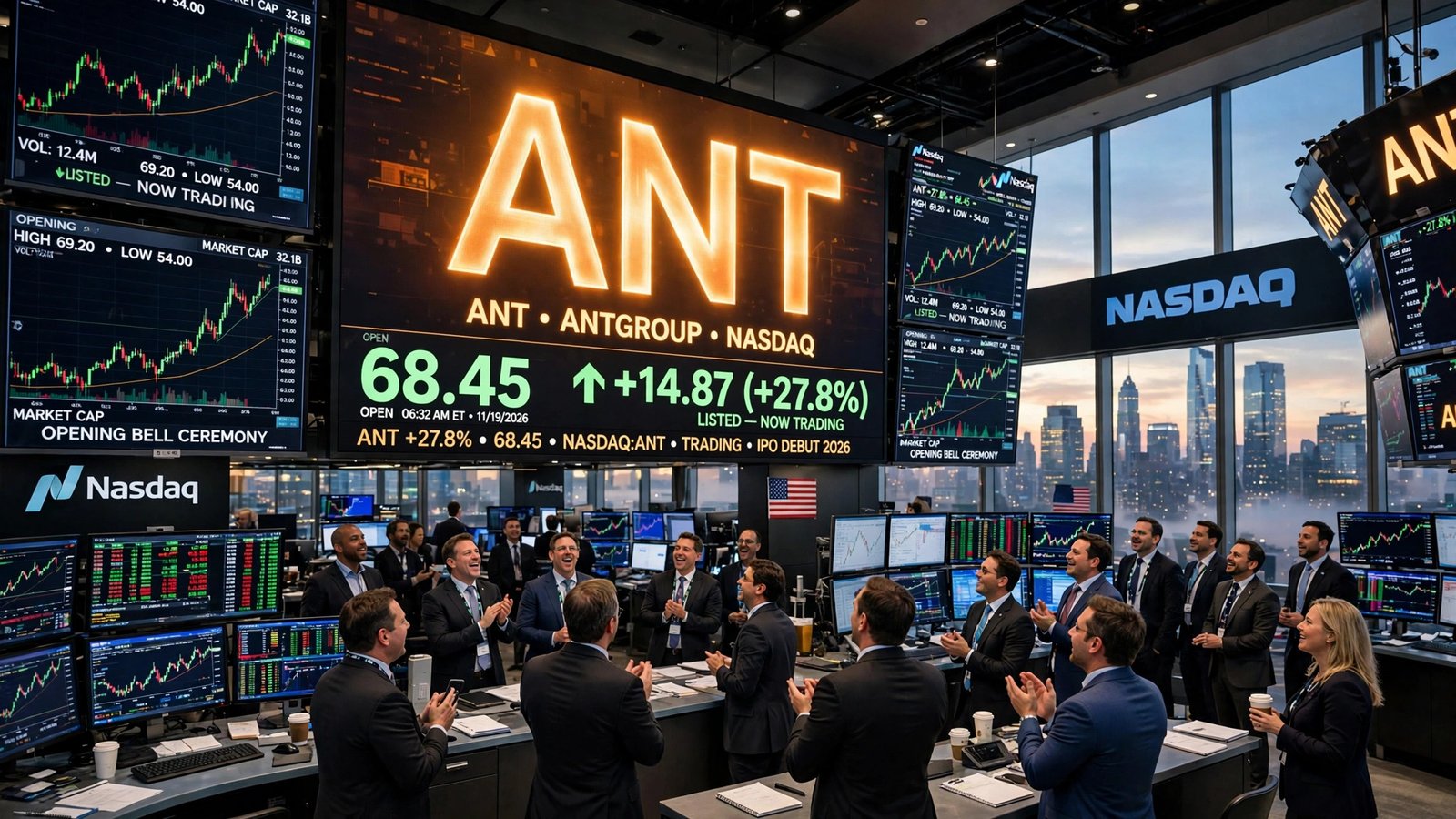
Anthropic priced its IPO at $83 a share on Wednesday, November 18 — $5 above the top of its marketed $70–$78 range — and the stock starts trading today, Thursday, November 19, on the Nasdaq under the ticker ANT. At $83, the deal values the company behind the Claude chatbot at roughly $1.5 trillion on a fully diluted basis, making it the largest IPO in stock market history.
This is the debut-day piece, not another explainer of the filing. If you want the roadshow background, our earlier coverage walks through the price range and the November 19 trading date and the order book that closed on November 17. What follows is what actually happened at pricing, what the $83 print means, how everyday investors can still get in, and what could go wrong on day one.
One honest note before the numbers: at the time of writing, the market has not opened yet. The $83 figure is the IPO price — the price institutions and allocated retail buyers pay. The opening price, the price you will pay if you buy ANT on the open market today, is set by trading and is not known yet. Nothing in this article pretends otherwise.
What the $83 print actually means
The headline numbers are bigger than the ones in the original filing, because Anthropic enlarged the deal at pricing:
- Price: $83 per Class A share, 6.4% above the $78 top of the range and 12.2% above the $74 midpoint.
- Shares sold: 980 million Class A shares — 956.35 million new shares sold by Anthropic and 23.65 million sold by existing stockholders, from whom the company receives no proceeds. The original filing covered 825 million shares.
- Gross public raise: about $81.3 billion, which makes this the largest IPO ever, passing SpaceX’s June 2026 debut.
- Total capital raised: roughly $107.3 billion once you add the $26 billion concurrent private placement (more on that below).
- Valuation: about $1.5 trillion fully diluted, including employee stock options and restricted shares. A narrower share count puts the figure closer to $1.08 trillion; the $1.5 trillion number is the one the market is using, and it is the one Anthropic’s bankers were targeting after dialing the valuation down from $2 trillion earlier in the year.
- Underwriters: Goldman Sachs and Morgan Stanley lead the deal. The offering is expected to close on November 20, subject to customary conditions.
Demand is the reason the price went above the range. Institutional investors placed roughly $400 billion in orders and retail investors about $100 billion, according to CNBC — leaving the offering roughly eight times oversubscribed at the top of the initial range. Our earlier piece reported the order book at seven times oversubscribed when it closed on November 17; the final tally ran a little hotter.
That demand arrived in a week when AI stocks were swinging hard and investors were openly questioning whether heavy AI spending will ever pay off. The pricing suggests the answer, at least for Anthropic, is that the biggest buyers are not waiting for the question to be settled.
Who bought in before the bell
The most unusual part of this IPO is not the size — it is who is buying alongside the public. Seven technology companies agreed to buy $26 billion of non-voting shares at the IPO price in a separate private placement:
| Buyer | Private placement |
|---|---|
| $10 billion | |
| NVIDIA | $10 billion |
| AMD | $2.5 billion |
| Broadcom | $1 billion |
| Micron | $1 billion |
| Microsoft | $1 billion |
| TSMC | $500 million |
Read that list as a map of Anthropic’s supply chain and customer base, not as a fan club. Google and NVIDIA are the two names that matter most: Google is Anthropic’s largest cloud partner and a major shareholder, and NVIDIA supplies the chips that Anthropic’s models run on. Every company on the list either sells Anthropic something it cannot live without or buys something Anthropic sells.
The existing stakes are just as concentrated. According to Anthropic’s latest SEC filing, Amazon holds around 15% of the company’s outstanding shares and Google around 14%. That means two of the largest companies in the world already own nearly a third of Anthropic between them — and both are now buying more at the IPO price.
For a small business owner watching this from the sidelines, the practical takeaway is simple: Anthropic is no longer a startup that might get acquired. It is a public company whose biggest customers and suppliers are also its biggest shareholders. That changes how it negotiates, how it prices Claude, and how much room it has to cut prices for small users. It does not change what Claude costs you today — but it is worth remembering the next time an Anthropic price change lands in your inbox.
The numbers behind the $1.5 trillion valuation
A $1.5 trillion valuation for a company founded in 2021 is either the bargain of the decade or a bet on a future that has not arrived yet. The revenue numbers are genuinely extraordinary; the cost numbers are genuinely frightening. Here is both sides, from Anthropic’s own amended SEC registration statement:
| Period | Revenue | What changed |
|---|---|---|
| Full year 2023 | $41 million | The starting point |
| Full year 2024 | $386 million | Roughly 9x growth |
| Full year 2025 | $4.59 billion | More than 10x growth |
| First nine months of 2026 | $33.24 billion | vs $2.55 billion a year earlier |
| Q3 2026 alone | $16.96 billion | The run rate reached $68 billion by end of Q3 |
Revenue is up about 1,200% through the first three quarters of the year, and the company has grown faster in its first five years than any company in history, by the Motley Fool’s count. At a $68 billion run rate and a $1.5 trillion valuation, the stock trades at roughly 22 times sales — rich by any normal standard, but not absurd for a company growing this fast.
Now the other side of the ledger:
- Net loss, first nine months of 2026: about $104 billion. That number looks catastrophic until you read the footnote: it is driven mostly by non-cash fair-value adjustments to convertible notes, derivative liabilities, and other financing instruments — accounting entries tied to the company’s pre-IPO financing, not cash going out the door.
- Operating loss, first nine months of 2026: $1.26 billion, improved from a $5.22 billion operating loss in the same period of 2025. This is the number that actually describes the business, and it is moving in the right direction fast.
- Compute and infrastructure commitments: about $900.9 billion in aggregate purchase commitments and lease arrangements, including commitments entered into after September 30. Compute and infrastructure expenses reached $18.81 billion in the first nine months of 2026 — roughly 57% of revenue.
- Analyst projections: Reuters reported that some investment bank projections put Anthropic’s revenue at $52–$53 billion in 2026, rising to $135–$137 billion in 2027 and approximately $270–$280 billion in 2028.
The honest way to read this is that Anthropic is a company with a real, fast-growing business and a cost base that only makes sense if the growth keeps compounding. The $900 billion in compute commitments is the bet: Anthropic has promised to buy the computing power to train the next generations of Claude, and it is counting on revenue growing fast enough to pay for it. If the growth stalls, those commitments become a weight. If it does not, today’s valuation will look cheap in hindsight. Nobody writing on the morning of the debut knows which one it will be — and anyone who tells you they do is selling something.
How everyday investors can still buy in
Anthropic made an unusually large effort to include retail investors, and that effort is one of the more interesting parts of this deal. Here is how it works, and where the deadlines already passed.
The retail slice. Anthropic’s SEC filing states that up to 20% of the shares offered could go to retail investors, both in the US and internationally — as many as 165 million shares, worth roughly $13.7 billion at the $83 price. That is a ceiling, not a promise: the final amount depends on actual demand, and with the book roughly eight times oversubscribed, most individual requests were cut back hard or filled with nothing.
The brokers. The prospectus names six US platforms that offered IPO shares: Charles Schwab, E*TRADE, Fidelity, Robinhood, SoFi, and TradePMR. Each set its own rules:
- Fidelity required at least $25,000 in qualifying assets or Premium/Private Client/Active Trader status, and its request window closed on November 17 at 4 p.m. ET. Its anti-flipping rule tracks sales for 15 calendar days: a first flip earns a six-month ban from future IPOs, a second a one-year ban, a third a permanent ban.
- Charles Schwab required a $50,000+ eligible account balance and suitability approval, with allocations decided offering by offering.
- Robinhood used either random allocation (equal odds regardless of how many shares you requested) or proportional allocation. Selling allocated shares within 30 days counts as flipping and can block IPO Access participation for 60 days.
- SoFi, E*TRADE, and TradePMR also participated, each with its own eligibility terms.
The two prices you need to keep straight. The IPO price ($83) is what allocated buyers pay. The opening price is whatever the market sets when trading begins — and it is almost never $83. Renaissance Capital’s Matthew Kennedy expected shares to climb toward $100 on the first day, and said a surge toward $140 would signal that “AI enthusiasm has come roaring back.” On prediction platform Polymarket, nearly $10 million was wagered on the debut, with traders assigning 43% odds to a first-day closing valuation between $1.25 trillion and $1.5 trillion. If you buy on the open market, use a limit order: it caps the price you pay. A market order in a fast opening auction does not.
The international angle. The retail offer also ran in the UK, Canada, Australia, Japan, Switzerland, and nine European Economic Area countries — but not in India or Singapore, where investors can only buy once the stock trades. In the UK, the offer ran through RetailBook with a £250 minimum, buyers received CDIs (CREST depository interests) rather than the shares themselves, and the offer closed on November 18. If someone offers you “pre-IPO units” of Anthropic from a country that was not in the offer, slow down: the SEC’s investor-education office warns that pre-IPO scams follow exactly this script.
The index effect. Anthropic’s size means its massive capitalization could trigger rapid inclusion in the Nasdaq 100 within weeks, which would force passive funds like Invesco’s $457 billion QQQ ETF to buy the stock. Entry into the S&P 500 will require at least 12 months of public trading. Senator Elizabeth Warren raised a separate concern this month, warning that Anthropic’s stock could reach ordinary retirement funds through index inclusion before the company has a public track record. That is worth knowing if your 401(k) holds a Nasdaq 100 fund: you may own ANT within weeks whether you choose to or not.
What the SpaceX debut says about first-day pops
Every IPO debut invites the same question — buy on day one, or wait? The most recent comparison is fresh, because SpaceX set the previous record only five months ago. Here is what actually happened:
| SpaceX, June 2026 | Anthropic, November 2026 | |
|---|---|---|
| IPO price | $135 | $83 |
| Opening price | $150 | Not yet known |
| First-day high | $225.64 | Not yet known |
| Valuation at debut | $1.77 trillion | ~$1.5 trillion |
| Retail buying, day one | ~$118 million (Vanda estimate) | ~$250 million (Vanda estimate) |
| Where the stock sat by mid-November | Back near $143 | — |
SpaceX’s story is the cautionary tale and the encouragement at the same time. The first-day pop was real — a 67% surge from the IPO price to the intraday high — and then most of it faded within five months, with the stock back near $143 by mid-November, barely above where it started. The people who bought at the open and held made almost nothing; the people who bought at the IPO price and held did fine; the people who chased the peak lost money.
Vanda Research estimates Anthropic could attract about $250 million in net retail buying on its first trading day — more than double the $118 million it estimates retail investors poured into SpaceX’s debut. That is a lot of enthusiasm, and enthusiasm is exactly what makes opening prices unpredictable.
The honest framework, borrowed from the SEC’s own investor guidance, is this: buying in the public market “in the days following the IPO” is the more common path for individual investors, and it is the one that avoids paying the opening-auction premium. If you believe in Anthropic’s business, the question is not whether to own it today — it is what price you are willing to pay for a company valued at 22 times a $68 billion revenue run rate, with $900 billion in compute commitments on the books.
What it means for Claude users: nothing yet
If you use Claude for your business — drafting emails, summarizing documents, building spreadsheets, writing code — the IPO changes nothing about your subscription today. Prices, plans, and the product roadmap are unaffected by the listing, and Anthropic has given no indication of changes tied to the debut.
What the IPO does change is the scrutiny. A public Anthropic files quarterly earnings, holds earnings calls, and answers to shareholders who will ask, every three months, when the $900 billion in compute commitments turns into profit. That pressure tends to push companies toward monetization — more paid tiers, more enterprise features, fewer free allowances. It also pushes them toward transparency, which is not a bad thing for a company whose product millions of small businesses now depend on.
One specific thing to watch: Anthropic’s usage policies and pricing for its API. The company repriced its Claude models several times during 2026, and a public company under earnings pressure has one more reason to keep doing so. If Claude is part of your workflow, the practical move is the boring one — keep an eye on the pricing page, and keep a second model in your toolkit so a price change never leaves you stranded.
The risks nobody should skip
A debut this large invites hype, and hype invites people to skip the risk section. Here are the ones that matter, stated plainly:
The valuation assumes the growth continues. Revenue projections of $135 billion in 2027 and $270 billion in 2028 come from investment banks, not from Anthropic, and they assume the AI boom keeps compounding at a pace no industry has ever sustained. If enterprise AI spending slows, Anthropic’s revenue growth slows with it — and a stock priced at 22 times sales has a long way to fall.
The compute bill is already committed. The $900.9 billion in purchase commitments and leases does not go away if demand cools. Anthropic has promised to pay for computing power years into the future. That is a rational bet if you believe your models will keep selling; it is an anchor if they do not.
The week had its own turbulence. The pricing landed the same week Nvidia — the chip giant at the center of the AI boom, an Anthropic investor, and a $10 billion private-placement buyer — was shaken by the resignation of chief executive Jensen Huang after he admitted to an affair with a woman US intelligence reportedly believes could be a Chinese spy. The market brushed it aside for Anthropic’s pricing, but it is a reminder that the AI trade’s biggest names are one headline away from a very bad week.
The opening price is not the IPO price. First-day pops feel like free money to the people who got allocations. For everyone buying on the open market, the pop is the price you pay. SpaceX’s five-month round trip is the recent evidence for what happens next.
This article is not investment advice. It is a news explainer written on the morning of a stock market debut, from public filings and reporting. If you are deciding whether to buy ANT, that decision deserves your own research, your own risk tolerance, and — for a position of any size — a conversation with a licensed financial adviser.
Frequently Asked Questions
What time does Anthropic stock start trading today?
Trading in ANT begins on the Nasdaq on Thursday, November 19, 2026. New listings do not open at the 9:30 a.m. ET bell like established stocks — the exchange runs an opening auction to find the first price, which can take minutes or longer when demand is heavy. The offering is expected to close on November 20.
What is the Anthropic IPO price?
$83 per share. That is $5 above the top of the marketed $70–$78 range. It is the price paid by institutions and by retail investors who received an allocation through a participating broker. It is not the price you will pay if you buy ANT on the open market — that price is set by trading.
How much did Anthropic raise in its IPO?
About $81.3 billion from the public offering of 980 million Class A shares, plus $26 billion from a concurrent private placement to seven technology companies (Google, NVIDIA, AMD, Broadcom, Micron, Microsoft, and TSMC), for roughly $107.3 billion in total. It is the largest IPO in stock market history.
What is Anthropic’s valuation after the IPO?
Roughly $1.5 trillion on a fully diluted basis, including employee stock options and restricted shares. On a narrower share count the figure is closer to $1.08 trillion. Either way, it is one of the largest public-company debuts ever, slightly below SpaceX’s $1.77 trillion June debut valuation.
Can I still buy Anthropic stock at the $83 IPO price?
No — not unless you already received an allocation through one of the six participating brokers (Charles Schwab, E*TRADE, Fidelity, Robinhood, SoFi, or TradePMR). The retail request windows closed before pricing. Once trading begins, anyone with a brokerage account that trades Nasdaq stocks can buy ANT at the market price. Using a limit order caps what you pay; a market order does not.
Is Anthropic profitable?
Not yet on a net basis. Anthropic reported revenue of $33.24 billion for the first nine months of 2026 against an operating loss of $1.26 billion — much improved from a $5.22 billion operating loss a year earlier — and a reported net loss of about $104 billion driven mostly by non-cash fair-value adjustments to convertible notes and derivative liabilities. The business is growing fast and losing less money as it grows, but it is not profitable today.
This article is for informational purposes only and is not investment advice. Figures are drawn from Anthropic’s SEC filings and reporting by Bloomberg, Reuters, CNBC, and the Financial Express as of the morning of November 19, 2026; the opening price of ANT was not yet known at the time of writing.