
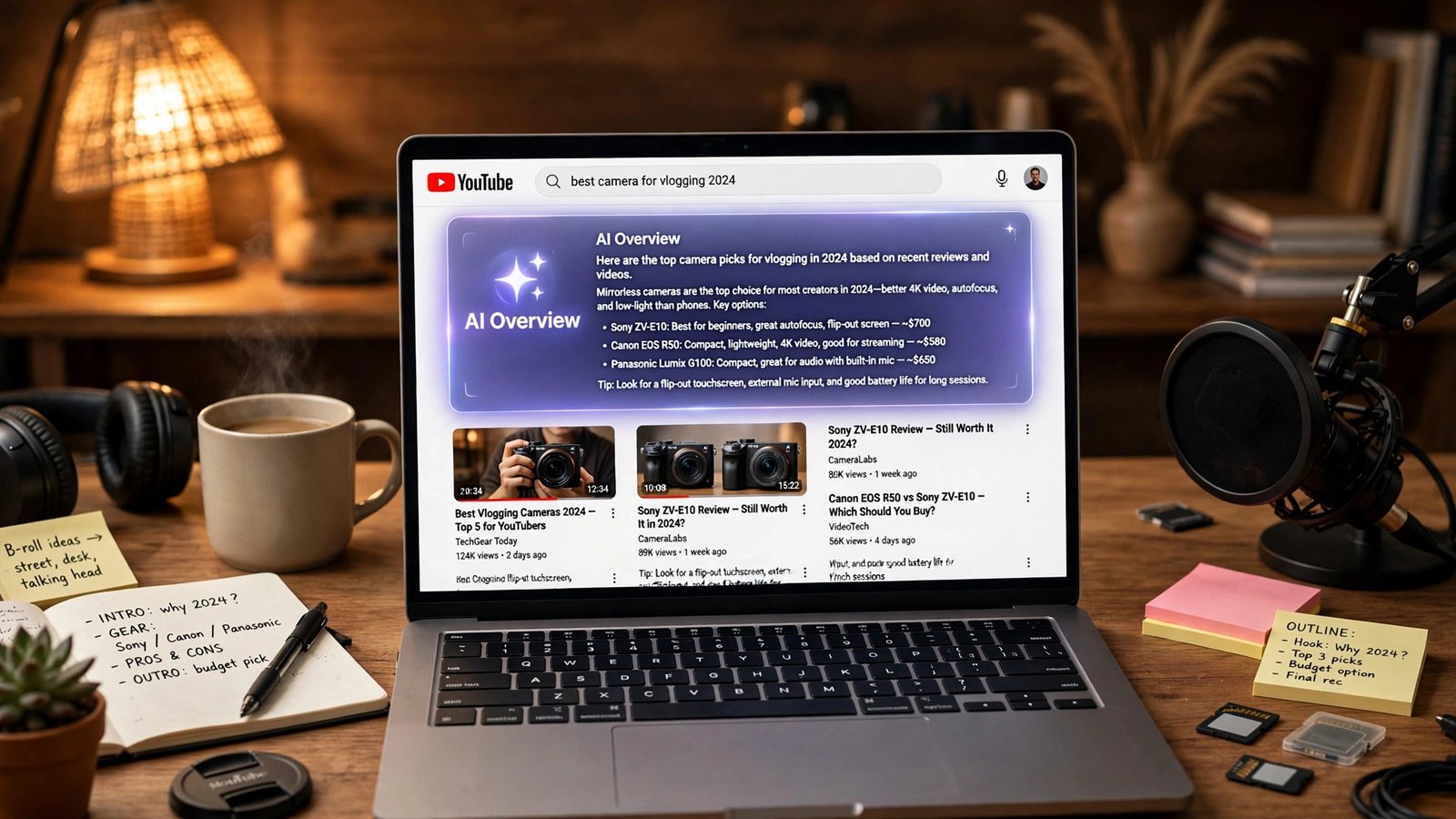
YouTube is testing AI-written answers at the top of its search results. Here’s the short version: a small group of signed-in desktop users in the US, searching in English, can now see a Gemini-powered answer — a short written overview built from clips pulled out of real videos — sitting above the usual list of results. The videos underneath are still there, the clips inside the answer still count as views, and nobody has published any measured impact on creator traffic yet, because the test is small and new.
The test was added to YouTube’s official test-features list on October 15, 2026, and first reported by Social Media Today on October 18, 2026. What it becomes depends on what YouTube learns — and on whether creators whose work powers those answers can still get found, clicked, and paid. This article covers how the test works, what YouTube has and hasn’t said, why Google AI Overviews has creators worried, what the Reddit earnings call does and doesn’t prove, and the playbook for making your videos the ones the answer cites.
How the Test Works
The feature at the center of this is Ask YouTube, a Gemini-powered assistant. It rolled out to all US users on October 13, 2026, across web, Android, iOS, and TV, after starting as a Premium-only test that opened April 7, 2026 for Premium subscribers 18 and over on desktop who opted in at youtube.com/new. What changed in October is where it shows up: now it can appear directly inside search results, unprompted, answering the query before you ever click a video.
The four gates: who actually sees an answer
Not everyone sees these answers. YouTube is showing them only to select signed-in desktop users in the US searching in English — four conditions stacked together, and missing any one means no answer appears. On mobile or TV, signed out, searching in another language, or outside the US, you don’t see it.
For creators, that narrow scope is good news: most of your audience still sees the search page the way they always have. Search on YouTube isn’t finished; it’s being experimented on in one corner, with one audience.
What the answer looks like
When YouTube decides an answer is warranted, the result is a short written overview paired with key moments and clips pulled from relevant videos. The clips show the video title and channel name, so the source stays visible. A viewer can expand the answer — “Show more” — to ask follow-up questions, or scroll past it to the standard video results, which stay on the page below.
The answer does not replace the results — it sits on top of them. And if a viewer clicks a clip inside the answer, that play still counts toward your video’s total views, as reported by Search Engine Land and Android Authority — one of the most important details in this whole story.
When does YouTube show an answer?
YouTube shows an answer when it judges that “a structured overview can add extra context beyond a standard list of videos.” In practice, that means open-ended, how-to, and skill-based queries — the kind with no single correct answer, where a short synthesis helps someone grasp a topic before picking a video. Think “how to start a vegetable garden” or “best way to learn the guitar.” A query with one factual answer, like a release date, doesn’t need an overview. A query about a skill, a process, or a comparison might.
Two more boundaries: playlists and Premium-exclusive content are not currently eligible for answers. On advertising, YouTube’s Help page says Ask YouTube conversations are not used to show viewers ads, and no YouTube page mentions ads inside the answers.
What YouTube Has Said — and What It Hasn’t
What YouTube has said: the test exists, it is limited to the audience above, answers appear where a structured overview adds context, answers combine a written overview with clips from relevant videos, viewers can expand or scroll past, playlists and Premium-exclusive content are excluded, and Ask YouTube conversations are not used for ads.
What YouTube has not said: how videos are chosen for an answer. There is no published list of ranking signals — no word on whether watch time, relevance, freshness, channel authority, or something else drives selection. YouTube has also not said whether the same video can appear in both the answer and the standard list below it. The answer to both right now is that we don’t know — and anyone telling you otherwise is guessing.
There is also no measured traffic impact on YouTube from this test yet. The test is small, limited, and weeks old; nobody has published data showing views going up or down because of it, and any creator claiming their channel was hurt — or helped — is working from anecdote, not evidence. Say it plainly: the impact is unmeasured. The right posture is watchful, not panicked.
Why Creators Are Nervous: The Google AI Overviews Precedent
If the reaction from creators feels outsized for a small test, there is a reason: Google AI Overviews. Creators watched what happened when Google put AI-written summaries at the top of search results, and the numbers were ugly for publishers. The fear is that YouTube is about to do the same thing to video.
The data behind that fear is real. Ahrefs compared 300,000 keywords and found that the top result on a page with an AI Overview got 58% fewer clicks by December 2025 — up from 34.5% in its earlier study. Pew Research Center’s real-browsing study from March 2025 found that users clicked a traditional search result in 8% of visits when an AI summary was shown, versus 15% when there was none, and clicked a link inside the summary in just 1% of visits. When an AI summary answers the question on the page, most people simply don’t click through to anything.
That is a genuine cautionary tale. But YouTube is not Google Search, and the mechanics here are different in ways that could change the outcome.
First, video plays inside the Ask YouTube snippet still count toward the original video’s total views. On Google, a click that never happens is traffic lost. On YouTube, a viewer who watches your clip inside the answer is still a view on your video — your view count, watch time signals, and standing in the algorithm still get the credit. The answer is another surface where your content can be watched, not a dead end.
Second, the answer is built from video clips, not scraped text. An AI Overview on Google synthesizes text from web pages into a paragraph that can fully satisfy a query without anyone visiting a source. The YouTube answer is closer to a highlight reel: a short overview plus moments from actual videos, with titles and channel names attached. A two-minute clip is a sample, not a substitute — and if the viewer wants the full method, your video is right there on the same page, in the results below.
Third, video is a format people choose for depth and personality, not just answers. A written summary can replace a written article for a simple factual question. It is much harder for a text overview to replace a 12-minute video where someone shows you, step by step, how to do something with their hands.
None of this means creators should relax. If YouTube’s answers get good enough to satisfy common how-to queries on the page, some viewers will watch the clip and move on without opening the full video — a real risk for channels built on short, single-answer tutorials. But the risk is not the same as the Google case, and the view-counting rule gives creators a fighting chance the web never got. The question is how much of your value lives in the clip versus the full video.
The Reddit Warning — and What It Does and Doesn’t Prove
The most quoted warning of the season came from Reddit’s earnings call, not from a creator. On October 29, 2026, during Reddit’s Q3 2026 earnings call, CEO Steve Huffman said Reddit lost more than one million Google search referrals per week on average in October, and he blamed Google’s AI Overviews and AI Mode. His exact words: “AI Mode does not drive traffic. Not for us, and not to anybody as far as I know.” That is a blunt statement from the head of a major platform, and it landed hard.
The surrounding numbers add context. Reddit’s Q3 revenue still grew 53% year over year to $895 million, so the company is not in financial distress. But US daily users fell 2% to 50.7 million, and shares fell 18% in after-hours trading after the call. Reddit is also testing a primarily logged-in experience in select non-US markets in Q4 2026 — an attempt to build a direct relationship with users rather than depending on shrinking search referrals.
Frame this carefully: the Reddit story is Reddit’s own assessment, not an independently measured figure. The “more than one million per week” number comes from Huffman’s statement on the call, as reported by Reuters — not a third-party audit. And the relationship is complicated: Reddit is also a paid data supplier to Google, licensing its content for AI training. So Reddit is simultaneously a Google partner and a Google critic, losing search traffic to the same company’s AI features while being paid by that company for data. That doesn’t make Huffman’s claim wrong — the direction of travel matches the Ahrefs and Pew data — but treat the figure as one company’s account of its own experience, not a universal law.
What does it prove for YouTube? Less than the headlines imply, and more than nothing. It proves AI answers on Google are already reshaping referral traffic for at least one large platform, and that a CEO is willing to say so on the record. It does not prove YouTube’s test will do the same to video creators: YouTube’s answers are built differently, count views differently, and sit on a platform where video is harder to summarize away. Reddit’s lesson is a warning about dependence on a search box you don’t control. The response is not to panic — it is to make your videos harder to summarize and easier to cite.
The Creator Playbook: Be the Cited Source
Here is the practical heart of this article. If AI answers are going to quote from videos, your job is to make your videos quotable — and to make the clip a doorway into your full video, not a replacement for it. None of this requires new equipment or a new niche, just structuring what you already make so that both a human viewer and an AI system can find the answer inside it fast.
Answer the query in the first 30 seconds
Open with the answer, then earn the watch. If your video is titled “How to Price Your First Digital Product,” say the pricing framework in the first half-minute — plainly, in your own voice — then spend the rest of the video showing how it works, with examples and edge cases. A viewer who found you through search gets an immediate payoff and a reason to stay, and an AI system scanning for a citable moment finds a clean, self-contained answer early, with your voice and framing attached.
This is the single highest-leverage change most how-to creators can make. Too many tutorials bury the answer under a long intro, a channel plug, and a story before getting to the point. That structure was already costing you viewers; now it could cost you the citation too. Lead with the value. The personality and depth come right after — they are what turn a cited clip into a subscriber.
Use chapters that match real search queries
Chapters are one of the most underused tools in a creator’s kit, and they matter more now than ever. Break your video into clearly labeled chapters whose titles match the way people actually search: “What to charge,” “Where to sell it,” “Mistakes to avoid.” Each chapter becomes a discrete, findable moment — exactly the kind of unit an AI answer pulls out as a clip. If your video is one unbroken 15-minute block, the system has to guess where the good parts are. Chapter it, and you have done the work for it — and made life easier for every viewer who wants to jump to the part they need.
Say the answer out loud, clearly, in plain language
AI systems that work with video rely heavily on transcripts and spoken language. If your key point only appears as text on screen, or is implied by a visual demonstration, it may never make it into an answer. Say it, using the words people type into search: if the question is “how long does it take to get monetized on YouTube,” say those words in your video, then give the answer. This isn’t keyword stuffing — it is speaking the same language as your audience, which is also the language of search.
Titles and descriptions that tell the truth
Accurate titles and strong descriptions have always mattered for search, and they matter more when an AI system is deciding which videos to pull from. A title that promises one thing and delivers another might win a click today, but it will not win a citation — and it erodes the trust that keeps viewers coming back. Write titles that describe the actual answer your video gives, and use the description to summarize the key points in a few clear lines, including the specific questions it answers. Think of the description as the paragraph a system — or a person — reads to decide whether your video is the right source. Make that decision easy.
Before you plan around them, know the numbers — our breakdown of creator earnings across YouTube, TikTok, and Instagram lays out the RPM data for 2026. And if you are weighing where else your content can earn, the guide to every platform that pays creators covers minimums, payout speed, and fees in one place.
Which videos are most exposed — and which are safest
Not every format faces the same risk. The most exposed videos answer a single, simple question in a few minutes: the quick how-to, the straightforward explainer, the short product review with a clear verdict. If your whole video is “the answer is X,” an AI overview can carry that answer in a sentence, and the clip might be all the viewer needs. If that describes much of your catalog, add depth a summary cannot carry — the demonstration, the comparison, the worked example, the thing you show rather than tell.
The safest videos are built on personality, entertainment, and community. A vlog, a storytime, a commentary video, a challenge, a series your audience follows week to week — none of these can be summarized into a paragraph that replaces watching them. Nobody reads an AI overview of a creator they love instead of watching the video.
Most channels sit somewhere in between. The move is not to abandon how-to content — it is to make it deeper than a summary: lead with the answer, prove it with a demonstration, and give viewers a reason to stay for the part no overview can deliver.
The Rest of the October Window
The AI answers test was not the only YouTube news in the same window. Paid “hype” — the feature that lets fans pay to boost a video — was extended to nine more markets effective November 6, 2026, bringing the total to 13 countries. It is available to creators with between 500 and 500,000 subscribers, which puts it in the hands of small and mid-sized channels. It works in the opposite direction from AI answers: instead of an algorithm summarizing your work, your own audience pushes it further. If you are in an eligible market and inside that subscriber band, it is worth testing.
Separately, AV2 web streaming is planned, with no date firmer than “as soon as early 2027,” according to a statement published October 22 — a technical upgrade to how video is delivered, not how it is discovered. For a month-by-month rundown of these changes, TubeBuddy’s October 2026 creator news roundup and Kurums’ November 2026 creator updates are useful references. For a wider view of how YouTube’s search features are shifting, see our earlier piece on Gemini search and Ask AI in YouTube search results.
What to Watch Next
Watch for three specific developments rather than reacting to every rumor.
First, whether the test widens. The current limits — desktop, signed in, US, English — are the kind of constraints that get loosened one at a time if the test performs well. Mobile would be the big one: most YouTube viewing happens on phones, and if answers come to mobile search, the share of viewers who see them jumps dramatically. Watch for announcements about expanded eligibility the way you would watch a monetization change.
Second, whether YouTube publishes selection and attribution details. Right now, creators are flying blind on how videos get chosen; if YouTube explains the signals, the playbook shifts from general best practice to targeted optimization.
Third, whether any traffic data emerges. The impact is unmeasured today, and it will not stay unmeasured forever — creators sharing their own analytics, YouTube publishing its own findings, or independent studies of click behavior on YouTube search will eventually fill in the picture. When that data arrives, take it seriously, and check it against your own numbers before changing strategy on the basis of someone else’s.
Until then, keep making videos that answer real questions well, structure them so the answer is easy to find and cite, and build an audience that comes back for you rather than for a single answer. AI answers can summarize information. They cannot replace a creator people trust.
Frequently Asked Questions
What is the YouTube AI answers test?
It is a test, added to YouTube’s official test-features list on October 15, 2026, in which a Gemini-powered answer can appear at the top of search results. The answer combines a short written overview with key moments and clips pulled from relevant videos, and it appears when YouTube judges a structured overview can add extra context — mainly for open-ended, how-to, and skill-based queries.
Who sees the AI answers in YouTube search?
Only select signed-in desktop users in the US searching in English. People on mobile or TV, signed out, searching in another language, or outside the US do not see the answers — most viewers still see the standard list of video results.
Do views from inside an AI answer count for the original video?
Yes. Video plays inside the Ask YouTube snippet still count toward the original video’s total views, according to reports from Search Engine Land and Android Authority — a key difference from Google’s AI Overviews, where a user who reads the summary and never clicks generates no traffic for the source.
Will AI answers hurt my channel’s views?
Nobody knows yet, and anyone who says otherwise is guessing. There is no measured traffic impact on YouTube from this test — it is small, limited, and only weeks old. The Google AI Overviews precedent is a real concern: Ahrefs found 58% fewer clicks for the top result on pages with an overview. But YouTube’s answers count clip plays as views and are built from video clips, not scraped text, so the effect may be very different. Watch your own analytics before changing strategy.
How can I get my videos cited in an AI answer?
YouTube has not published selection criteria, so there is no guaranteed method. The best-supported approach is to make your videos easy to cite: answer the query in the first 30 seconds, use chapters titled as real search queries, say the answer out loud in plain language, and write accurate titles and strong descriptions.
Is Ask YouTube the same thing as the AI answers test?
Not quite. Ask YouTube is the Gemini-powered assistant itself, which rolled out to all US users on October 13, 2026 across web, Android, iOS, and TV, after starting as a Premium-only test in April 2026. The AI answers test is a newer, narrower experiment in which that assistant’s answers appear directly inside search results for a small group of desktop users.