
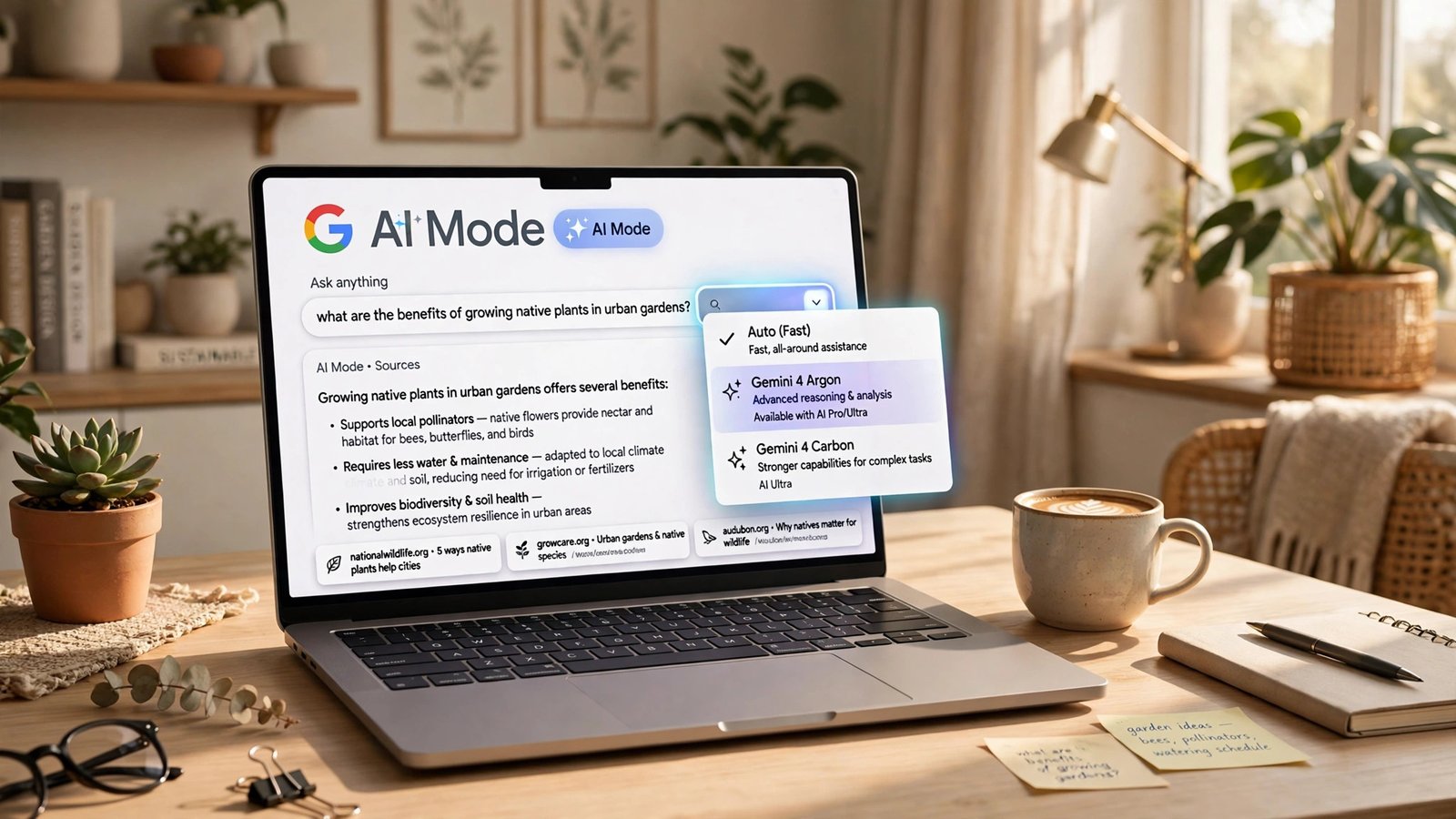
Google’s strongest AI model is now the one answering questions inside Google Search — but only if you pay for it. On November 10, 2026, Google rolled Gemini 4 Carbon into AI Mode for Google AI Ultra subscribers, the same day the November 2026 core update started rolling out. If you publish content for a living, that matters: the model deciding which sources to cite in AI answers just got a lot smarter, and the bar for being the source it picks just moved again.
Here’s the short version. Carbon is Google’s flagship Gemini 4 model, built for deep reasoning, cybersecurity, and long-horizon work. In AI Mode it shows up as a “4 Carbon” option in the model dropdown — but only for Ultra subscribers ($99.99 a month and up), only in 122 countries, and only with daily usage limits. Nothing about the results page looks different. No new citation format, no new layout, no published benchmarks for the Search deployment. The change is under the hood: how the model understands intent and holds a multi-turn conversation. And that, quietly, is the whole story for publishers.
What actually happened on November 10
Google announced Gemini 4 Carbon on October 28, but only for a narrow audience: cyber defenders in its Fairwind Program got first access. The public release came on November 10, when Google’s blog post — signed by Koray Kavukcuoglu, the executive who leads AI architecture at Google DeepMind — said the company was “making Gemini 4 Carbon available to developers, enterprises, scientists, and consumers.”
The Search part of that sentence is easy to miss, so let me spell it out. Google wrote that Carbon is “rolling out to all Google AI Ultra subscribers in Google Antigravity, the Gemini app, and AI Mode in Search.” Two Google Search leaders posted about it the same day on X. Rajan Patel, Google’s VP of engineering for Search, wrote: “We’re bringing our latest frontier model to Search! One thing I really love: Gemini 4 Carbon better understands your intent so you can have deeper back and forth convos in AI Mode. Rolling out now to Google AI Ultra subscribers.” Robby Stein, also on the Search team, put it more bluntly: “Shipping Gemini 4 Carbon in Search today for Google AI Ultra subs!”
So this wasn’t a quiet API-only launch. The newest model went straight into the product hundreds of millions of people use to find answers — gated behind the most expensive subscription tier.
One thing worth noting for anyone tracking Google’s release cadence: Carbon is based on Gemini 4 Argon, the model that opened the Gemini 4 family in September. Argon reached AI Mode for Pro and Ultra subscribers on October 13. Carbon arrived less than a month later, and only for Ultra. Google is clearly treating its flagship model as a premium-tier perk now, not a default.
Who gets Carbon in AI Mode — and who doesn’t
This is where most of the confusion lives, so here’s the full picture as Google’s own pages read on November 10–12.
| Google AI plan | Price | Carbon in the Gemini app | Carbon in AI Mode |
|---|---|---|---|
| Free | $0 | No | No |
| Google AI Plus | $4.99/month | No | No |
| Google AI Pro | $19.99/month | No — Pro keeps Argon | No — Pro keeps Argon |
| Google AI Ultra (5x limits) | $99.99/month | Yes | Yes |
| Google AI Ultra (20x limits) | $199.99/month | Yes | Yes |
Two details in that table deserve emphasis. First, the $99.99 Ultra tier comes with 5x the usage limits of AI Pro; the $199.99 tier comes with 20x. Both include Carbon. Second, Pro subscribers are not locked out of the Gemini 4 family — they keep Argon, which is still a strong model. They’re locked out of Carbon specifically.
Developers and businesses get Carbon a different way: through the paid Gemini API tier in AI Studio and Android Studio, and through Gemini for business. The API price is $2 per million input tokens and $10 per million output tokens — but only through November 30, 2026. After that date it doubles to $4 and $20. That’s the same introductory price Argon launched with, and the same doubling date. If you’re budgeting API usage for December, budget the doubled rate.
There are also three gates beyond the subscription:
- Age: Carbon in AI Mode is for Google AI Ultra subscribers 18 and above.
- Account: you must be signed in to a personal Google Account that you manage yourself.
- Country: Google’s AI Mode help page, updated November 11, lists 122 countries and territories where Carbon in AI Mode is available. The US, UK, Canada, India, Australia, Japan, and Brazil are in. Not one of the 27 EU member states is in — nor Norway, Iceland, Russia, China, Turkey, or Hong Kong. If you’re in the EU, no amount of money buys Carbon inside Search right now.
- Daily limits: Carbon in AI Mode has daily usage limits that Google says can change with demand and subscription plan. Google hasn’t published the numbers.
One more wrinkle: “rolling out” means an Ultra subscriber may not see Carbon on day one. If you pay for Ultra and the option isn’t there yet, that’s the rollout, not a bug.
How to switch it on
If you do have Ultra, finding Carbon takes about ten seconds.
In AI Mode, tap the model dropdown in the “Ask anything” bar at the top of Search and pick “4 Carbon.” In the Gemini app, open the model picker at the bottom of the chat box — 9to5Google reports the picker labels Argon “Code & analysis” and Carbon “Most complex work.” Pick Carbon for the questions that need real reasoning: multi-step research, comparing options with trade-offs, anything where the first answer leads to three follow-ups.
That’s the practical bit. The strategic bit is what the rest of this article is about.
Carbon vs Argon vs Hydrogen in Search
Google now has three Gemini 4 models touching Search, and they serve three different audiences. Mixing them up is the easiest way to misread this launch.
| Model | Who gets it in Search | What it’s for | Price (API) |
|---|---|---|---|
| Gemini 4 Argon | AI Pro and Ultra subscribers | Software engineering and knowledge work | $2/$10 per million tokens through Nov 30, then $4/$20 |
| Gemini 4 Carbon | AI Ultra subscribers only | Deep reasoning, cybersecurity, long-horizon agentic work | $2/$10 per million tokens through Nov 30, then $4/$20 |
| Gemini 4 Hydrogen | Everyone — free users included | Fast, everyday coding and agentic workflows | $1.50/$7.50 per million tokens, flat across 1M context |
Hydrogen launched November 12, two days after Carbon reached AI Mode, and it’s the fast, cheap tier: $1.50 per million input tokens and $7.50 per million output tokens, flat across the whole 1-million-token context window, with no long-context surcharge. It’s the first Gemini 4 model free users can reach, and it now powers Google Search globally.
So the picture is this: Hydrogen is the model answering Search for everyone. Carbon is the model answering AI Mode for the people paying $99.99 a month. Argon sits in the middle for Pro subscribers. A stronger model answering for paying users while a faster, cheaper model answers for everyone else — that’s the split to keep in mind when you think about what “the AI answer” even means now. There isn’t one answer engine anymore. There are tiers.
What Carbon actually changes for publishers
Let’s be honest about what we know and what we don’t, because the gap between the two is where bad SEO advice gets written.
What we know: Carbon is a stronger reasoning model. Google says it “better understands your intent” and supports “deeper back and forth convos” in AI Mode. That means longer, more layered questions get better answers — the kind of question where a user starts with “what’s the best CRM for a 10-person agency” and follows up with “what about the one that integrates with QuickBooks and costs under $100 a month.” A weaker model loses the thread. Carbon is built to hold it.
What we don’t know: Google has published no benchmarks specific to the Search deployment, and there’s no new citation format, result layout, or interface change tied to this rollout. Google has said nothing about whether Carbon changes which links AI Mode shows, how often it cites sources, or whether it shows ads differently. Any article telling you Carbon “boosts traffic to cited sites” or “kills small publishers” is guessing. Don’t trust it, and don’t repeat it.
Here’s what I think the realistic effect is, and I’ll label this as analysis, not fact: a model that understands intent better and sustains longer conversations is a model that rewards content written the way people actually ask questions. The vague, keyword-stuffed page that ranks because it matches a phrase loses ground to the page that answers the follow-up question the user hasn’t typed yet. That’s not a new rule — it’s the same direction Google has been moving for years, now with a stronger engine behind it.
And there’s a timing wrinkle you can’t ignore. Carbon landed in AI Mode on November 10, the same day Google confirmed the November 2026 core update was live. That rollout runs for up to two weeks, finishing around November 24. If your traffic moves this month, you cannot tell whether the core update, Carbon in AI Mode, or plain seasonality caused it. We covered the core update in detail in our November 2026 core update guide — the short version is: don’t judge winners and losers until at least a full week after the rollout ends, and don’t change your content strategy based on two weeks of noisy data.
The publisher checklist: how to stay citable
Google’s own framing gives publishers the playbook, if you read it carefully. When the answering model gets better at reasoning, the content that gets cited is the content that makes reasoning easy: direct answers, verifiable facts, named sources. Here’s the checklist I use for every article now, and it maps directly onto what Carbon rewards.
1. Answer the question in the first 100 words. Don’t open with throat-clearing. Name the thing plainly, give the direct answer, then explain. AI Mode lifts passages that work as standalone answers. If your first paragraph can’t stand alone, it won’t get picked up.
2. Put verifiable facts with named sources. “Google announced Carbon on November 10” beats “Google recently announced a new model.” A model that reasons well cross-checks claims against what it knows. Named dates, named people, named prices — those are the anchors.
3. Write headings that answer questions. “Who gets Carbon in AI Mode” works as a heading because it works as a question. “Key considerations” doesn’t. Every H2 should make sense if someone reads it in isolation.
4. Cover the follow-up questions, not just the first one. Carbon’s whole pitch is multi-turn conversation. The user asks about Carbon, then asks about the price, then asks whether Pro gets it, then asks about the EU. An article that answers all four in one place is the article the model keeps coming back to. This is why the FAQ section at the end of this article exists — and why it should exist on yours.
5. Say what you don’t know. “Google hasn’t said whether Pro subscribers will get Carbon later” is more useful than a confident guess with a fake date. Models that reason well penalize confident nonsense. So do readers.
6. Keep your pages structured and current. The November core update and the Carbon rollout arriving together is a reminder: Google is actively re-ranking while it upgrades its answering models. Stale prices, dead links, and 2024 dates on a 2026 topic are exactly the kind of thing a stronger model notices. We wrote about the AI Overviews and AI Mode merge earlier this year in our piece on how AI Overviews and AI Mode are merging for bloggers — the direction of travel hasn’t changed, only the speed.
None of this is new advice. That’s the point. Carbon doesn’t change the rules; it enforces them harder.
Should you pay $99.99 a month for this?
The honest answer for most publishers is no — not for Carbon in AI Mode alone.
Here’s the math. Ultra costs $99.99 a month for the 5x-limits tier, $199.99 for 20x. What you get for that is a bundle: Carbon in the Gemini app, Antigravity, AI Mode, and AI Studio, plus higher usage limits across the board and the rest of the Ultra package. If you’re already paying for Ultra, switching the AI Mode dropdown to Carbon costs you nothing extra and you should do it today. If you’re not paying for Ultra, Carbon in Search is not the reason to start. The answers you see as a searcher are not the answers your readers see — your readers are mostly on the free tier, getting Hydrogen-powered answers.
The one group for whom the math looks different: publishers and researchers who use the API. At the introductory $2/$10 rate, a serious research session is cheap. Say you run a 500,000-input-token research pass with 50,000 output tokens — that’s $1.00 of input plus $0.50 of output, $1.50 total. After November 30, the same session costs $2.00 of input plus $1.00 of output, $3.00 total. Still cheap. But if you’re running that session fifty times a month across a content team, the doubling matters: $75 becomes $150. Budget December at the $4/$20 rate, not the intro rate, and you won’t get surprised.
And if you’re a publisher wondering whether to chase Ultra for the SEO edge, spend the money on content instead. One well-researched, properly structured article that Carbon can cite is worth more than a year of Ultra.
The catch list: what Google isn’t shouting about
Every launch has a fine print section. Here’s Carbon’s, all in one place:
- The EU is excluded from Carbon in AI Mode. 122 countries are in; no EU member state is. If a chunk of your audience is European, they’re not seeing Carbon answers at all.
- The price doubles on November 30. $2/$10 becomes $4/$20 for API access. The intro rate was never the real rate.
- Daily usage limits apply in AI Mode, and Google hasn’t published the numbers or how they vary by plan.
- Pro subscribers don’t get Carbon, and Google hasn’t said whether or when they will. Treat any date you see elsewhere as a guess.
- No measured traffic impact exists yet. Nobody — not Google, not any SEO tool — has published before-and-after traffic data for Carbon in AI Mode. The core update is still rolling out until around November 24. Anyone claiming a traffic effect is speculating.
- Carbon’s benchmarks are Google’s own. Google says Carbon ranks first on CursorBench 4.0, Perplexity’s WANDR, and Zapier’s AutomationBench, at more than 2x lower cost per task than the next best external model. Those are vendor-reported numbers, not independently replicated. Useful signal, not proof.
One more thing worth knowing: Google also extended its program giving 10,000 scientists free Argon access in Antigravity for six months to include Carbon. That’s a small detail, but it tells you where Google thinks Carbon’s real edge is — scientific reasoning and long-horizon work, not casual chat.
What to watch next
Three dates matter from here.
November 24 (approximately): the November core update rollout should be finished. Wait at least a week after that before drawing any conclusions about your traffic. Our core update guide has the full do-and-don’t list.
November 30: Carbon’s API price doubles from $2/$10 to $4/$20 per million tokens. If you use the API, lock in any heavy research before then — or at least budget for the new rate.
The Hydrogen question: Hydrogen launched November 12 and now powers Search for everyone, including free users. That’s the model most of your readers actually meet. If you want to understand what the average searcher sees, Hydrogen matters more than Carbon. We covered its launch, pricing, and the flat-rate math in our Gemini 4 Hydrogen piece.
Longer term, the question is whether Carbon trickles down to Pro or free users the way Argon did — Argon reached AI Mode for Pro subscribers a month after its launch. Google hasn’t said. If it happens, the publisher checklist in this article becomes even more important, because the strongest model will be answering for everyone. If it doesn’t, the two-tier answer engine is the new normal, and the gap between what paying users see and what free users see becomes a real editorial consideration.
Either way, the move for publishers is the same, and it hasn’t changed since the first AI Overview appeared: write the clearest, most verifiable, most complete answer to the question your reader actually asked — including the follow-ups. Carbon just made that advice harder to ignore.
Frequently Asked Questions
Is Gemini 4 Carbon available in Google AI Mode for free users?
No. Carbon in AI Mode is only for Google AI Ultra subscribers, starting at $99.99 a month. Free users, Google AI Plus subscribers ($4.99/month), and Google AI Pro subscribers ($19.99/month) do not get it. Pro subscribers keep Gemini 4 Argon in AI Mode instead. Free users get Gemini 4 Hydrogen, which launched November 12 and now powers Google Search globally.
How do I use Gemini 4 Carbon in AI Mode?
If you’re a Google AI Ultra subscriber, open Google Search, switch to AI Mode, and tap the model dropdown in the “Ask anything” bar — then pick “4 Carbon.” You need to be 18 or older, signed in to a personal Google Account, and in one of the 122 countries where it’s available. Daily usage limits apply. If the option isn’t there yet, the rollout may not have reached your account.
How much does Gemini 4 Carbon cost?
For consumers, access comes through the Google AI Ultra subscription: $99.99 a month (5x AI Pro usage limits) or $199.99 a month (20x limits). For developers, the Gemini API charges $2 per million input tokens and $10 per million output tokens through November 30, 2026 — then the price doubles to $4 and $20 per million tokens.
Is Gemini 4 Carbon available in the European Union?
Not in AI Mode. Google’s AI Mode help page lists 122 countries and territories for Carbon in AI Mode, and no EU member state is among them — nor are Norway, Iceland, Russia, China, Turkey, or Hong Kong. The US, UK, Canada, India, Australia, Japan, and Brazil are included. Google hasn’t said when or whether the EU will be added.
Does Gemini 4 Carbon change how publishers get cited or clicked in AI Mode?
Google hasn’t said, and there’s no evidence either way yet. There’s no new citation format, no new results layout, and no published traffic data for the Carbon rollout. What Carbon does change is the quality of the reasoning behind the answers — it understands intent better and sustains longer multi-turn conversations. The practical advice for publishers is unchanged: direct answers up front, verifiable facts with named sources, headings that answer real questions, and content that covers the follow-ups, not just the first query.
What’s the difference between Gemini 4 Carbon, Argon, and Hydrogen?
Carbon is the deep-reasoning flagship for complex, long-horizon work; Argon is the earlier Gemini 4 model for software engineering and knowledge work; Hydrogen is the fast, cheap tier for everyday coding and agentic workflows. In Search, Hydrogen powers results for everyone including free users, Argon is in AI Mode for Pro and Ultra subscribers, and Carbon is in AI Mode for Ultra subscribers only.