
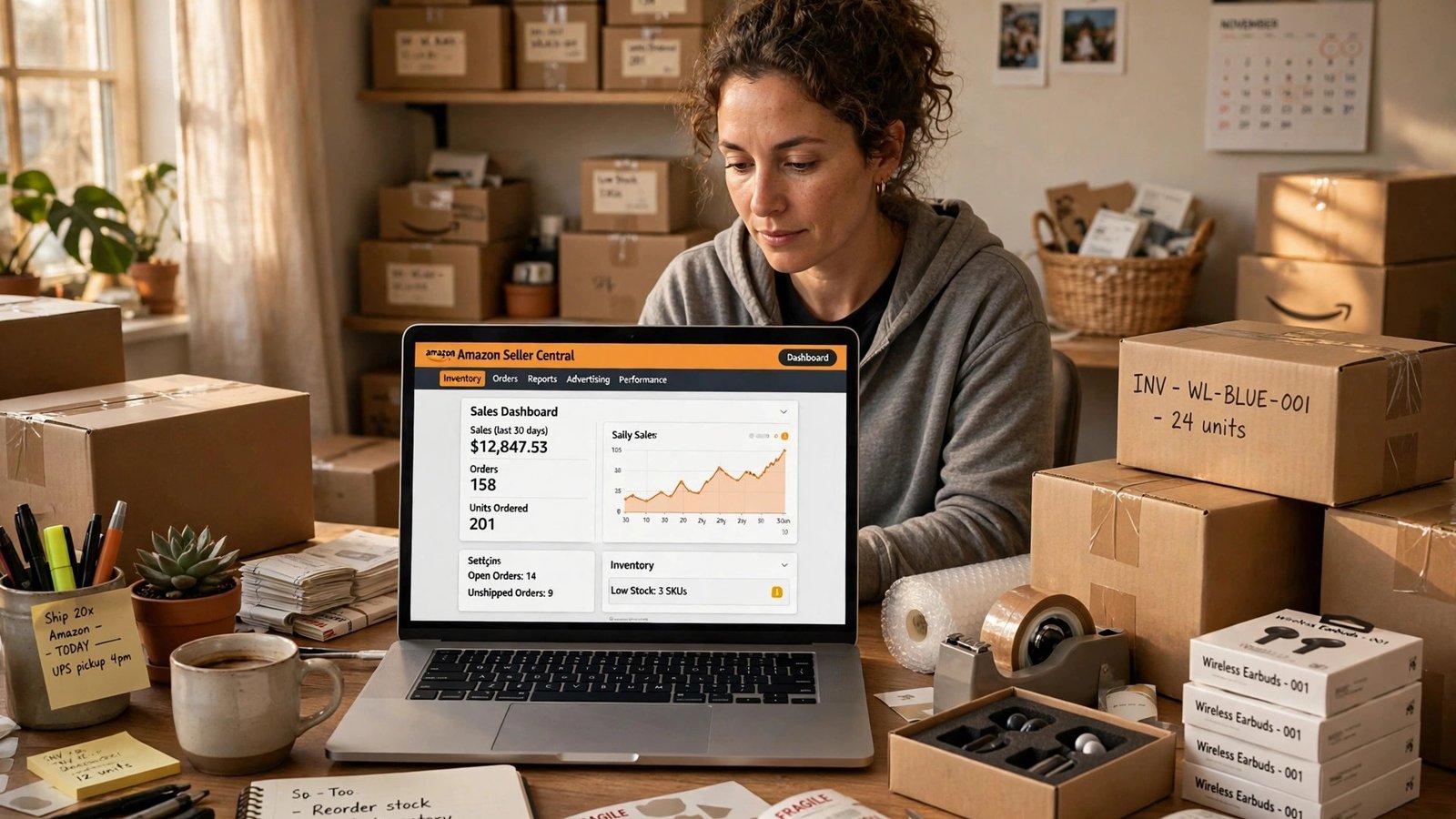
Amazon just told its US sellers what FBA will cost in 2027, and the headline number — $0.19 more per unit — is the least interesting part of the announcement. January 2027 brings three separate changes on three separate dates, and the one that costs sellers the most money isn’t a fee at all. It’s a packaging rule that can take a listing down entirely.
On November 5, 2026, Amazon sent every US selling partner its annual fee letter. Fulfillment fees rise by an average of $0.19 per unit from January 15, 2027, roughly 0.8% of the average item’s selling price. Storage gets rebuilt on February 1 into a single age-based rate. And on January 11 — four days before the fee rise — most product bundles sold as a single ASIN must be packaged by the original manufacturer or brand, or the listing gets deactivated.
If you sell on Amazon, this is the piece to read before you place your next inventory order. The math below uses Amazon’s own published rate tables, and every figure is dated so you can check it against your own catalog.
The short answer: what changes, and when
Three dates, three changes. Miss any of them and you either overpay or lose a listing.
| Date | Change | Who it hits |
|---|---|---|
| January 11, 2027 | Bundle rule: most single-ASIN bundles must be packaged by the original manufacturer or brand | Sellers with self-assembled kits and bundles |
| January 15, 2027 | FBA fulfillment fees rise an average of $0.19 per unit; size tiers restructured; low-price FBA narrowed | Every FBA seller |
| February 1, 2027 | Storage utilization surcharge and aged inventory surcharge end; one age-based storage rate replaces them; low-inventory fee test changes | Sellers holding stock 6+ months or running low on inventory |
The 3.5% fuel and logistics surcharge that started on April 17, 2026 stays exactly where it is. Amazon says fuel and line-haul trucking costs have stayed elevated since April, and it will keep reviewing the surcharge. Don’t model 2027 on the new rate card alone — that 3.5% still sits on top of every fulfillment fee.
The $0.19 average hides the SKUs that actually hurt
Amazon’s average is exactly that: an average across every size tier and price band. It is not the number that applies to any one product. Some fees go down. Small standard items — the size tier most small sellers live in — go up the most.
Here is what Amazon’s published 2027 rate tables show for a standard-size item priced between $10 and $50, non-peak rates:
| Item (non-peak, $10–$50) | 2026 fee | 2027 fee (Jan 15) | Change |
|---|---|---|---|
| Small standard, 4–6 oz | $3.45 | $3.92 | +$0.47 |
| Large standard, 12–16 oz | $4.60 | $4.67 | +$0.07 |
| Large standard, 1.75–2 lb | $5.82 | $5.98 | +$0.16 |
The small standard jump is more than double the headline average. And the averages by band tell the same story: for items priced $10 to $50, small standard rises $0.40 on average and large standard $0.12. Over $50, small standard rises $0.70 and large standard $0.47. Under $10, small standard rises $0.20 on average while large standard is mostly unchanged — except apparel, up $0.08.
There’s a second wrinkle the average hides: the gap between price bands widens. The same 12-to-16 oz item priced over $50 goes from $4.86 to $5.23, which puts it $0.56 above the $10-to-$50 rate, where it used to sit $0.26 above. If your product sits near a price-band boundary, a small price change can now move your fulfillment fee more than it used to.
Worked example: what $0.19 actually costs on a $25 item
Averages are abstract. Margins are not. Take a realistic small seller: a kitchen gadget selling for $25, small standard size, 4 to 6 ounces, 200 units a month, product cost $8 landed. Here is the per-unit math before and after January 15.
| Per unit, $25 item | 2026 | 2027 | Change |
|---|---|---|---|
| Sale price | $25.00 | $25.00 | — |
| Referral fee (15%) | −$3.75 | −$3.75 | $0 |
| FBA fulfillment fee | −$3.45 | −$3.92 | −$0.47 |
| Fuel and logistics surcharge (3.5% of fulfillment fee) | −$0.12 | −$0.14 | −$0.02 |
| Product cost (illustrative) | −$8.00 | −$8.00 | $0 |
| Professional plan ($39.99 ÷ 200 units) | −$0.20 | −$0.20 | $0 |
| Profit per unit | $9.48 | $8.99 | −$0.49 |
That is $98 a month, or about $1,176 a year, on one SKU at 200 units a month — from a fee rise Amazon describes as 0.8% of the average selling price. The referral fee doesn’t change (15% in most categories, including Home and Kitchen), and the Professional plan stays $39.99 a month. The entire hit lands in the fulfillment line, which is why the “average” framing is so misleading: your fee went up $0.47, not $0.19.
Now run the same math on a thin-margin SKU, because that is where this rise actually bites. EcomCrew worked the example of a product contributing $3 per order after variable costs: a $0.19 fulfillment increase drops that to $2.81, a 6.3% cut in contribution per order. If your margin per unit is under $2, the January rise eats a tenth of it or more. And if your item is small standard and priced $10 to $50, your real increase is closer to $0.40 than $0.19, which doubles that damage.
The honest takeaway: $0.19 is Amazon’s average, not your number. Pull your own numbers from Amazon’s new Fee Change Comparison dashboard inside Profit Analytics — it applies the 2027 rate table directly to your catalog, ASIN by ASIN — and the Revenue Calculator to model scenarios. A table in an article can’t do that for you.
Storage: February 1 is the bigger change for slow movers
If the January fee rise is the headline, the February 1 storage rebuild is the change that quietly costs more for sellers with slow inventory. Amazon is ending two separate charges — the storage utilization surcharge and the aged inventory surcharge — and folding them into one monthly storage rate that climbs with the age of your stock.
For standard-size products that aren’t dangerous goods, the January-through-September rates from February 1, 2027 are:
| Age of inventory | Monthly storage per cubic foot |
|---|---|
| 0–180 days | $0.78 |
| 181–270 days | $2.78 |
| 271–365 days | $6.68 |
| 366–455 days | Greater of $7.68/cu ft, or $0.78/cu ft + $0.30/unit |
| 456 days or more | Greater of $8.68/cu ft, or $0.78/cu ft + $0.35/unit |
From October through December, add $1.62 per cubic foot to each of those rates. Bulky and oversize items start at $0.56 and add $0.84 in the fourth quarter.
Amazon’s own framing is that inventory turning in under six months gets flat or lower fees, and inventory over six months gets higher ones. The numbers back that up. A unit taking up 0.1 cubic feet costs about $0.08 a month for its first six months and about $0.28 a month once it passes 181 days, where the old schedule charged $0.78 in storage plus a $0.50 aged inventory surcharge, or $0.13 a month in total. From 331 to 365 days the total is unchanged at $6.68 per cubic foot.
Two groups get a genuine break. If you were paying the storage utilization surcharge — the extra charge that applied when you held more than 22 weeks of stock in a tier — that charge disappears entirely, and Amazon says the change makes it easier to stock up ahead of high-demand events without a utilization penalty working against you.
The practical rule for February: if a unit has been sitting for five months, decide now whether it sells, gets discounted, or gets removed. The cost of indecision triples at the 181-day mark.
The low-inventory fee finally looks at what actually sells
The low-inventory-level fee — the per-unit charge Amazon adds when a product drops below 28 days of supply — has been one of the most complained-about FBA charges, because it used trailing 30-day and 90-day sales to decide you were running low. A sudden sales spike or an end-of-season wind-down could trigger it even when your stock was fine.
From February 1, 2027, the test changes. Amazon will compare your inventory at each weekly check with what actually shipped in the four weeks before and the four weeks after. The fee applies only if both come out under 28 days of supply, at the rate for the higher of the two. The charge appears four weeks after the check as its own line instead of inside the fulfillment fee, and it extends to every oversize tier. For a small standard item the rates stay $0.32 to $0.89 per unit, depending on how far below 28 days the product falls.
This is a genuine improvement, and sellers noticed it in the announcement thread. One seller on Amazon’s Seller Forums wrote about the low-inventory fee: “the new low inventory level fee seems insane. Do we have any way of projecting this? I don’t understand how this is going to work” — a fair reaction, since the new test depends on shipments that haven’t happened yet at the time of the check. The honest answer is that you can’t project it precisely; you can only keep your days of supply above 28 and stop worrying about it.
The bundle rule: the January 11 deadline that can kill a listing
Here is the change that costs more than any fee. Amazon announced it separately, back on September 10, 2026, in the Seller Forums — and it takes effect January 11, 2027, four days before the fee rise.
From that date, most product bundles listed as a single ASIN must be packaged by the original manufacturer or brand. The brand or manufacturer “must have physically packaged the bundle and not just created the listing.” A kit you assembled yourself — from other companies’ products, at your warehouse, at a prep center, or through a 3PL — no longer qualifies as a standard bundle listing.
What happens if you don’t comply: the listing is deactivated, it shows up as a listing violation on your Account Health dashboard, and Amazon points FBA sellers to a removal order for the inventory already sitting in its fulfillment centers. A deactivated bundle is still your inventory, and you still have to pay to get it back or dispose of it. Fees only cost money. A bundle that breaks the rule is deactivated and logged as a violation — and violations stack up on the account that holds them.
There are three exceptions, and they are narrow:
- Virtual bundles. Bundles built with Amazon’s Virtual Bundles tool are exempt, because nothing is physically combined — the components ship separately from your existing FBA inventory. A virtual bundle groups two to five eligible ASINs under one listing, and it requires Brand Registry plus a Brand Representative or Authorized Reseller role.
- Authorized repackaging. You hold a valid letter of authorization from the brand owner or manufacturer covering the specific combination and all included brands. Amazon directs sellers to upload the authorization through Account Health if a bundle is flagged after the deadline. One refusal from one brand ends the combination.
- Gifting and Camera categories. Bundles listed in gifting browse nodes (such as holiday gift baskets) or camera product types don’t need to be original-manufacturer configurations.
Multipacks of a single product are not bundles — Amazon’s ASIN creation policy covers those separately — and FBM bundles fulfilled through your own warehouse or a 3PL aren’t governed by this rule. But if your bundle is FBA and self-assembled, you have three options before January 11: get the authorization letter, restructure it as a virtual bundle, or sell through and remove the remaining stock. Note that the rule was announced in mid-September, with Q4 sitting in the middle — so holiday inventory bought in October and still unsold on January 11 is exactly the exposure. You can keep selling noncompliant bundles through January 10. After that, the listing comes down.
FBA vs self-fulfilled vs Walmart WFS on the same $25 item
The fee rise is also a good moment to re-check whether FBA is still the right fulfillment choice for each SKU, because the alternatives didn’t get more expensive in January. Using the same $25 item:
| Cost per order, $25 item | Amazon FBA (2027) | Walmart WFS | Self-fulfilled (FBM) |
|---|---|---|---|
| Fulfillment / shipping cost | $3.92 + 3.5% surcharge = $4.06 | From $3.45 per unit (≤1 lb) | Postage + packaging, paid by you |
| Referral / marketplace fee | 15% = $3.75 | 15% in most categories = $3.75 | 15% referral fee still applies on Amazon; $0 marketplace fee on your own store |
| Monthly fee | $39.99 Professional plan | $0 — no monthly, setup, or listing fee | $0 to Amazon on Individual plan ($0.99/item) |
| Storage | $0.78/cu ft/month under 180 days | $0.75/cu ft/month ($2.25 in Q4 peak) | Your own shelf, garage, or 3PL rate |
Walmart claims WFS costs about 15% less per item than other marketplace fulfillment, and its new-seller savings — up to $75,000 in referral discounts plus up to $2,000 in WFS credits — run through January 31, 2027. The catch is the approval bar: Walmart vets sellers, and Amazon doesn’t.
Self-fulfilled looks cheapest on the fee line, but it isn’t free: you pay postage, packaging, and your own time, and you lose the Prime badge that drives conversion on Amazon. The right question isn’t “which is cheapest” — it’s “which earns the most per unit after conversion.”
The rest of the announcement, in brief
A few more changes from the November 5 letter worth knowing about, even if they don’t touch every seller:
- Referral fees stay the same in almost every category. The exception is 3D printers, which get lower selling commissions.
- Low-Price FBA narrows. From January 15, products in Automotive and Powersports, Compact Appliances, Computers, Musical Instruments and AV Production, and Media no longer qualify for the lower under-$10 rates. A small standard item under $10 that paid $2.56 in 2026 now pays $2.80 in 2027 — and in those five categories it pays the full $10-to-$50 rate instead.
- Buy X, Get Y promotions add a $5 upfront fee and a 2% variable fee capped at $2,000 from January 15, consistent with Amazon Deals and coupons.
- Inbound placement regions shrink from three to two for standard-size shipments — East and West only, with the central region merged into the east. The minimal-split fee itself doesn’t change.
- Multi-Channel Fulfillment Standard and Buy with Prime fulfillment fees rise by an average of 3.5% from January 15; expedited speeds stay flat.
- Returns processing moves to the new size tiers — January 15 for apparel and shoes, February 1 for other categories. The per-unit fee above the category threshold stays the same.
Your pre-January checklist
Don’t wait for January to find out what this costs you. Run this before your next inventory order:
- Open the Fee Change Comparison dashboard in Profit Analytics. It shows the 2027 fees against your current ones, ASIN by ASIN. Sort by dollar impact, not percentage — a 6% rise on your best seller matters more than a 20% rise on a slow one.
- Audit every bundle ASIN. List each bundle, who packaged it, and which authorization or exemption supports it. For anything self-assembled without a brand letter, decide now: authorization, virtual bundle, or sell-through and removal before January 11.
- Flag inventory aged 150+ days. Anything crossing 181 days after February 1 costs $2.78 per cubic foot a month. Discount it, or remove it before the clock runs out.
- Check your days of supply. The new low-inventory test is fairer, but it still bites below 28 days. Restock, or accept the $0.32–$0.89 per unit.
- Re-price or re-source thin SKUs. If a product contributes under $3 a unit after variable costs, the January rise takes more than 6% of that contribution. A $0.50 price rise, a cheaper supplier, or dropping the SKU are all legitimate answers — absorbing it silently is not.
- Compare FBA against WFS for your top 5 SKUs. Same item, same price, both fee stacks. If Walmart’s $0 monthly fee and $3.45 starting fulfillment rate win on a SKU, test it there in January while the new-seller savings are still live.
- Don’t reorder bundles for Q4 without a January plan. Stock bought in October and still unsold on January 11 is the exact exposure the bundle rule creates. Order what you can sell by January 10, or have the authorization letter in hand.
The mood in the seller community
The reaction in Amazon’s Seller Forums has been blunt. One seller wrote on the announcement thread: “THIS IS NOT SUSTAINABLE. Amazon used to be EASY to sell on. Now it requires constant micromanagement just to track all the ways you are trying to screw us. It used to be hands-off, now I spend all day dealing with Amazon red tape and fees and almost no time building my business.”
That frustration is real, and it’s worth hearing — but it’s not a strategy. The sellers who come out of January fine will be the ones who ran the numbers in November, audited their bundles in December, and cleared their aged inventory before February.
For the full 2026 picture, see our earlier guides on Amazon’s 2026 FBA fuel surcharge and peak fees and the holiday peak-fee season. Amazon’s own 2027 fee summary and rate tables are the authoritative source for your exact ASINs — check them in Seller Central before you act. The figures in this article are as published on November 5, 2026, and checked against Amazon’s rate tables on November 12, 2026.
Frequently Asked Questions
How much are Amazon FBA fees going up in 2027?
FBA fulfillment fees rise by an average of $0.19 per unit from January 15, 2027, about 0.8% of the average item’s selling price, according to Amazon’s November 5, 2026 announcement. The average hides wide variation: small standard items priced $10 to $50 rise $0.40 on average, and a 4-to-6 oz small standard item goes from $3.45 to $3.92. The 3.5% fuel and logistics surcharge stays unchanged.
When do the 2027 Amazon FBA fee changes take effect?
Most changes take effect January 15, 2027, the day after the 2026 holiday peak fee period ends on January 14. Storage changes and the new low-inventory-level fee test take effect separately on February 1, 2027. The bundle packaging rule takes effect earlier, on January 11, 2027.
What is Amazon’s January 11, 2027 bundle rule?
From January 11, 2027, most product bundles listed as a single ASIN must be packaged by the original manufacturer or brand. Self-assembled kits — built at your warehouse, a prep center, or a 3PL — no longer qualify unless you hold a letter of authorization from every brand in the bundle, the bundle is in the Gifting or Camera categories, or you use Amazon’s Virtual Bundles tool. Noncompliant listings are deactivated and recorded as listing violations.
Does the 3.5% fuel and logistics surcharge go away in 2027?
No. The 3.5% fuel and logistics surcharge on FBA fulfillment fees, in place since April 17, 2026, stays unchanged for 2027. Amazon says fuel and line-haul trucking costs have stayed elevated and it will keep reviewing the surcharge.
What happens to my storage fees on February 1, 2027?
The storage utilization surcharge and the aged inventory surcharge both end, replaced by a single monthly storage rate based on how long each unit has been stored: $0.78 per cubic foot for stock 0–180 days old, rising to $2.78 at 181–270 days, $6.68 at 271–365 days, and higher beyond that (January–September rates for standard-size items). Inventory that turns in under six months pays flat or lower fees; aged inventory pays more.
Should I switch from FBA to Walmart Fulfillment Services in 2027?
It depends on the SKU. WFS starts at $3.45 per unit for items up to 1 lb, charges no monthly fee, and its storage is $0.75 per cubic foot per month — but Walmart’s referral fee is the same 15% in most categories, and Walmart vets sellers before approving them. Run the same item through both fee stacks, and weigh the Prime conversion advantage FBA gives you on Amazon against the lower fulfillment cost at Walmart.