
The Short Answer: Your HYSA’s Headline Rate Isn’t the Whole Story
Money market funds pay around 3.5% to 3.9% in November 2026, while the best high-yield savings accounts pay roughly 4.25% to 4.35%. On paper, the savings account wins. After tax, it often doesn’t. A Treasury money market fund like Vanguard’s VUSXX yields 3.88%, and every dollar of that income skips state tax — enough to beat a 4.35% HYSA in California or New York. The real question isn’t which rate is highest, but which account keeps the most after tax.
This article is for general information only and is not financial advice. Tax rules depend on your state and situation, and yields change daily. Check current terms with your brokerage or a tax professional before moving money.
What Money Market Funds Actually Pay in November 2026
The Fed’s September 16, 2026 hike lifted the federal funds target to 3.75% to 4.00%. The Fed held rates at its October 27–28 meeting; the next decision comes December 8–9, with markets pricing roughly 78% to 85% odds of another quarter-point hike — market pricing, not a decision.
Crane Data, which tracks the money fund industry weekly, reported for the week ended Friday, November 6, 2026 that the Crane 100 — an average of the 100 largest taxable money funds — paid a 7-day yield of 3.75%, unchanged from the prior week. The broader Crane average sat at 3.66%. By fund type: Prime Institutional 3.85%, Government Institutional 3.74%, Treasury Institutional 3.74%, Prime Retail 3.64%, Treasury Retail 3.50%, and Government Retail 3.47%.
The Funds You Can Actually Buy
Here are the major money market funds from the big brokerages, with 7-day yields and expense ratios as of early November 2026:
| Fund | 7-Day Yield | Expense Ratio | Assets |
|---|---|---|---|
| Vanguard Treasury Money Market (VUSXX) | 3.88% | 0.07% | ~$114B |
| Fidelity Government Portfolio (FRGXX) | 3.86% | 0.14% | — |
| Schwab Value Advantage (SWVXX) | 3.67% | 0.34% | ~$249B |
| Fidelity Government Cash Reserves (FDRXX) | 3.64% | 0.37% | — |
| JPMorgan U.S. Government (MJGXX) | 3.50% | 0.57% | — |
VUSXX charges 0.07% — cut from 0.09% on February 3, 2025 — while JPMorgan’s MJGXX charges 0.57%, more than eight times as much. That gap eats directly into your yield. VUSXX’s 3.88% yield (November 3, 2026) comes with a distribution rate of 3.96% as of November 9.
VUSXX has a $3,000 minimum, higher than most competitors. If you’re parking a smaller balance, Fidelity’s FDRXX or Schwab’s SWVXX have no such hurdle — you just give up a little yield and a lot of the tax advantage below.
Money Market Fund vs. Money Market Account: They’re Not the Same Thing
A money market account is a bank deposit, FDIC-insured up to $250,000. Bankrate’s November 2026 roundup lists the best at Zynlo Bank (4.05% APY, $0 minimum, no monthly fee), Bank5 Connect (4.00% APY, $100 minimum), and Quontic Bank (3.90% APY, $100 minimum). The national average is just 0.48% — the good rates are all at online banks you’ve probably never heard of.
A money market fund is a mutual fund. You buy shares through a brokerage, the fund invests in short-term government debt and high-quality commercial paper, and it aims to keep its share price steady at $1.00. It is not FDIC-insured. It’s governed by SEC Rule 2a-7, which limits what the fund can hold, but there is no government guarantee behind your balance. In theory, a fund can “break the buck” — fall below $1.00 a share — if its holdings lose value. It happened to a handful of funds in 2008 before the SEC tightened the rules.
The tax paperwork differs too. Fund income is reported as dividends on a 1099-DIV; savings account interest shows up on a 1099-INT. The detail that matters is buried in the 1099-DIV: how much of the fund’s income came from U.S. government obligations. Income from Treasury securities is exempt from state and local income tax in every state. Income from everything else isn’t.
That share varies wildly by fund. For 2025, 100.00% of VUSXX’s income came from U.S. government obligations — fully state-tax-exempt, and it clears the 50% threshold that California, Connecticut, and New York require before they’ll let you exclude the income at all. Vanguard’s Federal Money Market Fund (VMFXX), the default sweep fund in most Vanguard brokerage accounts, only hit 66.6% in 2025, so a third of its income is state-taxable. Vanguard Cash Reserves Federal (VMRXX) was at 69.6%.
One caveat: that 100% figure is a 2025 number, republished each January — it could shift for 2026, so check it if this is why you’re buying VUSXX.
The After-Tax Math: Where the Fund Actually Wins
A high-yield savings account pays more before tax, but every dollar of its interest is taxable at both the federal and state level. A Treasury money market fund pays slightly less before tax, but the state never touches it. Here’s the math on $20,000 in cash at a 22% federal tax bracket.
The HYSA side: the top high-yield savings accounts pay roughly 4.25% to 4.35% APY in November 2026 — Bankrate’s November 10 snapshot lists CIT Bank Platinum Savings at 4.35% and Vio Bank at 4.25%. For this example, I’ll use 4.05% — the top money market account rate in the same snapshot, and a fair stand-in for a strong savings rate. That earns $810 a year. After federal and state tax, you keep:
- No state income tax (Texas, Florida, etc.): $810 × (1 − 0.22) = $632
- 5% state tax: $810 × (1 − 0.22 − 0.05) = $591
- 9.3% state tax (California): $810 × (1 − 0.22 − 0.093) = $556
The VUSXX side: at a 3.88% yield, the same $20,000 earns about $776 a year. Because 100% of VUSXX’s income is from U.S. government obligations, there’s no state tax to pay. You keep $605 in any state ($776 × 0.78).
| State Tax Rate | HYSA at 4.05% (after tax) | VUSXX at 3.88% (after tax) | Winner |
|---|---|---|---|
| 0% | $632 | $605 | HYSA by $27 |
| 5% | $591 | $605 | VUSXX by $14 |
| 9.3% (California) | $556 | $605 | VUSXX by $49 |
The crossover sits at roughly a 3.3% state tax rate. Below that, the savings account wins; above it, the Treasury fund wins, and the lead widens with your state rate and federal bracket.
The Tax-Equivalent Yield Formula
Want to run this for your own situation? The tax-equivalent yield tells you what a fully taxable account would need to pay to match your Treasury fund after tax:
TEY = fund yield × (1 − federal rate) ÷ (1 − federal rate − state rate)
For a California investor at 22% federal and 9.3% state, holding VUSXX at 3.88%: TEY = 3.88% × 0.78 ÷ 0.687 = 4.41%. A taxable account would need to pay 4.41% APY to match VUSXX after tax in California. The best HYSA pays 4.35% — close, but the fund still wins, exactly as the dollar table shows. In a no-income-tax state, the formula collapses to the fund’s own yield, 3.88%, and a HYSA at 4.05% beats it.
When a Money Market Fund Beats Your HYSA
The fund wins for you if most of these are true:
- You live in a high-tax state. California (up to 13.3%), New York (up to 10.9%), New Jersey, Oregon, Minnesota, Hawaii — if your state rate is above roughly 3.3%, the Treasury fund pulls ahead. The bigger the balance, the more it’s worth: about $12 a year on $5,000 in California, about $245 on $100,000, over $600 on $250,000.
- Your money is already in a brokerage. If your cash sits in a Vanguard, Fidelity, or Schwab account, buying VUSXX or SWVXX takes about two minutes. Moving money to a new online bank for an extra 0.2 points, then moving it back when rates shift, is a lot of friction for a small gain.
- You don’t need instant ATM access. Money in a brokerage fund isn’t available at an ATM, and transfers out take a business day or two. If this is your emergency fund and you might need cash tonight, the bank account is the right home for at least part of it.
- You’re comfortable without FDIC insurance. Government money market funds hold Treasury and agency securities — about as safe as an investment gets short of holding the Treasuries yourself — but “about as safe” is not the same as “insured.”
The fund loses if you live in a no-income-tax state, your balance is small, or you need same-day cash. The right call depends on your state, your balance, and your nerves.
The Honest Limits of Money Market Funds
Yields move daily. A money market fund’s 7-day yield is a snapshot, not a promise. If the Fed cuts rates in December or early 2027, your fund’s yield falls within days — the portfolio turns over constantly, so there’s no lock-in. If you want certainty, a certificate of deposit locks your rate for the term — our look at whether to lock in CD rates now or wait walks through that trade-off.
A fund can break the buck. It’s rare — it happened to one prominent fund in 2008 and the SEC rewrote the rules afterward — but a money market fund’s $1.00 share price is a target, not a guarantee. Government funds like VUSXX hold only Treasury and agency securities, which makes the risk vanishingly small, but it’s not FDIC insurance. If your cash is money you absolutely cannot afford to see delayed or reduced, even briefly, a bank account is the safer parking spot.
The state-tax advantage is a yearly figure, not a permanent feature. VUSXX’s 100% U.S. government income share is a 2025 number. Vanguard republishes it each January, and it could come in lower for 2026. A fund that drifts below the 50% threshold wouldn’t qualify for the state exemption at all in California, Connecticut, or New York. Check the updated figure every January if this is why you own the fund.
Access is slower than a bank. Selling fund shares and moving the money to your bank typically takes one to two business days. Some brokerages offer check-writing or debit cards linked to money market funds, which closes the gap, but it’s still not the same as walking to an ATM. Keep your “need it tonight” money in a bank.
How to Buy a Money Market Fund in About Five Minutes
- Log in to your brokerage account. Vanguard, Fidelity, Schwab, or any major broker offers money market funds. No account yet? Opening one takes a day or two with identity verification.
- Check the fund’s current 7-day SEC yield on the fund’s page. Yields are published daily, so the number in this article is already a snapshot.
- Place a buy order for the fund’s ticker — VUSXX at Vanguard, SWVXX at Schwab, FDRXX at Fidelity. The order usually fills the same day if you place it before the market close.
- Set it as your sweep or core position if you want. At Vanguard, VMFXX is the default sweep fund, but you can hold VUSXX alongside it. At Fidelity, you can set a money market fund as your core position so idle cash earns the fund’s yield automatically. Then check the state-tax figure each January on your 1099-DIV.
What About T-Bills and I Bonds?
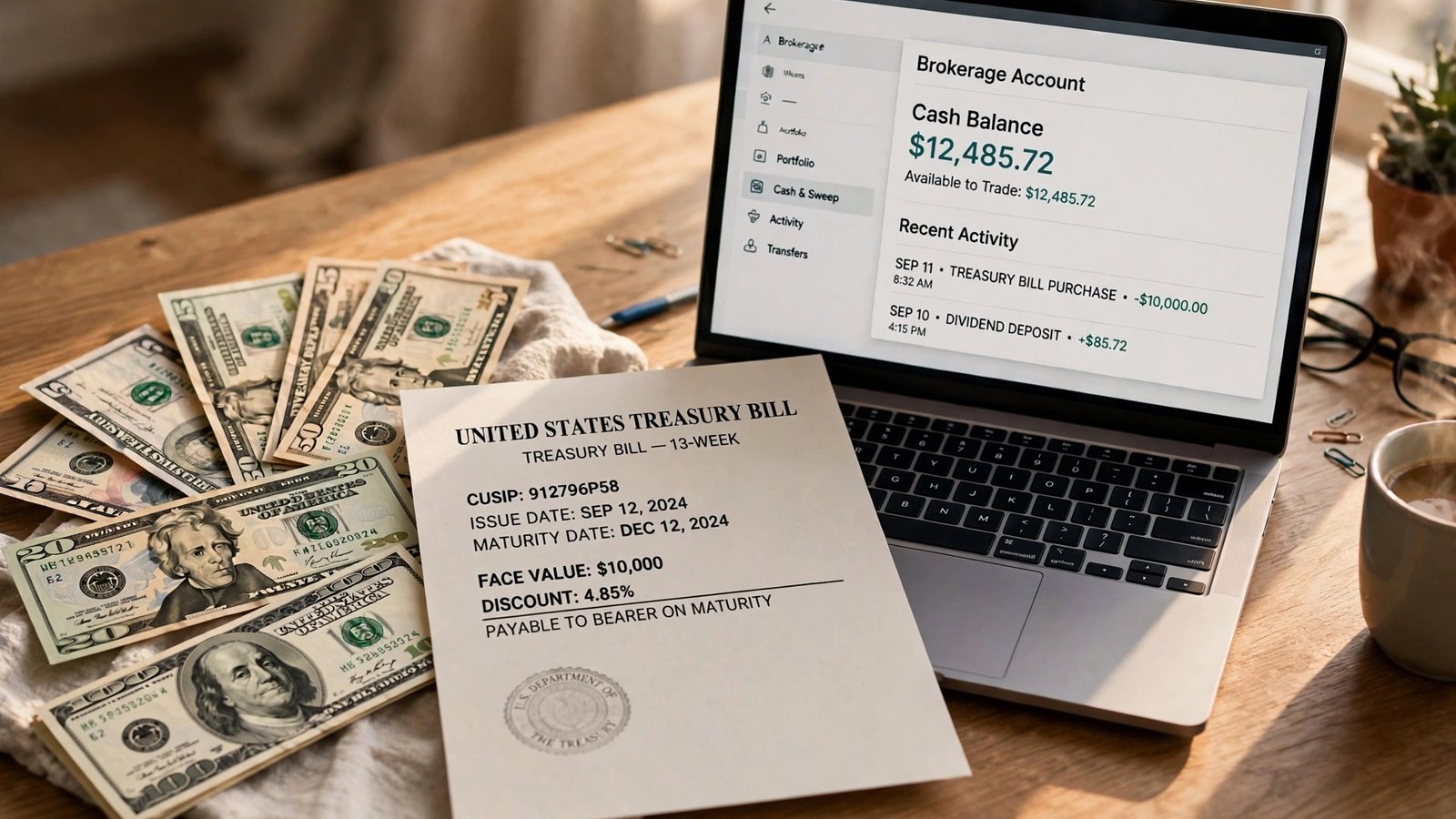
You can buy Treasury bills — the underlying investment inside a fund like VUSXX — directly. The week of November 9, 2026, Treasury bill auctions came in at 4.159% for the 13-week bill, 4.293% for the 26-week bill, and 4.064% for the 6-week bill, with the 52-week bill at 4.50% from its October 27 auction. Those rates beat every money market fund’s yield, and the interest is state-tax-free just like VUSXX’s income. The trade-off is that your money is locked up until the bill matures. Our deeper look at Treasury bills as after-tax passive income works through the ladder strategy that makes this practical.
I bonds pay 5.51% as of November 2026 — the highest rate in this comparison — but they lock your money up for 12 months, and you can only buy $10,000 a year per person. They’re a savings tool, not a cash-parking tool. Our piece on the November 2026 I bond rate covers the details.
T-bills pay more and are just as state-tax-free, but they lock your money up. I bonds pay the most, but they lock it up for a year and cap your purchase. Money market funds pay a little less, but your money is available in a day or two with no purchase cap. You’re choosing between yield and flexibility.
The Bottom Line
In November 2026, headline rates are basically tied — money market funds pay 3.5% to 3.9%, top savings accounts 4.25% to 4.35%. But after tax, a Treasury fund like VUSXX beats a higher-yielding HYSA for anyone in a state with an income tax rate above about 3.3%. In California, the fund keeps about $49 more per year on every $20,000 — a taxable account would need to pay 4.41% to match it.
The fund isn’t better for everyone: it isn’t FDIC-insured, its yield moves daily, and your money takes a day or two to reach your bank. If you live in Texas or Florida, keep a small balance, or need instant cash access, the HYSA is still the right call. But on a large balance in a high-tax state, with the money already in a brokerage account, the after-tax math says the fund wins.
Frequently Asked Questions
Are money market funds FDIC-insured?
No. A money market fund is a mutual fund, not a bank deposit, so FDIC insurance does not apply. Funds aim to hold a stable $1.00 share price under SEC Rule 2a-7, but there is no government guarantee. If FDIC insurance is a must-have, use a money market account or high-yield savings account at an FDIC-insured bank — the best money market accounts pay around 4.00% to 4.05% APY in November 2026.
How is money market fund income taxed?
It’s reported as dividends on a 1099-DIV and taxed as ordinary income federally, just like savings account interest. The difference is at the state level: income from U.S. government obligations is exempt from state and local income tax. For VUSXX, 100% of 2025 income came from U.S. government obligations, so it was fully state-tax-exempt. Other funds are only partly exempt — Vanguard’s VMFXX was 66.6% in 2025, so a third of its income was state-taxable.
Is a money market fund better than a high-yield savings account?
It depends on your state tax rate, your balance, and where your money already sits. In a high-tax state (above roughly a 3.3% state rate), a Treasury fund like VUSXX keeps more after tax than a HYSA — in California, about $49 more per year on $20,000. In a no-income-tax state, the HYSA wins by about $27 on the same balance. If your money is already in a brokerage and you don’t need instant ATM access, the fund is the easier choice; if you need same-day cash or FDIC insurance, the HYSA wins.
Do I pay state tax on Treasury bill interest too?
No — Treasury bill interest is exempt from state and local income tax, the same as the U.S. government portion of a Treasury money market fund’s income. The 13-week bill auctioned at 4.159% the week of November 9, 2026, which beats every money market fund’s yield. The catch is that your money is locked up until the bill matures, while a money market fund lets you sell and get your cash in a day or two.