
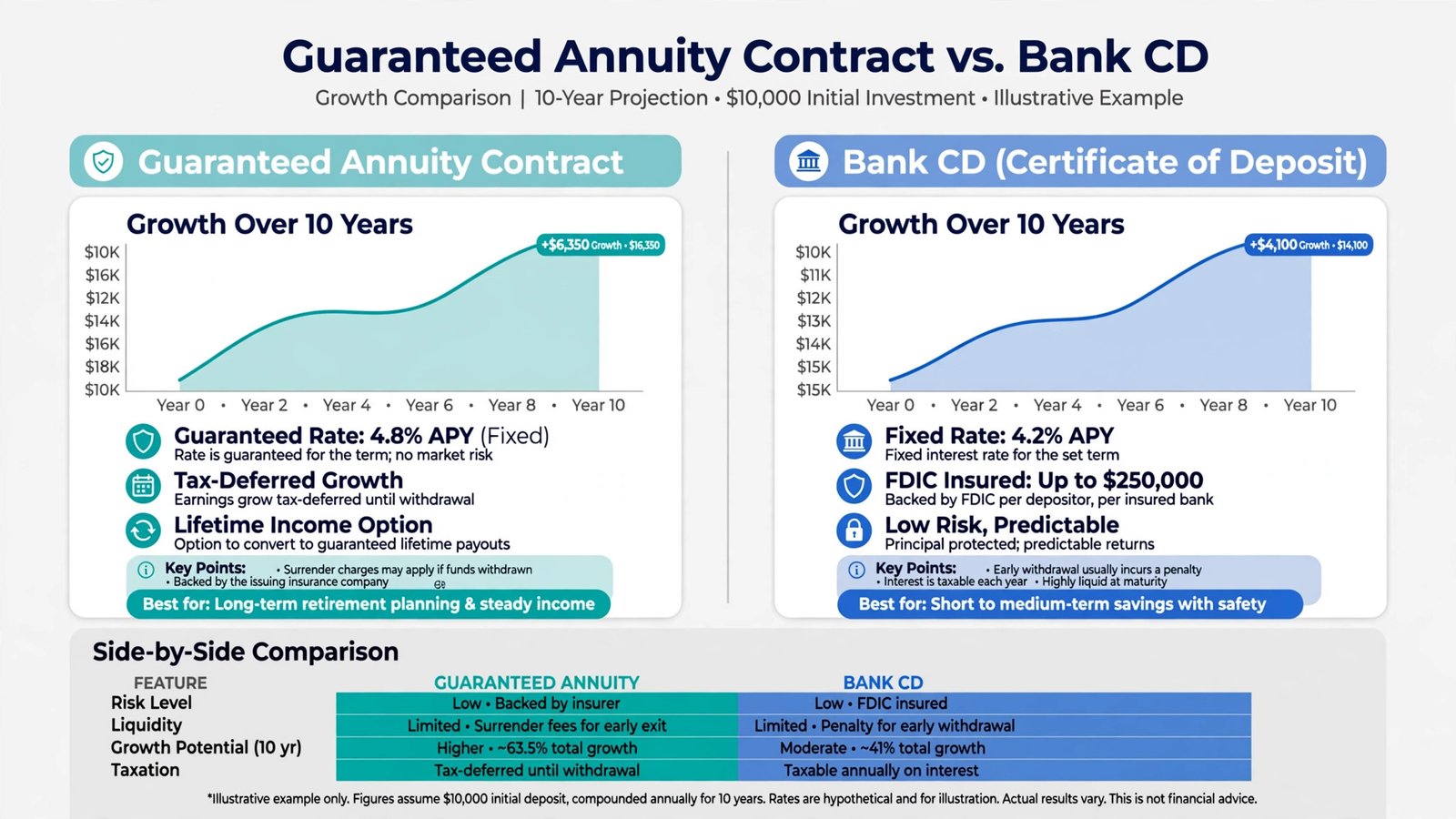
If you have cash you won’t need for five years, a 5-year MYGA can pay you noticeably more than a bank CD right now. A MYGA — a multi-year guaranteed annuity — is a fixed annuity that locks in one guaranteed interest rate for a set term. As of November 6–7, 2026, the top 5-year MYGA pays 7.00% simple interest, while the best nationally available 5-year CD pays 5.00% APY. That gap looks like two full points, but the real story is smaller and more interesting. The 7.00% rate is simple interest, not compound interest, so its true yearly yield is about 6.19%. That’s still well ahead of the best CD — but only if you pick the right carrier, understand the surrender rules, and don’t need the money early.
What a MYGA Actually Is
A MYGA is one of the simplest annuity products you can buy. You hand a lump sum to an insurance company, the insurer guarantees a fixed interest rate for a set number of years, and at the end of the term you get your principal back plus the interest it earned. There is no stock market exposure. Your balance does not fall when markets fall. The rate you sign up for is the rate you get for the whole term.
Growth inside a MYGA is tax-deferred: no tax on the interest each year, unlike a CD. It builds up untouched until withdrawal, when it’s taxed as ordinary income — the IRS covers annuity taxation in Publication 575 — a genuine advantage in a higher bracket, as the numbers below show.
But a MYGA is not a bank account. It is issued by an insurer, not a bank, so it is not FDIC-insured. Your protection is the insurer’s claims-paying ability — its financial strength — plus your state’s guaranty association, which covers annuity holders up to limits that vary by state. That is why the insurer’s credit rating is not a footnote in this decision. It’s the whole safety question.
A MYGA also locks your money up: pull money out early beyond the typical 10%-per-year free-withdrawal allowance and you pay surrender charges, steep in the early years. Withdraw before age 59½ and the IRS can add a 10% penalty on top of ordinary income tax on the gains. A MYGA is a commitment, not a parking spot.
The November 2026 Rates
The figures below come from the My Annuity Store and AnnuityRateWatch feed as of November 6–7, 2026, cross-checked against Hans Goldstein’s dated 5-year MYGA list, updated November 6, 2026, with rates checked between September 21 and November 4, 2026. Both sources tell the same story: five-year rates cluster around 6%, with the very top coming from lower-rated carriers.
- Top 5-year MYGA overall: 7.00% simple interest from Mountain Life (AM Best B-), Simple Summit 5, $5,000 minimum — about 6.19% compounded annually.
- Knighthead Life Staysail 5: 6.65% simple interest (about 5.91% compounded), AM Best A-, $100,000 minimum. A strong rating, but the six-figure minimum shuts out most savers.
- Best A-rated-or-better compound 5-year MYGA: Aspida Synergy Choice 5 at 6.30% (AM Best A-), quoted as a true compound rate. Use this number for a clean comparison with a CD.
- Hans Goldstein’s list, best A-rated example: Delaware Life Pinnacle Plus 5-year at 5.95% ($100,000 and up, effective October 6, 2026, AM Best A- with a negative outlook). His list shows the highest 5-year rates overall running 5.40% to 6.50% compound, with A-rated-or-better insurers paying about 5.50% to 6.05% on public carrier rate sheets dated October 14, 2026. The top rates came from B-rated carriers.
The median 5-year rate across 66 rates was 6.00%, per CANNEX via AnnuityRatesHQ on November 4, 2026 — so 6.00% to 6.30% from a solidly rated insurer is the middle of the market. The 7.00% headline is the edge: a B- carrier, simple interest.
Other terms: top 7-year pays 7.10% simple (Knighthead Staysail 7, A-); top 3-year pays 6.50% simple (Mountain Life); top 10-year pays 6.35% (Revol One Financial, B++). Rates vary by state and premium band, with minimums typically $2,500 to $100,000 — confirm the rate for your state and deposit size.
The Simple-Interest Trap
This is where most MYGA shoppers get misled. Some MYGAs pay compound interest: each year’s interest earns interest the next year, like a CD. Others pay simple interest: interest is calculated only on your original principal, so the interest never earns interest. The same number means two different deals.
Mountain Life’s 7.00% simple interest on $100,000 means $7,000 a year for five years — $35,000 total, for a final value of $135,000. If that were 7.00% compounded, you’d end up with about $140,255. The simple version gives you $5,255 less. As a compound annual yield, the simple 7.00% works out to about 6.19%. Still strong — better than any CD — but not 7% in the sense most savers mean when they hear “7%.”
| Product | Quoted rate | Effective yield | Value after 5 years |
|---|---|---|---|
| Mountain Life Simple Summit 5 (B-) | 7.00% simple | ≈ 6.19% | $135,000 |
| Knighthead Staysail 5 (A-) | 6.65% simple | ≈ 5.91% | $133,250 |
| Aspida Synergy Choice 5 (A-) | 6.30% compound | 6.30% | $135,727 |
| Delaware Life Pinnacle Plus 5 (A-) | 5.95% compound | 5.95% | $133,507 |
| Best 5-year CD | 5.00% APY | 5.00% | $127,628 |
The product with the biggest headline — Mountain Life at 7.00% — ends up behind Aspida’s 6.30% compound rate by $727 on $100,000. The headline is not the yield. Ask one question of every quote: “Is this simple or compound interest, and what is the effective annual yield?” Any agent or website that won’t answer plainly is telling you something. Hans Goldstein’s best 5-year MYGA rates list shows compound-equivalent figures beside quoted rates, with each carrier’s rating and check date. My Annuity Store’s MYGA rates page publishes the simple-interest quotes above — check whether your product quotes simple or compound interest before comparing it to anything.
The Rating-vs-Rate Tradeoff
How much extra yield is a weaker insurer worth? A carrier rated B- by AM Best has to offer more than one rated A-, because you’re taking more credit risk. That’s how the market works: the top rates come from B-rated carriers, while A-rated-or-better insurers pay about 5.50% to 6.05% compound, per Hans Goldstein’s list.
| Option | Effective yield | AM Best rating | Minimum | $100,000 after 5 years |
|---|---|---|---|---|
| Mountain Life Simple Summit 5 | ≈ 6.19% (7.00% simple) | B- | $5,000 | $135,000 |
| Aspida Synergy Choice 5 | 6.30% compound | A- | varies by band | $135,727 |
| Delaware Life Pinnacle Plus 5 | 5.95% compound | A- (negative outlook) | $100,000 | $133,507 |
Notice the surprise: the best A-rated compound option beats the B- simple-interest headline on final value — $135,727 versus $135,000, from a stronger-rated insurer. You don’t have to accept the weakest rating to get the best return this month. In November 2026 the A-rated compound option wins on both safety and dollars. When the safer product also pays more, the decision makes itself.
When the tradeoff is real, weigh it this way: an extra 0.30% a year is $1,500 on $100,000 over five years — payment for accepting the risk the insurer runs into trouble. State guaranty associations back annuity holders if an insurer fails, but limits vary by state — commonly $250,000 per person per company, though your state may differ — and a guaranty association is a backstop, not a guarantee of a smooth experience. Know your state’s limit before you buy, keep any single-carrier deposit comfortably inside it, and consider splitting a large deposit across two carriers rather than chasing the top headline from one. One more detail: Delaware Life’s A- carries a negative outlook from AM Best, meaning a downgrade is a real possibility. Check the current rating and outlook on the day you buy.
MYGA vs CD vs Treasury
The CD is the natural comparison, because a MYGA competes for the same job: a safe, fixed return on money you won’t touch for a set term. The Treasury is the other natural comparison, because it’s the risk-free benchmark. In November 2026, both the MYGA and the CD beat it.
The benchmarks, all verified in early November 2026: the best nationally available 5-year CD pays 5.00% APY (Bankrate, October 29, 2026) — the top of the CD market, not the average. The 10-year Treasury yields 4.84% (FRED DGS10, November 5, 2026). The 5-year Treasury yields about 4.89% (October 16, 2026).
On $100,000 over five years, using My Annuity Store’s own math, the best A-rated 5-year MYGA at 6.30% turns $100,000 into $135,727. The best 5-year CD at 5.00% turns it into $127,628. The 10-year Treasury at 4.84% turns it into $126,659. The MYGA beats the best CD by $8,099 and the Treasury by $9,068 — before tax.
What the CD gives you that the MYGA doesn’t: FDIC insurance up to $250,000 per depositor per bank and no age 59½ penalty. What the MYGA gives you: a higher rate and tax deferral. What the Treasury gives you: the full faith and credit of the U.S. government, exemption from state and local income tax, and a liquid market if you need to sell early. What it doesn’t give you: a competitive rate or tax deferral — Treasury interest is taxed federally each year. Our guide to Treasury bills and after-tax passive income explains the federal-versus-state treatment in detail. And remember the middle path: a CD or Treasury ladder for money you might need, and a MYGA for the slice you are sure you won’t touch.
The After-Tax Math: $25,000 and $100,000 at 22% and 32%
Pre-tax comparisons mislead in one way: the CD’s interest is taxed yearly, slowing its compounding, while the MYGA’s grows untouched until withdrawal. That deferral is worth real money, more the higher your bracket. But the MYGA’s tax bill arrives eventually, as ordinary income — so compare after-tax to after-tax.
Assumptions: a federal marginal rate of 22% or 32% on all interest, the same bracket for five years, no state tax counted (which slightly favors the CD and MYGA, since Treasury interest is state-tax-exempt), and no early-withdrawal penalties. The CD compounds at its after-tax rate; the MYGA grows tax-deferred, then the gain is taxed once at withdrawal; the Treasury is taxed yearly at the federal rate. Rates used: MYGA 6.30% compound (Aspida), CD 5.00% APY, Treasury 4.84%.
$100,000:
| Product | Before tax | After tax at 22% | After tax at 32% |
|---|---|---|---|
| MYGA, 6.30% compound | $135,727 | $127,867 | $124,294 |
| MYGA, 7.00% simple (≈6.19%) | $135,000 | $127,300 | $123,800 |
| CD, 5.00% APY | $127,628 | $121,081 | $118,196 |
| Treasury, 4.84% | $126,659 | $120,356 | $117,576 |
The math: Aspida grows $100,000 to $135,727 ($100,000 × 1.063^5), a $35,727 gain — tax at 22% is $7,860, leaving $127,867; at 32% it’s $11,433, leaving $124,294. Mountain Life grows to $135,000, a $35,000 gain — $7,700 tax at 22% leaves $127,300; $11,200 at 32% leaves $123,800. The CD’s after-tax rate at 22% is 5.00% × 0.78 = 3.90%, so $100,000 × 1.039^5 = $121,081; at 32% it’s 3.40%, giving $118,196. The Treasury’s after-tax rate at 22% is 3.7752%, giving $120,356; at 32% it’s 3.2912%, giving $117,576.
$25,000:
| Product | Before tax | After tax at 22% | After tax at 32% |
|---|---|---|---|
| MYGA, 6.30% compound | $33,932 | $31,967 | $31,074 |
| MYGA, 7.00% simple (≈6.19%) | $33,750 | $31,825 | $30,950 |
| CD, 5.00% APY | $31,907 | $30,270 | $29,549 |
| Treasury, 4.84% | $31,665 | $30,089 | $29,394 |
At $25,000 and the 22% bracket, the Aspida MYGA leaves you $1,697 ahead of the CD after tax. At 32%, the lead is $1,525.
Cross-check: Hans Goldstein’s after-tax table models a CD at 5.00% taxed yearly against a MYGA at 5.95% tax-deferred — CD $121,081 versus MYGA $133,507 before tax on $100,000. Note his $121,081 is the CD after annual tax, while $133,507 is the MYGA pre-tax. Tax the MYGA gain at withdrawal ($33,507 × 22% = $7,372, leaving $126,135) and the MYGA still wins by about $5,054 after tax.
Two caveats: the math assumes you hold to maturity and withdraw after 59½ — withdraw early and surrender charges plus a possible 10% IRS penalty change everything. And if you’re in the 12% bracket, the deferral advantage shrinks; the MYGA still wins on rate alone, but a Roth IRA or other tax-advantaged account should come first.
Who Should Buy — and Who Shouldn’t
A 5-year MYGA is a good fit if you have money you genuinely won’t touch for five years. Not “probably won’t touch.” Won’t touch. Money earmarked for a goal five or more years out fits. Money that might be needed for a roof, a car, or a job loss does not.
It’s a good fit if you’re in a higher tax bracket. The deferral advantage grows with your marginal rate. At 32%, the MYGA’s after-tax lead is driven as much by deferral as by the headline rate. At 22% it’s still meaningful.
It’s a good fit if you’ve already maxed your tax-advantaged accounts. A MYGA’s tax deferral is a weaker version of what a 401(k), IRA, or HSA already gives you, usually with better investment options and, for a Roth, tax-free growth. If you’re self-employed, check the solo 401(k) deadline for freelancers before locking money into an annuity — the December 31, 2026 deadline may matter more to your tax bill than any MYGA rate.
It’s a good fit if you want a guaranteed return and don’t need liquidity — the rate is locked and the maturity value is known on day one. And if you’re over 59½, or will be by withdrawal: the 10% IRS penalty on gains before 59½ can wipe out the rate advantage fast.
A MYGA is a bad fit if this is your emergency fund. Emergency money needs to be available in days, without surrender charges. A high-yield savings account is the right home for it, even at a lower rate.
It’s a bad fit if you might need the money before 59½, if you need FDIC insurance to sleep at night, or if you haven’t compared the effective yield. A CD’s 5.00% is still a strong rate, and you’ll sleep better. Don’t buy a product whose safety structure you don’t trust — and don’t buy a simple-interest quote you haven’t converted to a compound yield.
How to Buy One Without Getting Burned
Get quotes for your state and deposit size. Rates vary by state and premium band, and minimums run $2,500 to $100,000. Get the quote in writing for your exact situation. Ask whether the rate is simple or compound, and get the effective annual yield — or ask for the contract value at maturity for your deposit, which settles every debate. Check the insurer’s AM Best rating on the day you buy. Ratings and outlooks change. Read the surrender schedule before you sign: the charge in each year, the free-withdrawal allowance (typically 10% of contract value per year), and whether unused free withdrawals accumulate. Know your state’s guaranty association limit and keep your deposit inside it if you can. Check the renewal terms — some contracts auto-renew at whatever rate the insurer offers then; others open a penalty-free withdrawal window. Put a calendar reminder on the maturity date. Don’t rush. Rates change weekly, and “lock in now before it’s gone” is a sales tactic more often than a fact. Compare two or three carriers, sleep on it, and buy the product that fits your plan.
The Risks, Stated Plainly
Credit risk is real. The insurer could fail; state guaranty associations have limits, and a failure is slow and stressful even when coverage applies. Inflation risk is real too. A 6.30% nominal return is strong if inflation runs 2% to 3%, but if inflation spikes to 5% or 6%, your real return nearly vanishes. Liquidity risk is the one most buyers underestimate. Life happens in five years — job changes, health issues, family needs — and surrender charges make early exit expensive. Opportunity cost cuts both ways. If rates rise, you’re locked into today’s rate; if they fall, you’re the lucky one holding 6.30%. Tax treatment can surprise you. MYGA gains are taxed as ordinary income, not capital gains, and withdrawals are generally interest-first, so early withdrawals are fully taxable up to the gain. Talk to a tax professional before you buy, especially near retirement.
Frequently Asked Questions
Is a 7% MYGA really better than a 5% CD?
Usually yes, but not by as much as the headline suggests. The 7.00% MYGA from Mountain Life is simple interest, worth about 6.19% compounded — ahead of the best 5-year CD at 5.00% APY by about 1.19 points, not two. The best A-rated compound MYGA at 6.30% is worth more after five years than the 7.00% simple product: $135,727 versus $135,000 on $100,000. After tax, the MYGA’s lead grows because of tax deferral. The CD’s advantages are FDIC insurance and simpler early access.
Is a MYGA FDIC-insured?
No. A MYGA is issued by an insurance company, not a bank, so FDIC insurance does not apply. Your protection is the insurer’s financial strength plus your state’s guaranty association, which covers annuity holders up to limits that vary by state. Check your state’s limit before you buy, and keep your deposit inside it when you can.
What happens if I need my money before the five years are up?
You can usually withdraw up to 10% of the contract value each year without a surrender charge. Beyond that, surrender charges apply and can be steep in the early years. If you’re under 59½, the IRS may also add a 10% penalty on the gains, on top of ordinary income tax. That’s why a MYGA only suits money you genuinely won’t need for the full term.
How is a MYGA taxed?
Growth inside the MYGA is tax-deferred — you pay no tax year by year. When you withdraw, gains are taxed as ordinary income, not capital gains, and withdrawals are generally interest-first, meaning taxable gains come out before your tax-free principal. Withdraw before age 59½ and a 10% IRS penalty may apply to the gains as well. The deferral is valuable, especially in higher brackets, but the tax bill does arrive eventually.
Should I buy the highest-rate MYGA I can find?
Not automatically. The highest headline rate often comes from a lower-rated insurer and may be simple interest, worth less than the headline suggests. In November 2026, the best A-rated compound MYGA at 6.30% pays more in dollars than the top 7.00% simple-interest MYGA from a B- rated carrier. Compare the effective annual yield, the insurer’s rating, your state’s guaranty limit, and the surrender schedule — then pick the product that fits your situation, not the one with the biggest number in the ad.
The Bottom Line
A 5-year MYGA paying 6.19% to 6.30% effective yield is a genuinely good deal in November 2026 — better than the best 5-year CD at 5.00% APY and the 10-year Treasury at 4.84%, before and after tax. On $100,000, the best A-rated MYGA leaves you about $6,800 ahead of the best CD after tax at the 22% bracket, and about $6,100 ahead at 32%. On $25,000, the after-tax edge is roughly $1,500 to $1,700. That’s real money for choosing the better fixed-income product for cash you weren’t going to touch.
But the conditions aren’t negotiable: your money is locked up for five years, your safety net is an insurer’s balance sheet and a state guaranty association — not the FDIC — and the headline rate may be simple interest. Withdraw early or before 59½ and penalties can erase the advantage entirely.
If you have money you won’t need for five years, you’re in a higher tax bracket, you’ve maxed your tax-advantaged accounts, and you’re comfortable with an insurer’s guarantee rather than the FDIC’s, a 5-year MYGA deserves a serious look this month — starting with the A-rated compound options, not the headline. If any of those conditions fails, take the CD’s 5.00% and sleep well. The best fixed-income product is the one that fits your life, not the one with the highest rate on a list.
This article is for general information only and is not professional financial advice. Rates change frequently, vary by state and deposit size, and the figures here reflect early November 2026 sources — check current rates and terms, confirm the insurer’s rating, and talk to a qualified financial or tax professional before you buy.