
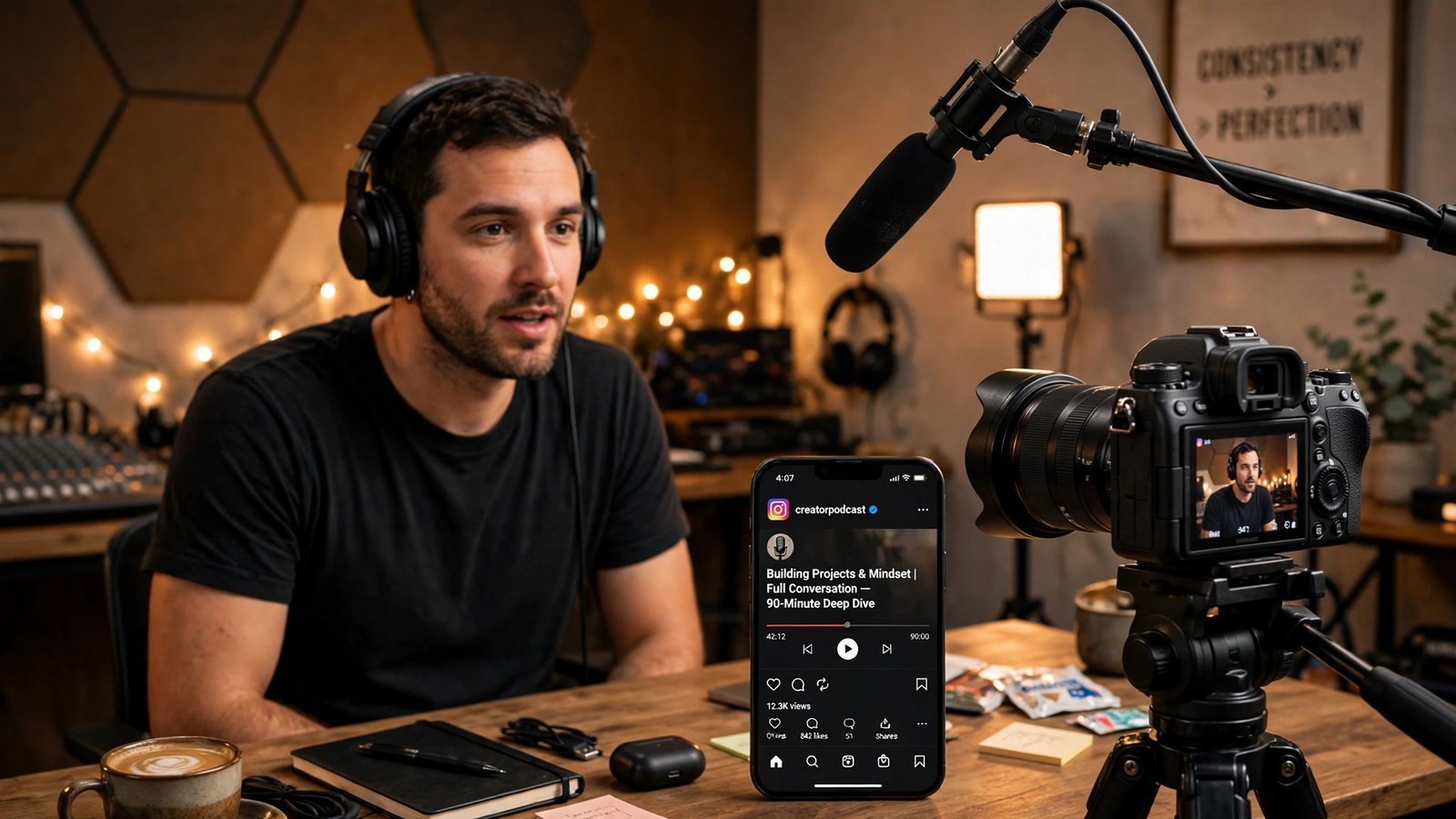
Instagram is paying some creators as much as $500,000 to post long videos on its new Features format — and paying everyone else nothing. Features, announced October 26, 2026, lets creators upload horizontal videos up to 90 minutes long. But unlike YouTube, Instagram has no ad revenue share for these videos. A handful of selected creators get direct deals; the rest get distribution and a promise that Instagram is “exploring” ways to pay them. If you make long-form video, the question isn’t whether Features is exciting. It’s whether the money works — and for most creators, right now, it doesn’t.
What Instagram actually announced on October 26
Features is Instagram’s return to long-form video, and the company announced it with unusual fanfare. Head of Instagram Adam Mosseri and VP of Product Tessa Lyons introduced it in a long-form video and in an interview on The Colin and Samir Show on Monday, October 26, 2026. The format is simple: horizontal videos up to 90 minutes long — about the length of a feature film — aimed at podcasts, vlogs, interviews, comedy sets, and other shows that never fit in a Reel.
The rollout is deliberately small. Features began testing with a small group of creators in the United States, after an earlier test in Brazil, and only creators with individual deals with Meta can post one for now. Instagram says it plans to expand to “tens of thousands of creators” in the US over the coming months, with the format expected to reach all US users by the end of 2026 or early 2027. The videos show up in the main feed, on Explore, and in Instagram’s TV app — the company is clearly chasing living-room watch time, not just phone scrolling.
There’s also a companion tool called Clips, which cuts snippets from a Features video and posts them as Reels with a link back to the full upload. That’s the mechanic Mosseri keeps coming back to: short and long video as “symbiotic,” with a viral 60-second podcast clip sending someone straight to the 90-minute episode without leaving the app. It’s a good product idea. The problem is the pay structure underneath it.
If you want the format details — length limits, where Features appear, how Clips works — our earlier piece on the Features format itself covers that ground. This article is about the economics: who gets paid, what the deal asks for, and what everyone else gets.
The $50,000 to $500,000 deals: what Business Insider reported
Three days after the announcement, on October 29, Business Insider reported how Meta is seeding the format: it’s paying for the content. According to the report by Sydney Bradley and Lucia Moses, citing people familiar with the deals, Meta has offered select YouTubers between $50,000 and $500,000 to post their long-form videos as Features. The floor is $50,000. Several creators received six-figure offers. The largest reach $500,000.
Meta confirmed the program in general terms, without confirming any number. “We’ve been public about the fact that we are funding Features content directly with some creators right now to support them,” a Meta spokesperson told Business Insider. “The details of those deals are confidential, but we’re excited to see the content going live.”
PetaPixel’s coverage of the Business Insider report confirms the same $50,000–$500,000 range and the non-exclusive terms.
Three things about the deal terms matter, and all three come from that same reporting:
The deals are not exclusive. Instagram isn’t asking creators to leave YouTube. People familiar with the agreements told Business Insider the platform asks creators to post their long-form videos as Features on the same day they upload them to YouTube. Meta is paying for parallel availability — the same episode, live in two places at once.
The payment structure is unclear. Tubefilter, covering the Business Insider report, noted that the reporting doesn’t say whether the amounts are paid per video, per month, or as a one-time flat fee. That matters enormously. $500,000 for one video is a different universe from $500,000 spread across a year of weekly episodes. Until a creator talks on the record, you can’t convert these figures into a per-video rate — and anyone who does is guessing.
Nobody will say who got what. Instagram has not named the creators it is funding, said how long the agreements run, or said when it will announce a monetization model open to all Features creators. The deal terms are confidential by design. That means the $50,000–$500,000 range is real reporting, not a rate card. There’s no application, no published eligibility bar, and no way to know if you’d qualify.
Reza Izad, co-CEO at Underscore Talent, which represents creators like Kareem Rahma and Noah Beck, called the deals “an exciting opportunity.” For a creator with an agent and a big enough audience to get the call, they are. For everyone else, they’re a headline.
What everyone else gets: $0 from ads
Here’s the part that set off the creator community within hours of the announcement. Features currently pays creators no share of advertising revenue. Variety reported that Instagram does not plan an ad revenue sharing program like YouTube’s for these videos. A Meta spokesperson told TechCrunch it’s “too early to share a long-term monetization model,” adding that the company is “exploring ways for creators to earn from brands, fans, and Instagram, including performance-based incentives.”
Mosseri addressed the gap directly on October 28, after creators complained on Threads and Reddit. “We understand the economics matter a ton, and are exploring multiple options to help long-form creators get paid,” he wrote.
He was blunter about why there’s no ad share yet. On The Colin and Samir Show, Mosseri called Instagram’s existing performance-based payments to video creators “ROI negative” and said scaling them would mean “burning capital” — while saying Instagram would keep making bespoke deals “to bootstrap the ecosystem.” He also said of the current payment program, “We spend more money than we make back by a long shot,” and that creators “don’t produce a lot more when we pay.”
Read that plainly: Instagram’s leadership believes paying creators per view loses money, so it won’t do it at scale. It will pay a small number of creators directly, as a launch cost, to seed a format it wants. The rest of the creator community gets no platform income from Features at this time. That’s not a bug in the launch. It’s the strategy.
What does exist for unfunded creators? Three things, all secondhand income. Established creators can bring their existing sponsorships into Features — Tessa Lyons told The Hollywood Reporter that brand deals travel with the video, and Meta says it will help creators who don’t have advertisers yet find brand partners. The Clips tool can funnel Reels viewers to the full episode. And the format puts long video in front of an audience that already follows you. None of that is a paycheck from Instagram.
The math: what a flat fee is worth vs. YouTube ad share
The honest way to judge a Features deal is to compare it with what the same video earns on YouTube, where the Partner Program pays creators 55% of ad revenue on long-form videos. YouTube says it has paid more than $100 billion to creators, artists, and media companies over four years.
How much is a long-form video worth on YouTube? According to an analysis by VidIQ, YouTube’s ad revenue share pays creators between $1 and $10 per 1,000 long-form views, depending on niche, audience geography, and advertiser demand. Finance and business content sits at the high end; entertainment and comedy sit lower. I’ll use that range for the math below, and the arithmetic is mine — work it with your own niche’s RPM before making any decision.
| Views on a 90-minute video | Gross ad revenue ($1–$10 per 1,000 views) | Creator keeps at 55% |
|---|---|---|
| 100,000 | $100–$1,000 | $55–$550 |
| 500,000 | $500–$5,000 | $275–$2,750 |
| 1,000,000 | $1,000–$10,000 | $550–$5,500 |
| 10,000,000 | $10,000–$100,000 | $5,500–$55,000 |
Now compare that with the reported Features deals. A $50,000 flat fee equals the YouTube creator earnings of roughly 9 million views at the high end of the RPM range — or about 91 million views at the low end. A $500,000 deal equals roughly 91 million to 909 million views’ worth of ad share. And here’s the part the table hides: YouTube pays every time the video gets watched, for years. A flat fee pays once. A 90-minute episode that finds a long tail on YouTube can keep earning long after a Features check clears.
That’s the real trade-off, and it splits creators into two camps:
If your episode already carries sponsor reads, Features is nearly free money. A podcaster with three host-read ads in every episode gets paid the same no matter where the episode is watched. Instagram puts that episode in front of people who already follow the host, the Clips tool markets the full episode for free, and the sponsor pays the same rate. If Meta also hands you a five- or six-figure deal for the same-day cross-post, you take it. The work is already done — you’re uploading a file you already made.
If you live on YouTube ad revenue, Features pays you nothing extra. A creator whose business is the 55% share gets no new income from posting the same video on Instagram, unless they’re one of the few with a direct deal. The upload costs time, the audience may split between platforms, and the views on Instagram cannibalize nothing on YouTube only if the audiences don’t overlap — which, for most creators, they do.
There’s a third camp worth naming: creators who aren’t big enough to get a deal and don’t have sponsors. For them, Features right now is a distribution bet. You’re posting a 90-minute video into a feed that has never rewarded long video, hoping the Clips funnel and Explore placement build an audience you can monetize later through brands. That might work. It’s also exactly the bet creators made on IGTV.
Why Instagram is paying at all: the IGTV lesson
Instagram has run this playbook before, and it didn’t end well. The company launched IGTV in 2018 as its first long-form video product, funded long-form shows on it in 2021, and shut it down in 2022. Features is, by Business Insider’s own description, the return of IGTV — same ambition, same target (YouTube’s TV watch time), same problem (creators need to get paid, and the platform doesn’t want to pay per view).
The funding pattern is familiar too. In 2021, Meta announced it would pay $1 billion to creators in 2022. Last year, Meta reportedly offered popular TikTok creators deals up to $300,000 to post Reels on Instagram while TikTok faced a potential US ban. The company pays when it needs supply — a new format, a competitive threat — and the payments fade when the strategic need passes. The Reels bonuses, for context, were paused for US creators on June 15, 2026, and only recently returned as a limited invitation-only test. Direct deals are launch fuel, not a business model.
That history is why the confidential, no-rate-card nature of the Features deals matters. There’s no published path from “funded test creator” to “everyone gets paid.” Instagram says it’s exploring performance-based incentives, but it has also said performance-based pay is ROI negative. Until the company publishes terms, the rational assumption is that the funding window is temporary and narrow — and that building a business on it is building on someone else’s launch budget.
What creators are saying
The reaction from long-form creators was fast and blunt. Creator Sidney Raskind wrote on Threads that long-form creators “need ad rev to survive” and called asking them to upload their work without payment “insane.” The complaints spread across Threads and Reddit within hours of the announcement, according to The Verge’s reporting.
Mosseri’s response — that Features isn’t fully launched yet and access is ramping slowly — is technically true and strategically beside the point. The question creators are asking isn’t whether the format will reach them. It’s whether it will ever pay them. “Too early to share a long-term monetization model” is a reasonable sentence from a product team. From a creator deciding where to put a 90-minute episode, it’s a reason to keep YouTube first.
I’ve been watching this space for a while, and the pattern I keep seeing is the same: platforms pay for supply when they need it and stop when they don’t. The creators who come out ahead are the ones who treat every platform payment as a bonus, not a foundation — and who keep the audience relationship somewhere they control, like an email list or a feed subscribers actually own.
What to watch next
Four things will decide whether Features becomes a real income stream or another IGTV:
- The expansion timeline. Instagram plans to reach “tens of thousands” of US creators over the coming months. Watch whether access comes with any monetization terms at all, or just the upload button.
- The first public rate or revenue-share announcement. Any move from “exploring options” to a published split — even a bad one — changes the math for everyone. A 55% share like YouTube’s would make Features a genuine second home for long video. A small performance bonus would not.
- Whether funded creators get extra distribution. Instagram has not said publicly whether funded Features receive a boost in the feed or on Explore. If the paid videos get reach the unpaid ones don’t, the gap between the two tiers is bigger than the money.
- The IGTV clock. IGTV lasted about four years. If Features is still a test with no broad monetization a year from now, treat it as a distribution channel for sponsored content and nothing more.
My advice, if you’re deciding today: if Meta offers you a deal, take it — it’s non-exclusive, the work is an upload of a video you already made, and the money is real. If nobody offers you a deal, post your sponsored episodes to Features and let Clips market them, but don’t build your income plan around Instagram paying you for long video. YouTube’s 55% share is still the only long-form paycheck in town. For a broader sense of how platform payouts compare, our creator revenue splits across 15 platforms puts the Instagram gap in context, and the latest RPM data across YouTube, TikTok, and Instagram shows what long-form views are actually worth.
Frequently Asked Questions
How much does Instagram pay creators for Features videos?
For most creators, nothing — there is no ad revenue share for Features. Business Insider reported on October 29, 2026 that Meta offered select YouTubers $50,000 to $500,000 in direct deals to post long-form videos, but Meta confirmed only that it is “funding Features content directly with some creators right now.” The amounts, the payment structure, and the creators involved have not been made public.
Does Instagram share ad revenue from Features like YouTube does?
No. Variety reported that Instagram does not plan an ad revenue sharing program like YouTube’s for Features videos. YouTube’s Partner Program pays creators 55% of ad revenue on long-form videos. A Meta spokesperson said it is “too early to share a long-term monetization model” for Features and that the company is exploring brand, fan, and performance-based earnings.
Are the Features deals exclusive to Instagram?
No. The deals are non-exclusive. According to people familiar with the agreements, Instagram asks creators to post their long-form videos as Features on the same day they upload them to YouTube. Creators keep their YouTube revenue and audience.
Is the $500,000 paid per video?
Nobody outside the deals knows. Tubefilter noted that the Business Insider reporting does not say whether the amounts are per video, per month, or a one-time flat fee, so the figures cannot be converted into a per-video rate. Treat any per-video math you see as speculation until a creator or Meta confirms the structure.
Who can post Features videos right now?
Only a small group of creators in the US (after an earlier test in Brazil) who have individual deals with Meta. Instagram plans to expand to tens of thousands of US creators over the coming months, with the format expected to reach all US users by the end of 2026 or early 2027. There is no public application process.
Should I post my long videos to Features if I don’t have a deal?
If your episodes carry sponsor reads, yes — the sponsor pays the same and Instagram’s Clips tool markets the full episode for free. If you depend on YouTube ad revenue, Features adds no new income today, so keep YouTube first and treat Instagram as distribution. Don’t build your income plan around Instagram paying for long video until it publishes actual monetization terms.