
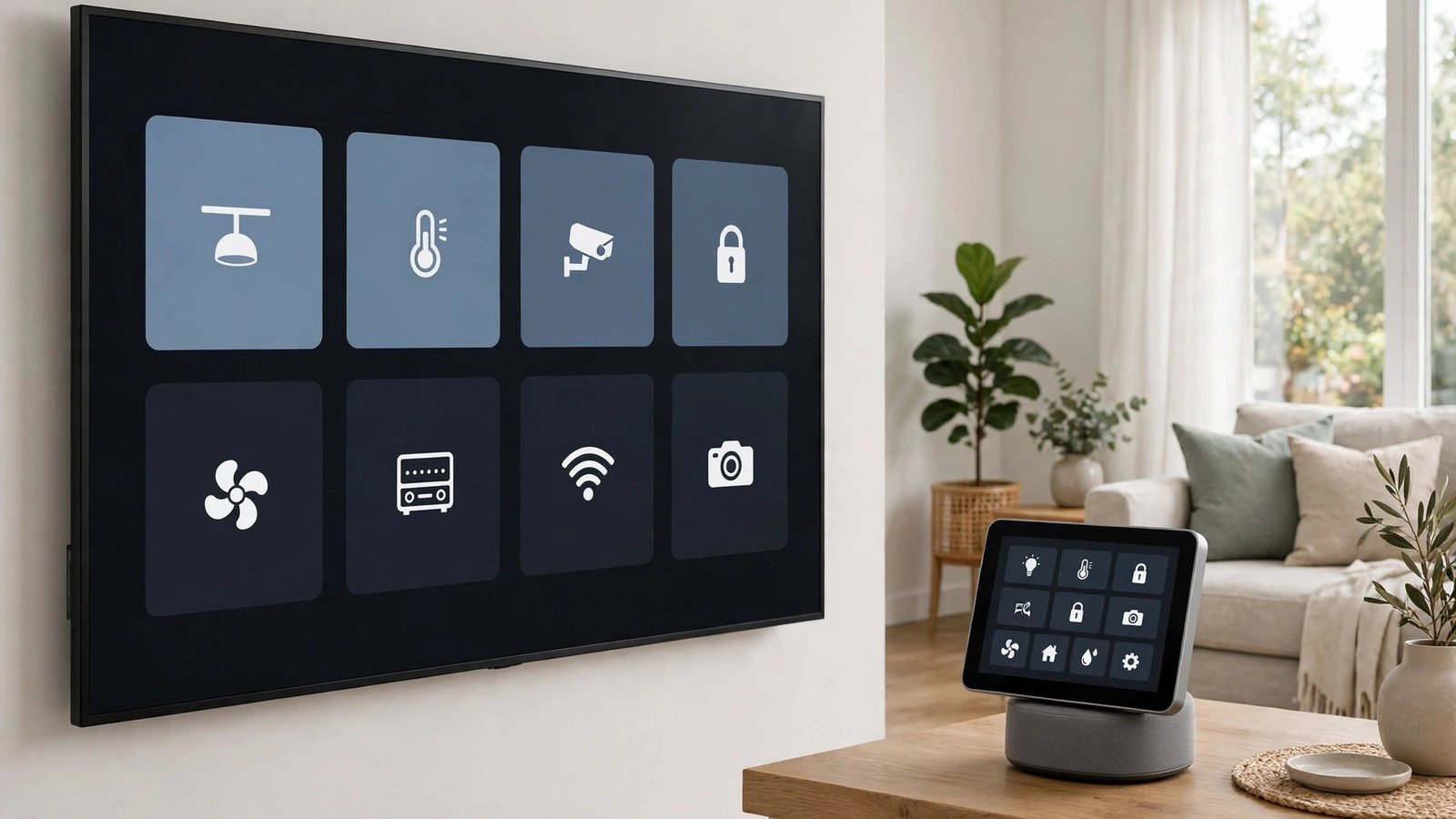
Amazon announced the Echo Show 16 on October 28, 2026, two weeks after Apple announced its first smart display, the HomeView. On paper they are both “smart displays.” In your home they would do completely different jobs, at completely different prices, and buying the wrong one is a $200 to $500 mistake that is easy to make if you shop by the category name alone.
Here is the short version: the Echo Show 16 is a 16-inch wall screen with a full Fire TV experience built in, priced at $499.99 ($569.99 with an anti-glare Nanomatte screen). Apple’s HomeView is a 7-inch countertop display on a speaker base, priced at $299, with a wall-mounted version at the same price. Amazon is selling you a small television that also runs your smart home. Apple is selling you a smart-home command center that also plays music and takes video calls. Which one fits your home depends almost entirely on which of those sentences sounds like what you actually need.
The two devices, side by side
Let us get the verified facts on the table first, because early coverage of both devices disagrees on a few details, and I want to flag where the record is still fuzzy rather than pretend it is settled.
| Amazon Echo Show 16 | Apple HomeView | |
|---|---|---|
| Announced | October 28, 2026 | October 13, 2026 |
| Price | $499.99; $569.99 Nanomatte | $299 (tabletop and wall-mounted) |
| Screen | 16-inch Full HD, 16:9 | 7-inch Liquid Retina, square-ish |
| Availability | Preorder now; Amazon says “later this year” | Preorder now; available November 13, 2026 |
| Camera | 13-megapixel wide-angle, night vision | 12-megapixel Center Stage for FaceTime |
| Speaker | 8 micro woofers + 2 tweeters | Down-firing woofer, 2 full-range drivers, 2 passive radiators (tabletop) |
| Voice assistant | Alexa+ (free with Prime; $19.99/month otherwise) | Siri AI (no separate fee announced; beta in software 27.2) |
| Smart-home radios | Zigbee, Matter, Thread reported by outlets; Amazon’s own spec page had not confirmed them at announcement | Matter-compatible accessories; HomeKit ecosystem |
| Stand/mount | Wall-mountable; stands sold separately (about $69 for a basic stand, $124.99 for adjustable, per early coverage) | Tabletop speaker base included; wall-mounted model sold separately, mounts sold separately |
| TV | Full Fire TV experience built in, remote in the box | No TV operating system; third-party media apps only via CarPlay-compatible apps, per early hands-on coverage |
Two honesty notes on that table. First, the shipping date for the Echo Show 16: Amazon itself has only said “later this year.” Some outlets report December 16, but treat that as an outlet report, not an Amazon promise, until Amazon confirms it. Second, the preorder price: Amazon lists $499.99 and $569.99, with $100 off for preorders reported by several outlets, and some coverage mentions coupons up to $125 off. The list price is firm; the exact discount you see at checkout may vary. Do not budget around a discount until you see it in your own cart.
What Amazon is actually selling: a wall TV for your kitchen
The Echo Show 16 is best understood as a replacement for the Echo Show 15, stretched and sharpened. Amazon says it has 10% more viewing area than the Show 15, a frame nearly 40% thinner, colors twice as vibrant, and 20% more computing power. The screen is Full HD at 16:9, which is the aspect ratio televisions use, and that is not an accident. This device is meant to show video properly: Prime Video, HBO Max, Peacock, YouTube, and the rest of the Fire TV catalog, with a remote in the box.
That TV-first design shapes everything else. The new Screen Styles let you pick a persistent home screen — a family organizer, a smart-home dashboard, an Alexa widgets screen, or a photo frame — that stays on all the time. The 13-megapixel camera adds night vision for the first time on an Echo Show, and Amazon says its Visual ID range extends from 8 feet to up to 17 feet, so the screen can recognize who is standing in front of it from across a large kitchen. The eight micro woofers and two tweeters are, frankly, a small soundbar’s worth of drivers, and early hands-on coverage describes the sound as loud and cinematic.
There is also a quieter change worth noting. Amazon’s Aidan Marcuss confirmed to one outlet that the Alexa Recommendations screen can still show full-screen ads, but only on that screen, and that users can turn them off. The new home screens themselves do not carry ads. If you have lived with an Echo Show that interrupted your photos with promotions, that distinction matters, and the ability to turn the recommendations screen off is worth setting on day one.
The catch is the total price, and it is larger than the headline. The Nanomatte screen adds $70. A stand adds roughly $69 to $124.99 depending on which one you choose. With the adjustable stand, early coverage puts the Nanomatte model at up to $695. And Alexa+ — which Amazon says certain features require — is free with Prime but $19.99 a month for everyone else. If you are not a Prime member, add $240 a year to the real cost of owning the fully-featured version, or be honest with yourself about which features you will actually use without it. Amazon has not published a clean list of exactly which features require Alexa+, which is a gap you should notice before you buy.
What Apple is actually selling: a Home app you can walk up to
Apple’s HomeView takes the opposite approach, and understanding that approach is the key to the whole comparison. The screen is 7 inches — small enough to sit on a counter without dominating the room, large enough to show a dashboard, a recipe, a timer, or a video call. It runs on Apple’s A18 chip, the same chip family as the iPhone 16, and it is built around Siri AI, Apple’s rebuilt Siri, which Apple labels a beta in HomeView software 27.2.
The personalization is the feature Apple is proudest of, and it is genuinely different from Amazon’s approach. HomeView recognizes up to six household members by face and switches to each person’s Home Screen. Shared things like photos and music stay available to the household; personal things like Messages and Calendar appear only when the recognized user’s paired iPhone or iPad is nearby and recently unlocked, with camera and microphone data handled in protected areas of the A18 chip. That is a thoughtful privacy design, and it is also a limitation: several of the headline features require a paired Apple Intelligence-enabled iPhone or iPad, and some recognition and video-description features require a supported iCloud+ plan and compatible cameras. If you are not already deep in the Apple ecosystem, the HomeView will feel like it is holding back features you paid for.
Where HomeView shines is the smart-home dashboard itself. The Home Camera face streams up to nine camera feeds at once. The Home Modular face shows favorite accessories. The screen dims from 500 nits all the way down to 0.3 nits at night, so it can sit in a bedroom or hallway without glowing like a television. The tabletop model sits on a domed speaker base with a stainless steel hinge for angle adjustment; the wall-mounted model is a slim square enclosure about 0.39 inch thick. Both cost $299, which is refreshingly simple after Amazon’s stand-and-screen add-on math.
Where HomeView deliberately does not compete is video. Apple did not put a tvOS-style operating system on it, and early coverage notes that third-party media apps arrive only via CarPlay-compatible apps — an odd limitation that reads like Apple protecting the Apple TV box rather than serving the customer. If your dream smart display is a kitchen television, HomeView will disappoint you on day one, and no software update has been promised to change that.
The decision framework: which home are you buying for?
Forget the spec sheet for a minute. Here is how I would decide, based on the home you actually live in.
Buy the Echo Show 16 if: your kitchen or family room has a wall where a television would be useful, you watch a lot of streaming video while cooking or eating, you are a Prime member (so Alexa+ costs you nothing extra), and your smart home already runs on Alexa, Zigbee, Matter, or Thread devices. The 16-inch screen earns its price only if it replaces a small TV. If it is just going to show the weather, you are paying $500 for a weather widget.
Buy the Apple HomeView if: your household runs on iPhones, you use HomeKit accessories, you want a shared screen that still respects who is standing in front of it, and you want a device that can live in a bedroom or hallway without lighting up the room. The $299 price is the honest price — no stand math, no subscription math — and November 13 availability means you can actually have it before the holidays.
Buy neither yet if: you are not committed to either ecosystem, you want a device that does both jobs well (big-screen video plus deep smart-home control), or you are buying for a household split between iPhone and Android users. No current device serves a mixed household gracefully, and both of these launches are first-generation in their own ways — Apple’s first smart display ever, and Amazon’s first 16-inch Show. Waiting for the first round of real-world reviews, especially on Alexa+ feature gating and Siri AI’s beta rough edges, costs you nothing.
A note on the rest of Amazon’s October 28 lineup: Amazon announced five devices that day, not just the Show 16. The new Echo Dot at $99.99 gains a smart-home hub; the Echo Studio with a home camera costs $249.99; the Echo Time bedside clock costs $199.99; and the Alexa Photo Frame starts at $199.99. If your real need is a bedroom clock, a speaker, or a photo frame, one of those is a better buy than either flagship display. Do not let a flagship launch talk you into a flagship purchase.
The ecosystem trap, stated plainly
Here is the part of this comparison that no spec table captures, and it is the part that will decide whether you are happy in six months. Both devices are ecosystem plays, and both companies are pricing the hardware to pull you deeper into their world.
Amazon’s play is Prime plus Alexa+. The Show 16 is cheapest, in total cost of ownership, for a Prime member with Alexa devices. For a non-Prime household, the $19.99 monthly Alexa+ fee quietly turns a $500 purchase into a $740 first-year purchase, and Amazon has not been transparent about which features sit behind that paywall. Apple’s play is the iPhone. The HomeView is cheapest, in practical terms, for a household where everyone carries a recent iPhone, uses iCloud+, and buys HomeKit gear. For an Android household, it is a $299 screen with several features grayed out.
That is why my advice is to count your household’s devices before you count the dollars. Walk through your home and list what you already own: how many Echo devices, how many HomePods or Apple TVs, which smart lights and locks, whose phones. The device that matches the list you already have is almost always the right buy, even if the other device wins on paper. A smart display that cannot talk to your lights is not a smart display; it is a very expensive clock.
For context on Apple’s side of this ecosystem, our coverage of Siri AI in five languages on iOS 27.2 explains what the rebuilt Siri can actually do today, and our iPhone Duo buy-or-wait guide covers another expensive Apple launch where the ecosystem question mattered more than the spec sheet.
The bottom line
If I had to pick one sentence for each device, it would be this. The Echo Show 16 is the better television and the better large-room screen, and its price only makes sense if you use it as one. The Apple HomeView is the better smart-home dashboard and the better small-room companion, and its price only makes sense if you live in Apple’s world. Neither is a bad product. They are just products for different homes, launched two weeks apart, sharing a category name that hides how different they are.
My own verdict, if you forced me to choose for a typical US household that already has Prime and a couple of Echo speakers: the Show 16 is the more versatile device, but wait until Amazon confirms a ship date and publishes exactly which features need Alexa+. If your household is all-iPhone and you want something before the holidays, the HomeView at $299 on November 13 is the safer, simpler buy — and the one you are less likely to regret when the credit card statement arrives.
Frequently Asked Questions
How much does the Echo Show 16 cost in total?
The list price is $499.99, or $569.99 with the Nanomatte anti-glare screen. Stands cost extra (about $69 to $124.99 in early coverage), and Alexa+ is free with Prime or $19.99 a month otherwise. Check your cart for the actual preorder discount before budgeting, as reported discounts have varied.
When will the Echo Show 16 ship?
Amazon has only said “later this year.” Some outlets report December 16, but that is an outlet report, not an Amazon-confirmed date. The Apple HomeView, by contrast, has a firm date: November 13, 2026.
Is the Apple HomeView just a small Echo Show?
No. The HomeView is a 7-inch smart-home display built around Siri AI and HomeKit, with face recognition for up to six household members and a screen that dims to 0.3 nits. It has no Fire TV-style television experience, and third-party media apps are limited compared with the Echo Show 16.
Does the Echo Show 16 work without Prime?
Yes, but certain features require Alexa+, which is free with Prime and $19.99 a month for everyone else. Amazon has not published a complete list of which features require Alexa+, so non-Prime buyers should confirm the features they care about before purchasing.
Which is better for a bedroom?
The HomeView, on paper: its screen dims to 0.3 nits, and its wall-mounted version is slim and quiet-looking. The Echo Show 16 is a 16-inch television-class screen, which is a lot of light and presence for a bedroom unless you specifically want a bedroom TV.
Should I wait for reviews before buying either?
Yes, if you can. Both are effectively first-generation in their current form — Apple’s first smart display, and Amazon’s first 16-inch Show with the new Screen Styles and Alexa+ gating. Early hands-on coverage is promising for both, but independent long-term testing of battery-free, always-on displays, camera privacy, and subscription gating has not happened yet. For the latest on Amazon’s full lineup, see The Shortcut’s Echo Show 16 launch coverage and the detailed spec breakdown at SmarterHome.guru.