
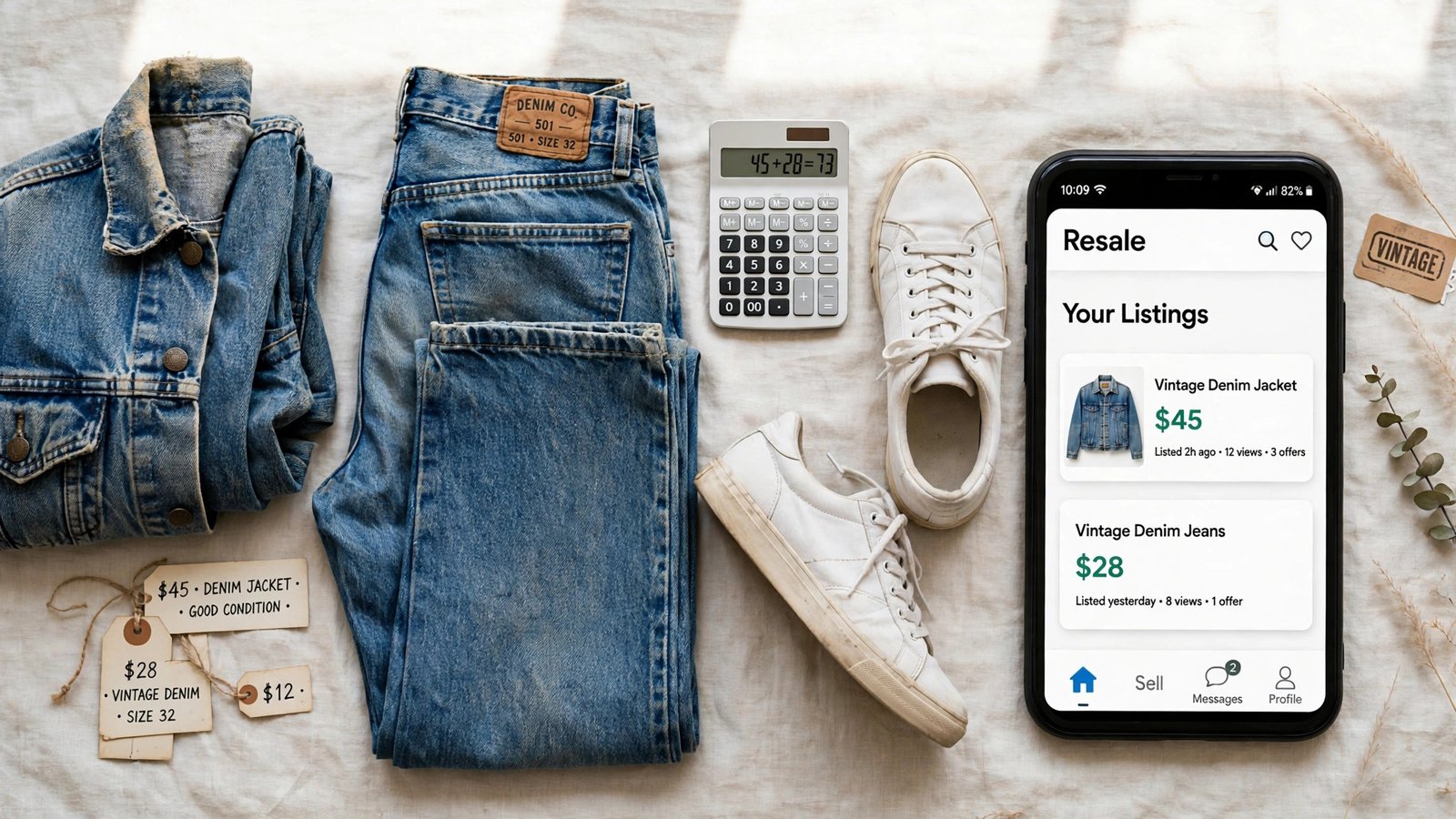
The short answer: Depop takes no selling fee in the US — but selling is not free
If you sell on Depop in the United States in 2026, Depop charges you 0% selling commission on current listings. What you do pay on every sale is a payment processing fee of 3.3% + $0.45, calculated on the item price plus shipping plus sales tax. If you turn on Boosted Listings and the sale comes through a boosted tile, add 12% of the item price on top.
That one paragraph corrects the number most old guides still get wrong. For years Depop charged a flat 10% selling fee, and a huge amount of search results, calculators, and even AI summaries still quote it. The 10% fee ended for new US listings on July 15, 2024, and for new UK listings on March 20, 2024. Australia followed on July 22, 2026. If you are still subtracting 10% from every Depop sale in your head, you are underpricing your profit — or overpricing your listings to cover a fee that no longer exists.
But the opposite mistake is just as costly. “No selling fee” is not the same as “free to sell.” Processing fees, the buyer-side marketplace fee that quietly changes what buyers will pay, the 12% boost fee, shipping labels, and packaging all eat into the same sale. This guide works through each cost with real numbers, compares Depop honestly against Poshmark, Mercari, eBay, and Vinted, and ends with a pricing checklist you can use before you list your next item.
A quick note on sources: fee figures below come from Depop’s own fee pages as reported by multiple independent 2026 guides, cross-checked against each other in October 2026. Where guides disagree — and they do, especially on older listings — this article says so plainly and tells you what to check in your own account. Depop can change its fee schedule, so treat the live fee page in your seller account as the final word before a big pricing decision.
How Depop’s fees changed — and why so many guides are still wrong
Depop’s old model was simple: 10% of every sale went to Depop, plus payment processing. The new model, rolled out market by market, flips the burden. Sellers in the US, UK, and Australia now pay no commission. Instead, Depop makes its money from payment processing, from an optional promotion product, and from a fee buyers pay at checkout.
The staggered rollout is exactly why the internet is full of wrong numbers. A guide written in 2023 was right then and wrong now. A guide written for the UK in early 2024 may describe a different launch date than the US one. A calculator that has not been updated since the 10% era will happily tell you that a $50 sale costs $5 in commission, when the real seller-side cost today is $2.10 in processing (on a $50 item with no separate shipping charge).
There is one more wrinkle worth knowing. The 0% rate applies to current listings. Sellers with very old listings — items listed before mid-2024 that were never edited or refreshed — have reported that those listings can still sit under the old fee structure. The fix sellers recommend is boring but effective: open each old listing, edit it, and save it again so it falls under the current terms. If you have a shop full of listings from 2023 or earlier, do not assume they are all on the new rate until you have checked a recent sale receipt. Your receipt shows the exact charges for that sale, and it is the best audit tool you have.
Every fee a US seller can face, line by line
1. Selling fee: 0% on current US listings
This is the headline, and it is real. List an item, sell it, and Depop takes no percentage commission from you. There is also no listing fee for putting the item up in the first place. You can list freely and only pay when something sells, which makes Depop unusually friendly for casual sellers clearing out a closet and for resellers testing whether an item has a market at all.
2. Payment processing: 3.3% + $0.45 per transaction
This is the fee you will pay on every single sale, and it is the one most sellers underestimate because of what it is calculated on. The rate is 3.3% plus a fixed $0.45, charged through Depop Payments (Stripe) on the total the buyer pays: item price + shipping + sales tax.
That base matters. If you sell a $20 shirt, charge $8 shipping, and the buyer’s state adds $2 in tax, the processing fee is calculated on $30, not $20. That is $1.44 instead of $1.11. The difference looks small on one sale and adds up across a hundred.
Worked examples, assuming the buyer pays no separate shipping beyond what is included in the total shown:
| Sale total | Processing fee (3.3% + $0.45) | You keep before other costs |
|---|---|---|
| $25 | $1.28 | $23.72 |
| $40 | $1.77 | $38.23 |
| $50 | $2.10 | $47.90 |
| $100 | $3.75 | $96.25 |
| $200 | $7.05 | $192.95 |
On a $50 item with no shipping or tax in the total, you keep $47.90. Compare that with the old 10% world, where the same sale would have cost $5 in commission plus processing on top. The saving is real — roughly $3 to $4 on a $50 sale — and it is the main reason Depop is now one of the cheapest major resale apps for sellers.
3. Boosted Listings: 12% in the US, only when a boosted sale happens
Boosted Listings is Depop’s optional promotion product. You opt an item in, and it gets an extra tagged placement in search results and in “Suggested for you,” alongside its normal organic spot. You pay nothing up front. You pay 12% of the item price (US and UK sellers, on new listings from March 23, 2026; sellers elsewhere pay 8%) only if a buyer who viewed, clicked, or liked the boosted listing then buys it within 28 days.
Three details catch sellers out. First, the 12% is calculated on the item price — and on self-arranged shipping if you did not use a Depop Shipping label — but not on taxes or Depop label costs. Second, turning a boost off does not end the window: a buyer who saw the boosted version before you switched it off can still trigger the fee if they buy within 28 days. Third, you are only charged when the sale actually traces back to the boosted tile. If someone finds the item organically without ever seeing the boost, there is no boost fee.
Here is what the boost does to the same $50 sale: processing $2.10 plus a $6.00 boost fee equals $8.10 in total fees, leaving $41.90. On a $100 sale, the boost costs $12, taking total fees to $15.75. That is still cheaper than Poshmark’s 20%, but it is a very different business than the “free” sale you started with. Boosting is a tool for slow-moving stock, not a default setting.
4. The buyer-side marketplace fee: up to 5% + $1
Since July 2024, buyers on Depop pay a marketplace fee of up to 5% of the item price plus up to $1 per order, on top of your asking price. You do not pay this fee directly, so it does not appear on your receipt as a deduction. But it absolutely affects you, because it raises the total the buyer sees at checkout.
Think about it from the buyer’s side. Your $40 vintage tee is not a $40 purchase to them — with shipping and the marketplace fee, the checkout total can push past $50. That changes offer behavior. Buyers negotiate harder, abandon carts more, and compare your total against Vinted or Poshmark totals, not just your tag price. When you price, price for the checkout total, not just the tag. A $2 lower tag that keeps the checkout total under a psychological threshold can outsell a stubbornly “fair” price.
5. Shipping labels, packaging, and payout timing
Depop Shipping labels, bought through the app, are deducted separately from your payout, and the label cost depends on weight and service. Arranging your own shipping can be cheaper for heavy or awkward items, but then the boost fee base and the processing base treat shipping differently, so run both versions before you commit.
Payout timing also affects cash flow. For US sellers using Depop Payments, tracked orders typically pay out 2 business days after delivery, or 10 business days after the sale if no tracking is provided — whichever comes first. Untracked shipping is not just riskier for disputes; it can leave your money sitting for over a week longer. Ship with tracking, upload it promptly, and your payout clock starts on delivery, not on guesswork.
The same item on five platforms: what you actually keep
Fee tables are abstract. The table below prices one item — a $50 vintage jacket, no separate shipping charge, no boost — across the major US resale platforms using their 2026 seller-side rates. Processing is included where the platform bundles it, and shown separately where it does not.
| Platform | Seller fee | Payment processing | Total fees on $50 | You keep |
|---|---|---|---|---|
| Depop (no boost) | 0% | 3.3% + $0.45 | $2.10 | $47.90 |
| Vinted | 0% | 0% (buyer pays 5% + $0.70) | $0 | $50.00 |
| Mercari | 10% | Included in most cases | $5.00 | $45.00 |
| eBay (typical clothing) | ~13.6% final value fee | Included + $0.40 order fee | ~$7.20 | ~$42.80 |
| Poshmark ($15+) | 20% | Included | $10.00 | $40.00 |
Depop with a boost sits between Mercari and eBay on this table: $8.10 in fees, $41.90 kept. That ranking tells you when each platform earns its place. Vinted wins on pure fees, but its buyer base and search behavior differ, and not every item that sells on Depop sells on Vinted. Poshmark costs the most, but its prepaid label, social-sharing engine, and buyer pool for brand-name pieces can justify the cut on the right item. eBay reaches the widest audience but charges for it.
For a fuller walkthrough of another platform’s payout math, see our Mercari seller fees and payout calculator. And if you sell digital products alongside physical resale, the same habit — pricing from the payout backwards, not from the tag forwards — applies; see our Etsy digital sellers fee math for Q4 2026.
The honest takeaway is not “Depop always wins.” It is that Depop wins on fees for fashion, vintage, and streetwear where its audience already shops, and loses its edge the moment you boost everything or list items its buyers are not looking for. Fees are only one side of the sale. Audience fit is the other, and no fee saving rescues a listing in front of the wrong buyers.
When boosting is worth 12% — and when it is not
Boosting has a bad reputation among sellers who turned it on for everything and watched 12% disappear from sales that might have happened anyway. Used narrowly, it makes sense. Use this decision framework before you boost:
Boost when: the item has sat for three or more weeks with views but no offers; it is a higher-priced piece where 12% still leaves a healthy margin; you have checked your Shop Stats and the item is getting impressions but not clicks, which suggests a visibility problem rather than a price problem; or you are clearing seasonal stock before it goes stale.
Do not boost when: the item is newly listed and has not had time to find its audience organically; your margin is already thin after sourcing, shipping, and packaging; the item is priced at the top of its range and the boost fee would push you below your walk-away price; or you are boosting out of impatience rather than data. A boost does not fix a bad photo, a vague title, or a price $15 above every comparable sold listing.
A practical rule many full-time resellers use: boost no more than 10–20% of your active listings at any time, and only the ones where you have already fixed the listing itself — clear title with brand, size, and era; real measurements; honest condition notes; and photos that show flaws as well as the good angles. Boosting a weak listing just pays Depop to show more people a listing they will not buy.
Also remember the 28-day attribution window when you evaluate results. If you boost on Monday, turn it off on Friday, and the item sells the following month to someone who clicked the boosted tile, the fee still applies. Judge a boost by the sales it can be linked to over a full month, not by the first week’s numbers.
Pricing from the payout backwards: a worked example
Here is the pricing habit that separates sellers who make money from sellers who stay busy. Start with the number you want to keep, then add back every cost.
Say you thrifted a pair of vintage jeans for $8, and you want to keep $30 after all Depop costs on a non-boosted sale with $7 buyer-paid shipping and no tax in the example for simplicity. The buyer pays item price + $7 shipping. Processing is 3.3% of the total plus $0.45.
Work backwards: if the item price is $38, the total is $45. Processing is 3.3% of $45 ($1.49) plus $0.45, which is $1.94. Your payout is $45 minus $1.94 minus the shipping label cost you actually pay — if the label costs $7, your net after shipping is $36.06, minus your $8 sourcing cost and roughly $1 in packaging, leaving about $27. That is close to your target but short of it. At a $42 item price, the total is $49, processing is $2.07, and after a $7 label, $8 sourcing, and $1 packaging, you land near $30.90.
Now run the same item boosted: at $42, the boost fee is 12% of $42, which is $5.04, taking your net down to about $25.86. If $30 is your floor, you either do not boost this item, or you price it near $47 before boosting. That is the entire game in one paragraph: every fee is small on its own, and together they decide whether the item was worth listing.
Keep a simple spreadsheet with five columns — item price, shipping, processing, boost fee if any, and net after sourcing and packaging — and fill it in before you list, not after the sale. Ten minutes of pricing math per batch of listings saves the slow bleed of discovering your margins only when the payout lands.
Five traps that quietly shrink Depop payouts
Trap 1: Pricing off the item price alone. Processing is charged on item + shipping + tax. If you charge shipping separately, your fee base is bigger than your tag. Always calculate on the checkout total.
Trap 2: Forgetting the buyer sees a higher total. The marketplace fee, shipping, and tax stack on top of your price. If your item looks $5 cheaper than a competitor’s but costs $3 more at checkout, you are not actually cheaper.
Trap 3: Boosting by default. A 12% fee on a sale that would have happened organically is pure margin given away. Boost deliberately, for slow stock, and measure over 28 days.
Trap 4: Letting old listings sit on old terms. Refresh pre-mid-2024 listings by editing and saving them, and verify with a recent receipt that the 10% commission is gone from your sales.
Trap 5: Shipping without tracking. Beyond dispute risk, untracked orders delay payout to the 10-business-day fallback. Tracking is cheap insurance for both your money and your seller standing.
Selling on Depop in 2026: a pre-listing checklist
Use this checklist for every batch before you hit publish:
- [ ] Refresh old listings. Edit and save any listing created before July 2024 so it sits under the current 0% terms.
- [ ] Calculate the payout first. Item price + shipping + estimated tax, minus 3.3% + $0.45, minus label, packaging, and sourcing costs. Boost fee added separately if you plan to boost.
- [ ] Check the checkout total. Add the buyer’s marketplace fee (up to 5% + $1) and shipping to your tag price. Is the total still competitive?
- [ ] Fix the listing before boosting. Title, measurements, condition notes, and honest photos first; boost only after the listing itself is strong.
- [ ] Ship with tracking the same day when possible. Faster delivery means faster payout and fewer “where is my order” messages.
- [ ] Read one recent receipt. Confirm the fees deducted match what you expected. If they do not, you have found a pricing error before it repeats across fifty sales.
The bottom line
Depop in 2026 is genuinely one of the cheapest places to sell clothes online in the US — 0% commission, 3.3% + $0.45 processing, and no listing fee is a strong deal. But the deal has edges: the processing base includes shipping and tax, buyers pay their own fee that shapes what they will offer, and the optional 12% boost fee can quietly turn your cheapest channel into a mid-priced one. Sellers who price from the payout backwards, boost only slow stock, and keep their old listings refreshed will keep most of what Depop’s fee change gave them. Sellers who trust a three-year-old fee guide — or who boost everything and hope — will give a good chunk of it back.
Not professional financial or tax advice. Fee schedules change; confirm the current rates on Depop’s fee pages and in your seller account before pricing a large batch, and keep your own sale receipts as the record of what you were actually charged.
Frequently Asked Questions
Does Depop charge sellers a fee in 2026?
US, UK, and Australian sellers pay no Depop selling commission on current listings. Every sale still carries a payment processing fee — 3.3% + $0.45 in the US — calculated on the item price plus shipping plus sales tax.
How much does Depop take from a $50 sale?
On a $50 item with no separate shipping charge and no boost, Depop takes $2.10 in processing (3.3% + $0.45), leaving $47.90 before your sourcing, packaging, and shipping-label costs. With a Boosted Listings sale, add $6.00 (12%), for $8.10 in total fees and $41.90 kept.
What is Depop’s Boosted Listings fee in the US?
12% of the item price for US and UK sellers on new listings from March 23, 2026, charged only when a buyer who interacted with the boosted listing buys within 28 days. Sellers outside the US and UK pay 8%. You can unboost at any time, but the 28-day attribution window still applies to earlier interactions.
Do buyers pay a fee on Depop?
Yes. Buyers pay a marketplace fee of up to 5% of the item price plus up to $1 per order, on top of the seller’s price, shipping, and tax. Sellers do not pay this fee directly, but it raises the buyer’s checkout total and affects offers and conversions.
Is Depop cheaper than Poshmark?
On fees alone, yes, by a wide margin. A $50 sale costs $2.10 on Depop without a boost versus $10.00 on Poshmark (20% on sales of $15+). Poshmark’s prepaid label and different buyer pool can still make it the right choice for certain brand-name pieces, but Depop wins the fee comparison for most fashion resale.
Do old Depop listings still pay the 10% fee?
Listings created before the 0% change in mid-2024 may still sit under old terms until they are refreshed. Edit and save older listings to bring them under the current terms, and check a recent sale receipt to confirm the commission is gone before assuming every listing in your shop is on the new rate.
Sources and further reading
- How much Depop takes from sellers in 2026: https://www.lilachbullock.com/how-much-does-depop-take/
- Depop fee examples and Boosted Listings rates: https://nifty.ai/post/how-much-does-depop-take-from-a-sale
- Full Depop selling guide for vintage resellers: https://www.underpriced.app/blog/depop-selling-complete-guide-2026
- Depop’s official Boosted Listings help page: https://depophelp.zendesk.com/hc/en-gb/articles/10110299060753-Boosted-Listings