
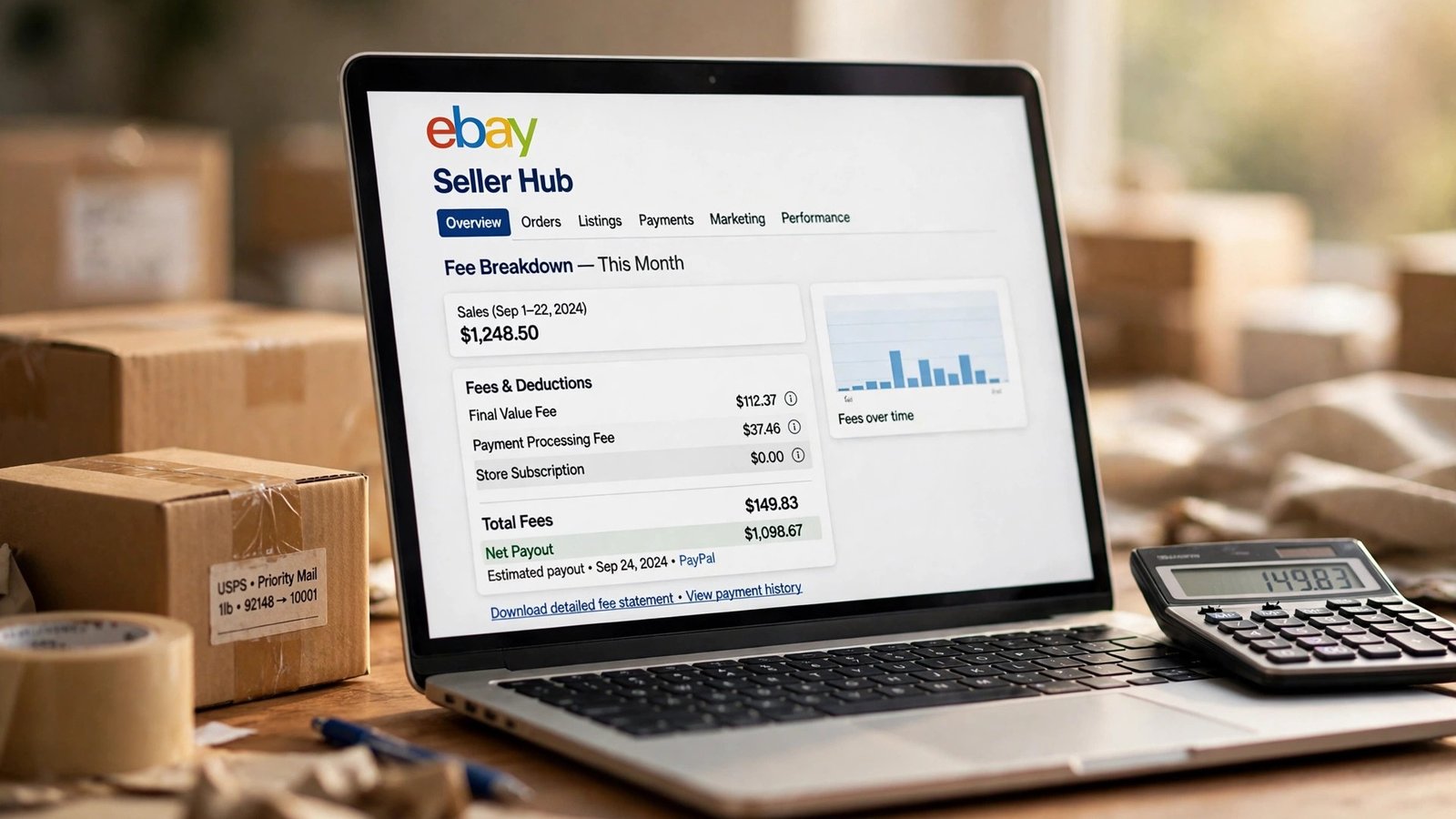
On a $100 sale with free shipping, eBay takes roughly $14 before you see a dime. That’s the short version of eBay seller fees in 2026: a 13.6% final value fee on the total amount the buyer pays (item price plus shipping plus sales tax), a $0.30–$0.40 per-order fee, and a stack of conditional fees that only apply if you sell internationally, run ads, or dip below performance standards.
And one of those conditional fees just went up. On October 14, 2026, eBay raised the seller currency conversion charge for US and Canadian sellers from 3% to 3.25%, with Australia, the UK, and several European markets following over the next two months. It’s a small number, but it compounds on cross-border sales — and it’s the one change most fee guides written earlier this year don’t mention.
Here’s every fee eBay can charge you in 2026, with worked receipt math so you can price your listings like a grown-up.
The complete 2026 fee stack, at a glance
Nine possible fees. Only two apply to every single sale — the final value fee and the per-order fee. The rest are conditional: they hit only if you sell across borders, exceed your free listings, subscribe to a Store, promote listings, or get flagged for poor performance.
| Fee | When it applies | 2026 amount |
|---|---|---|
| Insertion fee | Beyond your monthly free allowance | $0.35 per listing |
| Final value fee (FVF) | Every sale | 13.6% of total sale (item + shipping + tax), up to $7,500 |
| Per-order fee | Every sale | $0.30 (orders ≤$10), $0.40 (orders >$10) |
| International fee | Buyer/delivery address outside the US | 1.65% of total sale |
| Currency conversion charge | Non-US site payout in different currency | 3.25% for US sellers (from Oct 14, 2026) |
| Regulatory operating fee | Most US states | ~0.35% of total sale |
| Promoted Listings | Only if you run ads | The ad rate you set (2%–100%) |
| Below Standard surcharge | Poor seller performance | +6% FVF (+7% after 4 consecutive months) |
| Dispute fee | Payment disputes | $20 per dispute |
The one fee most sellers feel first is the final value fee — so let’s start there.
The final value fee: 13.6% of everything the buyer pays
eBay’s final value fee in 2026 is 13.6% of the total amount the buyer pays for most categories — and “total amount” is doing a lot of work in that sentence. eBay charges the 13.6% on the item price plus the shipping charge plus the sales tax collected. It’s capped: the fee only applies up to a $7,500 total per order (so very expensive single orders get a break at the top end).
Two things to note. First, categories vary: most sit at 13.6%, but some categories carry lower rates (collectibles like trading cards can be lower; jewelry has its own tiered structure). Second, your seller level moves the number: Top Rated Plus sellers earn a 10% discount on the final value fee on qualifying listings, while Below Standard sellers pay an extra 6% on top — turning 13.6% into 19.6% overnight. That’s the fee most likely to blindside you, and we’ll come back to it.
Then there’s the per-order fee: $0.30 on orders of $10 or less, $0.40 on orders above $10. It sounds trivial until you sell a $6 phone case and realize the per-order fee alone ate 5% of the sale.
What changed October 14, 2026: the currency conversion increase
This is the 2026-specific piece that old guides miss. When you sell on a non-US eBay site or get paid in a currency different from your payout currency, eBay builds its currency conversion charge into the transaction exchange rate. For US and Canadian sellers, that charge went from 3% to 3.25% on October 14, 2026. The rollout continues elsewhere: Australia moves to 3.25% on November 1, the UK goes from 2.5% to 2.75% on December 1, and Germany, France, Italy, and Spain move from 3% to 3.25% on December 2.
Separate from the conversion charge is the international fee: 1.65% of the total sale for US sellers when the buyer’s registered or delivery address is outside the US. The conversion charge is baked into the exchange rate on top of that. So a US seller shipping to the UK post-December can face 1.65% + 2.75% stacked on top of the standard 13.6% — roughly 17.9% before the per-order fee even shows up. One caveat that matters: the international fee is waived if you use eBay International Shipping (the program where you ship to a domestic eBay hub and eBay handles the rest), which is a real lever on cross-border math.
Worked receipt: what eBay keeps on a $50 sale
Numbers make this concrete. Take a $50 item, $8 shipping, buyer in a 7% sales-tax state ($4.06 tax). The buyer’s total: $62.06.
| Line | Math | Amount |
|---|---|---|
| Final value fee | 13.6% × $62.06 | $8.44 |
| Per-order fee | Order > $10 | $0.40 |
| Regulatory operating fee | ~0.35% × $62.06 | $0.22 |
| Total eBay cut | $9.06 | |
| Your payout before costs | $62.06 − $9.06 | $53.00 |
That’s a 14.6% effective take on the buyer’s total — higher than the headline 13.6% because of the fee-on-tax-and-shipping structure. If you price your listing thinking “eBay takes 13.6%,” you’re underestimating by about a point on every domestic sale. Scale it up and it stays consistent: on a $100 item with free shipping, the cut lands around $14.
Now the cross-border version. Same $50 item, buyer in Germany, no tax, shipping $14 to Germany. Buyer’s total: $64.
| Line | Math | Amount |
|---|---|---|
| Final value fee | 13.6% × $64 | $8.70 |
| Per-order fee | Order > $10 | $0.40 |
| International fee | 1.65% × $64 | $1.06 |
| Currency conversion | ~3.25% baked into exchange | ~$2.08 |
| Total eBay cut | ~$12.24 |
That’s roughly a 19% effective rate versus ~14.6% domestic. Unless your item has real international demand — vintage clothing, trading cards, collectibles — the extra margin often isn’t worth the hassle. Use eBay International Shipping to kill the 1.65% and see if the conversion charge alone still pencils out.
Small sales get squeezed: the per-order fee trap
The per-order fee is flat, which makes it regressive. On a $6 sale it’s 5%; on a $7 sale it’s 4.3%; on a $200 sale it’s 0.2%. Add the $0.22 regulatory fee and 13.6% FVF on a $6 item and you’re at roughly 24% before shipping costs. This is why veteran sellers quietly stopped listing sub-$10 singles years ago — or moved them into multi-quantity listings so the flat fee spreads across units. If your average sale price is under $15, raising the order minimum (bundles, two-packs, add-on items) is the single highest-leverage fee move you have.
Store tiers: when the subscription pays for itself
Sellers without a Store get 250 free listings a month, then pay $0.35 per extra listing. Store subscriptions start at $4.95/month (Starter, annual) and run up to the Anchor tier at $2,999.95; the popular Basic Store is $21.95/month and raises the free-listing allowance to 1,000. Store tiers also trim the final value fee by roughly 0.3–0.5 percentage points in many categories.
The break-even is simpler than eBay’s marketing makes it look. Take the $17.50/month question: 300 listings a month means 50 listings over your free 250, costing $17.50 in insertion fees at $0.35 each. Basic at $21.95 gives you 1,000 free listings — you only save about $17.50 on insertion fees alone, so the subscription doesn’t pay for itself on listings until you’re well past 350–400 listings a month. The real payoff comes from the FVF discount: at a $40 average sale and 100 sales a month, a 0.3% FVF reduction saves $12/month. Add that to the insertion-fee savings and Basic starts making sense around 50–75 active listings — exactly what experienced sellers say in practice.
Quick framework:
– Under 250 listings/month, occasional seller: No store. Pay the occasional $0.35.
– 250–1,000 listings/month: Basic ($21.95/mo) — do the FVF-discount math on your own categories first.
– Thousands of listings/month: Premium/Anchor — at that scale the lower fees and higher allowances pay for themselves several times over.
Don’t buy a Store for the badge. Buy it when your own numbers cross the line.
Promoted Listings: the fee nobody budgets for
Promoted Listings (General) charges only when someone buys through your ad — at the ad rate you set, typically 2–10%, charged on the total sale. Stack it with the final value fee and the math gets heavy fast: a 5% ad rate on top of 13.6% FVF means you’re paying 18.6% plus the per-order fee on promoted sales. On competitive categories like sneakers and electronics, 2–4% is a reasonable starting point; above 8% it eats margins fast. The discipline is simple: only promote items with enough margin to absorb the ad rate, and turn it off on anything that’s been sitting for months without selling at a lower rate — the ad can’t fix a listing with bad photos or a bad price.
The performance surcharge that turns 13.6% into 19.6%
This is the fee sellers talk about most angrily in the forums. If eBay rates your account Below Standard — too many transaction defects, cases closed without resolution, late shipments, missing tracking — you pay an additional 6% on every final value fee starting the month after the poor evaluation. Four consecutive bad months and it becomes 7%. On the flip side, Top Rated Plus earns a 10% discount on the final value fee on qualifying listings (the discount doesn’t apply to the per-order fee).
The math: a $62.06 sale at Below Standard costs 19.6% × $62.06 = $12.16 in FVF alone — nearly $4 more per sale than a healthy account, every single sale, all month. On 200 sales a month that’s roughly $800 in penalty fees. Uploading tracking on time and resolving cases quickly is not customer-service fluff; it’s the cheapest fee-reduction program eBay offers.
There’s also the $20 dispute fee on payment disputes you’re responsible for — non-refundable even if you win — which is a separate reason to respond to buyer messages fast and issue proactive refunds when you’re in the wrong.
What real sellers actually say
The community threads are blunt about the gap between the headline rate and the lived experience. On the eBay Community boards, sellers repeatedly flag that the fee applies to shipping and sales tax, not just the item price — as one seller put it, “eBay takes its final value fee on the item plus shipping plus tax and adds a per-order fee… so it often feels like 20%+ in real life” (thread). Another long-time seller who’s been on the platform since 2001 noted the trajectory: “Back in the day, I was paying 9% on the final value fee… eBay is literally profiting off of tax money.”
On the other side, cooler heads in the same forums push back on fee-panic posts: “For users of eBay’s US site, ebay.com, no eBay fees are being raised at this time… The sky is not falling” (thread). Both sides are right in a way: the base rates genuinely haven’t moved, but the total bite has grown through per-order fees, conversion charges, and the fee-on-tax structure. Knowing the full stack is what separates the sellers doing math from the sellers doing vibes.
How eBay’s fees compare to other marketplaces
Fee-wise, eBay sits in the middle of the pack. Amazon’s FBA ecosystem typically lands higher once fulfillment and storage fees stack up (see our Amazon FBA fees 2026 seller math breakdown), while Depop now runs 0% selling fees for US sellers (processing only) — a very different trade for resellers choosing a channel. For a deeper look at how Amazon reclassified categories and fees this October, see Amazon’s October fee and ASIN changes. eBay’s edge is reach plus simplicity: one fee schedule, no fulfillment warehouse, and categories where 13.6% beats Amazon’s referral-plus-FBA combo by a wide margin.
The bottom line
eBay seller fees in 2026 aren’t a single number — they’re a stack, and the stack is what you have to price against. Budget 14.6–15% on a typical domestic sale (FVF + per-order + regulatory fee), add 4–5 points more for cross-border once the October currency conversion increase is in your window, and treat the Below Standard surcharge as a fire to avoid rather than a bill to pay. The sellers who win on eBay aren’t the ones with the lowest fees — they’re the ones who priced every fee in before they listed.
Frequently Asked Questions
How much does eBay charge per sale in 2026?
For most categories, eBay charges a 13.6% final value fee on the total amount the buyer pays (item price + shipping + sales tax, up to $7,500), plus a $0.30 per-order fee on orders of $10 or less or $0.40 above $10. Most US sales also carry a ~0.35% regulatory operating fee. On a typical domestic sale, expect about 14.6–15% total before any optional fees.
What changed about eBay fees in October 2026?
eBay raised the seller currency conversion charge for US and Canadian sellers from 3% to 3.25%, effective October 14, 2026. Australia follows on November 1, the UK (2.5% to 2.75%) on December 1, and Germany, France, Italy, and Spain on December 2. The final value fee and per-order fee did not change.
Is the international fee the same as the currency conversion fee?
No. The international fee (1.65% for US sellers) applies when the buyer’s address is outside the US and is waived if you use eBay International Shipping. The currency conversion charge applies when funds are converted between currencies and is built into the exchange rate. On cross-border sales you can be charged both.
When does an eBay Store subscription pay for itself?
The Basic Store ($21.95/month) typically pays for itself around 50–75 active listings per month, once you combine the 1,000 free listings (versus 250 without a store) with the ~0.3–0.5% final value fee discount in many categories. Below that volume, no store is cheaper; above it, do the math on your own category’s discount.
Does eBay charge fees on sales tax and shipping?
Yes — the final value fee is calculated on the total amount the buyer pays, including the item price, shipping charges, and sales tax. This is the most common reason sellers find their actual fee percentage higher than the headline 13.6%.
How do I avoid the Below Standard fee surcharge?
Keep your transaction defect rate low, ship on time with tracking uploaded promptly, and resolve buyer cases with the seller (not by letting them escalate). A Below Standard rating adds 6% to every final value fee for the following month (7% after four consecutive bad months). Top Rated Plus sellers get the opposite treatment: a 10% discount on the final value fee.
Fee schedules change — the figures here were verified against eBay’s fee help pages and current seller guides in October 2026. eBay’s own fee pages (ebay.com fee help) are the final authority if anything differs. This is an informational breakdown, not financial advice.