
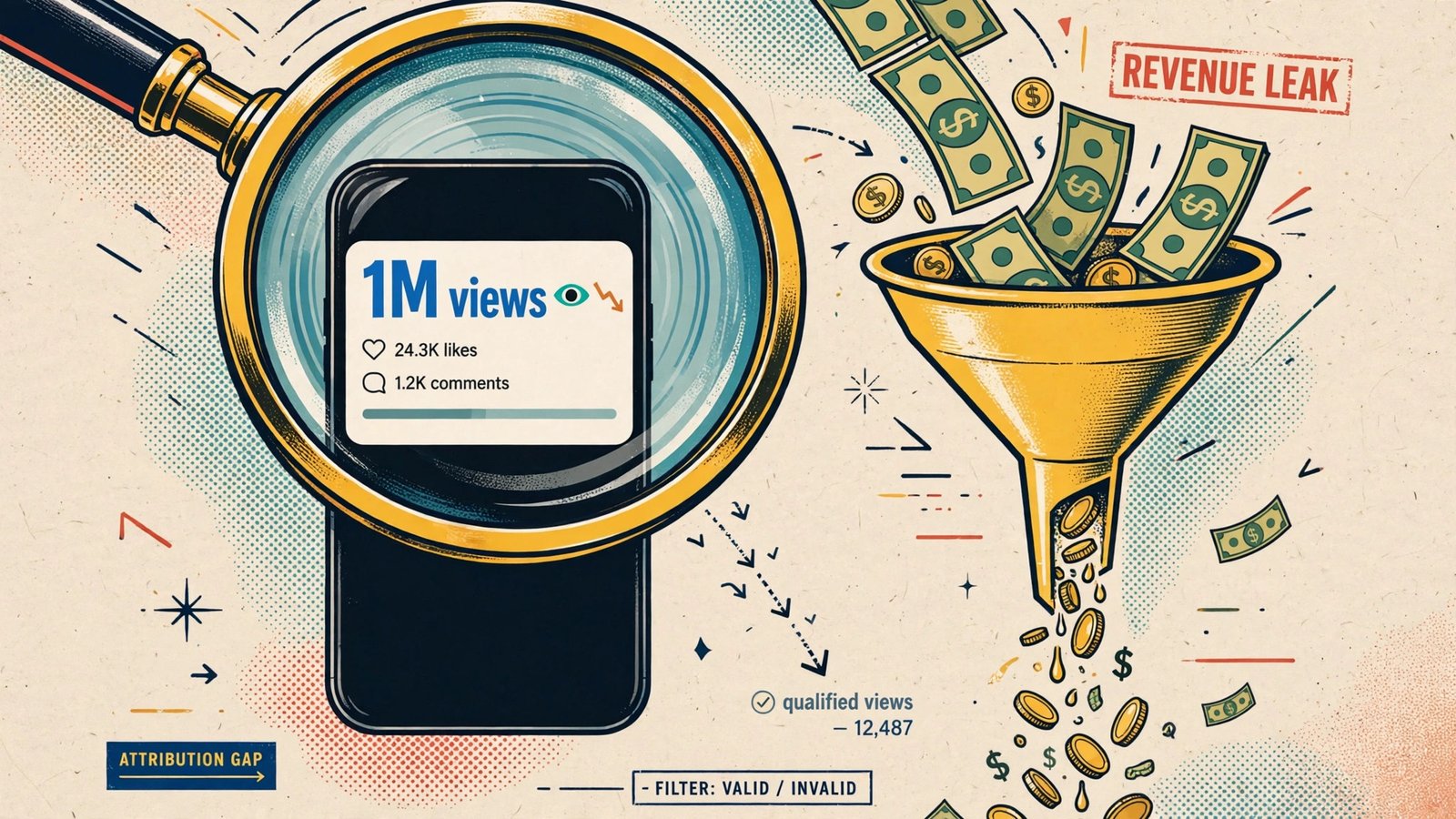
Here’s the uncomfortable truth about Facebook creator payouts in 2026: the view count on your screen and the view count Meta pays you for are two different numbers. And the second one is always smaller — sometimes dramatically smaller.
In March 2026, Meta quietly shifted the whole Facebook creator economy onto one word: qualified views. That same month it rolled out three new dashboard metrics — Qualified Views, Earnings Rate (your approximate earnings per 1,000 qualified views), and Non-Qualified Views (a breakdown of exactly why some views earn nothing). The message couldn’t be clearer: Meta no longer rewards the view. It rewards the qualified view.
If a 1-million-view video paid you less than a 50,000-view one, nothing is broken. You’re looking at the gap between views and qualified views. This guide explains the gap, shows the real math, and gives you the checklist to close it.
The direct answer: what a qualified view actually is
Meta pays ad revenue through its Content Monetization Program (CMP) — the single unified program that replaced Reels Play Bonus, In-Stream Ads, and the Performance Bonus when they were retired on August 31, 2025. Under CMP, earnings are calculated per 1,000 qualified views, and Meta excludes a long list of views from that count.
The exclusions we can verify across creator guides and Meta’s own materials:
- Repeat views — the same person watching again doesn’t earn twice
- Views shorter than 5 seconds — nothing under 5 seconds of watch time qualifies, whatever the format
- Reels must run at least 10 seconds to be eligible at all
- Stories must run at least 5 seconds — and resharing an existing post to your story doesn’t earn
- Non-public posts — anything shared to friends or a custom audience is outside the program
- No completed payout account — views earn nothing until your payout setup is finished
- Unoriginal or policy-violating content — reposted clips, text montages, looping clips, slideshows of still images, static videos with little or no motion, videos with embedded ads, engagement bait
In March 2026 Meta went further and gave creators a dashboard breakdown of non-qualified views sorted into twelve categories — so you can now see exactly where your paid views are leaking. That’s the single most useful new tool on the platform, and most creators I talk to have never opened it.
The math that explains your disappointment
Let me run two scenarios that make the problem concrete.
Scenario A: the viral clip. You post a funny clip. It explodes: 1,000,000 views. But 60% watched less than 5 seconds (it auto-played in feeds and got swiped past). Another 15% were repeat views from the same small group of engagers. 10% came from a country your payout account isn’t in or from non-public shares. Your qualified view share is roughly 15% — 150,000 qualified views. At an entertainment-niche rate of ~$0.50 per 1,000 (creator-network data consistently puts entertainment Reels in the $0.02–$0.50 range for typical pages), that’s about $75 from a million views.
Scenario B: the 50,000-view original. You post a 4-minute original breakdown your audience actually watches: average watch time 2 minutes, 85% qualified view share = 42,500 qualified views. You’re in a finance niche with a US-heavy audience, and the reported RPM range for that combo is $8–$20. Even at $10, that’s $425 — nearly six times the payout from 1/20th the views.
This is not a hypothetical quirk. One creator network that publishes its own CMP data across its pages reports rates from $0.08 to $0.33 per thousand qualified views, averaging $0.185 — and a 53x spread between the lowest- and highest-paying audience markets. The language and country your content lands in can matter more than your editing quality.
The direct answer, then: Meta pays roughly $0.02–$0.50 per 1,000 Reels plays for typical entertainment content, $0.30–$5 for strong niches with US audiences, and $8–$20+ for US finance/tech/business long-form (reported ranges from 2026 creator guides; your Earnings Rate metric in the dashboard shows your actual number). A 1M-view video at a $0.30 rate with a 15% qualified share pays $45. The “viral gold rush” isn’t gone — the money just never belonged to raw views in the first place.
Why Meta built the system this way
None of this is an accident, and honestly, none of it is new logic — it’s just finally visible.
In July 2025, Meta stated that “simply stitching together clips or adding your watermark does not qualify as meaningful enhancement,” and its Help Center lists added subtitles and logos as minor edits that don’t make content original. In March 2026 it sharpened the rules again: original content gets greater distribution and monetization; unoriginal content gets deprioritized in both. Commentary and analysis can qualify as original — but only when the creator adds genuinely new information or substantial creative value.
The industry picture backs up the direction. Meta reports it paid nearly $3 billion to creators in 2025 — up 35% year over year, with 60% of it going to Reels, and the number of creators earning over $10,000 a year on Facebook grew more than 30%. The money isn’t disappearing. It’s flowing toward original, watchable work while the aggregation pages that built audiences on reposted clips find their reach — and their payouts — shrinking. That was the whole point of the qualified-views shift: separate the views that represent genuine human attention from the views that represent an autoplay counter.
There’s a scam-warning attached to this confusion worth stating plainly: with the bonus era over, there’s no Meta program that pays creators for joining, and any course or “Facebook bonus agent” promising guaranteed per-view payouts outside the programs described here is not selling you a real Meta product.
Your qualified-view audit: the 7-point checklist
Open your Professional Dashboard → Monetization and find the Non-Qualified Views breakdown. Then work this list:
1. Check your qualified-view share first
Divide qualified views by total views for your last 30 days. Above 70% is healthy; under 40% means you’re entertaining scrollers, not earning viewers. Short Reels (under 10 seconds) and autoplay-friendly loops are the usual culprits — views pile up while qualifying views don’t.
2. Kill the 5-second skips
Meta excludes anything under 5 seconds. Your first 3 seconds decide everything: no slow logo intros, no “hey guys welcome back” — put the payoff or the hook in frame one. Creators who moved their hook from second 5 to second 1 routinely report the biggest single jump in qualified share.
3. Audit for originality violations
This is the biggest silent killer. Meta’s Content Monetization Policies exclude content where your “enhancement” was just a caption, a watermark, a speed change, or a border. Posting clips of someone else’s stream, compilations of third-party footage, or TikTok-watermarked reuploads can get you excluded from payouts entirely — not just deprioritized. If you’ve been doing this, remove or replace the flagged content and wait for the flag to clear (typically 30–90 days) before reapplying or expecting recovery.
4. Check your audience geography
Your Earnings Rate metric tells the truth. A US-heavy audience can pay 5–10x a low-CPM-region audience for the same content (advertiser benchmarks put US Facebook CPMs around $16–$21 vs ~$1–$1.80 in India). If your dashboard rate is under $0.20, look at where your viewers live before blaming your content.
5. Verify payout account and public posting
Views earn nothing while the payout account is incomplete — this is one of Meta’s own listed non-qualified reasons and it’s shockingly common. Also confirm your posts are public; friends-only posts sit outside the program entirely.
6. Ditch commercial music on monetized Reels
When a copyright claim hits, the ad money from that video goes to the music rights owner instead of you. Use Meta’s built-in Sound Collection or your own original audio on anything you intend to monetize. This is pure leakage most creators never notice.
7. Treat the 21st as accounting day, not a deadline
Meta processes payouts around the 21st of the following month. Recent creator guides report a $5 minimum payout threshold for U.S. creators (older guides still list $25 or $100 — thresholds have shifted over the years, so confirm in your own dashboard). Balances under the minimum roll over. If your payout never arrives, the checklist is: threshold → tax forms → payout account verification → payout method status, in that order.
The fastest path to actual money: Fast Track vs the slow grind
There are really two ways to earn on Facebook in late 2026, and they serve different creators.
Creator Fast Track (launched March 2026) is the guaranteed path: Meta pays $100–$450/month to creators with 20,000–99,999 followers on Instagram, TikTok, or YouTube, $1,000/month from 100,000, and $3,000/month above 1,000,000 — for posting 15 eligible reels a month across at least 10 separate days, for three months. (We break down the full Facebook Creator Fast Track pay structure separately.) Do the division Meta doesn’t print: at the bottom tier that’s $6.67–$30 per reel of guaranteed pay for original work you filmed. The catch that disqualifies most applicants: you must not have posted a Facebook reel in the past six months — the creators who’ve been dutifully posting are shut out. Applications are open in the US, Canada, the UK, and Australia.
The slow grind (CMP) is the open path: lower rates, no invitation barrier for most tools, but earnings that compound with retention skill. Your Earnings Rate is your real KPI — it tells you, per 1,000 qualified views, what your actual audience is worth.
Which one should you chase? If you have the off-platform following and haven’t touched Facebook Reels in six months, Fast Track is the best guaranteed money in the short-form game right now. If not, CMP rewards one thing: holding attention. Both, however, run on the same currency — qualified views — so the audit above is the homework either way.
A real creator’s number, for calibration
Here’s a real, linkable datapoint to anchor your expectations. Creator Chris Koerner, who publishes his short-form revenue math in his newsletter, reports: “I get paid about 25 cents per thousand views on my short-form videos. That’s pretty high because I’m in the business and finance niche. If you’re posting about gaming or unboxing videos, it’s going to be less.” (source)
Twenty-five cents per thousand — in a high-value niche — and he calls that high. Compare that with the Medium-era mythology of dollars per thousand and you see the real shape of the market: a million views in business/finance with a healthy qualified share might pay $200–$500; the same million in entertainment with a 15% qualified share might pay $50. Adjust your content strategy to that reality instead of arguing with it.
What to do this week
Stop optimizing for the view counter and start optimizing for the qualified-view share. Concretely:
- Open the Non-Qualified Views breakdown in your dashboard today and find your top leakage category. Fix the biggest bucket first, not everything at once.
- Move the hook to second zero. Rewrite your next five videos so the first frame is the content. Measure qualified share before and after.
- Purify your originality. If any content on your Page is someone else’s footage with your watermark on it, take it down this week. It’s suppressing your whole account, not just that video.
- Post natively to Facebook. Never use the cross-post toggle between Instagram and Facebook for monetized content — upload natively to each; creators consistently report better reach from native uploads.
- Watch your Earnings Rate weekly, not your follower count. A rising rate means your audience is getting more valuable; a falling one means you’re attracting the wrong viewers or the wrong geographies.
The Facebook gold rush of viral clips is over, and good riddance — it paid in lottery tickets. What’s left is a performance system that pays for actual human attention: original work, watched through, by audiences advertisers want. The creators who adjust to that math aren’t just earning more; they’re the ones Meta is actively trying to keep. For the full story on how the unified program replaced the old in-stream ad setup, see our breakdown of the shift from in-stream ads to Facebook content monetization, and if your Page is currently flagged, start with how to fix Facebook Page monetization ineligibility.
For the authoritative sources behind this piece: Neal Schaffer’s verified breakdown of the Content Monetization Program (the payout math and Fast Track numbers), Sirency’s qualified-view checklist (the twelve-category dashboard and format rules), and Creator Spotlight’s March 2026 changes roundup (the original-content emphasis announcement). Cross-check every threshold against your own Professional Dashboard — Meta is the final authority on your account.
Frequently Asked Questions
What is a qualified view on Facebook?
A qualified view is a view Meta counts toward monetization payouts. Repeat views, views under 5 seconds of watch time, non-public posts, and views on content that violates the originality rules are all excluded. Your dashboard’s total view count is always higher than your qualified view count.
Why did my 1-million-view video earn almost nothing?
Because payouts run on qualified views, not views. If most of that million watched under 5 seconds, rewatched, or watched from regions with near-zero ad demand, your qualified share may have been 10–20%. At typical entertainment Reels rates ($0.02–$0.50 per 1,000), a 150,000-qualified-view video pays $7–$75.
How much does Facebook pay per 1,000 views in 2026?
There’s no fixed rate — payouts track per-post performance. Reported 2026 ranges: Reels $0.02–$0.20 per 1,000 plays for typical entertainment, $0.30–$5 for strong niches with US audiences, and up to $8–$20+ for US finance/tech long-form. Check your dashboard’s Earnings Rate for your actual number.
What content doesn’t qualify for Facebook monetization?
Text montages, looping clips, slideshows of still images, static videos with little or no motion, videos with embedded ads, engagement bait, reposted third-party footage with only minor edits (captions, watermarks, speed changes), and any post under friends-only privacy. Adding subtitles or a logo does not make someone else’s content original.
When does Facebook pay creators?
Around the 21st of the following month for the prior month’s earnings. Recent creator guides report a $5 minimum payout threshold for U.S. creators (older guides list $25 or $100 — confirm your threshold in the payout dashboard). Balances below the minimum roll over to the next month.
Is Creator Fast Track still accepting applications?
Fast Track launched in March 2026 and, per recent guides, applications are open in the US, Canada, the UK, and Australia. You need 20,000+ followers on Instagram, TikTok, or YouTube, 30,000 video views in the last 60 days, and you must not have posted a Facebook reel in the past six months. If accepted, you earn $100–$3,000/month for three months by posting 15 eligible reels per month across at least 10 days.