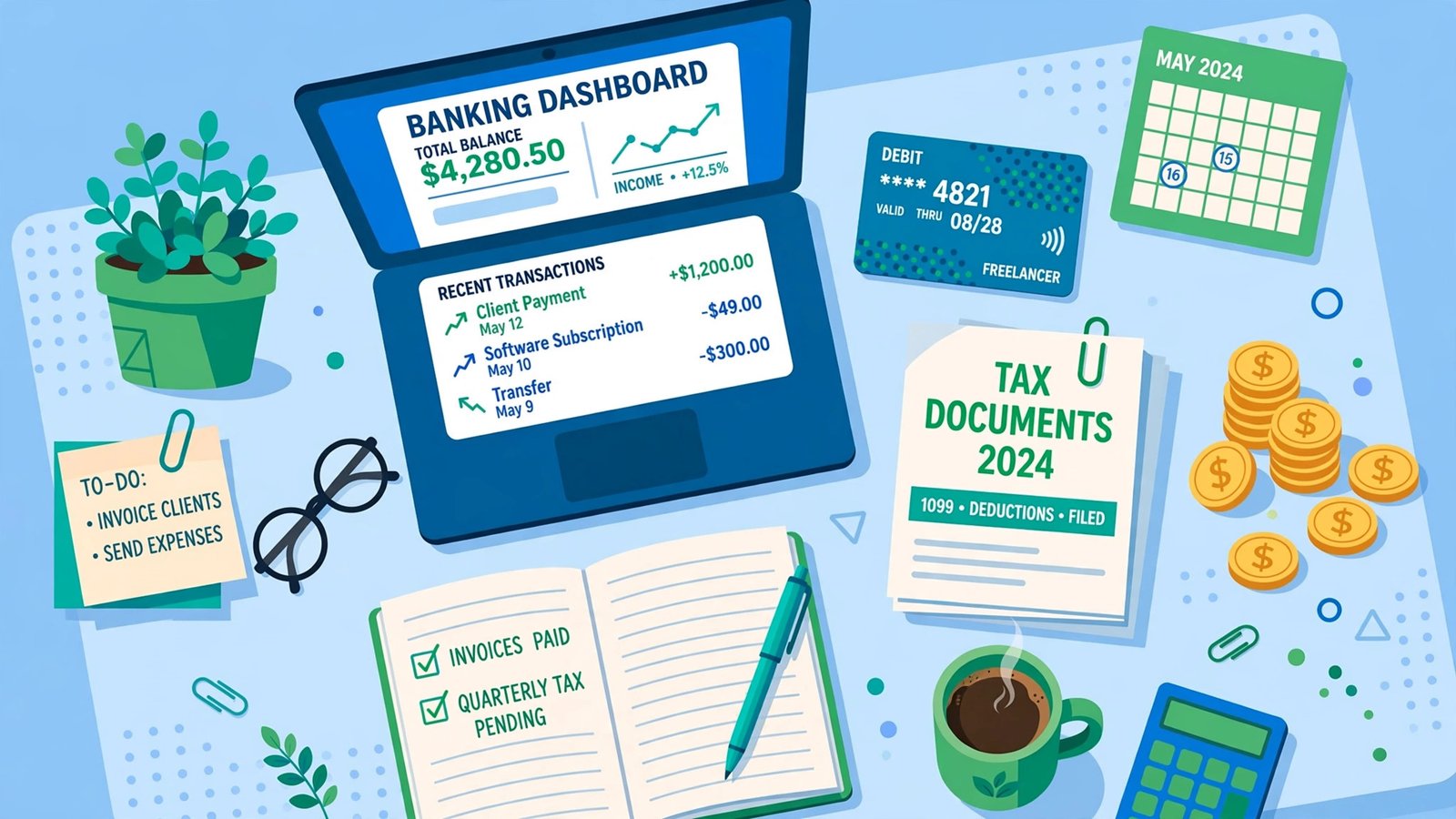
Mixing freelance income with your personal checking account is one of the easiest ways to make your life harder. When tax season rolls around, you’re scrolling through months of grocery runs and coffee purchases trying to figure out which charges were business expenses. Your bookkeeping is a mess, and if you ever get audited, good luck explaining that receipt.
A separate business checking account fixes all of that. It gives you clean books, makes tax prep dramatically simpler, and looks more professional when clients pay you. And in 2026, you don’t need a bank branch or minimum balances to get one — online banking tools built for freelancers mostly charge zero monthly fees.
Here are the best business checking accounts for freelancers this year, what to look for, and how to pick the one that fits.
What to Look For in a Freelancer Business Account
Not every “business checking account” is worth your time. Here’s what actually matters when you’re a freelancer:
Fees. Monthly maintenance fees are the first thing to eliminate. Most of the accounts on this list charge nothing per month on their base plans. Watch for fees in the fine print — ATM out-of-network charges, wire transfer costs, and cash deposit fees can add up.
Tax tools. Quarterly estimated taxes trip up more freelancers than anything else. Some accounts automatically categorize expenses by tax category or set aside a slice of every deposit for taxes. That automation is worth real money at tax time.
Sub-accounts. If you like separating money for taxes, expenses, and profit — the “profit-first” method — look for an account that lets you open multiple checking accounts under one login.
Invoicing. Some business accounts let you create and send invoices right from the dashboard, and clients can pay you directly — replacing a separate invoicing tool.
Integrations. If you use accounting software or an online store, check whether the bank connects with Stripe, Shopify, or QuickBooks. Manual data entry gets old fast.
Interest (APY). A few business checking accounts pay interest on your balance. Treat advertised rates as “as advertised in 2026 — rates and terms change” and always verify the current rate before signing up.
The Best Business Checking Accounts for Freelancers in 2026
Lili — Best for freelancers who want tax help built in
Lili was designed from the ground up for freelancers, and it shows. The standout feature is automatic tax categorization: your expenses get sorted into tax categories as you spend, so you always know where you stand. It also helps you track income and expenses without a separate app.
There’s no monthly fee on the base plan, which keeps it accessible when you’re starting out. Paid tiers add extras, but most freelancers can run on the free plan.
The honest downside: Lili is a fintech, not a bank — your deposits are held by partner banks. That’s fine and common (your money is still FDIC-insured through the partner banks), but if you want branches, this isn’t it. International wire options are also more limited than what a big bank offers.
Bluevine — Best for earning interest on your balance
Bluevine‘s business checking stands out because it pays interest — advertised up to 3.0% APY for eligible customers, which is unusually high for a checking account. (As advertised in 2026 — rates and terms change, and eligibility requirements apply, so check the current terms before you count on it.)
There’s no monthly fee on the Standard plan, and you get sub-accounts for organizing your money plus built-in invoicing, so you can bill clients without leaving the dashboard.
The honest downside: that top advertised APY usually comes with conditions, like meeting activity requirements or keeping balances in a certain range. If you don’t meet them, the rate drops.
Novo — Best for freelancers who sell online
Novo keeps it simple: no monthly fees, and strong integrations with the tools online sellers use — Stripe, Shopify, and QuickBooks all connect directly. If you run a freelance business with an online store or take card payments through Stripe, that integration saves you real bookkeeping time.
Novo also offers cash flow insights and invoice features, and it doesn’t charge for common things like incoming wires.
The honest downside: Novo doesn’t pay interest on checking balances, so your money sits idle. It also lacks the sub-account system that Relay offers, so profit-first allocation takes manual work.
Relay — Best for profit-first money management
Relay’s killer feature is that you can open multiple checking accounts under one login — up to 20 — with no monthly fee.
There are no monthly fees and no minimum balance requirements, and Relay includes basics like check writing and a debit card.
The honest downside: Relay doesn’t pay interest, and it lacks Lili’s automatic tax categorization or Found’s auto tax set-aside. You’ll handle the tax math yourself (or with your accountant).
Found — Best for automatic tax savings
Found’s headline feature is simple and powerful: it automatically sets aside a percentage of every deposit for taxes. If you’ve ever spent your tax money by accident — and plenty of freelancers have — this feature alone is worth it. The app also includes invoicing tools so you can bill clients and track payments in one place.
It’s built specifically for self-employed people, so the whole experience is tuned to how freelancers actually get paid: irregular amounts, multiple clients, mixed income streams.
The honest downside: Found’s fee structure includes some paid features and transaction-based costs depending on the plan, so read the pricing carefully. It also doesn’t offer sub-accounts like Relay.
Which One Should You Pick?
There’s no single winner — it depends on how you work:
- If taxes stress you out, go with Lili for automatic tax categorization, or Found if you want money physically set aside for taxes with every deposit.
- If you keep a healthy balance, Bluevine is the obvious pick — it’s the only one here advertising meaningful interest on a checking balance.
- If you sell products online, Novo‘s Stripe and Shopify integrations will save you the most time.
- If you like the profit-first method, Relay‘s multiple checking accounts are built exactly for that.
And honestly? You can open more than one. Plenty of freelancers run their main income through Bluevine to earn interest while using Lili alongside it just for the tax categorization. These accounts are free to open, so mixing and matching costs you nothing but a few minutes.
One practical tip: whichever you choose, use it for all business income and expenses. A business account only keeps your books clean if you stop running freelance money through your personal account.
Frequently Asked Questions
Do freelancers really need a separate business checking account?
Legally, a sole proprietor isn’t always required to have one — but you should anyway. It keeps your books clean, makes tax prep and deductions far easier, simplifies things if you’re ever audited, and looks more professional to clients. Once you form an LLC, separating business and personal finances becomes even more important for liability protection.
Are these online business accounts safe?
Yes, with a normal caveat: most of them are fintech companies rather than banks themselves. Your deposits are held by FDIC-insured partner banks, which means the same federal insurance applies. Confirm the FDIC arrangement on the account’s site before you sign up — it’s usually disclosed clearly in the fine print.
Can I get a business checking account without an EIN?
Many of these accounts let sole proprietors sign up with just a Social Security number. An EIN (free from the IRS) looks more professional and keeps your SSN off more forms, but it isn’t always required. Requirements vary by provider.
Will opening a business checking account affect my credit score?
Generally, no. Business checking accounts typically verify your identity rather than pulling your credit, so a plain checking account won’t show up on your personal credit report. Business credit cards are a different story.
How much does a business checking account for freelancers cost?
The accounts on this list have no monthly fee on their base plans. You’ll still want to watch for per-transaction costs — out-of-network ATM fees, wire transfer fees, and cash deposit fees vary. For most freelancers doing electronic payments, the realistic cost is close to zero.
Can non-US citizens open these accounts?
Most of the accounts listed here require US residency or a Social Security number. If you’re a non-US citizen running a US LLC, check our guide to virtual banks that accept LLC owners without an SSN for alternatives built for that situation.
Opening a business checking account takes about ten minutes and costs nothing on any of these plans. The hard part is just picking one — and now you know which one fits how you work. Your future self, the one doing taxes next April, will thank you.