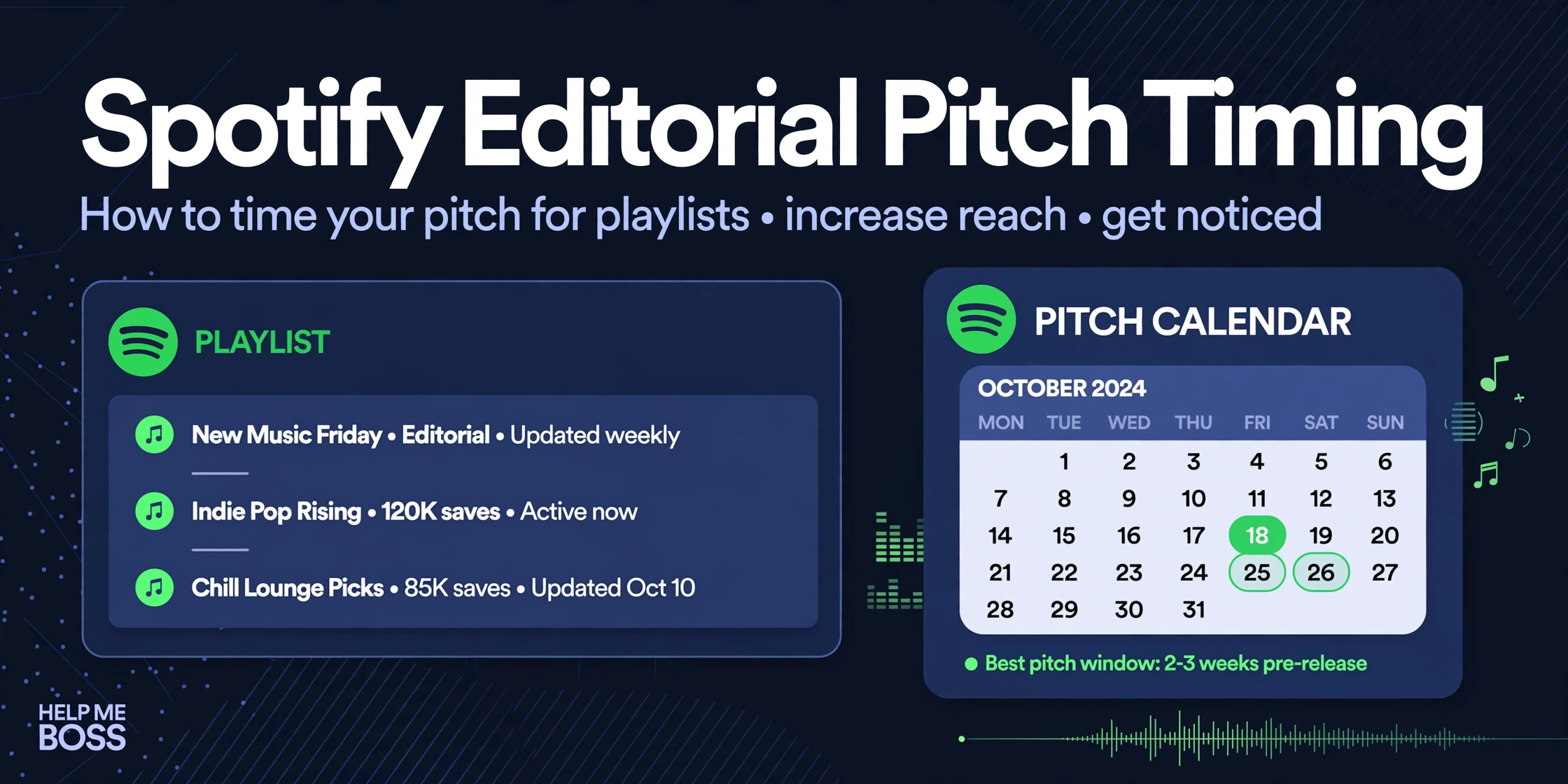
If you’re releasing music on Spotify, there’s one deadline that matters more than all the others: your editorial playlist pitch must be submitted at least 7 days before your release date. Miss it, and you lose your shot at Spotify’s editorial playlists and your automatic Release Radar placement.
Here’s the full timeline that working independent artists actually use.
The Non-Negotiable Timeline
Spotify’s editorial playlists — New Music Friday, Fresh Finds, Lorem, and hundreds of genre lists — are pitched through Spotify for Artists, and only for unreleased tracks. The mechanics:
- Your distributor must deliver the track to Spotify first. You can’t pitch a song Spotify doesn’t have yet. The pitch option appears in your Spotify for Artists dashboard under “Upcoming” only after delivery.
- Pitch at least 7 days before release day. That’s Spotify’s hard minimum. Hit it and your track also lands on your followers’ Release Radar automatically.
- Earlier is better. Multiple artist guides recommend delivering to your distributor 3–4 weeks before release and pitching the moment the track appears in your dashboard. Editors work through Friday playlist updates on a schedule — late pitches rarely get reviewed.
So the real-world calendar for a Friday release looks like this:
- 4 weeks out: upload to your distributor (DistroKid, Ditto, etc.)
- 3 weeks out: track appears in Spotify for Artists → submit your pitch immediately
- 1 week out: hard deadline — pitch must be in
- Release day: track goes live, Release Radar delivers it to followers
Rushing the distributor upload is the #1 reason artists miss the window. DistroKid and similar services usually deliver within days, but allow buffer for metadata corrections or profile-mapping issues.
How to Write a Pitch Editors Actually Read
You get 500 characters — roughly 75–85 words, three to four sentences. Editors skim hundreds of these. The structure that works:
Sound (120–150 characters). Genre, mood, and one or two direct artist comparisons. “Late-night bedroom pop for fans of Clairo and Men I Trust.” This is how editors file your track mentally — be precise.
Context (120–150 characters). Notable producers, collaborators, instruments, or lyrical themes. Concrete details, not hype.
Momentum (150–200 characters). Real numbers only: confirmed press, tour dates, pre-save counts, ad spend, TikTok views. Editors want evidence you’re promoting the song outside Spotify.
And fill in the metadata dropdowns carefully — genre, subgenres, mood tags, instrumentation. Editors filter by these tags, and mislabeling your track can knock you out before anyone reads a word.
What not to write: “This song will go viral.” “The next big hit.” Anything you’d put on a poster. Editors evaluate fit, not adjectives.
Why This Matters More Than You Think
Editorial placements aren’t just about the streams on the playlist itself. Industry data consistently shows that editorial adds act as a trust signal to Spotify’s algorithm, pushing tracks into Discover Weekly and Release Radar at higher rates. One analysis of 2025 data found tracks placed on editorial playlists saw an average 3.2x increase in monthly listeners in the 30 days after placement — and for independents starting from a small base, the relative lift is often larger.
In other words: the pitch is the domino. Everything downstream — algorithmic playlists, listener saves, long-tail catalog streams — starts with getting heard by an editor.
After You Pitch: What Happens Next
Once your pitch is in, here’s the actual sequence:
- Nothing, for a while. Editors work on their own schedule building Friday updates. You won’t get a confirmation that a human read your pitch — the system doesn’t work that way.
- Release day. Your track goes live. If an editor picked it up, you’ll see it appear on editorial playlists over the following days. If not, your Release Radar placement still fires for your followers — that part is automatic as long as you hit the 7-day deadline.
- Watch the first 72 hours. Saves, playlist adds, and completion rates in the opening days are the signals Spotify’s algorithm weighs most heavily. This is when your off-platform promo (Shorts, social posts, email) matters most — early velocity feeds the algorithmic machine.
- Pitches are editable until release. If your plans change — new press coverage, a TikTok video takes off — you can update the pitch any time before the track goes live. Use that.
And if you don’t get placed? That’s the normal outcome, not a failure. Editorial acceptance for independents is low single digits. The pitch cost you nothing, you kept your Release Radar, and the track is now building the algorithmic history that makes your next pitch stronger. Every release is a data point.
The Release Radar Bonus
Here’s the part many artists miss: pitching on time guarantees your track appears on your followers’ Release Radar, Spotify’s personalized new-release playlist. That’s free distribution to the audience you’ve already built, and it happens whether or not an editor picks your track. Miss the 7-day cutoff and you lose this too — your own followers won’t get the automatic notification.
AI Music? Same Rules Apply
If you’re releasing AI-assisted music, the pitching process is identical — but your upstream choices matter. Make sure your distributor accepts AI-generated music and that you hold the rights to release it. Our comparison of DistroKid vs Ditto for AI music breaks down which distributor fits AI releases better, and our walkthrough of building an AI music release covers the full pipeline from generation to distribution.
One caution: never use services promising “guaranteed” playlist placements or paid streams. That’s artificial streaming, it violates Spotify’s policies, and it can get your music removed.
Official source: Spotify for Artists
Frequently Asked Questions
Can I pitch a song that’s already released?
No. Spotify’s editorial pitch tool only works for unreleased tracks. Once the song is live, the pitch option disappears.
What happens if I pitch less than 7 days before release?
You lose the guaranteed Release Radar placement, and editors are unlikely to review a late submission. The pitch may still go through technically, but you’ve forfeited the main benefits.
Do I need a distributor to pitch?
Yes. Independent artists can’t upload to Spotify directly — your track must be delivered by a licensed distributor (DistroKid, Ditto, TuneCore, etc.) before it appears in Spotify for Artists.
Can I pitch more than one song per release?
You can only pitch one track per release, so choose the strongest single — usually the lead track with the most promo behind it. The rest of the release still benefits from the Release Radar placement.
How long should my pitch be?
500 characters max, and shorter is fine. Aim for 75–85 words split across sound, context, and momentum. Editors skim.
Does pitching guarantee playlist placement?
No — acceptance rates for independents are low single digits. But pitching is free, it guarantees Release Radar, and it’s the only legitimate path to editorial consideration. There’s no downside.
Sources: Spotify for Artists pitching guides via thesmrecords.com, indierocket.app, and sonurastudio.com.