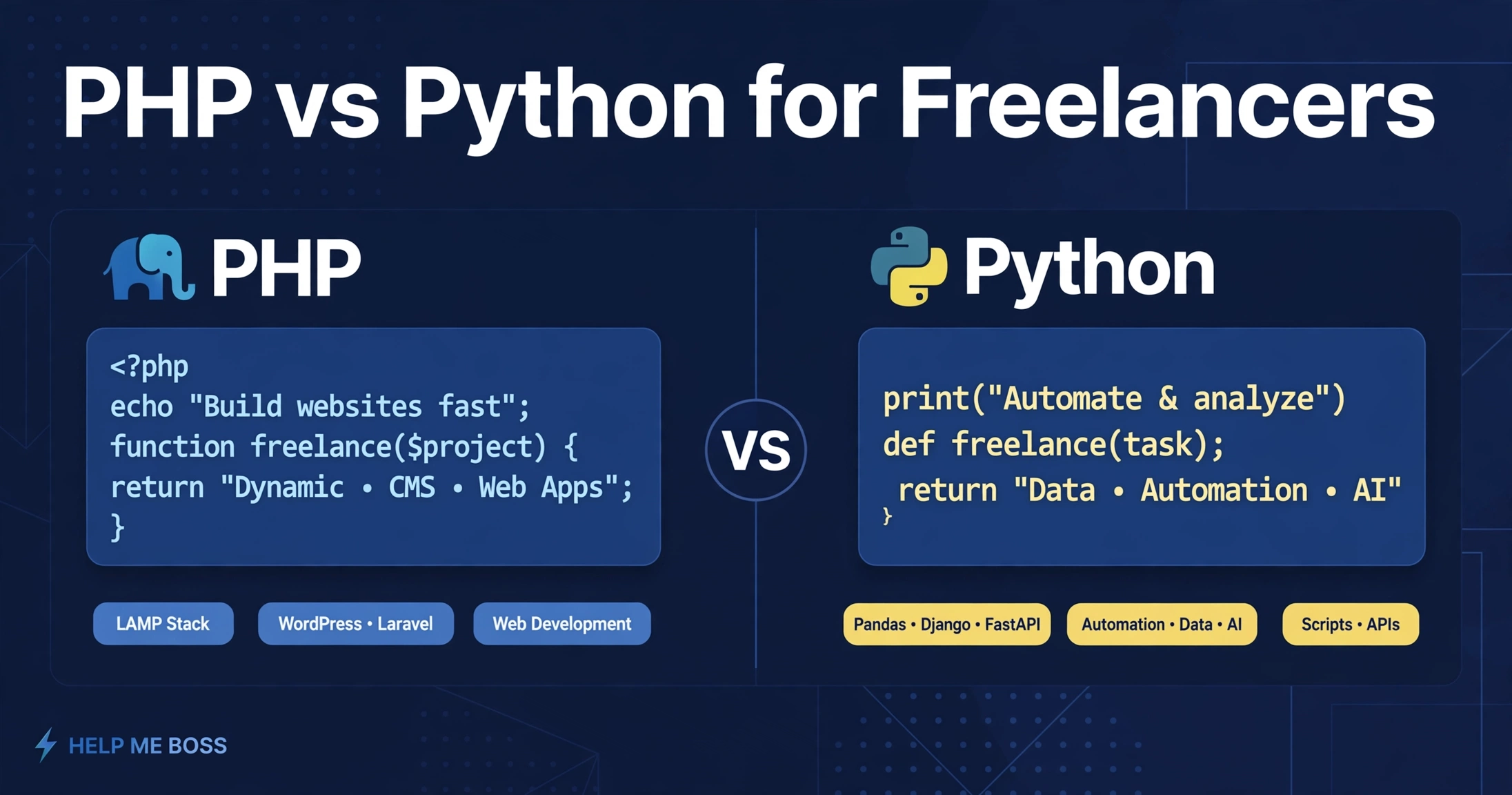
If you’re choosing between PHP and Python for freelance work in 2026, the short answer is this: PHP gives you more jobs to bid on, Python gives you more money per job. Which one wins depends on how you want to earn — steady volume or higher-ticket contracts.
Let’s break down the actual trade-off with what’s happening on the freelance platforms right now.
The Volume Story: PHP (and WordPress) Owns the Job Boards
PHP’s biggest advantage is raw demand from small businesses. A few years back, one freelancer tracked live Upwork searches and found roughly 6,000+ open PHP projects versus about 3,000 for Python — and that pattern hasn’t flipped. The reason is simple: most freelance clients aren’t tech startups. They’re restaurants, law firms, e-commerce stores, and agencies, and their websites run on PHP stacks, usually WordPress.
That’s the real unlock most people miss. It isn’t really PHP vs Python — it’s WordPress vs everything else. The same tracking showed 10,000+ open WordPress jobs on Upwork, dwarfing both languages. If you know PHP plus WordPress theme/plugin work, you’ve got the steadiest beginner-friendly client stream in freelance development: plugin fixes, theme customizations, speed optimization, WooCommerce tweaks.
PHP work tends to look like this:
– WordPress plugin and theme customization
– WooCommerce store fixes and feature adds
– Laravel backend work for small agencies
– Bug fixes and maintenance retainers
The catch: PHP competition is fierce, and a chunk of the work is price-sensitive. You’ll see plenty of “$50 to fix my checkout page” gigs alongside proper $2,000+ projects.
The Pay Story: Python Bills More Per Hour
Python freelancers typically command higher rates. A 2026 industry snapshot of freelance developer platforms put mid-level freelance Python developers in the US at $85–$135 per hour, and Python’s share of professional developers hit nearly 55% in Stack Overflow’s 2025 survey data. Clients pay for Python because it’s the language of data, automation, and AI — and those problems feel expensive to the businesses that have them.
Python freelance work tends to look like this:
– Data scraping, automation scripts, and API integrations
– AI/ML-adjacent work (chatbot integrations, RAG pipelines, model fine-tuning support)
– Django/FastAPI backend builds
– Data analysis and dashboard projects
The catch: there are fewer Python gigs on the general freelance marketplaces, and many of the best ones go to specialists with proven portfolios. A Python generalist competes against a global pool of data people; a WordPress specialist competes against… well, also a global pool, but the volume of posted jobs is much bigger.
Platform Fees Change the Math
Where you sell matters too. On Fiverr, you pay a flat 20% fee on every order, forever. On Upwork, the fee starts at 10% and drops to 5% once you’ve billed over $500 with the same client. So a $12,000/year client relationship costs you $2,400 in fees on Fiverr versus about $625 on Upwork.
What this means for your language choice: PHP’s volume game — lots of smaller jobs from many clients — works okay on Fiverr’s gig model, where discovery is built in. Python’s higher-ticket game — fewer, bigger projects — favors Upwork’s proposal model, where long-term clients get dramatically cheaper to serve over time. If you’re just starting out and need quick wins, Fiverr plus PHP/WordPress gigs is the fastest path to your first dollars. If you’re targeting $5K+ months, Upwork plus a Python specialty is the more common route.
For a deeper walkthrough of landing those first jobs, see our guide on how to get your first freelance client with no experience.
A Realistic Rate Card (Year-One Targets)
Rates vary by market and skill, but here’s what competent freelancers actually charge once they’re past the beginner phase:
PHP / WordPress:
– Plugin/theme fixes: $50–$200 per task
– Full theme customization: $500–$2,500 per project
– WooCommerce store builds: $1,500–$5,000 per project
– Monthly maintenance retainers: $200–$800/month per client
Python:
– Automation scripts: $200–$1,000 per script
– API integrations: $500–$3,000 per project
– Data dashboards: $1,000–$5,000 per project
– Hourly consulting: $50–$135/hour depending on specialty and market
The PHP path reaches paying work faster; the Python path reaches higher rates faster. Neither is “better” — they’re different games. And remember the platform fee math from earlier: on Upwork, long-term clients get cheaper to serve over time (10% dropping to 5%), which rewards the retainer-style relationships both stacks can build.
Which Should You Learn?
Pick PHP if: you want paying clients fast, you’re comfortable with WordPress, and you like the idea of many smaller projects adding up. The learning curve to billable is short — a working WordPress site is a portfolio piece.
Pick Python if: you already code, you’re interested in data or AI work, and you’d rather chase fewer, better-paying contracts. The ramp-up is longer, but the ceiling is higher.
Pick both (seriously): plenty of working freelancers run a PHP/WordPress front door for steady cash and a Python back room for automation and API work. A WordPress site that pulls data from a Python-powered API is a very sellable package.
How to Position Yourself Either Way
Whichever language you choose, three things decide your income more than the language itself:
- Niche down. “PHP developer” is invisible. “WooCommerce checkout specialist” or “Python automation for real estate teams” gets hired.
- Productize. Fixed-scope packages (“WordPress speed optimization in 48 hours”) sell better than hourly availability.
- Protect yourself. Once clients arrive, get the paperwork right — our freelance contract template clauses cover the payment and scope terms that keep projects from going sideways.
Official source: Upwork
Frequently Asked Questions
Is PHP dead for freelancing in 2026?
No — it’s the opposite of dead for freelancers. PHP powers a huge share of the small-business web, and WordPress alone keeps thousands of freelance gigs posted at any time. It’s not trendy, but trends don’t pay rent. Client demand does.
Can a Python beginner get freelance work?
Yes, but not usually by competing on “Python developer” job posts. Beginners do better selling outcomes: “I’ll automate your spreadsheet workflow” or “I’ll build a scraper that feeds your CRM.” The language is a tool; the outcome is the product.
Which language is better for Fiverr gigs?
PHP/WordPress. Fiverr rewards narrow, repeatable gigs — plugin installs, theme fixes, speed optimization — and PHP dominates that format. Python gigs exist on Fiverr but the platform’s real Python money is on Upwork.
How much can I realistically earn in year one?
It varies wildly, but a reasonable expectation: a PHP/WordPress freelancer doing consistent gig work can reach $1,500–$4,000/month within the first year. A Python freelancer who lands two or three solid retainer clients can pass that with fewer hours — the hard part is landing those clients.
Should I learn a framework first?
For PHP, learn WordPress deeply before Laravel. For Python, learn automation and APIs before Django. Frameworks follow the work, not the other way around.
Sources: Upwork/Fiverr freelance marketplace data via medium.com/on-freelancing and secondtalent.com; fee comparisons via gigwisemoney.com.