
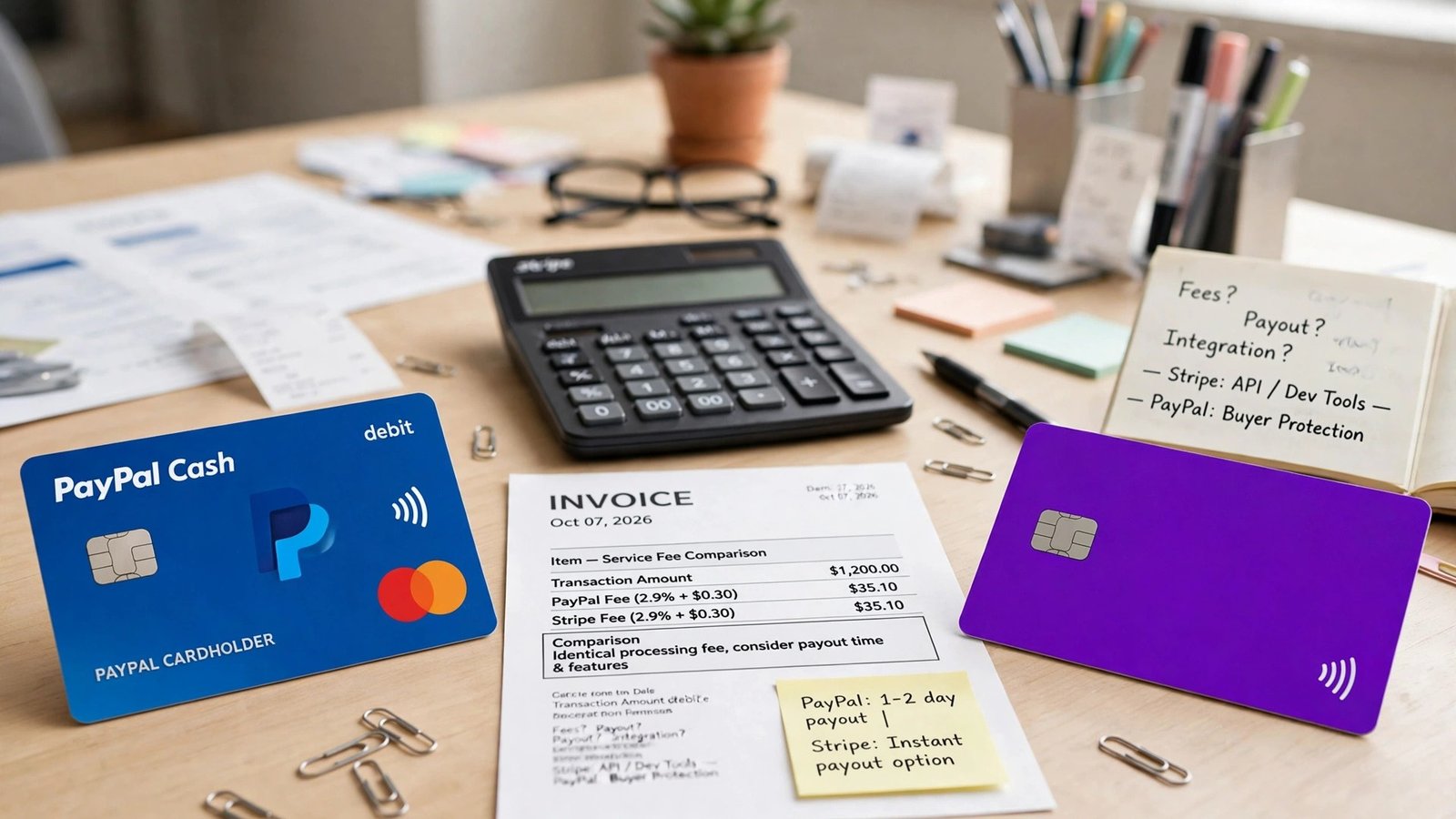
If you’re a freelancer choosing between PayPal Business and Stripe in 2026, here’s the short answer: Stripe is usually cheaper. Stripe charges 2.9% + 30¢ per online card payment while PayPal charges 2.99% + 49¢ for cards and 3.49% + 49¢ when clients pay through the PayPal button. The gap gets wider with international clients, because PayPal’s currency conversion spread runs around 3–4% while Stripe’s is 1%.
That said, the cheapest processor depends on how your clients actually pay you. A freelancer who invoices US clients by card cares about a different number than one whose clients sit in London or Berlin and pay from their PayPal balances. Let’s run the real numbers.
The 2026 rates, side by side
Both processors charge per-transaction fees with no monthly or setup costs. Here are the published US rates that apply to most freelancers:
| Fee | Stripe | PayPal Business |
|---|---|---|
| Domestic online card payment | 2.9% + 30¢ | 2.99% + 49¢ |
| Client pays via PayPal balance/Venmo/guest checkout | N/A | 3.49% + 49¢ |
| International card (extra) | +1.5% | +1.5% on the applicable rate |
| Currency conversion markup | +1% | ~3–4% spread on the exchange rate |
| ACH bank debit | 0.8%, capped at $5 | Not available (Venmo/PayPal balance instead) |
| Dispute/chargeback fee | $15 | $15 (up to $30 for high-dispute sellers) |
| Instant payout to bank | 1.5% | 1.75% |
| Standard payout time (US) | ~2 business days | 1–3 business days (free) |
These rates were current as of fall 2026 — PayPal’s official merchant fee schedule was updated May 28, 2026, and independent breakdowns verified Stripe’s numbers against its pricing page in September 2026. Always double-check the live fee pages before you commit, because both companies revise pricing periodically.
The pattern that matters: PayPal charges you more per transaction in nearly every domestic scenario, and the 49¢ fixed fee (vs Stripe’s 30¢) quietly punishes smaller invoices. On a $200 invoice, PayPal’s fixed fee alone is 0.245% of the amount — nearly 0.1 percentage points more than Stripe’s.
What a $1,000 invoice actually nets you
Let’s do the math on a single $1,000 client payment, because this is where freelancers feel the difference.
Stripe, domestic card: 2.9% of $1,000 = $29.00 + $0.30 = $29.30 fee. You keep $970.70.
PayPal, client pays by card through your invoice: 2.99% of $1,000 = $29.90 + $0.49 = $30.39 fee. You keep $969.61.
PayPal, client pays with their PayPal balance or via the PayPal button: 3.49% of $1,000 = $34.90 + $0.49 = $35.39 fee. You keep $964.61.
So on a domestic $1,000 invoice, Stripe saves you about $6 versus PayPal’s invoice card rate and about $11 versus a PayPal-balance payment. Run twelve $1,000 invoices a year and that’s roughly $70–$135 in your pocket for switching — real money, but not life-changing. The international numbers are where it gets dramatic.
Stripe, $1,000 from a German client with euro conversion: 2.9% + 1.5% international + 1% conversion = 5.4% → $54.00 + $0.30 = $54.30 fee. You keep $945.70.
PayPal, $1,000 from a German client paying by card: 2.99% + 1.5% international = 4.49% → $44.90 + $0.49 = $45.39 in transaction fees, plus PayPal’s currency conversion spread of roughly 3–4% on the exchange rate — another ~$30 to $40 you never see itemized. Total cost: around $75–$85.
That conversion spread is the sleeper cost. PayPal doesn’t publish it as a line item; it’s baked into the exchange rate they give you, which consistently trails the mid-market rate by several percentage points. If half your client base pays in foreign currency, Stripe’s 1% conversion fee saves you hundreds per year.
The ACH trick Stripe users often miss
Here’s the cheapest legitimate way to collect a US client’s payment: Stripe ACH direct debit at 0.8%, capped at $5. On a $1,000 invoice, the fee is $5 flat — compared to $29.30 by card.
The trade-off: ACH takes 3–5 business days to clear, and some clients are skittish about entering bank details instead of a card. But for retainer clients who pay you monthly, setting up ACH billing once saves you ~$24 per invoice, or nearly $300 a year on a single $1,000/month retainer. PayPal has no equivalent low-cost bank-debit option for invoicing.
Payout speed and access to your money
Getting paid is only half the story — the other half is how fast the money lands in your bank account.
Stripe’s standard US payout takes about 2 business days (T+2). PayPal’s standard free bank transfer takes 1–3 business days. Both are fine for normal cash flow. When you’re in a hurry, Stripe’s instant payout costs 1.5% and PayPal’s costs 1.75% — Stripe wins that round too.
One practical difference: money you receive through PayPal sits in your PayPal balance until you move it, which makes it easy to spend directly from PayPal without a transfer. With Stripe, payouts go automatically to your linked bank account on your payout schedule. Neither is better in absolute terms — PayPal is more wallet-like, Stripe is more bank-like.
When PayPal is still worth it
Stripe wins on fees, but PayPal wins on client familiarity — and that can be worth more than the fee difference.
- Clients trust the PayPal button. Many small-business clients already have PayPal accounts and pay invoices without entering card details. A familiar checkout converts better than a generic card form.
- Venmo payments. For US clients, PayPal invoices can accept Venmo at no extra effort — handy if your clients are individuals rather than companies.
- No technical setup. PayPal’s invoicing tool works out of the box. Stripe is friendly to developers, but a non-technical freelancer will spend more time setting it up.
- Pay Later caution: PayPal’s invoice fee jumps to 4.99% + 49¢ when a client uses PayPal Pay Later. If you invoice large amounts, consider disabling Pay Later as a payment option — that fee tier is brutal.
So which should you pick?
Match the processor to your situation:
- Mostly US clients paying by card: Stripe. Lower rates, and ACH gives you a nearly free option for retainers.
- International clients paying in foreign currency: Stripe, decisively. The conversion spread is the single biggest lever here.
- Clients who prefer PayPal balances or Venmo: PayPal. You’ll pay more in fees but get paid more often and faster by clients who live in the PayPal ecosystem.
- Zero technical patience: PayPal’s invoice tool. You can send your first invoice in minutes.
Many freelancers end up with both: Stripe as the default payment link, PayPal as the fallback option for clients who ask for it. Offering both costs nothing extra and removes friction at the moment of payment — which is worth far more than a few basis points.
One last note: platform income works differently. If part of your revenue comes from ad networks like Google AdSense, those payouts arrive by wire transfer to your bank account rather than through either of these processors — the PayPal vs Stripe decision applies to direct client work. For getting approved as an ad publisher, see Google AdSense approval requirements.
Related: Best Business Checking Accounts for Freelancers (2026)
Frequently Asked Questions
Is Stripe or PayPal cheaper for freelancers in 2026?
Stripe is cheaper in almost every scenario. Domestic cards cost 2.9% + 30¢ on Stripe versus 2.99% + 49¢ (card) or 3.49% + 49¢ (PayPal balance) on PayPal. The gap widens for international payments because PayPal’s currency conversion spread (~3–4%) dwarfs Stripe’s 1% fee.
How much does PayPal charge on a $1,000 freelance invoice?
If the client pays by card: $30.39 (2.99% + 49¢), leaving you $969.61. If they pay from their PayPal balance through the invoice’s PayPal button: $35.39 (3.49% + 49¢), leaving $964.61. International payments add 1.5% plus the currency conversion spread.
Can I use both PayPal and Stripe for my freelance business?
Yes. Many freelancers use Stripe payment links as the default and offer PayPal as an alternative for clients who prefer it. There’s no conflict — you simply give clients two ways to pay the same invoice.
Which is better for international freelance clients?
Stripe, by a wide margin. Beyond the base rate difference, Stripe’s 1% currency conversion fee beats PayPal’s ~3–4% spread. On a $1,000 invoice paid in euros, that difference alone can save you $30–$40.
Does PayPal charge a monthly fee for business accounts?
No. PayPal Business has no monthly or setup fee for standard accounts — you pay per transaction. The same goes for Stripe’s standard plan. (Stripe does offer an optional paid Scale plan with volume-based pricing, which most freelancers don’t need.)
This article compares published fee schedules for informational purposes only — it’s not financial advice. Fees change, so verify the current rates on the official pricing pages before making a decision.
Sources: PayPal merchant fee schedule (official PDF), Stripe fees 2026 breakdown