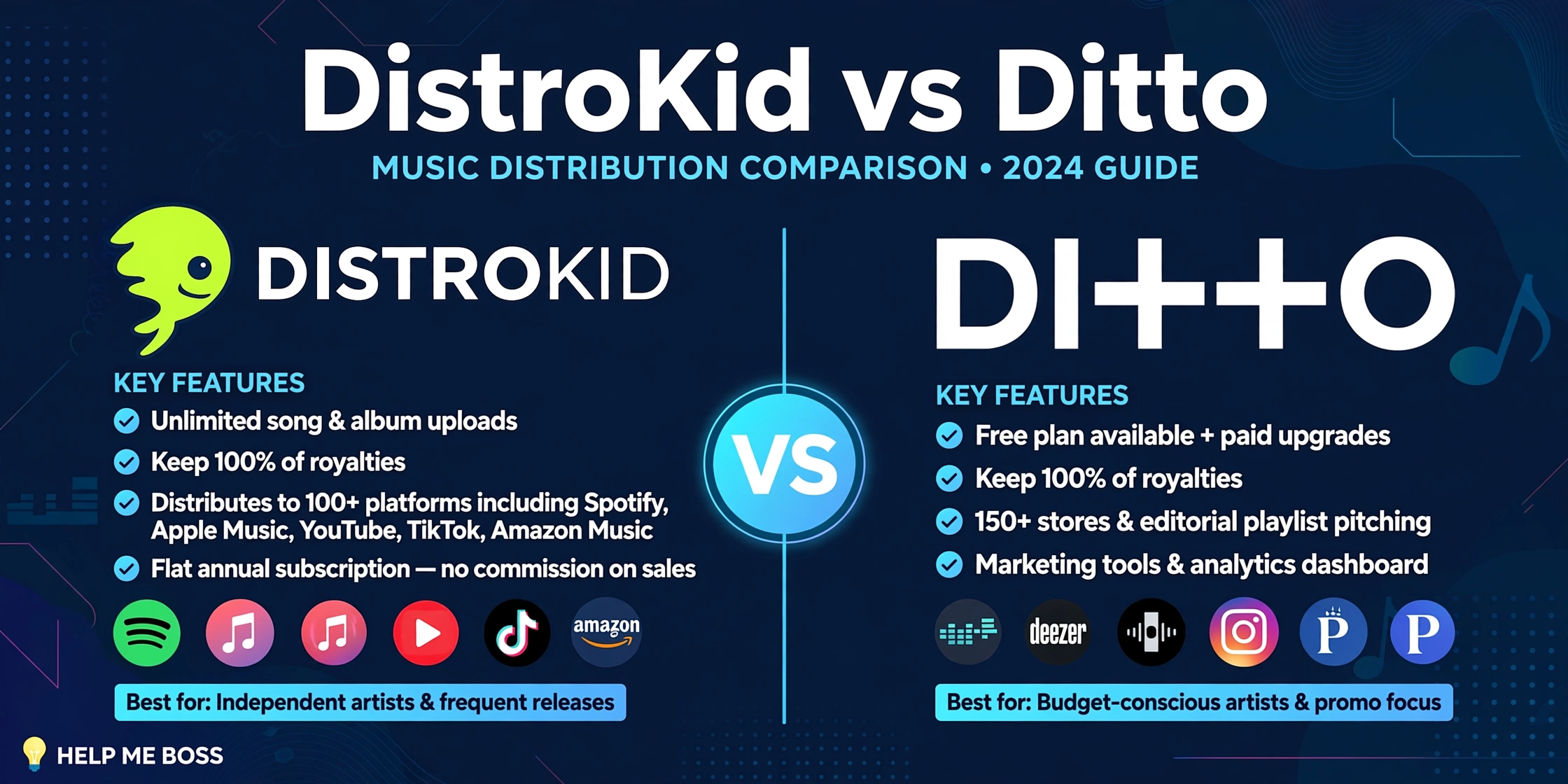
“DistroKid or Ditto?” comes up in every AI music community, and most of the answers are built on outdated forum lore. Here’s the comparison based on what the two companies actually publish in 2026 — their prices, their AI rules, and their warnings.
Quick answer: For AI music, DistroKid is the better fit for most people, and Ditto is the cheaper one. Both accept music made with AI tools as of late 2026.
Pricing: The Raw Numbers
| DistroKid | Ditto Music | |
|---|---|---|
| Entry plan | $24.99/year | $19/year |
| Uploads | Unlimited | Unlimited |
| Royalties kept | 100% | 100% |
| Higher tiers | $44.99 / $89.99 / $139.99 | $59 / $109 |
Ditto wins on price — it’s about $6/year cheaper at entry level. But the decision was never really about $6. It’s about what happens to your AI releases after you upload them.
AI Policy: What Each One Actually Says
DistroKid added an AI credits question at upload in April 2026 — when you submit a track, it asks about AI involvement and passes that information along as AI credits. It lists no AI-specific exclusions in its published terms. The posture is: disclose it, and you’re fine.
Ditto also accepts AI-generated music, but with a notable warning: it publishes a list of platforms that may reject fully AI releases, including Apple Music and YouTube Content ID. So your track can go live through Ditto and still get bounced by specific stores.
Both operate on nearly identical underlying rules: you must own the rights, no voice cloning of real artists, no spam. Neither company publishes details of an AI detection system — the old forum claims about one distributor “scanning harder” than the other rest on lore, not on anything either company has said.
The Differences That Actually Matter
1. The AI credits workflow. DistroKid’s upload-time AI question means disclosure is built into the process — you answer once and it’s handled. With Ditto, you’re responsible for understanding each platform’s stance yourself, including their published warning list.
2. The platform rejection risk. This is Ditto’s real disadvantage for AI creators. If Apple Music or Content ID rejects your release, you’ve paid for distribution that didn’t fully distribute. DistroKid’s cleaner published stance means fewer surprises — though no distributor can guarantee every store accepts every track.
3. Content ID costs. If YouTube Content ID revenue matters to you, compare carefully: DistroKid charges an add-on fee per release plus takes a 20% commission on Content ID earnings. Factor that into your math if UGC revenue is part of your plan.
4. Appeal process. Ditto offers a 7-day appeal window if a release gets flagged — a genuine plus if you’re operating near the edges of platform policies.
The Money Math
For an AI creator releasing ~20 tracks a year, the annual cost looks like this:
- DistroKid: $24.99/year, unlimited uploads, 100% royalties
- Ditto: $19/year, unlimited uploads, 100% royalties
The per-stream economics are identical regardless of distributor — Spotify pays roughly $0.003–$0.005 per stream in 2026, Apple Music about 2–3x that. The distributor is a pipe, not a negotiator. So choose based on policy compatibility and price, not royalty fantasies.
(For context on what those streams add up to, our AI music earnings walkthrough runs the full math.)
Which Should You Pick?
Pick DistroKid if: you release frequently, you want the smoothest AI disclosure workflow, and you want the distributor with the fewest published AI caveats. It’s the default choice for AI music in 2026 for a reason.
Pick Ditto if: budget is the top priority and you’re comfortable managing platform-specific risks yourself. The $6/year savings are real, just make sure you read their platform warning list before uploading fully AI-generated tracks.
Either way, do this first:
– Confirm you hold the rights to release the music (Suno’s paid tiers grant commercial rights; free-tier generations generally don’t transfer)
– Disclose AI involvement honestly at upload
– Never use voice cloning of real artists — that’s a takedown everywhere
– Keep your release cadence sane (flooding stores with dozens of tracks triggers spam flags at any distributor)
Red Flags That Get AI Releases Taken Down
Regardless of which distributor you choose, these are the patterns that trigger removals:
- Voice clones of real artists. The fastest way to lose your entire catalog. Distributors and stores treat this as impersonation, not a gray area.
- Spam-release patterns. Uploading 30 near-identical tracks in a week looks like catalog flooding. Stores have automated flags for it, and distributors will pass the takedown along.
- Misleading artist names. Naming your AI project something confusingly similar to a famous artist invites both takedowns and legal trouble.
- Royalty-free loop repackaging. Uploading barely-modified stock loops as “original” tracks is one of the most common reasons AI-adjacent releases get pulled.
Stay clear of these and the distributor choice becomes a boring administrative decision — which is exactly what you want.
And once the music is live, distribution is only half the job — our 6-week Shorts promo plan covers the part that actually gets you listeners.
Switching Distributors: What to Know
Already with one and considering the other? A few practical notes:
- Your music stays live only while you pay. Both DistroKid and Ditto are subscription models — if you cancel, your releases can be taken down unless you’ve paid for catalog-preservation add-ons (DistroKid’s “Leave a Legacy” is the well-known example). Factor this into any switch: you’ll need overlapping subscriptions during the transfer.
- ISRC codes matter. Keep your ISRCs when re-uploading through a new distributor so stream counts and playlist placements carry over. Both distributors let you enter existing ISRCs at upload — don’t skip this field.
- Don’t duplicate. Never have the same track live through two distributors simultaneously. Stores flag duplicates, and you can end up with takedowns on both sides. Move releases one at a time: upload to the new distributor, confirm it’s live, then take down the old one.
Frequently Asked Questions
Do DistroKid and Ditto both accept AI-generated music?
Yes, as of late 2026 both accept music made with AI tools, provided you own the rights and follow their rules (no voice cloning, no spam).
Which is cheaper, DistroKid or Ditto?
Ditto — $19/year versus DistroKid’s $24.99/year at entry level. Both offer unlimited uploads and 100% royalties.
Can Apple Music reject my AI release?
Possibly. Ditto explicitly warns that Apple Music, YouTube Content ID, and other platforms may reject fully AI-generated releases. This risk exists regardless of distributor, but Ditto documents it openly.
What are AI credits on DistroKid?
Since April 2026, DistroKid asks about AI involvement during upload and passes that information to stores as AI credits — a disclosure mechanism, not a penalty.
Does the distributor affect how much I earn per stream?
No. Streaming rates are set by the platforms, not the distributor. Choose based on price, policy fit, and workflow.
Sources: distributor comparison re-checked September 2026 via undetectr.com; pricing cross-checked via interspacemusic.com.