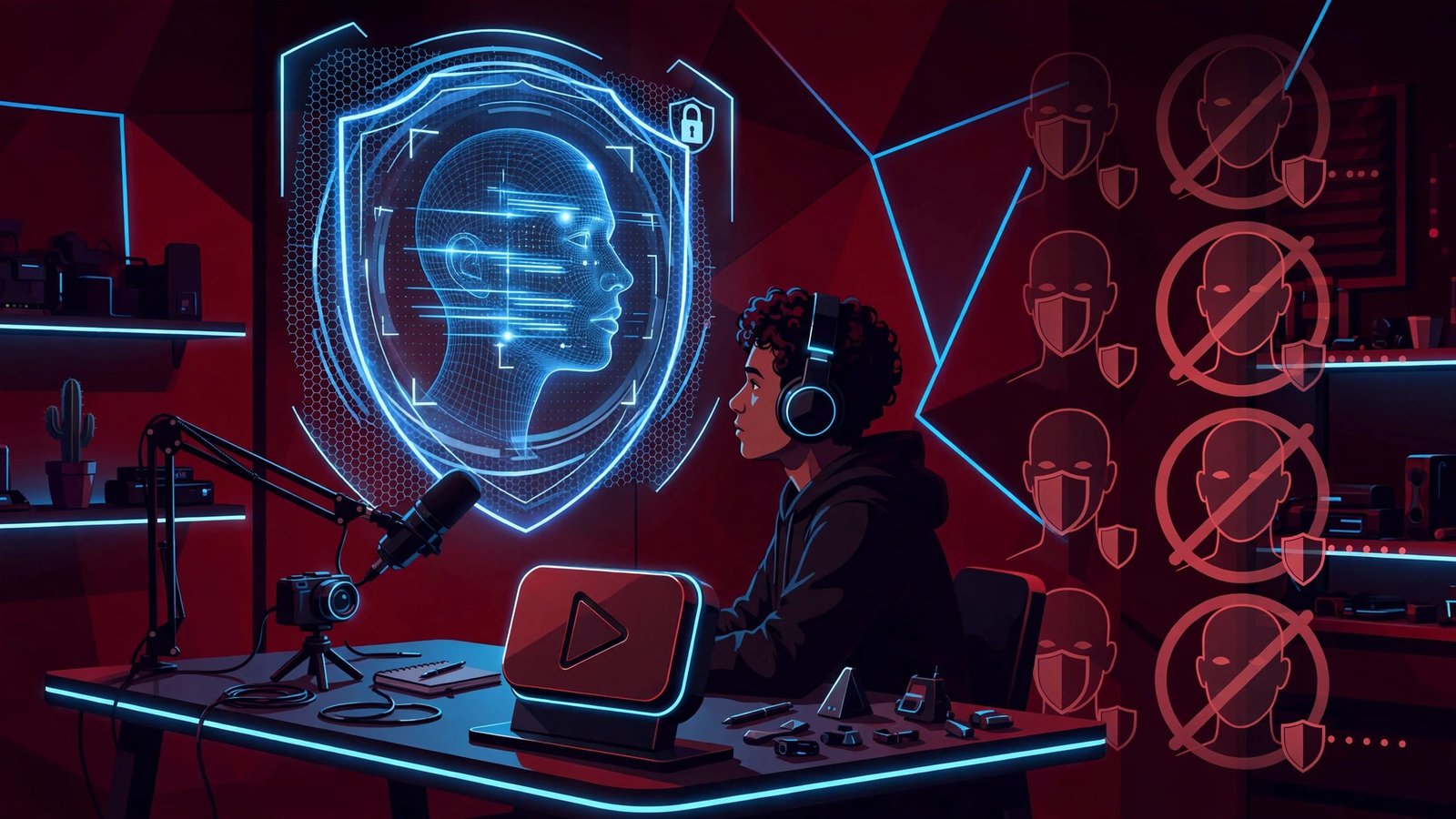
Someone can now clone your face or your voice with a few clicks — and if you make videos for a living, that’s not just creepy, it’s a business risk. Scammers run deepfake endorsement ads, copycats post fake “apology videos” to steal your audience, and AI voice clones read sponsorship scripts you never recorded.
YouTube has been building the counterweight for a year. Its likeness detection tool scans YouTube for AI-generated videos using your face and lets you request removals — and back in May 2026 the company opened it to every adult creator on the platform. At the Made on YouTube 2026 event it added mobile enrollment and match alerts so creators can act on the go. Here’s how it works, who qualifies, and exactly how to enroll and file a removal.
What Likeness Detection Actually Does
The tool runs one-time searches of newly uploaded YouTube videos for altered or synthetic uses of your enrolled face. When it finds a potential match — say, a deepfake of your face — you get a notification and a review screen in YouTube Studio. From there, you inspect the flagged video and choose your next move: submit a likeness removal request, file a copyright request instead, or archive the result.
Three important limits to know up front:
- It finds faces, not voices — yet. The detection system currently matches enrolled creators’ faces. YouTube says speaking-voice detection will be integrated later in 2026 to improve match accuracy. If someone clones your voice today, you have to find the video yourself and use the manual privacy-complaint route.
- It’s face-matching, not mind-reading. It may surface genuine footage of you too, not just synthetic material. Privacy removal may not apply to real footage — an unauthorized use of original copyrighted footage might need a copyright removal request instead (after considering fair use).
- It’s experimental and not available in some countries. Eligibility, enrollment, and feature availability depend on your account and region.
Who Can Enroll: The Full Timeline
This is the part that changed. Likeness detection rolled out in stages:
- Late 2025 — launched for YouTube Partner Program members
- March 2026 — extended to politicians, government officials, and journalists
- May 2026 — opened to all adults aged 18 and older (announced on YouTube’s creator forum)
- Made on YouTube 2026 — mobile enrollment and match alerts added; speaking-voice detection planned for later in 2026
That’s a big deal for small channels. Previously, protection was gated behind monetization eligibility; now, per YouTube’s May announcement, “whether creators have been uploading to YouTube for a decade or are just starting, they’ll have access to the same level of protection.” (See our roundup of the Made on YouTube 2026 AI tools for the rest of what launched at the event.) RedShark News, covering the Made on YouTube 2026 announcements, expects detection progress to move fast given the resources YouTube can throw at it.
Requirements to enroll: you must be over 18, have the required channel permissions, and complete a one-time identity verification — uploading a government-issued ID and recording a brief face/selfie video. You can leave the program later and request deletion of your facial data.
How to Enroll Step by Step
- Sign in to YouTube Studio on desktop.
- Open the Content detection section (left navigation).
- Choose Likeness, then select Start now.
- Complete the one-time verification: upload your government-issued ID and record the brief face video as prompted.
- Wait for enrollment to complete, then check the review area — potential matches appear there for you to inspect.
After enrollment, you don’t have to go hunting. The tool surfaces potential matches under the review area, where you can view the flagged video and decide whether to submit a removal request, choose a copyright route, or archive it.
What Happens After You File a Removal Request
Filing through the privacy complaint process kicks off a specific sequence that creators often misunderstand:
- YouTube contacts the uploader first and gives them 48 hours to remove or edit the video. The silence during that window is the clock running, not a rejection — many creators read it wrong and give up.
- If the uploader does nothing, YouTube’s team reviews the video independently. They can remove the video outright, blur your face and other identifying details, or strip identifying information from the title, description, and metadata while the video stays up.
- YouTube weighs specific factors. Parody and satire cut against removal. So does a video where you aren’t uniquely identifiable. And here’s the one that surprises people: public-official or well-known-figure status raises the bar rather than lowering it — an audience puts you nearer the public-figure end than a private individual, so a request that just says “this is fake” tends to lose.
Specificity is what moves a request. Give timestamps for every point where you appear, describe exactly what the video claims you said or endorsed, and name the guideline it breaks. Requests that read like evidence get treated like evidence.
Voice Clones: Your Options Today
The synthetic-likeness privacy request has covered voice as well as face since November 2023 — so if someone uploads an AI copy of your voice, you can file a privacy complaint over it even though Likeness Detection can’t find those videos for you yet. You’ll need to find the video yourself, then file the same complaint you’d file over a face.
Musicians get a dedicated route: labels and distributors representing artists in YouTube’s AI music program can request removal of tracks that mimic an artist’s singing or rapping voice, judged case by case and weighed against news reporting or critique of the synthetic vocals.
Also worth knowing: state law can reach further on voice rights than most creators expect — the right of publicity in several US states covers commercial voice imitation independent of any platform policy. For anything with money attached, talk to a lawyer, not just a support form. (This isn’t legal advice.)
Why YouTube Is Doing This Now
The likeness expansion is the defensive half of YouTube’s AI strategy; the offensive half is the creator AI tools it keeps shipping. The guardrails arrived alongside July 2026’s clarification of the inauthentic content policy, which spelled out three categories that lose monetization: generic templated content (including AI-generated video that adds no original perspective), emotionally manipulative or shock content, and AI personas posing as human experts on health, legal, financial, or political subjects. YouTube even named AI “doctors” and AI “lawyers” as examples — a sign it’s trying to get ahead of toxic AI slop before it swamps the platform.
For creators, the message is two-sided: use AI as a production tool, but the same tools in someone else’s hands can target you — and the platform now gives every adult creator a way to fight back. If you’ve been putting off enrollment because you thought it was a big-channel perk, that gate is gone. Enroll now, before you need it.
Frequently Asked Questions
Is YouTube’s likeness detection free?
Yes — it’s included for eligible creators in YouTube Studio at no cost. Enrollment requires a one-time identity verification with a government ID and a face video.
Does likeness detection cover AI-cloned voices?
Not yet. The detection tool currently matches faces only; YouTube says speaking-voice detection will be integrated later in 2026. For voice clones today, file a privacy complaint manually — the synthetic-likeness request has covered voice since November 2023.
What do I need to enroll in likeness detection?
You must be 18 or older, hold the required channel permissions, and complete one-time verification with a government-issued ID and a brief face video. Find it in YouTube Studio under Content detection → Likeness → Start now.
Can parody or satire videos be removed?
They’re much harder to remove — YouTube explicitly says parody and satire cut against removal, and public-figure status raises the bar. Be specific in your complaint: timestamps, what the video claims you said, and which guideline it violates.
What if the uploader ignores the removal request?
YouTube contacts the uploader first and gives them 48 hours to remove or edit the video. If they do nothing, YouTube’s team reviews it independently and can remove the video, blur your face and identifying details, or strip identifying information from the title, description, and metadata.
Can I leave the program and delete my face data?
Yes. Users who opt into likeness detection can leave the program later and request deletion of their facial data.