
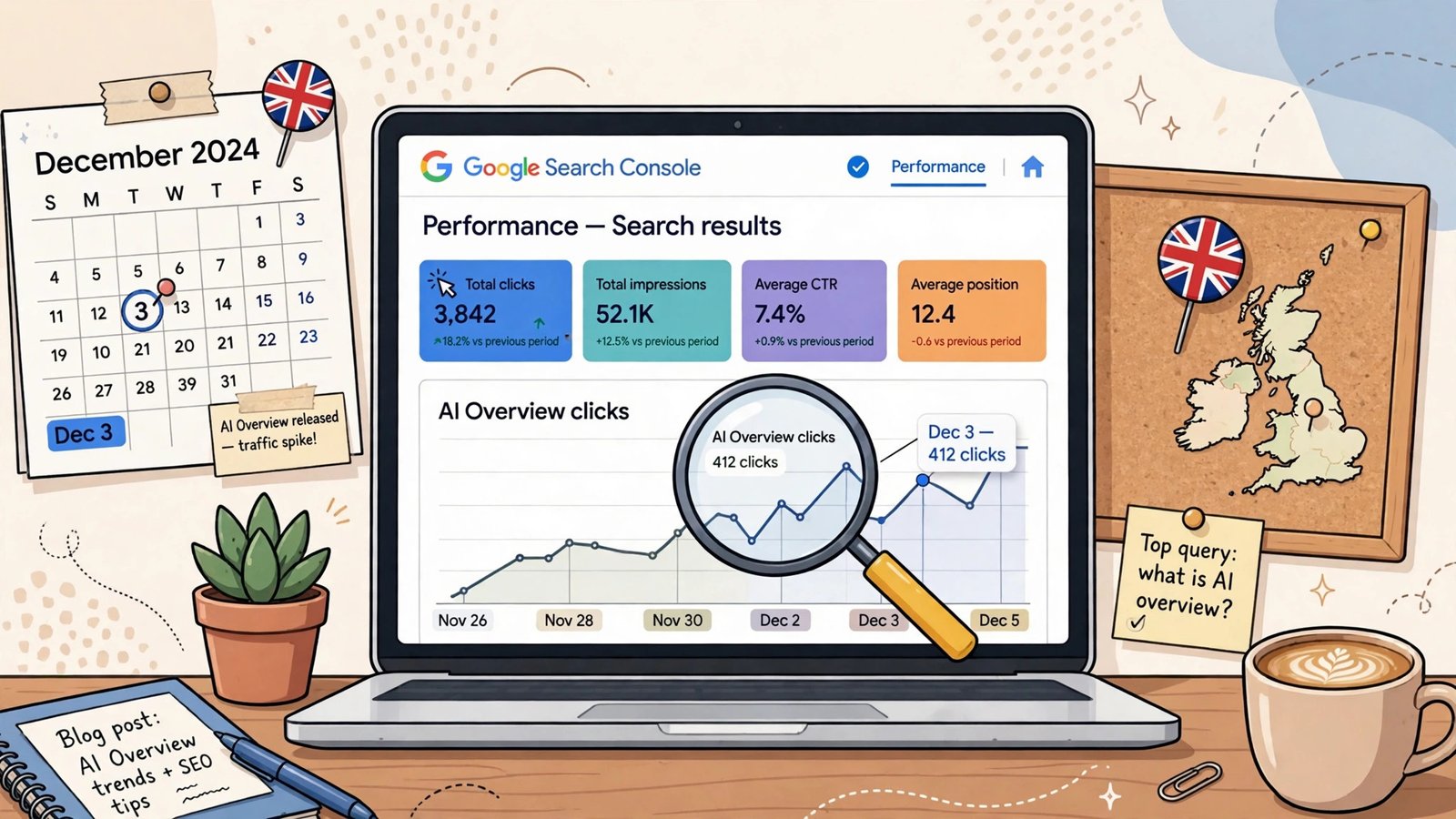
On December 3, 2026, Google runs out of time. The UK’s Competition and Markets Authority (CMA) gave the company until that date to hand publishers real engagement numbers for AI Overviews and AI Mode — impressions, clicks, and click-through rate, kept separate from ordinary organic results. If you run a blog, this is the first time anyone will have forced Google to show you what its AI answers actually do to your traffic.
That’s the short version. The longer version matters just as much, because December 3 is a regulatory deadline, not a Google product launch. Google has not announced what it will ship, when it will appear in your Search Console, or whether anyone outside the UK will see it. This article walks through what the CMA actually ordered, the dates that matter, the hole in your data today, and the exact steps to take before the deadline so you’re ready the day the numbers arrive.
What the December 3 deadline actually requires
The order is called the publisher conduct requirement, and it is the first conduct requirement the CMA has ever imposed under the UK’s Digital Markets, Competition and Consumers Act 2024. It was imposed on June 3, 2026, and it stays in force until October 10, 2030 unless the CMA changes or revokes it.
Here is what Google has to deliver by December 3:
| Requirement | What it means in practice |
|---|---|
| Clear, detailed engagement metrics | Impressions, clicks, and click-through rate for content used in AI Overviews and AI Mode |
| Link position included | Impressions must show where a link sat inside the AI answer, not just that it appeared |
| Clicks identifiable | Click-throughs must be separable from ordinary organic clicks — not buried in one total |
| Separate from organic results | The AI numbers must be reported apart from classic blue-link performance |
| Delivered on a common platform | The CMA’s notes point to a platform “such as Google Search Console” |
| Referral data | Enough information for publishers to judge the quality of the traffic, not just the volume |
The scope is narrower than the headlines suggest. These duties cover AI answers shown to people or businesses located in the UK. Nothing in the order obliges Google to give the rest of the world the same data on the same day. Google might roll it out everywhere — it did the same with the opt-out switch itself — but it has not said so, and you should not plan on it.
Two more pieces come with the same order. Directory-level controls that keep your content out of AI Overviews and AI Mode grounding are due on December 3 as well. Page-level controls follow three months later, around March 3, 2027. And Google’s first compliance report to the CMA, covering June 3 to December 3, is due on January 3, 2027. That report will be public, which means even if nothing shows up in your Search Console on December 3, the January filing should tell you what Google actually did.
The timeline: how we got here
This did not come out of nowhere. The CMA has been building toward it for almost two years, and the dates explain why December 3 is a hard deadline rather than a suggestion:
| Date | What happened |
|---|---|
| January 14, 2025 | CMA opens strategic market status investigations into Google Search |
| June 24, 2025 | CMA publishes a roadmap of possible interventions in search |
| October 10, 2025 | Google designated as having strategic market status in general search and search advertising — it accounts for more than 90% of UK general search queries |
| June 3, 2026 | Publisher conduct requirement imposed — the CMA’s first ever conduct requirement |
| June 17, 2026 | Two more requirements imposed: fair ranking and data portability |
| August 4, 2026 | CMA publishes its summary of what the publisher requirement demands, including the metrics |
| August 31, 2026 | Search Console’s generative AI performance report opens to all websites — impressions only |
| September 23, 2026 | CMA consults on a fourth requirement, on user choice |
| November 2, 2026 | Google’s Gary Illyes says publicly there is no announcement yet on AI click data |
| December 3, 2026 | Publisher conduct requirement comes into force |
| January 3, 2027 | Google’s first compliance report to the CMA is due |
| March 3, 2027 | Page-level grounding controls due |
Two details in that timeline deserve attention. First, the CMA said Google would have nine months to implement all the changes, but that it “expects important parts of the controls to become available to publishers well before that deadline.” December 3 is the date the metrics and the directory-level controls are due. Second, conduct requirements are legally enforceable — unlike the voluntary commitments regulators used to accept, a company affected by non-compliance can enforce them. That is why this deadline is worth taking seriously in a way that a Google blog post promise would not be.
The CMA also imposed a fair ranking requirement on June 17, 2026, which says Google must rank organic results — including in AI Overviews — using objective and non-discriminatory criteria, give businesses advance notice of significant ranking changes, and set up clear processes for raising concerns. Google has six months to implement that one. A data portability requirement, with three months to implement, puts Google’s UK Data Portability API on a legal footing. The December 3 story is the publisher piece; the fair-ranking piece is the one to watch next year.
What you can see today — and the hole in it
Open Search Console today and go to the generative AI performance report. It has been open to every website since August 31, 2026, and it shows your AI Overview and AI Mode impressions broken down by page, country, device, and date. That is genuinely useful. It is also only half the picture.
The report shows impressions, not clicks. Google counts a click on a link inside an AI Overview or AI Mode as an ordinary click in the Performance report, folded into your Web totals with no way to separate it. So you can see that your pages appeared in 40,000 AI answers last month, and you cannot see whether those appearances sent you 400 clicks, 40 clicks, or none at all. For a blogger whose income depends on visits, that is the number that matters, and it is the number Google does not show you.
That gap is exactly what the December 3 order is designed to close — for UK traffic, at least. The CMA’s interpretative notes expect click-throughs “with a way to identify them” and a click-through rate, kept separate from organic results.
Until the data arrives, the only public estimate of the click rate comes from one experiment. SEO consultant Cyrus Shepard opted his own site, Zyppy, out of Google’s AI features for 28 days in September 2026, then opted back in and compared the two periods. His estimate: AI impressions earned about a 0.9% click-through rate, with a reasonable range of 0.7% to 1.1%. He was careful about the limits himself, telling Search Engine Journal that readers should treat the findings “more as a directional yardstick than Google gospel” and not assume the numbers apply to other sites. Our site covered that experiment in detail, including the surprise finding that his regular organic clicks fell while the site was opted out — the halo effect of being visible in the answer.
Here is what that 0.9% estimate means in real clicks at different traffic levels, using the same proportions Shepard reported — AI impressions at roughly 10% of a site’s total search impressions:
| Monthly search impressions | AI impressions (~10%) | Estimated AI clicks at 0.9% CTR |
|---|---|---|
| 10,000 | 1,000 | 9 |
| 50,000 | 5,000 | 45 |
| 100,000 | 10,000 | 90 |
| 500,000 | 50,000 | 450 |
| 1,000,000 | 100,000 | 900 |
Those numbers are small, and that is the point. At a 0.9% click rate, AI impressions are a weak traffic source on their own. But they are not the whole story — Shepard’s test estimated that AI features produced about 21% of his site’s search clicks once the halo lift to regular listings was counted, and 23% including a possible listing lift. The clicks inside the answer are only part of what visibility in the answer is worth. December 3 is when publishers get to stop estimating and start measuring.
Why Google hasn’t just published the numbers
If you are wondering why a company that reports everything has not simply added a clicks column, Google’s own search team gave you the honest answer on November 2, 2026. Gary Illyes replied on LinkedIn to a post quoting an unnamed Googler who said click and query data was expected in Search Console. His reply, as reported by Search Engine Journal: “I don’t think we’ve phrased it like this. The team is super interested in giving more data, data that makes sense, but we don’t have anything to announce yet.”
Read that carefully. It does not say the data is coming. It does not say it is not coming. It says the team is interested and there is nothing to announce. As of November 20, no later public announcement from Google with a date for AI click data had appeared.
That is the honest tension at the center of this story. The CMA’s deadline is real and enforceable, and Google said in June that it will comply with the CMA decision. But compliance can take more than one form. The metrics could arrive as a new tab in Search Console, as a downloadable report, as data in the compliance filing itself, or as something narrower than publishers hope — for example, aggregated across AI Overviews and AI Mode rather than split by feature, or UK-only with no global rollout. The CMA’s August summary says the data should be “aggregated across features such as AI Overviews and AI Mode,” which suggests aggregation is acceptable. Do not expect a per-query click report on December 3. Expect something, check what it actually is, and then decide what it is worth.
There is also a second reason for caution. The same month the CMA order lands, Google is still rolling out its November 2026 core update, which started on November 10 and may run until around November 24. Any traffic move you see in early December could be the core update settling, the new model in AI Mode, or the new data itself. Annotate the dates before you draw conclusions — the same discipline that applies to every core update applies here.
What the data will be worth when it lands
The reason publishers fought for these numbers is that the existing evidence about AI search and clicks is grim, and it all points the same way:
- Pew Research Center, 2025: In a panel of 900 US adults and 68,879 searches, users clicked a link inside an AI summary in just 1% of visits to pages with one. They clicked a traditional result in 8% of visits with an AI summary, against 15% without one.
- Ahrefs, 2026: Across 300,000 keywords, the top result on a page with an AI Overview earned 58% fewer clicks than it would have without one — up from a 34.5% gap a year earlier.
- Authoritas, submitted to the CMA: Publisher click-through fell by 47.5% on desktop and 37.7% on mobile when an AI Overview appeared.
- Randomized field experiment, 2026 data: AI Overviews cut outbound organic clicks by 39.8% when one appeared, in a controlled test of 1,065 US desktop users and 68,089 searches.
Set against that, Shepard’s 0.9% looks less like a rounding error and more like the first measurement of the other side of the ledger: the clicks AI answers do send, and the halo they cast on everything else on the page. The December 3 data will let every publisher with UK traffic run the same comparison Shepard ran, on their own numbers, without opting out of anything. That is the real prize — not a single industry benchmark, but a per-site answer to the question every blogger has been asking all year: is being in the AI answer worth more than it costs?
One more number to keep in mind. The UK now has the highest zero-click rate of any major search market — about 69.5% of UK Google searches end without a click to a website. That is the market where this data lands first. If AI click data exists anywhere, it will exist for the searches where clicks are scarcest.
What to do before December 3
You do not need to wait for the deadline to get ready. Four steps, all free, all in Search Console:
1. Segment your UK traffic now. In the Performance report, filter by country: United Kingdom. Then open the generative AI report and filter the same way. Record your current AI impressions for UK traffic, by page, for the last 28 days. That is your baseline. When the click data arrives, you will compare against it — not against a vague memory of “traffic was fine in November.”
2. Write down your own estimate. Take your UK AI impressions from step 1 and multiply by 0.9%. That is your rough expected click count, using the only public estimate available. Write it down with the date. When the real number arrives, you will know immediately whether your site behaves like Shepard’s or nothing like it. If your real CTR is far lower, your pages are being summarized rather than cited — and that is a content problem you can fix.
3. Check which pages carry your AI impressions. The generative AI report breaks impressions down by page. Your top five pages by AI impressions are the pages whose click data will matter most. Make sure each one has a direct answer in the first 100 words, a table where a table fits, and a date on its key facts — the same citability checklist that applies in the Hydrogen era, because the model that writes the answers is now Gemini 4 Hydrogen, and it lifts tables and dated facts more easily than buried prose.
4. Put January 3 on your calendar too. Google’s first compliance report to the CMA is due January 3, 2027. If Search Console shows nothing new on December 3, the compliance report is where you will find out what Google actually delivered and what it says it will deliver next. The page-level opt-out controls are due March 3, 2027 — if you have pages an AI answer can fully replace in two sentences, that is the date that matters for them.
For US bloggers, the honest answer is that December 3 probably changes nothing in your account that day. The order covers UK traffic only. What it changes is the information available to everyone: once UK publishers can see AI click data, the industry will finally have real numbers instead of one-site estimates, and Google will face the obvious question of why the same data is not available everywhere. Watch what UK publishers report in December, and be ready to ask for the same.
What to watch after December 3
December 3 is a deadline, not a finish line. Here is what to check, in order:
- December 3–5: Open Search Console and look for anything new in the generative AI report — a clicks column, a CTR column, a UK filter that behaves differently. Check the Search Central blog and the CMA case page for announcements. If nothing appears, do not assume non-compliance; the CMA’s own summary allows delivery through a platform “such as” Search Console, and the compliance report is the formal record.
- January 3, 2027: Google’s first compliance report lands. Read it before you believe any vendor’s summary of it.
- March 3, 2027: Page-level controls for keeping content out of AI Overviews and AI Mode grounding are due. That is when the opt-out decision becomes granular instead of site-wide.
- Ongoing: The CMA is consulting on a user choice conduct requirement, and it has said it is actively monitoring how Google implements the AI changes. If the December data disappoints, the regulator has already shown it will come back with more.
Frequently Asked Questions
Will Google show AI Overview clicks in Search Console on December 3, 2026?
Not necessarily in Search Console, and not necessarily on that exact day. The UK CMA requires Google to provide impressions, clicks, and click-through rate for AI features shown to UK users by December 3, and points to Search Console as an example of how the data could be delivered. Google has not announced a specific product or date. The compliance report due January 3, 2027 is the formal record of what was delivered.
Does the December 3 deadline apply to US publishers?
No. The conduct requirement covers AI outputs shown to people or businesses located in the UK. US bloggers will not get the data automatically. But once UK publishers can measure AI clicks, the numbers will become public knowledge quickly, and pressure for a global rollout will follow.
What data does Search Console show for AI Overviews today?
The generative AI performance report, open to all websites since August 31, 2026, shows impressions by page, country, device, and date. It does not show clicks or click-through rate. Clicks on AI Overview and AI Mode links are counted inside the ordinary Web totals in the Performance report, where they cannot be separated out.
What is the click-through rate for AI Overviews?
The only public estimate comes from Cyrus Shepard’s one-site opt-out test: about 0.9%, with a range of 0.7% to 1.1%. Pew Research Center found users clicked a link inside an AI summary in 1% of visits. Both figures are small, but Shepard’s test also found that AI visibility lifted clicks on regular organic results — so the click rate inside the answer is not the whole value of being cited.
Can I opt out of AI Overviews before December 3?
Yes. Search Console has a Search generative AI control under Settings that excludes your site from AI Overviews, AI Mode, and generative features in Discover. It takes effect within a day or two and is reversible. But Shepard’s experiment found that opting out cost regular organic clicks as well as AI clicks, so do not opt out expecting a traffic rebound — the evidence points the other way. Page-level controls arrive March 3, 2027 if you only want to exclude specific pages.
What happens if Google misses the December 3 deadline?
Conduct requirements under the Digital Markets, Competition and Consumers Act are legally enforceable, and companies affected by non-compliance can enforce them. The CMA monitors compliance and receives Google’s first compliance report on January 3, 2027. The practical outcome of a missed deadline would be regulatory action, not a Search Console update — which is why the January report matters as much as the December date.