
Anthropic’s stock gave back nearly all of its debut-day gain on Friday, November 20, closing at $88.91 — down 8.5% from Thursday’s $97.17 close and just $5.91 above the $83 IPO price. At one point in the early afternoon, ANT traded as low as $83.05, five cents above the price IPO investors paid. But the price is only half the story. The other half is structural: on the same day, Anthropic closed its IPO with the underwriters exercising their full 147-million-share greenshoe option, which closed Morgan Stanley’s stabilization position. The bank that could have bought shares to support the stock below $83 can no longer do so. From Monday, November 23, ANT trades without a net.
If you read our first-day piece, you know the setup: Anthropic priced the biggest IPO in history at $83 on November 18, opened at $111.50 on Thursday, November 19, spiked as high as $115.10, and closed at $97.17 — a 17% first-day gain. Friday was the hangover. This piece picks up where that one left off: the day-two numbers, the five-cent hold, the greenshoe explained in plain English, the broader AI selloff that dragged the whole sector down, and what to watch in the first full week of trading.
A quick note on the numbers in this article: a couple of outlets printed a slightly different close ($88.30), but the session data from Finnhub — open $89.86, high $92.56, low $83.05, close $88.91 — is the market-data record I am using throughout, and every figure here comes from that one source unless I say otherwise. When prices move this fast on a brand-new listing, small discrepancies between data feeds are normal, and I would rather name the source than pretend the disagreement does not exist.
The day-two numbers, side by side
The fastest way to see what happened is to put the two sessions next to each other:
| Day 1 — Thursday, Nov 19 | Day 2 — Friday, Nov 20 | |
|---|---|---|
| Open | $111.50 | $89.86 |
| High | $115.10 | $92.56 |
| Low | $83.05 (not reached day 1) | $83.05 |
| Close | $97.17 | $88.91 |
| Change vs prior close | +17.1% vs $83 IPO price | −8.5% (−$8.26) |
| Premium over IPO price at close | +$14.17 (+17.1%) | +$5.91 (+7.1%) |
| Volume | ~847 million shares | ~390.5 million shares |
| Market value at close | ~$1.30 trillion | ~$1.19 trillion |
Read that table slowly, because it tells three stories at once. First, the debut pop is more than half gone: of the $14.17 premium ANT held at Thursday’s close, only $5.91 remained by Friday’s close. Second, the stock spent the whole of Friday below Thursday’s close — it opened at $89.86, never got near $97 again, and its best moment of the day was a $92.56 high that was still 5% below where it had finished the day before. Third, volume fell by more than half, from about 847 million shares to about 390.5 million. Day one was the scramble — index funds, IPO buyers, flippers, and everyone who had waited months for this listing all trading at once. Day two was closer to a normal market, and in a normal market the stock drifted down. After hours, ANT slipped further, to $87.80 by 8 p.m. ET.
The five-cent hold
The most dramatic moment of the session came at 12:49 p.m. ET, when ANT touched $83.05 — five cents above the $83 IPO price. Five cents. On a stock with more than 13.3 billion shares outstanding, that is a rounding error, and it is worth being honest about what it does and does not mean.
What it means is that every investor who bought in the IPO is still, technically, in the green. The IPO price is the line that separates the people who got in at the offering from the people who chased the stock higher. As long as ANT stays above $83, the IPO buyers have not lost money. That is psychologically important, because a new listing that falls below its offer price in its first week gets a label — a “broken IPO” — that sticks to it in every headline for months.
What it does not mean is that $83 is a floor. A stock does not bounce off a price because the number is round, or because it was the IPO price. It bounces because buyers step in, and on Friday the buyers who stepped in at $83.05 were enough to lift the stock about 6% back to $88.91 by the close — but they were not the bank. They were ordinary market buyers, and there is no guarantee they show up again on Monday at the same level. Friday’s close, at $88.91, was $5.91 above the line. That is the cushion, and it is thin.
Here is the math that makes the thinness concrete. Anthropic had 13,366,642,276 shares outstanding after the IPO closed — about 13.37 billion. At $88.91, that is a market value of roughly $1.19 trillion, down from roughly $1.30 trillion at Thursday’s close. About $110 billion of market value evaporated in a single session, on a day when nothing about Anthropic’s business changed. No earnings, no product news, no guidance. The company was, as its president and co-founder Daniela Amodei told CNBC on Thursday, “the same company” the next day. The price moved; the business did not.
The greenshoe, explained in plain English
To understand why Friday matters beyond the price, you need to understand the greenshoe — the part of an IPO that almost nobody outside Wall Street talks about, and the part that decided what happens next for ANT.
When a company goes public, the underwriting banks sell more shares than the base deal size. In Anthropic’s case, the base offering was 980 million Class A shares at $83, raising $81.3 billion. The underwriters sold extra shares on top of that, creating a short position — they sold shares they did not yet own. The greenshoe is the option that lets them fix that short position: they can buy up to 147 million additional shares directly from the company, at the $83 IPO price, within 30 days of the listing.
That option gives the banks two ways to close their short, and the choice depends on where the stock trades:
- If the stock falls below $83, the banks can buy shares in the open market to cover their short. That buying supports the price — it is the stabilization mechanism, and it is the reason IPO stocks often seem to find a floor near their offer price in the first days of trading.
- If the stock trades above $83, the banks instead exercise the greenshoe and buy the extra shares from the company at $83. That is the profitable, standard move when a listing debuts strongly, and it is what Morgan Stanley did.
Anthropic confirmed on Friday that the underwriters had exercised the full 147-million-share option when the IPO closed. The offering now totals 1.127 billion Class A shares, and aggregate gross proceeds are roughly $93.5 billion. On top of that sits a separate private placement of about $26 billion in a different class of shares, sold at the same $83 price to AMD, Broadcom, Google, Micron, Microsoft, Nvidia, and TSMC — bringing the total raised to roughly $119.5 billion.
Here is the part that changes the game: exercising the full greenshoe closed Morgan Stanley’s stabilization position. The bank can no longer buy shares in the open market to cover any remaining over-allotment if ANT falls below $83. The safety net is gone — and it is gone after one day, even though the banks had up to 30 days to decide. One market commentator quoted in the coverage put it plainly: the bookrunners gave up their remaining stabilization option after a single day, just as the share price was getting closer to the IPO price.
That is not a scandal, and it is not a mistake. Exercising the full greenshoe after a strong debut is standard practice — it is what underwriters do when a stock trades above its offer price. But standard practice has a consequence that retail investors rarely hear about: the mechanism that would have cushioned a fall below $83 no longer exists. From Monday, the $83 level is defended only by buyers who actually want the shares at that price, not by a bank with a contractual reason to buy them.
Why the timing stings
The timing is what turns a routine piece of IPO plumbing into the story of the week. The greenshoe was exercised on the very day the stock nearly touched the IPO price. If Morgan Stanley had waited — and it had 29 more days — the stabilization position would still have been available on Monday, when options on ANT start trading and volatility typically rises. Instead, the net came down on the day the stock needed it most.
Think of it this way: a trapeze artist has a safety net for the first month of performances. After a spectacular first night, the crew takes the net down on the second night, because the first night went well. The artist is just as skilled on night two as on night one. But the risk has changed, even though nothing about the performance has. That is ANT’s position going into its first full week: same company, same business, no net.
It is also worth noting what Anthropic did not do on Friday: the company has not publicly commented on the share-price decline. That is normal — companies almost never comment on day-to-day moves in their own stock — but it means there was no reassuring statement, no buyback announcement, no new disclosure to lean on. The stock fell on market forces alone, and it will rise or fall on market forces alone from here.
It was not just Anthropic: the AI selloff
ANT did not fall in a vacuum. Friday was a brutal day across the whole AI trade, and Anthropic’s slide was both a symptom and a trigger.
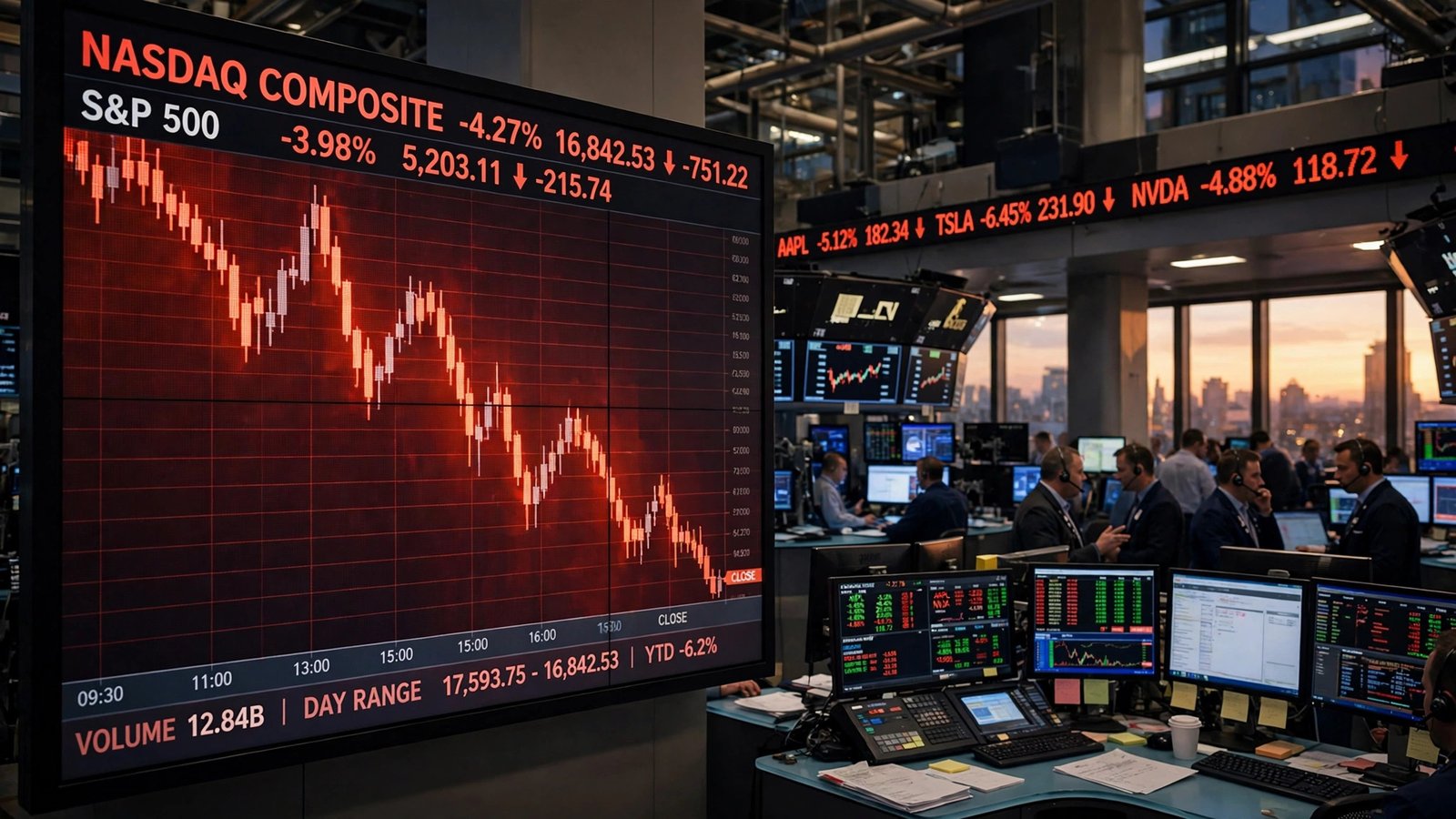
The Nasdaq fell about 5% on Friday, according to Investor’s Business Daily’s market coverage, and the Dow and the S&P 500 were pushed more than 10% below their recent highs — into what Wall Street calls correction territory. Nvidia, the stock that has come to stand for the entire AI buildout, fell around 10%. Overnight, the Nikkei in Japan and the Kospi in South Korea both tumbled about 5%. The selling was global, and it was concentrated in exactly the names that had led the market higher all year.
Several wires pointed to the same chain of events: Anthropic’s second-day plunge detonated confidence in the AI trade one day after the biggest IPO in history. The logic is uncomfortable but easy to follow. The IPO was priced as a referendum on AI valuations — a $1.5 trillion valuation for a company that is still unprofitable and carries enormous future spending commitments on computing power. When the referendum’s poster child gave back most of its debut gain within 24 hours, investors started asking whether the whole sector was priced for a future that might arrive more slowly, or cost more, than the market had assumed.
The Motley Fool’s coverage of the day put a number on the valuation question: even after Friday’s drop, Anthropic was valued at about $1.2 trillion, or roughly 18 times its annualized revenue — last quarter’s revenue multiplied by four. That is not a cheap stock by any traditional measure. It is a stock priced on the belief that Anthropic’s revenue will keep growing fast enough, for long enough, to justify the multiple. Friday’s selling was, in part, the market re-pricing how certain that belief should be.
There is also a simpler, less dramatic explanation that deserves equal weight: profit-taking. Anyone who bought at $83 and watched the stock hit $115.10 on day one was sitting on a 38% gain within hours. Taking some of that off the table on day two is not panic — it is common sense. The truth is probably a mix of both: some profit-taking, some genuine rethinking of AI valuations, and a market that had been looking for a reason to sell.
What to watch next
Monday, November 23, is the first real test, and there are three things to watch.
Options start trading. Options on ANT are expected to list on Cboe on Monday, November 23, according to CNBC. That matters for two reasons. First, options give traders a cheaper way to bet on the stock falling, which can add selling pressure. Second, options trading tends to amplify moves in both directions — the same stock, with more ways to trade it, usually gets more volatile, not less. If you are watching ANT next week, expect bigger swings than the first two days, not smaller ones.
The $83 line. Everything now comes back to the IPO price. If ANT holds above $83 through its first full week, the story becomes “the debut pop faded, but IPO investors are still whole, and the stock found its level.” If it closes below $83, the story becomes “the biggest IPO in history is underwater for its own investors” — and with no stabilization buyer left, there is no mechanical reason the slide would stop there. The next support level below $83 is whatever price buyers decide is fair, and nobody knows what that is yet.
Index inclusion. Market commentary has pointed to December 1 as the reported date for ANT’s inclusion in major indexes. That matters because it forces index funds to buy the stock, creating a large, mechanical source of demand. That buying could cushion the stock — but it is still more than a week away, and a lot can happen in a week when a stock is falling 8.5% a day.
One more voice worth hearing: Seaport analyst Jay Goldberg gave the stock a Neutral rating on Thursday, and his line was quoted widely for a reason — “If Anthropic really is the greatest company ever, there will be time to buy later.” That is the patient investor’s case in one sentence. You do not have to catch the first week of the biggest IPO in history. If the company is as good as its valuation claims, it will still be there in a month, or six months, at a price set by a calmer market.
What this means if you own AI through an index fund
A 10% correction in the Dow and the S&P 500, and a roughly 5% single-day fall in the Nasdaq, will show up in your retirement account. That is not a reason to panic, and it is not a reason to sell — it is the normal functioning of a market that had gone up a long way, very fast, on a single theme. Corrections of 10% happen regularly; the S&P 500 has averaged roughly one a year over the long run. What made Friday unusual was the speed and the trigger: the biggest IPO ever, one day after it happened, becoming the symbol of a sector-wide rethink.
The practical question is the same one it always is after a day like this: is your portfolio positioned for the possibility that the AI trade takes a breather? If your retirement savings are in a broad target-date fund, the answer is mostly yes — those funds are diversified by design, and a single sector’s bad week is a bump, not a crisis. If you are heavily concentrated in tech or AI names, Friday was a reminder that concentration cuts both ways.
The honest box: what we still do not know
A few things about Friday are genuinely unresolved, and I would rather say so than smooth them over.
First, the exact close. Finnhub’s session data says $88.91. A few other outlets printed $88.30. The difference is 61 cents — small in percentage terms, but it changes the day’s decline from 8.5% to about 9.1%, and it changes the premium over the IPO price from $5.91 to $5.30. I have used Finnhub throughout because it is a market-data source, but if you see a different number elsewhere, that is why.
Second, we do not know who was selling. The volume data tells us how much traded, not who traded it. It could have been IPO flippers taking profits, institutions trimming positions, short sellers opening bets ahead of Monday’s options listing, or some mix of all three. Anyone who tells you they know exactly who sold is guessing.
Third, we do not know whether the AI selloff is a one-day event or the start of something longer. The same week produced record-breaking news in the other direction — GTA 6’s official $3.79 billion day-one sales, for example, and a wave of new AI model launches. A single bad day for AI stocks, even a very bad one, does not erase the earnings and products behind the sector. But it does tell you the market’s mood has shifted from “buy everything AI” to “prove it.”
The bottom line
Anthropic’s second day as a public company took back most of the first day’s gain: $88.91, down 8.5%, with a midday brush against $83.05 that left the stock five cents above its IPO price. The price is the headline. The mechanism is the story. Morgan Stanley exercised the full 147-million-share greenshoe when the IPO closed on Friday, taking total gross proceeds to about $93.5 billion — and closing the stabilization position that could have supported the stock below $83. From Monday, when options start trading, ANT stands on its own: no net, no guaranteed buyer, and a market that has just spent a week learning how fast AI enthusiasm can turn.
This article is for information only and is not financial advice. Stock prices move quickly, especially in a new listing’s first week — check a live quote before acting on anything here.
Frequently Asked Questions
Why did Anthropic stock fall on its second day of trading?
ANT fell 8.5% to $88.91 on Friday, November 20, as the excitement of its record debut faded and a broad selloff hit AI and chip stocks — the Nasdaq fell about 5% the same day. Some of the drop was simple profit-taking after Thursday’s run to $115.10; some of it was investors rethinking AI valuations after the IPO priced Anthropic at roughly $1.5 trillion despite the company still being unprofitable.
What is the greenshoe, and why does it matter for ANT?
The greenshoe is an option that lets IPO underwriters buy up to 147 million extra shares from the company at the $83 IPO price. It matters because it is also the stabilization mechanism: if the stock falls below $83, the underwriters can instead buy shares in the open market to support the price. Morgan Stanley exercised the full option when the IPO closed on November 20, which closed the stabilization position — so the bank can no longer buy shares to support ANT below $83.
How close did ANT come to its $83 IPO price?
Very close. ANT traded as low as $83.05 at 12:49 p.m. ET on Friday, November 20 — just five cents above the IPO price — before recovering to close at $88.91. At the low, the company was worth about $1.11 trillion, down from about $1.30 trillion at Thursday’s close.
When do options on Anthropic stock start trading?
Options on ANT are expected to start trading on Cboe on Monday, November 23, 2026, according to CNBC. Options give traders more ways to bet on the stock in both directions, which typically means bigger price swings in the first weeks.
Is Anthropic’s IPO still the biggest ever?
Yes. The offering raised about $93.5 billion in gross proceeds after the full greenshoe exercise, plus roughly $26 billion in a concurrent private placement to investors including AMD, Google, Microsoft, and Nvidia — about $119.5 billion in total. The base offering alone, at $81.3 billion, was already the largest IPO on record.
Should I buy ANT now that it has fallen?
There is no single right answer, and this article is not financial advice. The case for waiting is that the stock just gave back most of its debut gain, the stabilization safety net is gone, options trading starts Monday, and the shares are still valued at roughly 18 times annualized revenue. The case for buying is that Anthropic is a leading AI company and IPO investors are still in the green. If you believe in the company long-term, there is no rush — as one analyst put it on day one, if it really is one of the great companies, there will be time to buy later.