
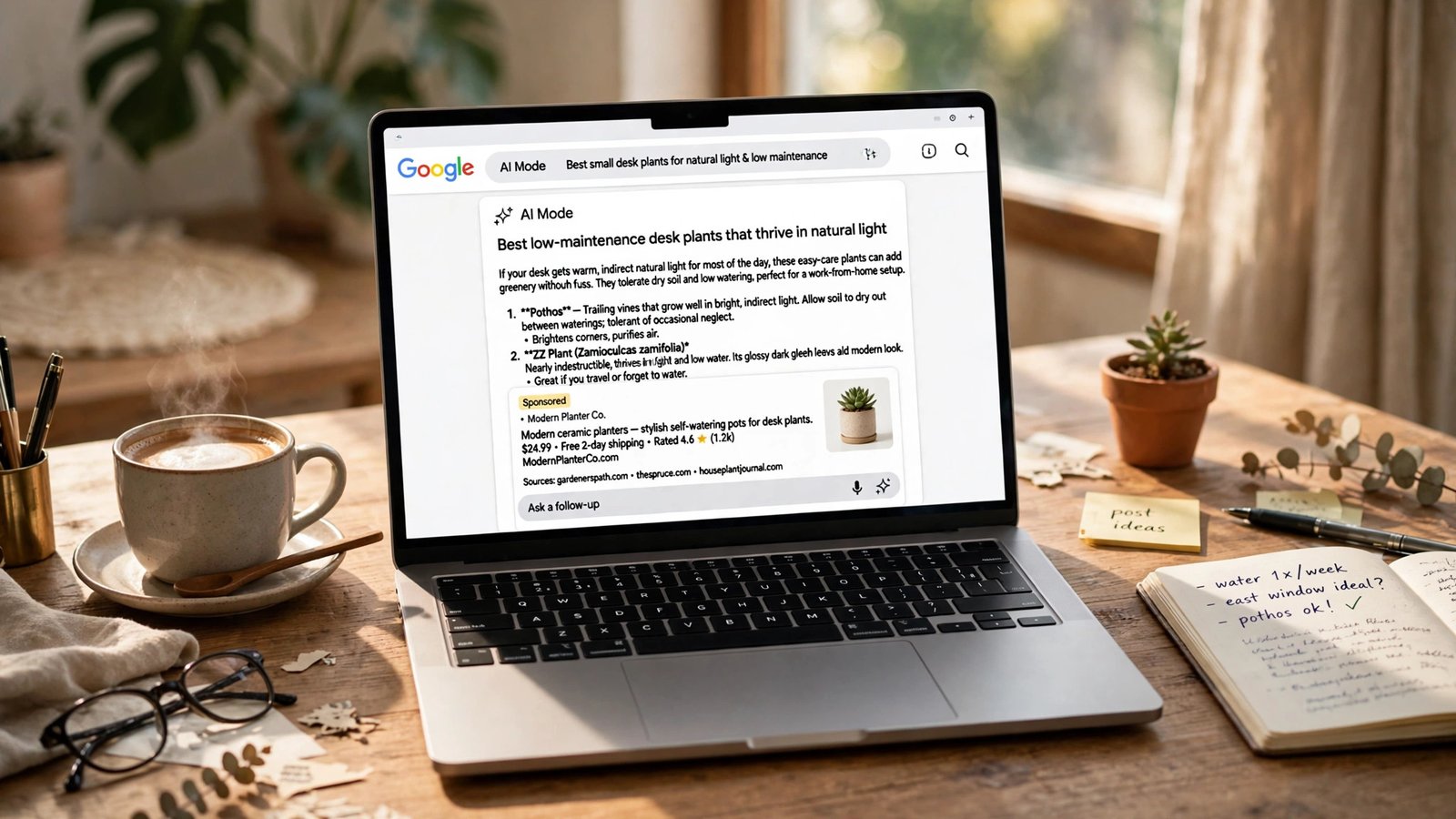
Google’s AI Mode ads went global on October 28, 2026 — and if you run a blog or a small Google Ads campaign, your work is already inside them. Google expanded ads in AI Mode to ten more countries that day, launched ads in follow-up questions in the US, and told investors on the same earnings call that an AI Mode query currently earns less than a classic search. There is no switch to flip, no way to opt out separately, and no separate report to see how the placement is performing for you.
That combination is the story. This is not a new ad format you can choose to test. It is an automatic expansion of where your existing campaigns already show up, and a shift in where your blog’s readers are being answered instead of clicked through. Here is what actually changed, what Google admitted about the money, and what to do about it this week.
What happened on October 28, 2026
On October 28, 2026 — the same day Alphabet reported its third-quarter results — Google’s ads team announced it was scaling ads inside AI Mode to ten more countries: Australia, Canada, India, Kenya, Malaysia, New Zealand, Nigeria, Pakistan, the Philippines, and Singapore. Brazil, Mexico, and the United Kingdom are planned for the fourth quarter of 2026, which would bring the total to 14 markets.
In the United States, Google also launched what it calls multiturn ads. Until now, an ad could appear in the answer to your first question in an AI Mode conversation. With multiturn ads, a sponsored placement can also appear in the answers to your follow-up questions — the second, third, or fourth turn of the same conversation. Every ad is labeled “Sponsored,” and Google says ads do not influence the AI-generated answer itself.
A few details worth getting right, because the coverage has been sloppy:
- Ads in AI Mode first launched in the US in May 2025. The October announcement is an expansion, not a debut.
- Ads above or below an AI Overview are available in every country and language where AI Overviews appear, according to Google Ads Help. Ads inside an AI Overview or AI Mode answer are English only, and only in the listed countries — Pakistan gets text ads only, and Indonesia is listed for AI Overviews only.
- The same announcement covered AI Overviews too. Google said it is “scaling high-quality ads within AI Overviews and AI Mode to more users and queries.” For the blogger side of that merge — what happens when AI Overviews and AI Mode start answering together — see our guide to the AI Overviews and AI Mode merge.
The ten new countries at a glance
| Country | AI Mode ads | Notes |
|---|---|---|
| Australia | Yes | Added Oct 28, 2026 |
| Canada | Yes | Added Oct 28, 2026 |
| India | Yes | Added Oct 28, 2026 |
| Kenya | Yes | Added Oct 28, 2026 |
| Malaysia | Yes | Added Oct 28, 2026 |
| New Zealand | Yes | Added Oct 28, 2026 |
| Nigeria | Yes | Added Oct 28, 2026 |
| Pakistan | Yes, text ads only | Added Oct 28, 2026 |
| Philippines | Yes | Added Oct 28, 2026 |
| Singapore | Yes | Added Oct 28, 2026 |
| Brazil | Planned Q4 2026 | No date given |
| Mexico | Planned Q4 2026 | No date given |
| United Kingdom | Planned Q4 2026 | No date given |
If your audience is in any of the first ten, the change is already live for them. If your readers are in Brazil, Mexico, or the UK, it is coming before the year ends.
Google’s own admission: an AI Mode query earns less
The more important October 28 news was not the country list. It was what Google told investors on the earnings call that evening.
Alphabet reported Google Search and other revenue of $63.35 billion for the third quarter, up 12% from a year earlier. That sounds healthy until you look at the trend: the same line grew 19% in the first quarter and 17% in the second. An analyst asked chief business officer Philipp Schindler why Search growth was slowing while query growth was the fastest in five years.
Schindler named three causes, in this order. Currency came first — he called exchange rates “the single largest driver” of the slowdown. Then advertiser spending in retail and media, including softer spending from some retail advertisers in Asia and normalized media and entertainment spending after a strong World Cup quarter. Then AI Mode:
“The strong growth in AI Mode queries had an impact because of the lower monetization we were seeing in AI Mode.”
That is Google saying, in its own words, that a question asked in AI Mode earns less than a classic search. Schindler did not say what makes it lower — fewer ads, cheaper ads, or fewer clicks on them — and he gave no figure. He also did not say AI Overviews, the AI summaries at the top of a standard results page, earn less. The admission was specific to AI Mode.
He also gave the other side of the argument. The majority of AI Mode queries are incremental, he said, and many are upper-funnel — people asking longer, more exploratory questions they would not have typed into a search box. That, in his words, creates “more monetization opportunities over time.” Google’s answer to lower earnings per query is more ads in more places, not fewer.
Why AI Mode queries are different
Google’s CEO Sundar Pichai added two numbers on the same call that explain the gap. Queries in AI Mode are on average three times longer than traditional searches, and one in five AI Mode searches globally use voice, images, or documents instead of plain typed text.
A three-times-longer query is a different kind of question. It is “plan a three-day trip to Austin with a toddler, a dog, and a $600 budget” instead of “Austin hotels.” Longer questions carry more context and more commercial intent — but they also end inside the answer more often. When the answer is the destination, the click is optional. That is the tension at the heart of this whole change: AI Mode is growing fast, the queries are richer, and yet each one is currently worth less to Google than the searches it replaces.
Your campaigns are already in AI Mode — and you cannot opt out
Here is the part that matters most if you spend money on Google Ads, and the part most small advertisers have missed entirely.
According to Google Ads Help, existing Search, Shopping, and Performance Max campaigns are automatically eligible for ads in AI Mode and AI Overviews. There is no new campaign type to create, no checkbox to tick, and no separate budget to set. If your campaigns are running, your ads can already appear inside AI answers in the listed countries — including, in the US, in follow-up questions.
Three consequences follow, and Google’s own help page confirms all three:
- You cannot opt out separately. The help page states plainly that advertisers “can’t target ads exclusively to AI Overviews or AI Mode, or opt out of” those placements separately from Search. Your only way out of AI Mode ads is to stop running the Search, Shopping, or Performance Max campaign entirely.
- You cannot see how they perform separately. There is no separate reporting line for AI Mode or AI Overview placements. Your AI Mode impressions, clicks, and spend are folded into your campaign totals, indistinguishable from classic search results.
- You cannot target them separately either. You cannot bid more for AI Mode, or less. You cannot write ad copy that only shows inside an AI answer.
For a small advertiser, that is an uncomfortable combination: a new placement, in a new kind of answer, in ten new countries, with no visibility and no control.
What Google claims about performance
Google’s one cited performance figure is that click-through rates for sponsored and unpaid product listings in AI Mode were similar. That claim rests on Google’s own internal US data from August 20 to September 3, 2026. Google has not published the underlying numbers, so treat it as Google’s internal measurement, not an independent finding. “Similar CTR” also does not mean similar value: a click from inside a long AI conversation may convert very differently from a click on a classic search result, and you cannot measure the difference because there is no separate reporting line.
That is the honest limit of what anyone outside Google can tell you about AI Mode ad performance right now. Any guide quoting a precise AI Mode conversion rate for your niche is inventing numbers.
What this means for your blog’s traffic
If you run a blog, you are on the other side of the same change — and the implications are less about your ad spend and more about your traffic.
Longer queries, fewer clicks
AI Mode’s whole point is to answer the long question in one place. A reader who asks a three-times-longer question and gets a sourced, structured answer with product listings inside it has less reason to click out to your site. Google says ads do not influence the AI answer, and the answer cites sources — but the click is no longer the default next step. It is one option among several, competing with the answer itself and with sponsored listings that sit inside it.
This is the same pressure AI Overviews have put on publishers since they rolled out, extended into longer conversations. If your blog’s traffic comes from informational queries — the “how do I,” “what is the best,” “how much does it cost” questions that AI Mode is built to answer — your exposure is real. I have written before about how AI Overviews and AI Mode are merging into one search experience for bloggers, and about the sidebar test that put news and paid results next to AI answers. The October 28 expansion is the next step in that same direction: the answer is getting longer, the ads are moving inside it, and the click-through is getting thinner.
The November core update makes this worse — temporarily
The timing matters. Google’s November 2026 core update is still rolling out as I write this — it started November 10 and runs for up to two weeks, ending around November 24. Core updates shuffle rankings across the board, and judging winners and losers before the rollout finishes is a mistake. If your traffic dipped in mid-November, you cannot yet tell whether it was the core update, the AI Mode expansion, or both. Wait for a full week of clean data after the rollout ends before drawing conclusions. I covered the what-to-do checklist for this update separately, and the first rule still holds: do not panic-edit your site mid-rollout.
The traffic-value question
The deeper question for bloggers is not whether traffic drops, but what the remaining traffic is worth. If AI Mode answers the easy questions and only the readers with a real problem click through, your visitors may be fewer but better qualified — more likely to buy, subscribe, or sign up. That is the optimistic reading, and it is the one Google’s “upper-funnel, incremental queries” argument implies. The pessimistic reading is that the clicks that disappear are the ones that used to turn into ad impressions and affiliate sales, and the ones that remain are not enough to replace them.
Neither reading is provable yet, because Google does not break out AI Mode traffic in Search Console the way a blogger can measure it. What you can measure is your own data: watch your Search Console clicks and impressions by query length and by page type over the next month, and compare informational pages against transactional ones. If your how-to pages are falling while your comparison and review pages hold steady, AI Mode is doing exactly what it is designed to do — and your content strategy should shift toward the pages that still earn the click.
What small advertisers should do this week
You cannot opt out and you cannot measure the placement separately. That does not mean you do nothing. It means you control the inputs Google uses to decide whether your ad belongs in an AI answer.
1. Check what is actually running
Open your Google Ads account and list your live Search, Shopping, and Performance Max campaigns. Those are the campaigns eligible for AI Mode placements. If you have a campaign you forgot about — an old test, a broad-match experiment, a Shopping feed with stale products — it is eligible too. Pause anything you would not want shown inside an AI answer in India or Nigeria this week. Google has also been automating more of this on its own — our look at Google Ads automated promotions from October explains which campaign settings Google now changes without asking.
2. Audit your landing pages and product feed
Google decides your ad is a good match for an AI Mode answer using the same quality signals as classic search: your keywords, your landing page, and your product feed. A thin landing page that ranks for a keyword will now also represent you inside a long AI conversation, where the reader has more context and more skepticism. Fix the obvious problems first: pages that load slowly, product titles that do not match the feed, prices that are out of date. Shopping and Performance Max advertisers should check their Merchant Center feed this week — a wrong price inside an AI answer is worse than a wrong price on a search results page, because the reader trusts the answer more.
3. Watch your totals, not a line item you cannot see
Since there is no separate AI Mode report, watch your campaign totals for the signs of a placement change: a rise in impressions without a matching rise in clicks, a shift in average cost-per-click, or a change in conversion rate that starts in late October or early November. You cannot prove AI Mode caused it, but you can see whether your account’s efficiency changed when the expansion went live. If your cost per conversion climbs and nothing else changed, the honest move is to tighten your targeting and your negative keywords — the levers you still control — rather than chasing a placement you cannot see.
4. Revisit your negative keywords
AI Mode queries are three times longer than classic searches, which means your ads can now match against much longer, more conversational phrasing. A broad-match campaign that was safe for short queries can show up for long questions it was never meant to answer. Add negatives for the question types you do not serve: “free,” “DIY,” “how to make,” “jobs,” and the competitor names you do not want to bid against. This is unglamorous work, and it is the highest-value hour you can spend on this change.
5. Do not build a separate “AI Mode strategy” yet
There is nothing to build a strategy on. You cannot target the placement, bid on it, or measure it. What you can do is make your existing campaigns better: tighter keyword themes, better landing pages, cleaner feeds, and honest ad copy that matches what the page actually delivers. If AI Mode rewards anything, it will be relevance — and relevance is the same work you should have been doing anyway.
What bloggers should do this week
Write for the click that still happens
The pages that survive AI Mode are the ones that give a reader a reason to leave the answer. That means original value no AI summary can replace: your own test with real results, your own math worked from real numbers, a comparison table built from verified data, or a process you actually walked through. A page that restates what five other pages say is exactly the page an AI answer replaces. A page with a number nobody else has published is the page the answer cites — and the citation is a link a reader can follow.
Check your Search Console for the AI impressions signal
Google has been adding generative-AI reporting to Search Console, and it has also had logging errors in that data — the AI-impressions data for November 9–11, 2026 was a logging error, not a real drop, which I covered when it happened. Treat any sudden AI-related swing in your reports with the same skepticism: verify it against a second source, usually your analytics, before acting on it.
Diversify the click
If one search engine’s answer box is eating your informational traffic, the fix is not to fight the answer box. It is to build traffic that does not depend on it: an email list, a YouTube channel, a Pinterest presence, direct bookmarks. The bloggers who weathered the AI Overviews rollout best were the ones whose readers came back directly, not the ones who optimized hardest for the snippet. The same rule applies now, only more so.
The bottom line
Google told investors an AI Mode query earns less than a classic search, then expanded ads inside AI Mode to ten more countries and into follow-up questions in the US. That is not a contradiction. It is a company scaling the ad surface inside the product that is growing fastest, while it is still figuring out how much that surface is worth.
For a small advertiser, the practical facts are simple: your campaigns are already eligible, you cannot opt out separately, and you cannot see the placement’s performance on its own. Control what you can — your landing pages, your feed, your negatives — and watch your totals.
For a blogger, the facts are equally simple: the answer is getting longer, the ads are moving inside it, and the click is no longer the default. Write the pages that earn a click on their own merits, and build the audience that comes back without asking Google first.
The UK, Brazil, and Mexico arrive before the end of the year. The November core update finishes around November 24. Between now and then, the only honest advice is the boring kind: check your campaigns, check your pages, and do not mistake a logging error or a mid-rollout wobble for a trend.
Frequently Asked Questions
When did Google AI Mode ads expand to more countries?
On October 28, 2026, Google expanded ads in AI Mode to ten more countries: Australia, Canada, India, Kenya, Malaysia, New Zealand, Nigeria, Pakistan, the Philippines, and Singapore. Brazil, Mexico, and the United Kingdom are planned for the fourth quarter of 2026. Ads in AI Mode first launched in the United States in May 2025.
What are multiturn ads in Google AI Mode?
Multiturn ads are sponsored placements that can appear in the answers to follow-up questions inside an AI Mode conversation, not just the first question. They launched in the United States on October 28, 2026, and are labeled “Sponsored.” Before that, ads in AI Mode only appeared in the answer to the initial query.
Can I opt out of ads in Google AI Mode?
No, not separately. Existing Search, Shopping, and Performance Max campaigns are automatically eligible for ads in AI Mode and AI Overviews, and Google Ads Help states that advertisers cannot target ads exclusively to AI Overviews or AI Mode, or opt out of those placements separately from Search. The only way to stop your ads appearing in AI Mode is to pause the campaign itself.
Can I see how my ads perform in AI Mode?
No. Google provides no separate reporting line for AI Mode or AI Overview placements. Impressions, clicks, and spend from those placements are folded into your campaign totals. Watch your campaign totals for changes in impressions, cost-per-click, and conversion rate after the October 28 expansion instead.
Why does Google say AI Mode earns less per query?
On Alphabet’s third-quarter 2026 earnings call, chief business officer Philipp Schindler said “the strong growth in AI Mode queries had an impact because of the lower monetization we were seeing in AI Mode.” He did not say whether the gap comes from fewer ads, cheaper ads, or fewer clicks, and gave no figure. AI Mode queries are on average three times longer than traditional searches, and many are upper-funnel questions that end inside the answer rather than in a click.
Will AI Mode ads hurt my blog’s traffic?
They can, especially for informational pages. AI Mode answers long questions in one place, so readers have less reason to click through to a site — and sponsored listings now sit inside the answer. The pages most at risk are the ones that restate what other pages say. Pages with original value — your own tests, your own math, a comparison table built from verified data — are the ones the answer cites, and a citation is a link readers can follow. The November 2026 core update is also still rolling out, so wait for clean data after around November 24 before judging any traffic change.