
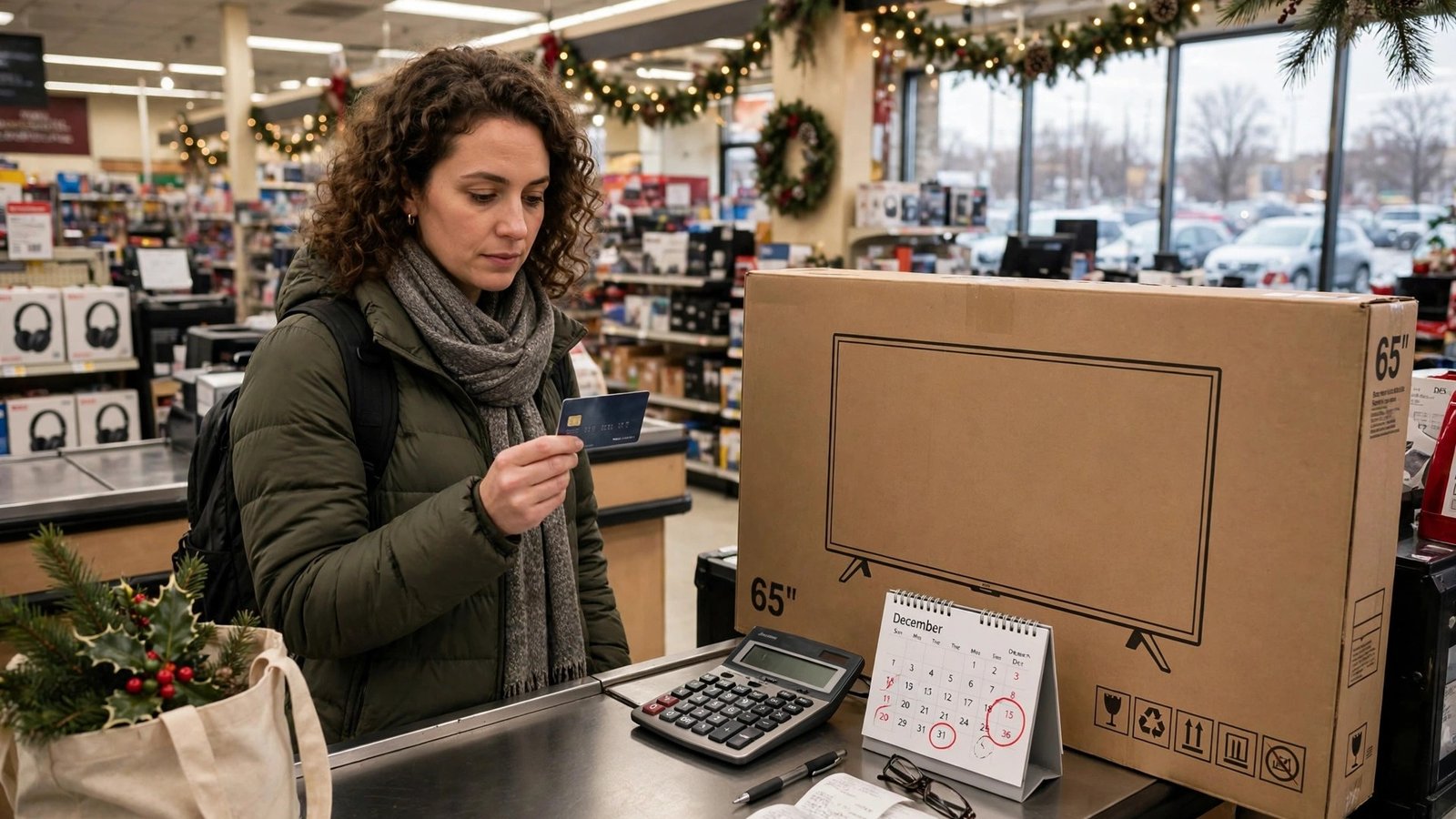
Here is the deal that will be pitched to you at checkout this holiday season, probably by a friendly cashier while your cart is already full: “Open our store card today and pay no interest for 12 months.” It sounds like free money. It is not free money. It is a deferred-interest offer, and if you owe even $1 when the promotional period ends, the card can charge you interest on the entire original purchase, all the way back to the day you bought it.
The direct answer, up front: a true 0% intro APR charges no interest during the promotion and, if a balance remains afterward, starts charging interest only on what is left. A deferred-interest offer — usually worded “no interest if paid in full” — lets interest build up silently in the background and waives it only if you reach a zero balance before the deadline. Miss by a little, and you pay interest on all of it. On a $2,500 TV at a typical store-card rate, that mistake runs roughly $400 to $430 in a single statement. I will show you the exact math below, the checkout checklist that tells the two offers apart in ten seconds, and the autopay trick that makes the trap nearly impossible to fall into.
The $430 TV: how a nearly-paid-off purchase still costs you
Let us walk through the example consumer advocates keep using, because it is the one that makes the trap click. You buy a $2,500 TV on a store card offering 12 months of “no interest if paid in full.” The card’s regular APR is around 31% — high, but normal for store cards in 2026, when WalletHub puts the average store card APR at 33.14%.
You are a responsible buyer. You pay steadily all year and, by the end of month 12, you have paid off all but $100. You expect to owe interest on $100. Instead, your month-13 statement adds roughly $430 in interest — interest on the full $2,500, calculated back to the purchase date, as if the promotional year never happened. The National Consumer Law Center’s version of this example uses a 31% APR and lands in the same place: about $430 on a $2,500 purchase with $100 left unpaid.
Why $430 and not the $775 you would get from 31% of $2,500? Because the interest is not calculated on the full balance for the full year as a flat charge — it accrues month by month on a declining balance as you pay it down, then gets added up and dumped on you at once. The precise number depends on your payment timing and the card’s daily calculation method, which is why honest guides say “roughly $400 to $430” rather than pretending to a penny. The point that matters is the shape of it: you paid 96% of the TV, and you still got charged as though you had paid almost nothing.
A second, newer example makes the same point at today’s rates. MoneyCrashers worked through a $2,400 couch on a 12-month plan at 30%: come up $100 short at the deadline, and about $400 of interest lands on the next bill, because it is charged on every dollar you owed, every month since the purchase — not on the $100. Different store, different couch, same trap.
And this is not a rare edge case. The Consumer Financial Protection Bureau has found that about one in five deferred-interest promotional balances ends up charged that back interest. One in five. If five of your friends take the same “no interest” deal, one of them, statistically, pays the retroactive charge. For borrowers with subprime credit scores, CFPB research found more than 40% were unable to pay off the balance by the end of the promotional period. The product is designed so that a large minority of users pay the charge — that is part of how the “free” financing pays for itself.
Deferred interest vs true 0% APR: the ten-second checkout test
These two products sound identical at the register and behave completely differently at the deadline. Here is the whole distinction in one table:
| Deferred interest (“no interest if paid in full”) | True 0% intro APR | |
|---|---|---|
| Interest during the promotion | Accrues silently from day one, held back | Does not accrue at all |
| If you pay in full by the deadline | $0 interest | $0 interest |
| If $100 remains at the deadline | Interest on the full original purchase, back to day one (roughly $400 on a $2,400–$2,500 purchase) | Interest starts only on the remaining $100, going forward |
| If you miss a payment mid-promotion | Can cancel the promotion and trigger retroactive interest immediately, plus a late fee | Usually ends the promotional rate, but no retroactive charge on amounts already paid down |
The wording on the offer is your ten-second test. If it says “no interest if paid in full” or “same as cash” or “no interest if paid in full within 12 months,” you are looking at deferred interest. If it says “0% intro APR” with no “if paid in full” condition, it is a true 0% offer — the same distinction Experian’s deferred interest explainer draws, with interest on the full original balance as the deferred-interest consequence. The CFPB’s own deferred-interest explainer draws the same line: the word “if” is what makes it deferred interest, not true 0%. Federal advertising rules also require a deferred-interest offer to warn that the issuer will charge interest back to the purchase date if you miss the deadline — but that warning is routinely printed in small type, below the big “NO INTEREST” headline, which is exactly why WalletHub’s 2026 study found retailers often fail to display the regular APR prominently.
WalletHub’s 2026 deferred-interest study, covering financing options from 72 large retailers, found that 94% of all deferred-interest credit cards are issued by just three banks: Synchrony, Citi, and Comenity. That concentration is useful knowledge at checkout: if the store card in your hand is issued by one of those three, slow down and read the deferred-interest language before you sign, because the odds are high that the “no interest” offer is the deferred kind. (WalletHub’s 2026 deferred interest study) The study also found that the average deferred-interest transparency score fell in 2025, meaning retailers are making these offers less consumer-friendly, not more — and it named Best Buy the least transparent retailer on deferred interest in 2025, with a 31.24% regular rate on its 12, 18, and 24-month plans.
The minimum-payment trap: why “just pay the minimum” guarantees failure
Here is the second trap inside the first one, and it is the one that catches even careful people. The minimum payment the card sets during the promotional period is usually not enough to pay off the balance by the deadline. The National Consumer Law Center has documented that lenders generally set the minimum below the amount that would clear the balance during the deferred-interest period. Follow the card’s own suggested payment, and you arrive at the deadline with a balance remaining — through no carelessness of your own.
Do the division yourself, and do it with a safety margin. Take the purchase price and divide it by one month fewer than the promotional term. A $2,400 couch on a 12-month plan: $2,400 ÷ 11 = $218.18, so autopay $219 a month. That leaves you a spare month in case a payment posts late, a month gets tight, or you misread the deadline by a few days. A $2,500 TV on a 12-month plan: $2,500 ÷ 11 = $227.27, so autopay $228. A $1,200 appliance on a 6-month plan: $1,200 ÷ 5 = $240 a month. The formula is boring, and that is the point — boring autopay beats heroic end-of-promotion scrambles.
Three more payment rules that save people real money:
Keep new purchases off the card until the promotional balance is gone. This one surprises people. Payments above the minimum generally go to the highest-rate balance first — but during the promotion, the issuer counts the promotional balance’s rate as 0%, so your extra payments go toward any new purchases instead of the balance that is about to explode. Federal rules redirect extra payments to the promotional balance only in its last two billing cycles. If you keep charging everyday purchases to the same card, your extra payments are not doing the job you think they are doing.
Treat the deadline as the month before it actually is. Promotional periods end on a specific date, not “around” that date, and a payment that posts one day late can be a payment that never counted. Set your autopay to finish the balance a full billing cycle early. The cost of finishing early is zero — there is no penalty for paying a deferred-interest balance early. The cost of finishing late is $400.
Put the deadline in your calendar the day you buy, with two alerts. One alert two months before the deadline, to check the remaining balance against your autopay math. One alert one week before, to confirm a zero balance in writing on the statement, not just in your banking app’s pending view. If the statement still shows a promotional balance, pay it that day — do not wait for the next autopay cycle.
Which retailers use deferred interest, and which do not
WalletHub’s study is genuinely useful here because it names names. Retailers it found offering deferred-interest plans include Best Buy, Dick’s Sporting Goods (in stores), and BrandSource (in stores, with a plan running until January 1, 2027). Retailers it found not offering any deferred-interest financing include Target, Walmart, Costco, Apple, Kohl’s, Gap, Nordstrom, and TJX, among many others. A second group — including Amazon, Macy’s, IKEA, and GameStop — does not currently use deferred interest but reserves the right to do so in the future, which means the offer you get this holiday season is the one you have to read, not the one a guide from last year describes.
The honest caveat: retailer offers change, and a chain can run different financing at different times of year or through different card issuers. Use the WalletHub list as a starting suspicion, not as a verdict. The ten-second wording test on your own offer — “if paid in full” versus “0% intro APR” — always outranks any list.
Medical and dental financing deserves a special warning, because the same trap shows up there at the worst possible moment. CareCredit, issued by Synchrony, offers deferred-interest plans of 6, 12, 18, or 24 months on qualifying purchases of $200 or more, with a regular APR around 32.99% for new accounts. A $3,000 dental procedure on a 24-month deferred plan, paid down to $450 by month 23, can trigger roughly $1,440 in retroactive interest if that final $450 is not cleared in time. When you are financing care you need, not a TV you want, the pressure to sign quickly is highest and the fine print matters most. Ask the provider’s office, in writing, whether the plan is deferred interest or true 0% — and if the answer is vague, treat it as deferred.
What to do instead: the safer ways to spread a big purchase
Deferred interest is not the only way to split a holiday purchase into monthly payments, and for most shoppers one of these alternatives is strictly better:
A true 0% intro APR card from a general-purpose issuer. These exist — major bank cards regularly offer 12 to 21 months at 0% intro APR on purchases, with no retroactive charge. The catch is qualification: you generally need good credit, and the card’s regular APR after the intro period will still be high. But the downside shape is completely different: if $100 remains at the end, you pay interest on $100 going forward, not on the original purchase going back a year. For a purchase you are confident you can mostly — but not certainly — pay off, that difference is worth hundreds of dollars.
A buy-now-pay-later plan with fixed installments. BNPL splits a purchase into, typically, four payments over six weeks, or monthly installments for larger purchases. The fee structure varies — some plans charge no interest, some charge interest from the start — but the honest ones do not charge retroactive interest on the full purchase for missing the last payment. Read the late-fee terms, which are the real BNPL trap, but do not confuse a late fee with a $400 retroactive interest charge. Pay-over-time deals at big retailers work the same way — see how Affirm’s pay-over-time deal at Sam’s Club structures its installments. They are different problems at different scales.
Save first for the purchases you can wait on. I know this is the least exciting advice in the article, and I am including it anyway because the math is undefeated: a $2,500 TV bought with cash costs $2,500. The same TV bought on deferred interest and missed by $100 costs about $2,930. The same TV bought on a true 0% card and missed by $100 costs about $2,500 plus a few dollars of interest on $100 going forward. The ranking is not close, and no rewards points on a store card — typically 5% back at that one retailer, often as store credit, not cash — close a $430 gap.
If you already took a deferred-interest deal, protect it now. Check the exact end date on your statement today, not from memory. Divide the remaining balance by the months left minus one, and set that autopay amount. Stop putting new purchases on the card. If you cannot clear it by the deadline, consider a balance transfer to a true 0% card before the promotion expires — a 3% to 5% transfer fee on the remaining balance is far cheaper than retroactive interest on the original purchase. A $500 remaining balance transferred at 3% costs $15; the same $500 left to trigger retroactive interest on a $2,500 purchase costs roughly $430. And if you also take cards yourself as a small business, the fee side of the card world has its own rulebook — see credit card surcharge rules by state.
Already missed the deadline? You still have moves
If the retroactive charge has already hit your statement, do not just pay it and move on — try these in order:
- Pay the remaining promotional balance to zero first, then call the issuer and ask for a courtesy waiver. Both Synchrony and Comenity sometimes reverse retroactive interest, particularly for a first occurrence and a small shortfall. Your leverage is highest when the balance is already zero and you are a customer in good standing asking once, politely, for an exception. It works more often than people expect, and the worst outcome is a no.
- If the waiver is refused, pay the balance down fast. The retroactive charge is now part of a balance accruing interest at the card’s regular APR — typically around 30% or more on store cards. Every month you carry it, it grows. This is the worst balance in your wallet to carry; prioritize it above lower-rate debt.
- File a complaint if the terms were misrepresented. If the salesperson told you the offer was “0% interest, no catch” or the disclosure was missing the required deferred-interest warning, the Consumer Financial Protection Bureau takes complaints at consumerfinance.gov, and your state attorney general’s consumer protection office is a second route. Keep the original offer paperwork and the statement showing the charge. A complaint does not guarantee a refund, but issuers take CFPB complaints seriously, and the paper trail matters if the same offer misled others.
One more consequence people underestimate: the retroactive charge raises your balance, which raises your credit utilization, which can lower your credit score — and store cards tend to have low credit limits, so a $400 charge on a $2,500-limit card moves utilization by 16 points in one statement. That score dip can matter if you are applying for anything else soon, which is one more reason to deal with the charge immediately rather than letting it sit.
The checkout checklist (save this for Black Friday)
Print this, or screenshot it — it is the whole article in ten lines:
- Does the offer say “no interest if paid in full”? If yes, it is deferred interest. Stop and read further.
- Does it say “0% intro APR” with no pay-in-full condition? If yes, it is a true 0% offer. Still check the intro period length and the regular APR afterward.
- What is the regular APR after the promotion? On store cards in 2026, expect roughly 30% to 35%. That is the rate your retroactive interest would be calculated at.
- What is the exact end date of the promotion, and does it end on a statement date you can hit?
- Divide the purchase price by (promotion months minus one). Can you autopay that amount every month without strain? If not, do not take the deal.
- Will you keep new purchases off this card until the promotional balance is zero? If not, your extra payments will not go where you think.
- Who issues the card? If it is Synchrony, Citi, or Comenity — the issuers behind 94% of deferred-interest cards — assume deferred interest until the paperwork proves otherwise.
- Is there a true 0% card or a no-interest BNPL plan available for the same purchase? Compare the worst case, not the best case: the worst case on deferred interest is $400-plus; the worst case on true 0% is interest on the remainder only.
Black Friday checkout lines are designed to make you decide fast. The card application takes three minutes; the retroactive interest takes a year to arrive and one statement to ruin a month. Take the ten seconds. Read the words “if paid in full.” And if you take the deal, set the autopay the same day you buy — your future self, staring at a month-13 statement, will be glad you did.
This article is general financial information, not professional financial advice. Card terms, APRs, and retailer offers change frequently — always confirm the exact terms on your own card agreement before applying. If you are unsure whether an offer is deferred interest, ask the issuer in writing before you charge the purchase.
This article is general information, not financial advice. Check your card agreement for your exact APR, promotional end date, and deferred-interest terms before you buy.
Frequently Asked Questions
What is deferred interest on a store credit card?
Deferred interest is a promotional financing arrangement where interest accrues from the purchase date but is waived only if you pay the promotional balance in full by the end of the promotional period. If any balance remains, the issuer adds all the interest that accrued since day one to your account at once.
How is deferred interest different from 0% intro APR?
With a true 0% intro APR, no interest accrues during the promotion, and if a balance remains afterward, interest starts only on the remaining balance going forward. With deferred interest, interest accrues the whole time and, if you miss the deadline, is charged retroactively on the entire original purchase amount.
How much can deferred interest cost on a $2,500 purchase?
Using the National Consumer Law Center’s example — $2,500 at 31% APR with $100 left unpaid after 12 months — the retroactive charge is roughly $430. A similar MoneyCrashers example ($2,400 at 30%, $100 short) puts the charge at about $400. The exact amount depends on payment timing and the card’s calculation method.
Which banks issue most deferred-interest cards?
WalletHub’s 2026 study of 72 large retailers found that 94% of deferred-interest credit cards are issued by just three banks: Synchrony, Citi, and Comenity. If your store card is issued by one of these, read the promotional terms carefully before assuming an offer is true 0% financing.
Can I avoid deferred interest if I pay the minimum payment?
Usually not. Minimum payments during a deferred-interest promotion are generally set below the amount needed to clear the balance by the deadline. Divide the purchase price by one month fewer than the promotional term and autopay that amount instead — for example, $219 a month on a $2,400, 12-month plan.
What should I do if deferred interest was already charged?
First pay the promotional balance to zero, then call the issuer and ask for a courtesy waiver — Synchrony and Comenity sometimes grant one for a first occurrence and a small shortfall. If refused, pay the balance down quickly, since it now accrues interest at the card’s regular APR, typically around 30% or more.