
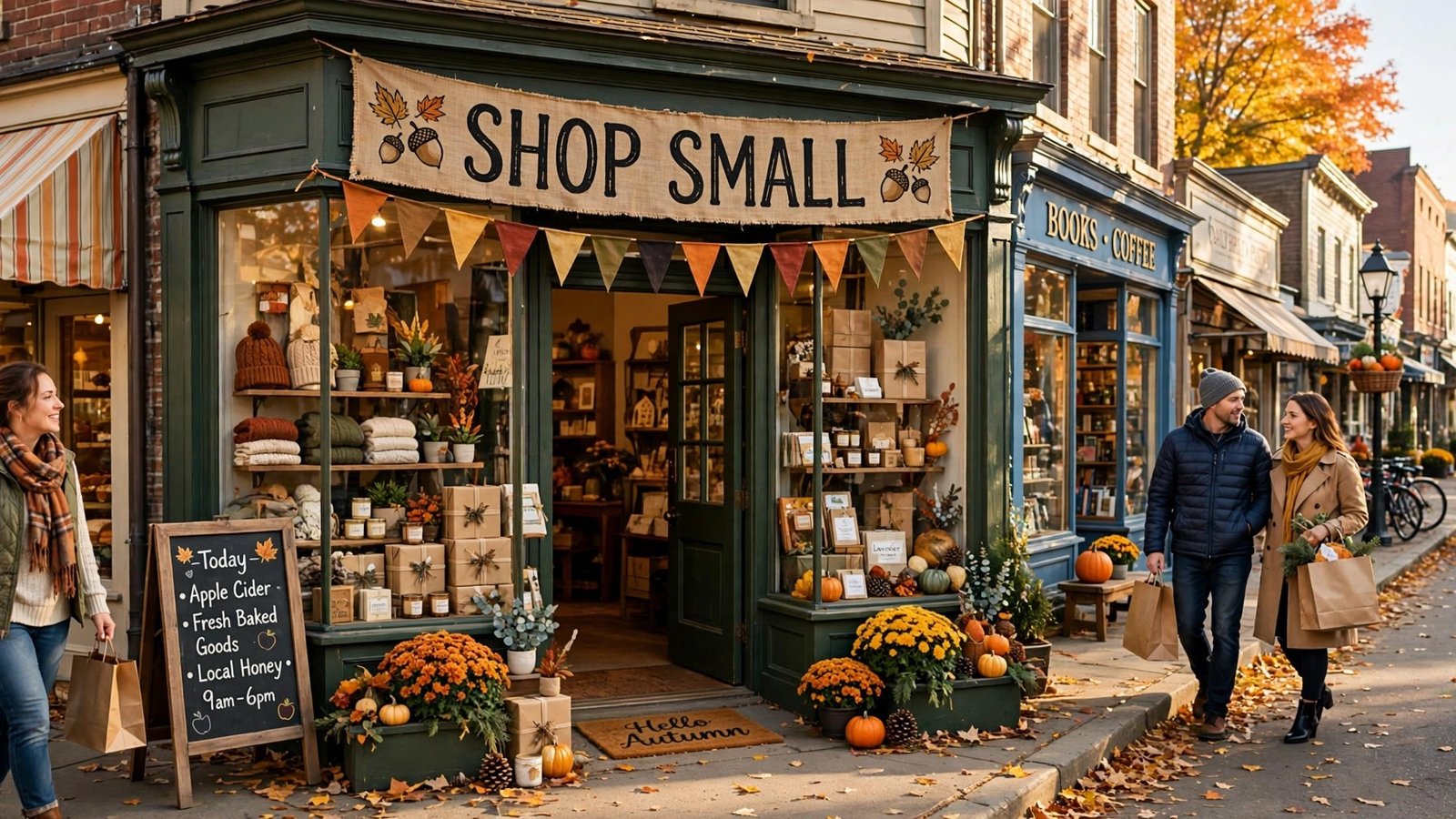
Small Business Saturday 2026 Is November 28 — and You Still Have Time to Win It
Small Business Saturday 2026 falls on November 28, the Saturday after Thanksgiving, sandwiched between Black Friday and Cyber Monday. If you run a small business, that date is either your best sales day of the year or a missed opportunity — and the difference is almost entirely decided in the next five weeks, not on the day itself.
Here’s the direct answer: you don’t need a big budget, and you don’t need to accept American Express to take part. Any small business can run an offer and use the free Shop Small marketing materials. You only need to accept Amex cards if you want to appear on the official Shop Small Map. What you do need is one clear offer, a partner or two, stock ready before the rush, and a plan to turn Saturday’s buyers into December’s repeat customers.
That last part matters more than most owners realize. American Express reports that shoppers said they spent an estimated $18 billion at small businesses on Small Business Saturday 2025 — a self-reported survey figure, not card receipts, but still a useful signal of how much money moves on this one day. Amex also puts cumulative reported spending since the event began at roughly $200 billion. And in the 2025 Shop Small Impact Study, over half of the 500 small business owners surveyed estimated that Small Business Saturday sales contribute up to 15% of their annual revenue. One Saturday carrying that much weight deserves more than a poster in the window.
This guide gives you a week-by-week plan starting right now — five weeks out — plus the offer math, the free tools, and the follow-up system that turns a single day into repeat business.
What Small Business Saturday Actually Is (and Isn’t)
American Express founded Small Business Saturday in 2010 to give independent businesses a fighting chance during the year’s biggest shopping weekend. Black Friday belonged to the chains; Cyber Monday belonged to the big online retailers. Small businesses were getting squeezed out of both. The U.S. Small Business Administration has cosponsored the event since 2011, and the U.S. Senate has recognized it by resolution. It is not a federal holiday and your shop doesn’t close for it — it’s a shopping day, and the whole point is that you’re open.
A few facts worth getting straight before you plan:
- It is always the Saturday after Thanksgiving. In 2026 that’s November 28. In 2027 it will be November 27.
- You do not have to accept American Express to participate. Any small business can run a Small Business Saturday offer and download the free Shop Small posters, social graphics, and templates.
- The Shop Small Map is the exception. Appearing on the map that shoppers use to find participating businesses requires accepting Amex cards. If you already accept Amex, check that your listing is current — map updates can take two to three business days, so don’t leave this to the week of the event.
- The “local multiplier” is real marketing material. A 2025 study by Econsult Solutions, cited by American Express, found that 68 cents of each dollar spent at a small business stays in the local community. That’s a line you can put on your signage, and it works because shoppers already believe it — they just need a reason to act on it this Saturday.
One honest caveat about the big numbers: the $18 billion and $200 billion figures come from consumer surveys, not transaction data. Treat them as a sign of shopper intent, not a promise of your Saturday revenue. Your revenue will come from your offer, your list, and your foot traffic — all things you control.
The Discount Trap: Why a Bigger Discount Is Usually the Wrong Plan
The most common Small Business Saturday mistake is trying to out-discount the big retailers. You will lose that game, and you’ll train your customers to wait for the next discount.
SCORE mentor Christopher Jacob puts it bluntly: don’t play the “who can give the biggest discount” game, because it usually ends with selling inventory at a loss — and customers may expect the same discount next time, which hurts how they see your brand. That warning is worth more than any generic “offer 20% off” advice.
Here’s the math that makes the point. Say your average sale is $40 with a 50% margin, so you keep $20 per sale. A 30% across-the-board discount drops that sale to $28 and your margin to $8 — you’d need two and a half times as many buyers just to make the same money, and every one of those buyers now thinks your $40 product is a $28 product. Compare that with a bundle: a pre-wrapped gift set priced at $55 (three items that would cost $62 separately) protects your margin, raises the average sale, and feels like a deal without teaching anyone your prices are negotiable.
A better offer menu for November 28:
- A gift bundle or pre-wrapped set at a modest built-in saving, available only that weekend.
- A free gift above a spend line — for example, a free $8 item with purchases over $50. The gift costs you little, the threshold lifts the average sale, and the customer leaves with something extra to talk about.
- A future-use coupon tucked into every bag: $10 off a December visit. This is the single highest-value move in this whole plan, because it converts a one-day buyer into a second sale. If 100 new buyers visit on November 28 and just 20% redeem a $10-off coupon on a $45 December purchase, that’s $900 in December revenue (before the coupon cost) from people who otherwise might never have come back.
- An experience, not a price cut. A tasting, a styling session, a first look at new stock, a kids’ activity while parents shop — anything that gives someone a reason to show up beyond “we’re open as usual.”
Pick exactly one lead offer. One. Businesses that try to run three promotions at once end up with a confusing window display and a staff that can’t explain any of them clearly.
Your 5-Week Plan, Starting Now
You’re about five weeks out. That’s less time than the ideal eight-week runway, but it’s plenty if you move in order. Each week below has one job — finish it before moving on.
Week 1 (October 26 – November 1): One Offer, One Partner, Stock Ordered
This is the decisions week, and it’s the one most owners skip.
- Choose your one offer using the math above. Write it in one sentence a staff member could repeat: “On November 28, every gift bundle is $55, and every bag gets a $10 December coupon.” If you can’t say it in one sentence, it’s too complicated.
- Line up one partner. Team up with a nearby non-competing business and cross-promote: your customers get a coupon for the café next door, their customers get one for you. A bakery and a bookstore, a salon and a gift shop — the pairing matters less than the fact that each of you reaches the other’s customers for free. If you’re online-only, do the same thing by email: include a partner’s coupon in your order confirmation emails that week.
- Order stock and packaging now. Suppliers and partners need lead time before the holiday rush, and shipping delays in November are a fact of life. Order gift wrap, bags, and boxes this week, not the week of the event.
- Check your listings. Confirm your hours, address, and holiday hours match everywhere — your Google Business Profile, your Shop Small Map listing if you have one, and any local directory. Inconsistent hours are how a ready-to-buy shopper drives past your door.
Week 2 (November 2 – 8): Build the Announcement, Not the Event
This week is about assets, not activity.
- Download the free Shop Small materials from American Express’s Shop Small Resource Hub: posters, window decals, and social media templates you can customize. Print the window poster now, while the print shop still has capacity.
- Write your three announcement posts (one for the week of November 14, one for the week of the event, one for the day itself) and your one email to your list. Specific, dated copy beats vague copy every time: “Saturday, November 28 — our $55 gift bundle, free gift over $50, and a $10 December coupon in every bag” will outperform “Come celebrate Small Business Saturday with us!” because it tells the reader exactly what to expect.
- Set up measurement before you need it. Give your offer a unique code for online redemptions and a simple tally sheet at the register for in-store ones. Decide now what success looks like: how many new email addresses or loyalty sign-ups, not just total sales. A healthy Small Business Saturday for a small shop is one where new contacts meaningfully outnumber one-time buyers you never hear from again.
- Confirm staffing. If you plan to add even one seasonal helper for the weekend, the hiring window is already tight — post the role this week and text former seasonal hires first. A short “we’re planning for the holidays and thought of you first” beats a job board post.
Week 3 (November 9 – 15): Announce, Open Preorders, Refresh Your Presence
- Announce the offer on November 14 — two weeks out is when shoppers start making weekend plans. Post it, email it, and put the poster in the window on the same day so every channel says the same thing.
- Open preorders or reservations if your product allows it. Preorders do two things: they lock in sales before the day, and they tell you exactly how much stock to have ready. Even a simple “reserve your bundle, pick up November 28” form works.
- Refresh your reviews and profiles. A handful of fresh reviews in the weeks before the event, plus identical hours and address on your Shop Small listing, Google Business Profile, and local directories, makes your business easier for both search engines and AI answer systems to recommend when someone nearby asks where to shop small this weekend.
- Plan the in-store experience. If you’re running an event element — tastings, a photo backdrop, a raffle, a food-bank collection — book it now. A festive backdrop with a few photo props costs almost nothing and gives shoppers a reason to post about you, which is free advertising to exactly the local audience you want.
Week 4 (November 16 – 22): Pack, Price, and Prepare for Black Friday Spillover
- Pack bundles and price everything. Do the fiddly work this week, not on Friday night. Every bundle wrapped, every shelf ticket printed, every register code tested.
- Charge devices, test your card reader, and restock after Black Friday. Some of your Saturday shoppers will be people who were out on Friday and are still in shopping mode — be ready for them, and be ready for the ones who deliberately skipped Black Friday to shop small instead.
- Extend your hours for the day and say so in every announcement. Shoppers are used to midnight openings and 24-hour online shopping; opening an hour earlier and closing an hour later on November 28 catches people who otherwise pass you by.
- Brief your staff on the one-sentence offer and the follow-up ask. Every buyer should leave with the December coupon and, where natural, an invitation to join your email list or loyalty program. The follow-up ask is the whole point — a Saturday sale with no way to reach the buyer again is a missed December sale.
Week 5 (November 23 – 28): Sell, Capture, and Enjoy It
- Post daily in the final week, but keep each post specific: the offer, the date, the address, the hours. Vague excitement posts don’t move anyone; a post that says “tomorrow, 9 a.m., $55 bundles, free gift over $50” does.
- On the day, sell, bag, and collect. Count new email sign-ups and loyalty opt-ins alongside sales. Take photos (with permission) of the bundles, the window, and the partner cross-promotion — you’ll reuse them next year and in your December posts.
- Thank every buyer by name where you can, and hand every bag out with the December coupon inside. If you promised a raffle or a drawing, run it before closing so the day ends on a high note for someone standing in your shop.
The Week After: Where the Real Money Is
The most valuable Small Business Saturday work happens between November 29 and December 5, and most owners skip it entirely.
- Send a thank-you email within 48 hours. Not a generic blast — a short note thanking Saturday’s buyers, reminding them of the December coupon, and showing one December gift idea. This single email is the highest-return message most small businesses send all year.
- Compare results against the plan. How many bundles sold? How many new emails captured? How many December coupons went out? Write the numbers down now, while you remember them, because next October you’ll be grateful you did.
- Push December orders while buyers are still in gift mode. Shoppers still need gifts for the rest of December. Your Saturday buyers are the warmest audience you’ll have all season — a December offer to them will outperform any cold ad you could run.
- Tell your partner what happened. Share the rough numbers, thank them, and agree to do it again next year. A partnership that works once is an asset; most local partnerships die because nobody follows up.
Run this honestly and the math is straightforward. Say Saturday brings 120 buyers at a $52 average sale — that’s $6,240 in a day. If a quarter of them come back in December at a $45 average, that’s another $1,350 from one Saturday’s effort, before counting the partner referrals and the email list you now own. The Saturday itself is the headline; the follow-up is the business.
If You Sell Mostly Online
Everything above still works, with three adjustments. First, run the same offer on your website through Cyber Monday — online buyers don’t distinguish between Saturday and Monday, and cutting the offer off on Saturday night just sends them to a competitor. Second, free shipping matters more than a discount for online shoppers; a free-shipping threshold at the same level as your free-gift threshold does double duty. Third, watch your shipping costs: holiday peak surcharges from carriers can quietly eat the margin on a bundle, so price the bundle with the surcharge included rather than discovering it after the sale. (Our guide to 2026 holiday shipping surcharges for Etsy and eBay sellers walks through the current peak fees.)
One more online note: if you accept cards, know your state’s surcharge rules before you pass any card cost to customers. Some states still restrict or ban credit card surcharges, and a Small Business Saturday promotion is a bad time to discover you’ve broken one. Our breakdown of credit card surcharge rules by state for 2026 covers where you stand.
Free Tools and Where to Get Them
You don’t need to buy anything to run this plan:
- Shop Small marketing materials — free posters, social templates, and window signage from American Express’s Shop Small Resource Hub. Start at the American Express Shop Small page and follow it to the Resource Hub.
- Shop Small Map listing — if you accept Amex, add or update your listing there so shoppers can find you. Amex notes it cannot guarantee every business appears in every map search, so don’t rely on the map alone — your own email list and social posts are the channels you control.
- Neighborhood Champions — local chambers and trade groups often act as Neighborhood Champions, organizing multi-business events like passport games where shoppers collect stamps at several stores for a prize. If your chamber runs one, join it; a passport game is one of the few tactics that reliably moves shoppers between stores.
- SBA resources — the Small Business Administration, as cosponsor, publishes planning guides and checklists for the day. If you need help beyond this article, the SBA’s local district office is a free, underused resource.
- Help by phone or email — American Express runs a Shop Small servicing center at 1-833-213-0506 (9 a.m. to 6 p.m. Eastern, Monday through Friday) and at ShopSmallHelp@aexp.com for listing questions.
Frequently Asked Questions
When is Small Business Saturday 2026?
November 28, 2026 — the Saturday after Thanksgiving, between Black Friday (November 27) and Cyber Monday (November 30). It always falls on the Saturday after Thanksgiving, so the date moves slightly each year.
Do I have to accept American Express to participate?
No. Any small business can run a Small Business Saturday offer and use the free Shop Small marketing materials without accepting Amex. You only need to accept American Express cards to appear on the official Shop Small Map that shoppers use to find participating businesses.
Is Small Business Saturday a federal holiday?
No. It’s a shopping day, not a day off. American Express founded it in 2010, the SBA has cosponsored it since 2011, and the U.S. Senate has recognized it by resolution — but your business stays open, and that’s the point.
How much do shoppers actually spend on Small Business Saturday?
American Express reports that shoppers said they spent an estimated $18 billion at small businesses on Small Business Saturday 2025, and roughly $200 billion cumulatively since 2010. Both figures come from consumer surveys, not card transaction data, so read them as a signal of shopper intent rather than a forecast for your store.
What offer works best — a discount, a bundle, or a free gift?
A bundle or a free gift above a spend threshold usually beats a straight discount. Deep discounts cut your margin and train customers to expect the same price next time, while a bundle raises the average sale and a future-use coupon (for example, $10 off a December visit) turns a one-day buyer into a repeat customer.
I’m starting only five weeks out. Is it too late?
No — five weeks is enough if you move in order: one offer and one partner in week one, announcements and listings in weeks two and three, packing and pricing in week four, and selling plus capturing contact details on the day. The one thing you can’t compress is the follow-up: send the thank-you email and December offer within 48 hours of the event.
What should I measure to know if it worked?
Track three numbers: total sales, new email addresses or loyalty sign-ups captured, and December coupon redemptions. Sales tell you about the day; the other two tell you whether the day built your business. Write all three down the week after, while the numbers are fresh.