
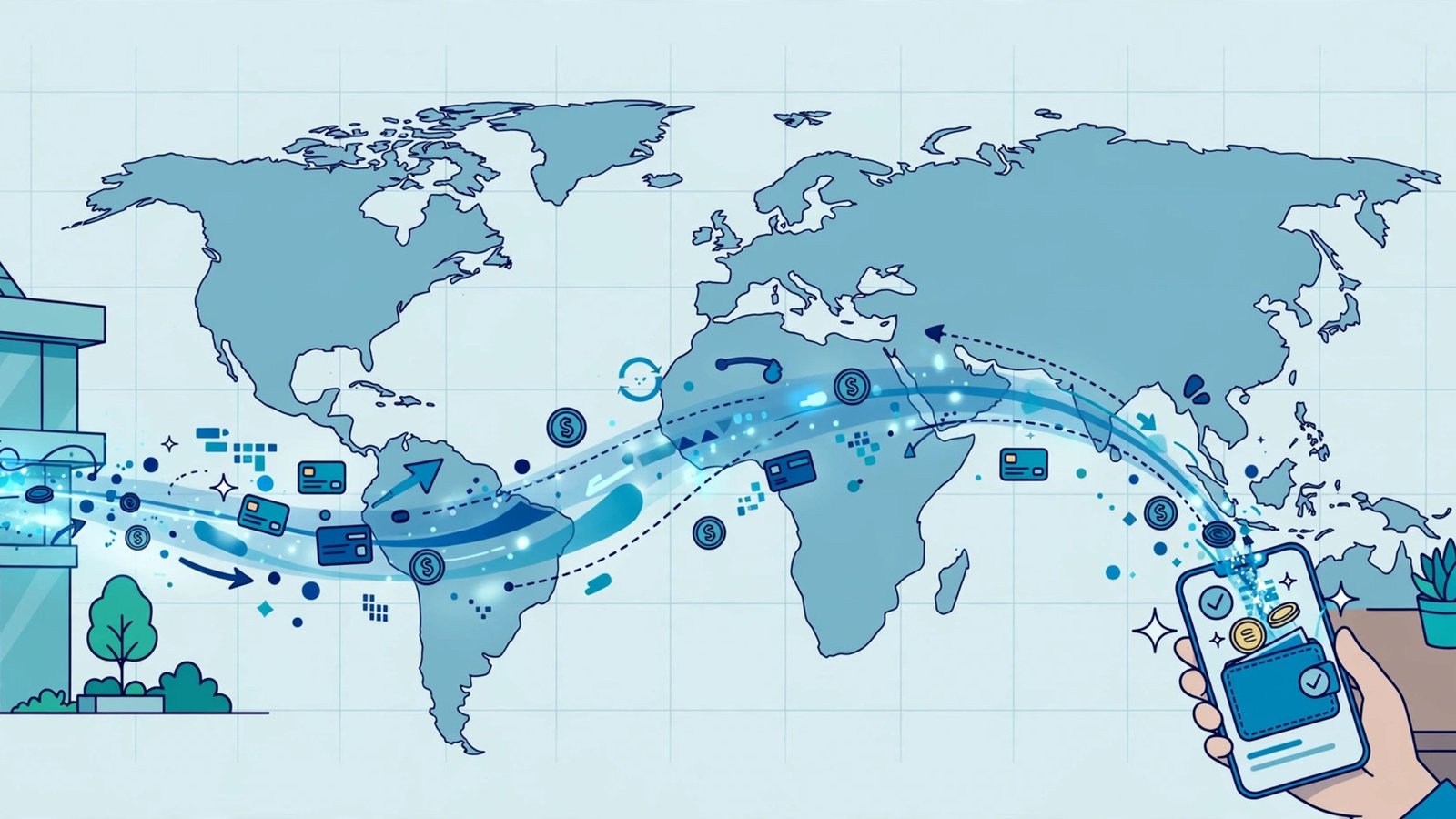
On October 22, 2026, LianLian Global announced a partnership with PayPal that lets the marketplaces and social commerce platforms it serves pay creators, influencers, developers, and independent contractors directly into PayPal and Venmo wallets. If you earn money from brand deals, you probably will not sign up for anything new because of this deal — and that is exactly the point. The change happens on the brand’s side, in the payout plumbing, and it lands in a wallet you probably already have.
Here is the short version: brands and platforms that run on LianLian Global can now send payouts to a creator’s PayPal account in 96 markets using just an email address or phone number, no bank details required, or to Venmo for creators in the United States. The deal does not make payouts free, and it does not change PayPal’s own fee schedule. What it changes is how many platforms can reach you through a wallet you already use, and how little information you have to hand over to get paid.
What actually changed on October 22
LianLian Global is a cross-border payments company, not a creator platform. Its clients are the marketplaces, social commerce apps, and e-commerce companies that pay creators. Until now, those clients had their own payout options, and creators often had to set up bank transfers, share account details, or wait for a wire to clear. Under the new partnership, those clients can plug into PayPal’s wallet network through LianLian’s infrastructure.
The announcement breaks the deal into three pieces:
- Pay to PayPal: payouts from LianLian Global clients to PayPal account holders in 96 markets, using only the recipient’s email address or phone number.
- Pay to Venmo: payouts to Venmo accounts in the United States, which covers the domestic creator economy where Venmo is already a daily-use app.
- PayPal Payouts for Platforms: mass payouts in 24 currencies, aimed at platforms that pay many creators at once rather than one deal at a time.
The scale behind the announcement is worth a pause. Brands are expected to spend $32.6 billion on creators in 2026, according to the Gigapay Global Creator Economy Report 2026 cited in the announcement, and roughly 50 million people worldwide now create content professionally or semi-professionally. PayPal had over 400 million active accounts across approximately 200 markets at the end of the second quarter of 2026, and Venmo reached 67 million monthly active accounts in the fourth quarter of 2025. That is the real reason this deal matters: the wallet is already where the creators are.
LianLian brings the other half. Its parent company, Lianlian DigiTech, says it has served more than 13.3 million clients, reaches more than 200 countries and regions, supports transactions and settlement in more than 140 currencies, and connects with more than 180 global e-commerce platforms. In plain terms, LianLian handles the cross-border collection, currency exchange, and compliance work, and PayPal supplies the last mile into a wallet.
What this means if you are the creator getting paid
First, the practical upside. If a brand or marketplace pays through a LianLian-served platform, you may soon be offered PayPal or Venmo as a payout option where previously you were offered only a bank transfer or a platform-specific wallet. For a US creator, Venmo means money lands in an app you already check, with no routing number shared with a brand you have worked with exactly once. For a creator outside the US, PayPal means getting paid with an email address instead of handing bank details to a company in another country.
Second, the part nobody’s press release will headline: this is infrastructure, not a new product you join. You do not open a LianLian account. You do not get a new payout dashboard. When a platform adopts the new rails, it shows up as a payout option in that platform’s existing payment settings. If your platforms have not adopted it yet, nothing changes for you on day one, and that is normal for this kind of deal — adoption rolls out platform by platform.
Third, the tax and paperwork side does not go away. A new payout rail does not replace the W-9 (for US creators) or W-8BEN (for many non-US creators) that brands collect before paying you, and it does not change your obligation to report the income. If a brand asks for your tax form and your PayPal email, those are two separate steps, and the form is the one that usually causes the delay.
The cost question: what a payout actually keeps
Here is where you need to read past the announcement. The partnership announcement does not publish a creator-facing fee schedule, and that silence matters, because the costs in cross-border payouts rarely sit in one visible fee. They sit in three places: the sender’s payout fee, the currency conversion spread, and the withdrawal fee when you move money to your bank.
PayPal’s published Payouts fee table charges the sender 2% of the payment, capped at $14 for a domestic US dollar payout and $90 for an international US dollar payout. That fee is normally paid by the brand or platform, not by you — but “normally” is doing work in that sentence, because some platforms pass payout costs to creators in their own terms. Always check who pays the fee in your platform’s payout terms, not in the press release.
The bigger cost for international creators is currency conversion. PayPal converts at its own exchange rate, which multiple fee analyses put at roughly 3% to 4% above the mid-market rate. That spread is not listed as a fee on your statement; it is baked into the rate, which is why a payout can look “free” and still arrive smaller than you expected. Patreon’s own payout guide illustrates the same structure from the creator side: its PayPal payout fee is 1% with a $0.25 minimum and a $20 cap, and that sits on top of whatever conversion applies when currencies change.
Worked example: a $500 brand deal, three ways
Say a US brand pays you $500 for a sponsored post. Here is how the math roughly plays out depending on where you are and what the payout crosses:
| Scenario | Sender payout fee (2%) | Conversion spread | You keep (approx.) |
|---|---|---|---|
| US creator, paid to Venmo or PayPal in USD | $10 (brand usually pays) | None | ~$500 |
| Creator abroad, paid in USD, held in USD | $10 (brand usually pays) | None until you convert | ~$500, minus later withdrawal/conversion |
| Creator abroad, payout converted to local currency at ~3.5% spread | $10 (brand usually pays) | ~$17.50 | ~$482.50 |
The lesson is simple and worth real money: if you can hold the payout in the currency it was sent in and convert it later through a cheaper route, do that. Converting inside PayPal at the moment of payout is usually the most expensive way to change currency. And if a platform gives you a choice between “convert now” and “hold in USD,” holding is almost always the better default for larger payouts.
For comparison, Payoneer’s typical currency spread is often cited around 0.5% to 2%, and Wise built its whole brand on showing the mid-market rate with a transparent fee. That does not make PayPal a bad choice — its advantage is ubiquity and speed, and for a $100 payout the difference between a 3.5% spread and a 1% spread is $2.50, which is not worth switching platforms over. For a $5,000 campaign payment, the same gap is $125, and it absolutely is.
Who wins, and who this deal leaves out
US creators win most directly. Venmo payouts mean same-day-style money movement into an app most US creators already use, with no bank details exchanged. If you do small, frequent brand deals, this is the most friction-free version of getting paid that the US creator economy has had.
Creators in the 96 PayPal Payouts markets win on access. Getting paid with an email address instead of bank details is a genuine improvement, especially for creators in countries where international wires are slow, expensive, or require a trip to the bank. The 24 payout currencies also mean fewer forced conversions for creators whose local currency is on the list.
Creators outside those 96 markets see no change. PayPal Payouts does not cover every country where PayPal itself operates, and the announcement does not promise expansion. If your country is not in the 96, this deal is a “not yet” story, and you should keep your existing payout setup exactly as it is.
Creators who need the lowest cost, not the fastest payout, should still compare. A payout that arrives in minutes at a 3.5% spread is worse than a payout that arrives in two days at a 1% spread, if the amount is large. Speed is a feature; it is not free.
What to do about it this week
You do not need to do anything dramatic. But four small checks will put you in position to benefit the moment your platforms adopt the new rails:
- Make sure your payout email matches your PayPal email. Payouts sent to an email address only work if that address is attached to your PayPal account. A mismatch is the most common reason a “sent” payout sits unclaimed. Check the email on file with every platform that pays you.
- Turn on PayPal’s option to hold balances in the sender’s currency where available. This is the single highest-value setting for international creators, because it moves the conversion decision from payout day — when you have no leverage — to a day you choose.
- Ask new brands one question before you sign: “Which payout rail do you use, and who pays the payout fee?” If the answer is PayPal Payouts and the brand pays the fee, great. If the platform deducts the fee from your payment, negotiate it into your rate or add it to your invoice.
- Keep your tax form current. A payout rail upgrade does not unblock a payment held for a missing W-9 or W-8BEN. If you changed countries, names, or business entities this year, update the form before your next campaign, not after the payment stalls.
One more honest caveat, because it matters for planning: everything in the announcement about speed and coverage comes from the companies themselves, and independent creator-side reporting on how these rails perform in practice does not exist yet — the deal is days old. Treat the first few months as a trial period. Test it with a small payout before you route a big campaign payment through a brand-new option, and keep a second payout method active until you have seen one payment land cleanly.
The bigger picture
Zoom out and the deal fits a pattern that has been building all year: the creator economy’s payment problem was never really about moving money, it was about the last mile. Banks move money fine. The friction was always in onboarding, bank details, currency, and compliance for thousands of small, cross-border payments. LianLian and PayPal are splitting that problem down the middle — LianLian handles the cross-border and compliance layer, PayPal handles the wallet the creator already trusts.
If that split works, the next few years of creator payouts look less like wire transfers and more like sending money to a friend: an email address, a tap, done. The fees will not disappear, and the conversion spread will still be where the money quietly goes. But the days of a creator waiting two weeks for an international wire, or handing bank details to a brand they met on Instagram last Tuesday, are numbered. For a $32.6 billion creator economy, that is a meaningful upgrade — as long as you watch the exchange rate.
Frequently Asked Questions
Do I need to sign up for LianLian to get paid through this deal?
No. LianLian serves the brands, marketplaces, and platforms that pay you, not creators directly. You only need a PayPal account (or Venmo, in the US) with the same email address or phone number the platform has on file for you.
Which countries does Pay to PayPal cover?
PayPal Payouts is live in 96 global markets, and the mass-payout option supports 24 currencies. The announcement does not publish the full country list, so check with your specific platform whether your country is included before you switch payout methods.
Does the LianLian-PayPal deal make creator payouts free?
No. PayPal’s published Payouts fee is 2% to the sender (capped at $14 domestic and $90 international for USD payouts), and currency conversion carries a spread of roughly 3% to 4% above the mid-market rate. Who bears the sender fee depends on your platform’s terms.
Is Venmo available for creators outside the United States through this deal?
No. The Venmo option in this partnership is for domestic US payouts. International creators use the Pay to PayPal rail instead.
Should I switch my payout method to PayPal because of this deal?
If you already use PayPal, nothing needs to change — the improvement is on the platform side. If you currently wait on slow international wires, PayPal is worth testing with a small payout first, especially if you can hold the balance in the sender’s currency and convert later at a better rate.
Does this change my taxes?
No. Payout rails move money; they do not change tax obligations. US creators still generally provide a W-9, many non-US creators a W-8BEN, and you still report the income. This article is general information, not professional tax advice — check current terms and your local rules.
Sources and further reading: the LianLian Global and PayPal announcement, PayPal’s merchant fee tables, and Help Me Boss’s own guides to freelancer payment rails and creator revenue splits across 15 platforms.