
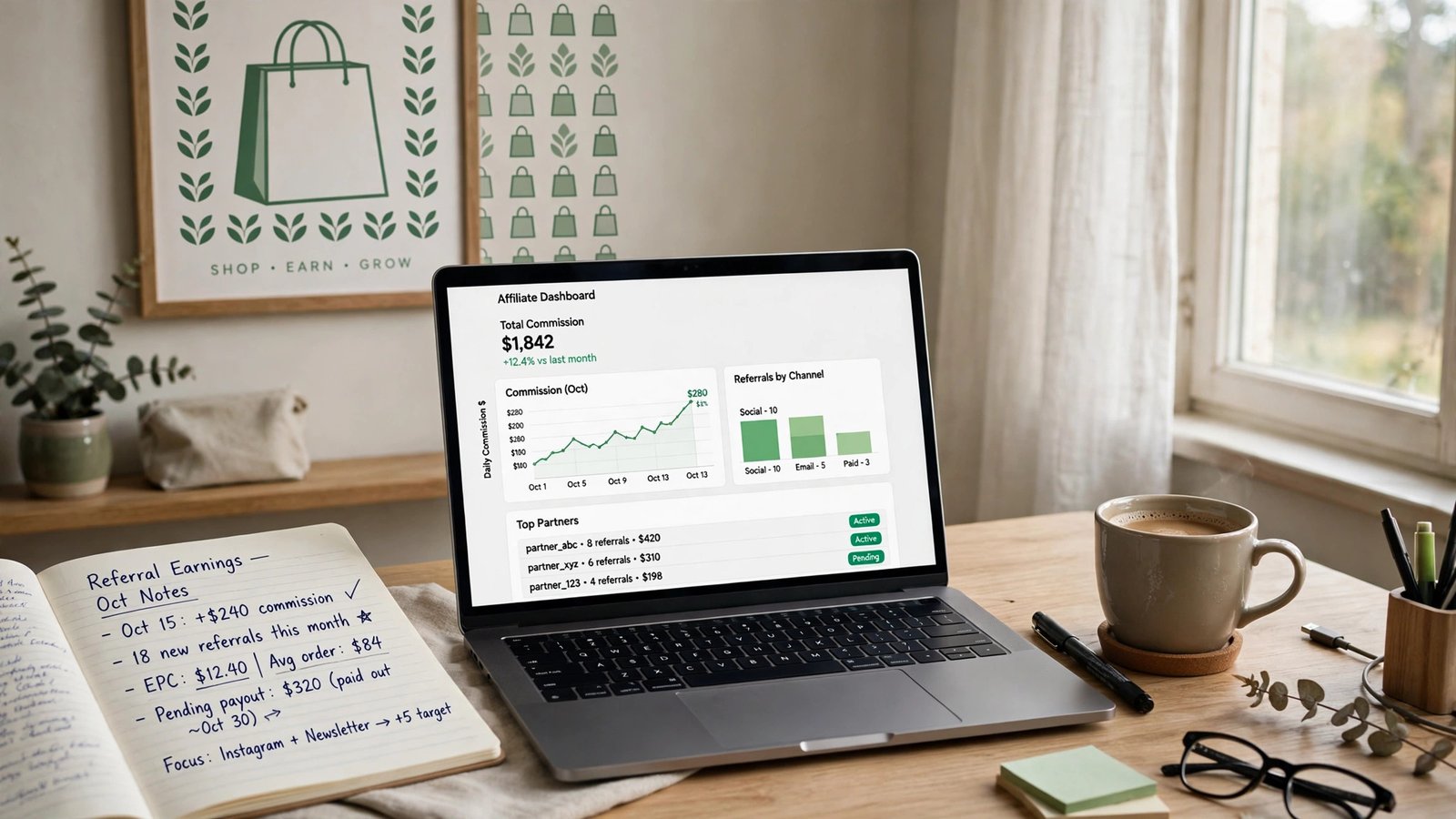
The Shopify affiliate program pays a one-time bounty of up to $150 USD for every new merchant you refer who buys a full-price plan — but the amount drops to $25 for merchants in some regions, and you only earn if they convert within a 30-day cookie window (or a 400-day trial-tracking extension). There’s no earnings cap and payouts start at a $10 minimum balance. If you run a blog, YouTube channel, or course about starting an online business, this is one of the most straightforward bounties in ecommerce — as long as you know where your audience actually lives, because that’s what decides your real commission.
I pulled all of this from Shopify’s own terms pages and the Impact dashboard terms in October 2026, because third-party reviews keep publishing numbers that flat-out contradict the official rules. You’ll see exactly where they disagree, and which version to trust.
What the Shopify Affiliate Program Actually Is
At its simplest: you recommend Shopify, someone signs up through your link and buys a plan, Shopify pays you a flat bounty. It’s free to join, it’s tracked through the Impact.com platform, and you get a personal dashboard with referral links, banners, and analytics once you’re approved.
Now here’s the part that confuses people — and honestly, a lot of affiliate roundups make it worse. Shopify runs three different earning paths, and they pay very differently:
1. The Shopify Affiliate Program (this article). Built for creators, educators, and publishers. You promote Shopify with content, and you earn a one-time bounty — up to $150 per qualified referral. No store-building required, no client work. This is the one you join at shopify.com/affiliates.
2. The Shopify Partner Program. Built for agencies, freelancers, and developers who actually build stores for clients. This one changed dramatically on August 10, 2026: partners now earn 20% of the merchant’s subscription fee plus 0.1% of the merchant’s eligible online sales for four years. That’s recurring revenue share, and it can dwarf a one-time bounty for partners who serve growing brands. More on this below, because the line between “affiliate” and “partner” is exactly where most reviews go sideways.
3. Referring yourself (merchant referral). Shopify lets existing merchants invite other businesses through their admin dashboard, but that’s a referral program for users, not an affiliate income channel. Don’t mix it up with the affiliate bounty.
The practical takeaway: if you create content for a living — tutorials, reviews, comparisons, courses — the Affiliate Program is your lane. If you build stores for clients, the Partner Program is almost certainly worth more. And if a review table blends all three into one “Shopify pays X” row, close the tab.
The $150 vs $25 Split: Where Most Reviews Get It Wrong
Here’s the official line, straight from Shopify’s affiliate page: affiliates can earn commission when new merchants purchase a full-priced Shopify store plan, with “up to $150” for each full-priced plan referral (and eligible Point of Sale Pro referrals, per Shopify’s own affiliate-program roundup). The exact amount, Shopify says, varies by the referral’s location.
That last clause is doing a lot of work, and it’s the part most roundups either skip or get wrong. Here’s the reality as mapped out by affiliate-review sites that read the actual Impact campaign terms: in tier-one countries (primarily the US, UK, Canada, Australia, and much of Western Europe), the bounty is the full $150. For merchants in India, Africa, Latin America, and most of Asia, the payout drops to $25.
Six times less. For the same referral.
Note the sourcing: Shopify’s public page advertises “up to $150” but doesn’t publish the $25 figure on the open web — that number comes from the program’s Impact campaign terms, as reported by affiliates who read the contract. If your audience is 90% US-based, you’re looking at $150 a head; a mostly Indian or African audience means $25 — worth knowing before you build a six-month content funnel around it.
Where third-party reviews contradict the official terms
This is the discrepancy the topic brief warned about, so let’s put it on the table. A widely copied review claims Shopify pays in tiers by plan — $150 for Basic, $500 for the mid plan, $2,000 for Advanced — with a 90-day cookie and even recurring revenue percentages.
Shopify’s official affiliate FAQ contradicts every piece of that: commission is a flat bounty per merchant (up to $150, location-dependent), the cookie is 30 days, and there’s no recurring component in the affiliate program at all. The $150/$500/$2,000 tier structure looks like a mangled blend of the affiliate bounty and the Partner Program’s revenue share. And the 90-day cookie? That’s BigCommerce’s old number — which belongs in the comparison table below anyway, because BigCommerce’s affiliate program no longer exists at all.
The rule here is simple: when a third-party table and Shopify’s own terms page disagree, trust Shopify’s terms page. It’s what the payouts are actually computed from.
Not every click pays, either. A “qualified referral” is a new merchant who buys a full-price Basic, Grow, or Advanced plan through your link — free trials alone don’t pay, discounted plans don’t pay until they convert to full price, and existing merchants don’t count. The upside: if someone clicks your link, starts a trial, and converts eight months later, you still get paid, because Shopify tracks trial conversions for up to 400 days. More on that in the tracking section.
Real Earning Math: What 5, 20, and 50 Referrals a Month Looks Like
This is the part most reviews never do, so let’s run the numbers. These are simple multiplications, but they show how violently the geo split changes the picture.
Tier-one audience ($150 per referral):
– 5 referrals/month = $750/month ($9,000/year)
– 20 referrals/month = $3,000/month ($36,000/year)
– 50 referrals/month = $7,500/month ($90,000/year)
Emerging-market audience ($25 per referral):
– 5 referrals/month = $125/month ($1,500/year)
– 20 referrals/month = $500/month ($6,000/year)
– 50 referrals/month = $1,250/month ($15,000/year)
Mixed audience (realistic for most global creators): say you land 20 referrals a month, 60% from tier-one regions and 40% from emerging markets. That’s 12 × $150 = $1,800, plus 8 × $25 = $200, for $2,000/month — a full third less than the “20 × $150” math most roundups imply.
There’s no recurring income here, so every month starts at zero. That’s the trade-off against programs that pay smaller percentages forever: Shopify pays big and once. A fair question to ask yourself is how many clicks it takes to produce a paying merchant. Shopify doesn’t publish affiliate conversion rates, but let’s work an illustrative example so you can see the shape of it: if 1,000 people click your affiliate link in a month, 2% sign up for a trial (20 trials), and 25% of those trials convert to a paid plan within the tracking window, that’s 5 paid merchants — $750 at tier-one rates. At a 1% click-to-trial rate, that same traffic makes $375. The honest version: this is a volume game built on trust, and content that converts readers into buyers is worth ten times more than content that just collects clicks.
One more number worth knowing: the minimum withdrawal is just $10, which means even a single emerging-market referral ($25) clears the bar. You’ll see cash quickly — you just won’t see much of it unless the volume or the geography cooperates.
The Tracking Rules: 30-Day Cookie Plus 400-Day Trial Protection
Shopify’s official FAQ states the tracking rules plainly, and they’re more generous than they first look:
- Click window: every referral is tracked for 30 days from the moment someone clicks your link.
- Trial extension: if that person starts a free trial within those 30 days, Shopify keeps tracking whether the store converts to a paid, full-price plan for up to 400 days.
Walk through it with dates. Someone clicks your link on November 1. On November 20, they start a free trial. They tinker for months, and on June 15 — 226 days after the click — they finally buy a full-price plan. You earn the bounty, because the trial started inside the 30-day click window and the conversion happened inside the 400-day trial window.
Why does this matter so much? Because ecommerce platform decisions are slow. People don’t pick a business platform the way they buy a $20 gadget — they research for weeks, test during trials, compare against Wix and Squarespace, and only commit when they’re ready to launch. A plain 30-day cookie would lose a huge share of those conversions. The 400-day trial extension is quietly one of the best features of this program, and it’s the real answer to every “30-day cookie vs 90-day cookie” comparison: Shopify’s effective window for trial users is 13 months.
One thing Shopify doesn’t spell out publicly: the attribution model (first-click vs last-click) when multiple affiliates touch the same buyer. Some comparison sites guess “last-click” as the industry default, but that’s a guess, not a published term. Don’t quote it as fact. What is published: tracking runs through Impact’s platform, and everything — clicks, trials, conversions, balances — shows in your affiliate dashboard.
How and When You Get Paid
Shopify’s official FAQ lays out the payment mechanics clearly enough that you can plan around them:
- Payment methods: direct deposit to your bank account or PayPal. Payouts go out in your choice of 80+ currencies, though Shopify’s affiliate roundup page says commissions are issued in USD — check your Impact dashboard for how conversion applies to your account.
- Schedule: commissions are credited to your balance once a month, on the 22nd, for the prior month’s referrals. So a merchant who converts in October lands in your balance on November 22.
- Minimum: you need a $10 balance before you can withdraw. That’s it — one tier-one referral covers fifteen months of minimums.
- Cadence: you can choose bi-weekly payouts or set a custom balance threshold, independent of the monthly crediting. Want to let it accumulate to $500 before each withdrawal? That’s your call.
- No cap: there’s no limit on how much you can earn. Land 200 referrals, get paid for 200.
If you’re a US-based freelancer managing cross-border payouts, this is also where your payment stack matters — a single international payment platform that receives in multiple currencies can save you real money versus converting twice. Here’s a genuinely useful one: my guide to setting up a Payoneer account for receiving global payments walks through exactly that setup.
Tax paperwork: what Impact will ask for
Because payouts run through Impact, the tax process follows Impact’s rules. For US-based affiliates: Impact will ask you to upload a valid W-9 tax form, and if you withdraw more than $600 in a calendar year, Impact’s payment provider (PayQuicker) sends you a 1099 form — 1099-MISC or 1099-NEC — in January or February. One wrinkle: if you get paid via PayPal, Impact won’t generate the 1099 — PayPal handles its own 1099 reporting, so grab it from PayPal directly.
For non-US affiliates: you’ll generally provide a W-8BEN (for individuals) or W-8BEN-E (for entities) certifying your foreign status, and you’re responsible for reporting the income in your own country. Treat everything in this section as informational, not tax advice — tax rules shift and your situation is your own, so check the current terms in your Impact dashboard and talk to a tax professional before filing season.
The August 2026 Change That Matters More Than the $150
Here’s the timely angle that makes this article worth writing in late 2026. On August 10, 2026, Shopify overhauled its Partner Program earning model — and it’s a fundamentally different deal from the affiliate bounty.
Under the new model, verified on Shopify’s official partners announcement:
- Partners earn 20% of the merchant’s subscription fee plus 0.1% of eligible online GMV, for a 4-year term
- The same rates apply to every plan — Basic, Grow, Advanced, and Plus — whether the deal is partner-led or sales-assisted
- Eligible GMV covers online consumer transactions (excluding B2B), capped at $100 million a year, calculated net of returns and refunds
The GMV piece is the headline. For the first time, partners share directly in the merchant’s sales, not just the subscription fee. Shopify’s own examples: a merchant doing $1 million a month in eligible online sales sends the partner $1,000 a month in GMV share alone — and that compounds over the four-year term. Third-party analysis of Shopify’s figures puts a $2M Advanced brand at roughly $11,800 over four years and a $15M Plus brand at roughly $82,000.
If you build stores for clients, this change is a pay raise: you now earn while your clients grow. If you’re a content creator, you can’t access partner revenue share (it requires building and transferring stores) — but know it exists, because agencies are about to promote Shopify harder than ever, and the noise in “best ecommerce platform” search results will rise accordingly.
Do the crossover math and the choice gets obvious. One partner with a single client doing $500K a year in online sales earns $500 a year in GMV share — before the 20% subscription share — for four years, from one relationship. An affiliate needs four tier-one referrals to beat that in a single year, and the affiliate starts from zero every January. The partner model rewards depth; the affiliate model rewards breadth. Pick your game.
How Shopify Stacks Up: A Verified Comparison
Before you commit to promoting any program, look at what the alternatives actually pay — with terms I could verify from each program’s own pages this month, not from copied roundup tables.
| Program | Commission | Cookie | Payout minimum | Model |
|---|---|---|---|---|
| Shopify Affiliate | Up to $150 bounty (tier-one); $25 in emerging regions | 30 days + 400-day trial tracking | $10 | One-time bounty per merchant |
| Wix Affiliate | $100 per premium signup | 30 days | $300/month minimum to get paid | One-time bounty; payment via wire |
| Squarespace Affiliate | $100–$200 per new subscription (reported by affiliate roundups) | 45 days (reported) | Not published on the open web | One-time bounty via Impact |
| BigCommerce Affiliate | Closed — May 17, 2025 | N/A | N/A | No replacement planned |
| WooCommerce | No single official program | N/A | N/A | Ecosystem: hosting partners $65–$150, themes 20–50%, plugins 25–40% |
The pattern: Shopify’s one-time $150 bounty is the largest single, verified flat payout among open programs, with the lowest payout threshold and the most generous trial tracking. Its weaknesses: the geo split (no competitor discounts your commission by 83% based on where the buyer lives) and no recurring component. For the WooCommerce route — which has no single official affiliate program but a whole ecosystem of hosting, theme, and plugin payouts — see my rundown of WooCommerce 11.2 and what it changes for digital sellers.
How to Promote It Without Spamming Your Audience
The application asks for an active website, an established audience, and original content about commerce or entrepreneurship. Shopify says applications are typically processed within 24 hours, but “not every application is approved” — quality and relevance decide. If you’re starting from zero, build the content first and apply once it exists.
Here’s what actually converts, based on how the program’s economics work:
Comparison content is the money page. “Shopify vs Wix for print-on-demand” catches people at the decision moment — a comparison reader is far closer to buying than someone reading a “what is ecommerce” explainer. These pages also let you disclose the affiliate relationship naturally.
Setup tutorials rank and convert for months. A “how to launch your first Shopify store” walkthrough earns clicks from beginners and converts whenever someone finally commits — including months later, thanks to that 400-day trial window. Long-tail versions (“Shopify for handmade jewelry”) face weaker competition than head terms.
Niche down past the saturation. Generic “Shopify review” content fights every affiliate on the internet. Niche angles — Shopify for food trucks, for digital downloads, for subscription boxes — have thinner SERPs and readers who feel personally spoken to. If your audience is heavily emerging-market, niche content about selling locally converts better than generic platform comparisons.
Use the creative library, but don’t lead with banners. Shopify provides banners, text links, and content through Impact. Use them — but banner-blindness is real, and a tutorial with your affiliate link in the “here’s the tool I use” section outperforms a sidebar banner every time.
Disclose, every time. The FTC requires you to clearly disclose affiliate relationships in endorsements — a sentence like “I earn a commission if you sign up through my link, at no extra cost to you” near the link, not buried in a footer. It’s the law, and it’s also good business: undisclosed links erode the trust that makes people click.
Don’t buy ads against Shopify’s brand terms. Most Impact campaigns restrict bidding on brand keywords. Read the terms inside your Impact dashboard before spending a dollar on PPC.
Honest Caveats Before You Apply
This is the section most affiliate reviews bury, and it’s the one that determines whether you waste six months.
Approval isn’t instant and isn’t guaranteed. Twenty-four hours is the typical processing time, not a promise, and Shopify explicitly prioritizes quality and relevance. A thin site with three posts won’t cut it. Build the audience and the content first.
The bounty is one-time, and earnings reset monthly. There’s no residual income. If you stop publishing, you stop earning. Compare that honestly against recurring programs (some SaaS affiliates pay for 12+ months per referral) before you go all-in.
Geography can cut your commission by 83%. I’ve said it three times because it decides your strategy. An audience in tier-one markets makes this program excellent. An audience elsewhere makes it mediocre. Know which one you have — your analytics will tell you in thirty seconds.
Conversion is a slow burn. The 400-day trial tracking exists because ecommerce decisions take months. That’s great for eventual payouts, but it means your first meaningful commission check can arrive a quarter or two after your first click. Budget your expectations — and your cash flow — accordingly.
Merchant quality rules apply. You earn on new merchants buying full-price plans. Trials that never convert, discounted plans that never upgrade, and existing merchants don’t pay. It’s a fair filter, but it means raw signup numbers always overstate your expected income.
This article isn’t professional tax or legal advice. The tax section above reflects Impact’s published help documentation as of October 2026. Rules change, thresholds change, and your tax situation is your own — check the current terms in your Impact dashboard and consult a qualified tax professional before you file.
Frequently Asked Questions
How much does the Shopify affiliate program pay in 2026?
Up to $150 USD per qualified referral in tier-one countries, and $25 in emerging regions (India, Africa, Latin America, most of Asia), per the program’s Impact campaign terms. Shopify’s public affiliate page advertises “up to $150” per full-priced plan referral and notes the amount varies by the referral’s location. It’s a one-time bounty, not recurring — you earn once per merchant.
Is the Shopify affiliate program free to join?
Yes. There’s no cost to apply or participate. Shopify says applications are typically processed within 24 hours, though it can take longer, and not every application is approved — the program prioritizes applicants with an active website, an established audience, and original commerce or entrepreneurship content.
How long is the Shopify affiliate cookie?
30 days from the click, according to Shopify’s official FAQ. But there’s a meaningful extension: if your referral starts a free trial within those 30 days, Shopify keeps tracking that trial’s conversion to a paid, full-price plan for up to 400 days. Beware third-party reviews claiming a 90-day cookie — that contradicts Shopify’s own terms page.
When do Shopify affiliate payouts arrive?
Commissions are credited to your balance once a month, on the 22nd, for the prior month’s referrals. Once your balance reaches $10, you can withdraw via direct deposit or PayPal (you can also choose bi-weekly payouts or a custom balance threshold). Expect your first payout roughly two months after your first converting referral, given the monthly crediting cycle.
What’s the difference between the Shopify Affiliate Program and the Shopify Partner Program?
The Affiliate Program is for creators and publishers: promote Shopify with content, earn a one-time bounty (up to $150) per referred merchant. The Partner Program is for agencies, freelancers, and developers who build stores for clients: since August 10, 2026, partners earn 20% of the merchant’s subscription fee plus 0.1% of eligible online sales for four years. Different audiences, different pay structures — and different application pages.
Can I join if my audience is outside the US?
Yes — the program is open globally and tracks referrals in 175+ countries. But know the geo reality: merchants in India, Africa, Latin America, and most of Asia pay the $25 tier instead of $150, which dramatically changes the math. Also, payouts go out in USD and Impact handles currency conversion for non-US affiliates. And if you’re a non-US affiliate, you’ll provide W-8 tax forms rather than a W-9.