You did the work. The client loved it. Now comes the part many freelancers dread: asking to be paid. Invoicing feels awkward at first, but it’s just a process — and a good process gets you paid faster with less stress. Here’s how to invoice clients as a freelancer the right way, from what’s on the invoice to what to do when payment is late.
What Every Freelance Invoice Must Include
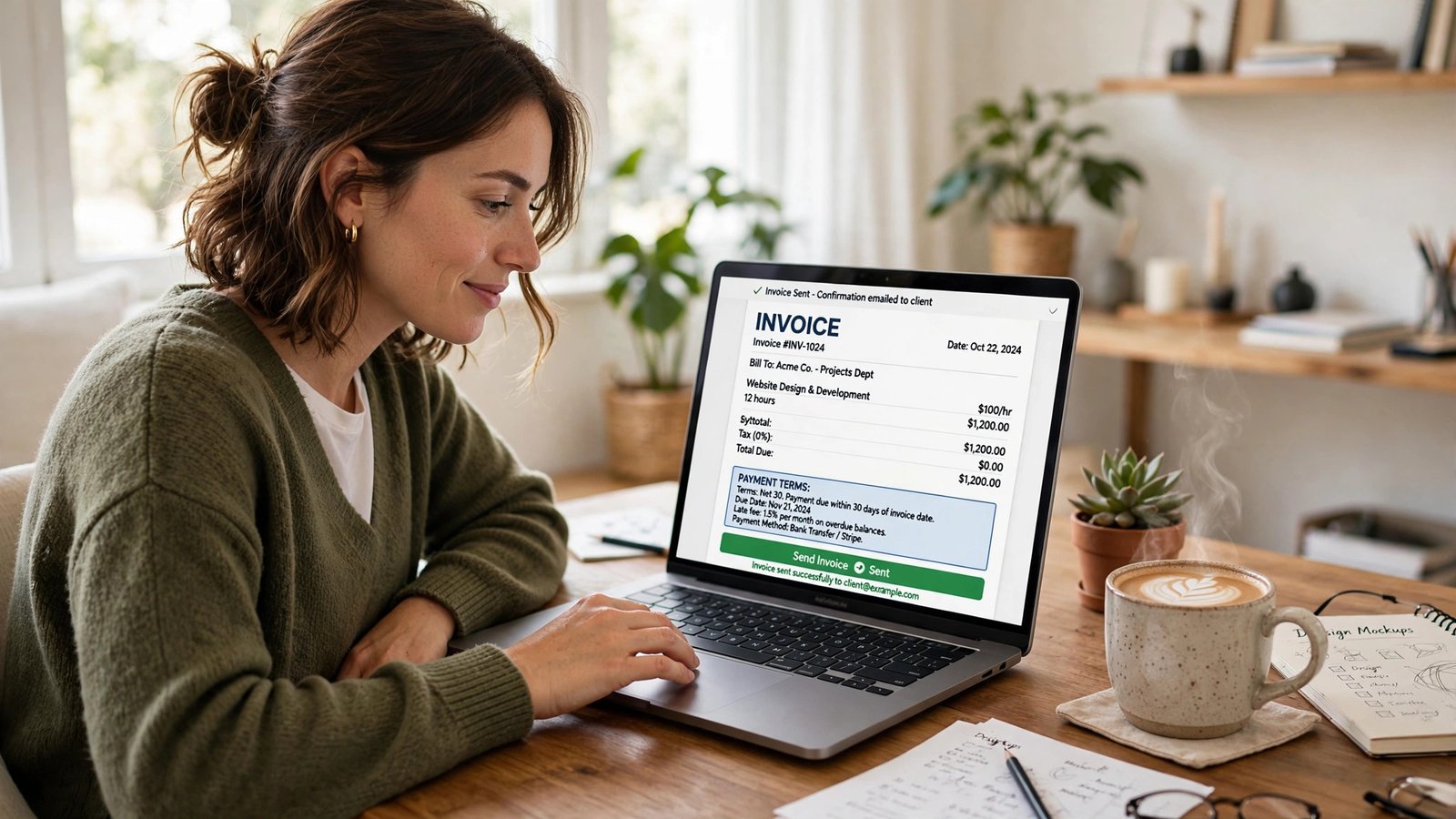
A professional invoice needs these basics — no exceptions:
- Your business name and contact info (and your client’s)
- A unique invoice number (INV-2026-001, then sequential — this matters for your records and theirs)
- Invoice date and payment due date (not just “due upon receipt” — give a real date)
- A clear description of the work (what you delivered, hours or deliverables, the project name)
- The amount due, with any taxes or fees itemized
- Payment terms (Net 15, Net 30, etc. — more on this below)
- How to pay (payment link, bank details, or accepted methods — make this dead obvious)
If you’re operating under a DBA or brand name rather than your legal name, use the business name consistently across invoices, contracts, and your bank account. It keeps your books clean and looks professional.
Setting Payment Terms That Actually Get You Paid
Your payment terms are the single biggest lever on how fast you get paid. Most freelancers default to Net 30 (payment due 30 days after invoice) because they’ve seen it somewhere. You don’t have to.
Terms that work better:
– Net 15 instead of Net 30 — halves your wait with minimal pushback from most clients
– 50% deposit upfront on any project over a few hundred dollars — standard practice in creative and consulting work, and it filters out unserious clients
– Milestone billing on longer projects — e.g., 30% to start, 40% at midpoint, 30% on delivery, so you’re never carrying all the risk
Late fees: Many freelancers add a late fee (often 1–1.5% per month) stated right on the invoice. It won’t make you rich, but it signals you’re serious. Just check your state’s rules first — a few states restrict or regulate late fees on consumer contracts.
Early-payment discounts: The carrot instead of the stick. “2% discount if paid within 10 days” gives the client’s accounting department a reason to prioritize your invoice. It costs you a little but can dramatically shorten your cash cycle.
The golden rule: negotiate terms before the work starts, in the contract or proposal — not after delivery when you have zero leverage.
How to Actually Send Invoices (Tools That Help)
You don’t need expensive software on day one, but you do need something better than a Word doc you manually update. Options, roughly in order of cost:
- Free invoice generators — fine for your first few clients; you fill in a template and download a PDF.
- PayPal or Stripe invoicing — free to send, small fee when paid; the big win is the built-in “pay now” button, which gets you paid noticeably faster than bank-transfer instructions.
- Accounting software (Wave is free; QuickBooks, Xero, and FreshBooks are paid) — worth it once you have regular clients: recurring invoices, automatic reminders, expense tracking, and tax-time reports in one place.
Whatever you use, turn on automatic payment reminders. A polite nudge sent by software three days before the due date — and again on the due date — recovers more late payments than any angry email you’ll ever write. Let the tool be the bad guy so you don’t have to be.
One more habit: invoice the moment the work is delivered, not at month-end. Invoices sent within 24 hours of completion get paid days faster on average than ones batched later. It’s the easiest win in this entire article.
What to Do When a Client Pays Late
Late payment happens to every freelancer. Most of the time it’s an administrative oversight, not malice. Handle it with a calm, escalating cadence:
- 3 days before due: friendly heads-up. “Quick reminder that invoice INV-2026-014 for $1,200 is due Friday. Let me know if you need anything from me!”
- On the due date: short nudge with the payment link again.
- 7 days overdue: firmer but professional. “This invoice is now a week past due. Could you confirm when payment will go out?”
- 14+ days overdue: pick up the phone. A short, direct call resolves things faster than a fourth email. Ask for a specific date.
- 30+ days, no response: formal demand letter restating the amount, the late fee if your terms include one, and a deadline. For larger amounts, small claims court is a real option — filing fees are usually $30–$75.
Keep every email. If it ever escalates, a clean paper trail is your best asset.
And protect yourself going forward: a client who pays late twice gets shorter terms or a bigger deposit next time. That’s not punishment — it’s risk management.
Invoicing and Taxes: Keep Records Like You Mean It
Every invoice is a tax document. The IRS doesn’t care how pretty your invoices are, but it does care that your reported income matches reality. A few essentials for US freelancers:
- Save everything. Every invoice, every payment confirmation, every expense receipt. Your accounting software should do most of this automatically.
- Report on Schedule C. As a freelancer (sole proprietor or single-member LLC), your net profit goes on Schedule C of your personal tax return, and you’ll owe self-employment tax (15.3%) on top of income tax.
- Pay quarterly estimated taxes. The IRS expects you to pay as you earn — usually four times a year. Skip this and you’ll face underpayment penalties. The IRS Self-Employed Tax Center has the forms and deadlines.
- Watch for 1099s. US clients who pay you $600+ in a year should send you a Form 1099-NEC. Track this yourself too — their paperwork isn’t always right.
- Set aside 25–30% of profit in a separate savings account for taxes. Future you will be grateful.
This is general information, not tax advice — tax rules have edge cases, so check IRS guidance or talk to a CPA for your specific situation.
As your freelance income grows, it’s smart to build income streams beyond client work. Many freelancers add content revenue on the side — if you run a blog, understanding Google AdSense approval requirements early means your site can start earning ad revenue while you focus on clients.
Frequently Asked Questions
How do I invoice a client for the first time?
Use an invoice template or free generator, include all the essentials (invoice number, dates, work description, amount, payment terms, how to pay), and send it as a PDF right after delivering the work. Keep a copy for your records.
What payment terms should a freelancer use?
Net 15 is a good default — faster than the traditional Net 30. For larger projects, ask for a 30–50% deposit upfront and bill the rest at milestones. Always agree on terms in writing before starting work.
Should I charge late fees on overdue invoices?
It helps, and many freelancers do (typically 1–1.5% per month). State the fee on the original invoice so it’s agreed upfront, and check your state’s regulations first.
What if a client refuses to pay at all?
Start with a formal written demand, keep all records, and consider small claims court for amounts within your state’s limit (usually $5,000–$10,000). For ongoing protection, require deposits from new clients.
Do I need accounting software as a freelancer?
Not on day one — a free invoice generator works for your first few clients. Once invoicing becomes weekly work, software with automatic reminders and tax reports (Wave is free; QuickBooks and FreshBooks are popular paid options) pays for itself in time saved.
How long should I keep invoices and payment records?
The IRS generally recommends keeping tax-related records for at least 3 years from the date you file, and 7 years is safer. Digital copies are fine — just make sure they’re backed up somewhere other than your laptop.