
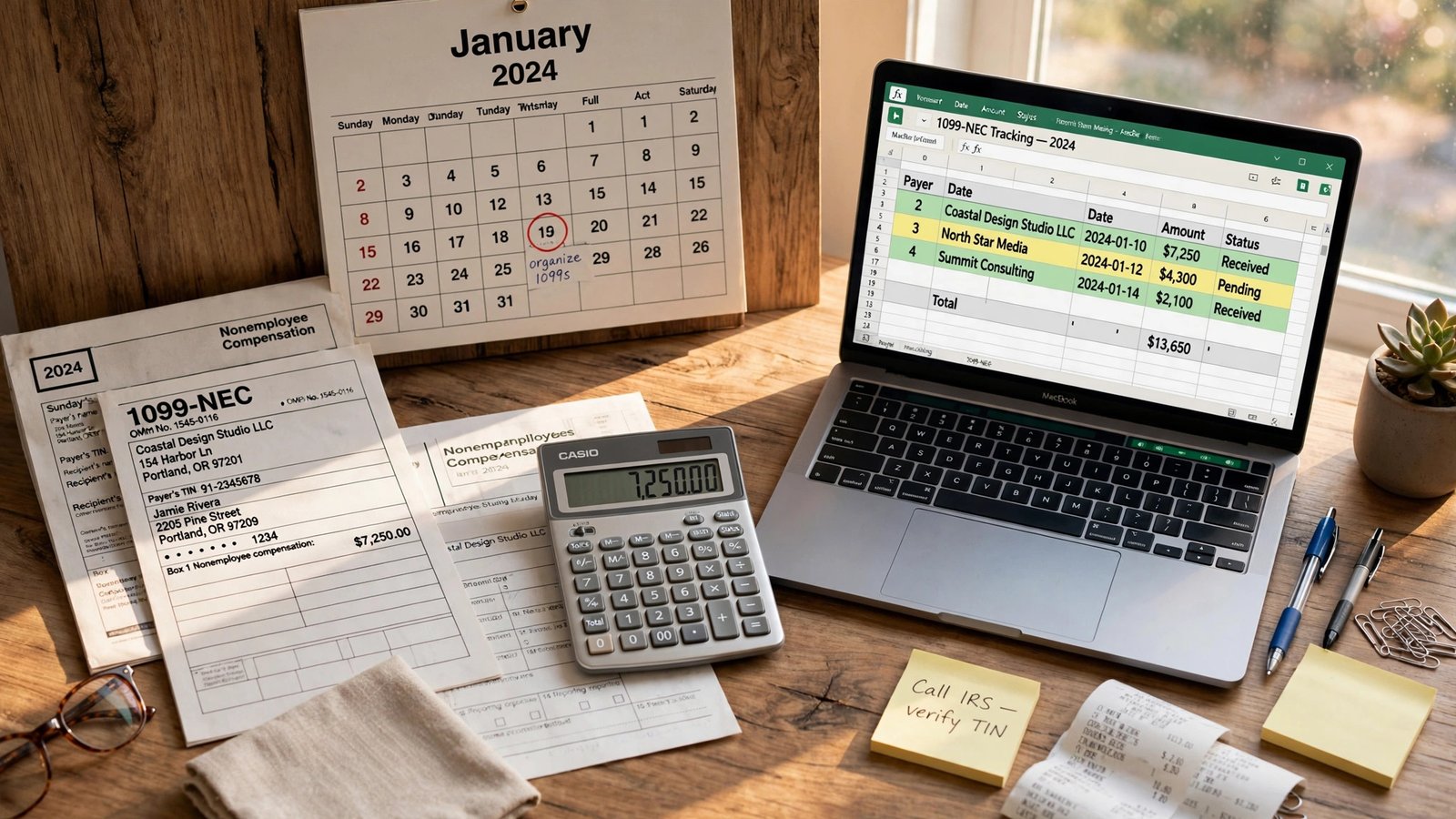
For payments made in 2026, a business only has to issue Form 1099-NEC when it paid a non-employee $2,000 or more for services during the calendar year — up from the $600 floor that had stood since the 1950s. The change came from the One Big Beautiful Bill Act (OBBBA), signed July 4, 2025, which amended Internal Revenue Code Sections 6041(a) and 6041A(a)(2) to raise the reporting threshold for payments made after December 31, 2025. Starting in 2027, the $2,000 figure will be adjusted annually for inflation.
Here’s what that means in the simplest terms: if you paid a freelance designer $1,800 for work done entirely in 2026, you don’t need to file a 1099-NEC. If you paid her $2,000 or more, you do. And if you’re the freelancer on the receiving end, listen closely — getting fewer forms does not mean owing less tax. Every dollar of self-employment income is still taxable whether or not anyone reports it.
This article gives both sides the playbook: the October W-9 sweep small businesses should run right now, the per-payee math that trips people up, the backup-withholding trap that ignores the new threshold entirely, and what freelancers should do about the forms they will (and won’t) receive in early 2027.
This article is educational and not professional tax advice. Confirm your situation with your CPA or tax professional before filing.
What the new $2,000 line actually changed
The rule change is straightforward on paper. Section 70433 of the OBBBA raised the information-reporting threshold in Section 6041 of the tax code from $600 to $2,000, applying to Forms 1099-NEC (nonemployee compensation) and most 1099-MISC payment types — rent, prizes, awards, medical payments, and other income (IRS General Instructions for Forms 1099-MISC and 1099-NEC). It applies to payments made after December 31, 2025, so the forms filed in early 2027 (covering 2026 payments) use the new line, while the forms filed in early 2026 (covering 2025 payments) still used $600. That’s why you’ll see both numbers floating around online right now — they’re describing different tax years, and mixing them up is the single most common mistake people make with this rule.
Two things are worth locking in. First, the threshold is per payee, per calendar year — it’s the sum of everything you paid one person in 2026, not each individual payment. A $700 project in March and a $1,500 project in November is $2,200 total. You file. Five different vendors at $1,800 each is $9,000 of total spend but zero required 1099s, because no single payee crossed the line. Second, the number won’t sit still forever. Beginning with payments made in 2027, the threshold adjusts annually for inflation (rounded to the nearest $100), so any bookkeeping rule you write that hard-codes “$2,000” will drift out of date within a year.
The four conditions that trigger a 1099-NEC are unchanged otherwise. A form is required only when all four are true: the payment went to someone who is not your employee, it was for services performed in the course of your trade or business, it went to an individual, partnership, estate, or (in some cases) a corporation, and the calendar-year total hit the threshold. Miss any one condition and no form is required.
What did NOT move — the lines that still matter
This is where most quick explainers stop, and where the expensive mistakes live. The OBBBA raised the threshold for 1099-NEC and most 1099-MISC categories, but several forms and boxes kept their own separate triggers:
| Form / box | 2026 threshold | Changed? |
|---|---|---|
| 1099-NEC box 1 (services) | $2,000 | Yes — was $600 |
| 1099-MISC (rent, prizes, other income) | $2,000 | Yes — was $600 |
| 1099-MISC box 2a (royalties) | $10 | No |
| 1099-NEC box 2 (direct sales for resale) | $5,000 | No |
| 1099-INT, 1099-DIV | $10 | No |
| 1099-S (real estate) | $600 | No |
| 1099-B (broker transactions) | No minimum | No |
| 1099-K (payment platforms like PayPal, Venmo, Stripe) | $20,000 and 200 transactions | Yes — but a separate law section; OBBBA permanently restored the original thresholds |
The royalty trap catches session musicians and songwriters every year: a $400 royalty stream still triggers a 1099-MISC because royalties kept their $10 floor. And the 1099-K situation deserves its own callout, since the OBBBA handled it separately: it permanently reverted the platform reporting threshold to $20,000 in gross payments and 200 transactions, treating the planned $600 phase-down as if it never happened. If you were paid through PayPal or Stripe as a client reimbursement, those payments arrive on a 1099-K from the processor — and they may arrive alongside a 1099-NEC from the same client for the same income. That’s double-paperwork, not double income; report it once.
If you’re a small business paying contractors: run your W-9 sweep now
October is the right month to do this. You still have two-plus months of payments to make, and the threshold applies to the calendar-year total, not to what you’ve paid so far. A vendor sitting at $1,700 in October crosses the line with one more invoice by Christmas. The checklist:
1. List every non-employee payee you’ve paid in 2026, with running totals. Not just contractors — include attorneys (legal services are reportable even when the law firm is incorporated), commissions to non-employees, and prizes or awards for services.
2. Collect a completed Form W-9 from every vendor before the next payment — regardless of their running total. There is no IRS rule tying W-9 collection to a dollar threshold, and this is the discipline that protects you. The scenario: you stop collecting W-9s because a vendor is “only” at $900, then scope expands, December payments push them over $2,000, and you have no taxpayer ID on file. IRS rules then require you to start backup withholding at 24% on all future payments immediately — and if you fail to withhold, your business is liable for the tax itself. One form, collected upfront, eliminates the entire problem.
3. Exclude what doesn’t belong. Payments made by credit card or through a third-party processor (PayPal, Stripe, Venmo for business) do not go on a 1099-NEC — the processor handles reporting via 1099-K. Personal payments don’t count either: only payments made in the course of your trade or business. The plumber who fixed your shop’s sink gets considered; the plumber who fixed your home kitchen doesn’t.
4. Mark the payees that will need a form at $2,000+ and calendar the deadline. For tax year 2026, the forms are due to both recipients and the IRS on February 1, 2027. That date deserves explanation: the statutory date is January 31, but January 31, 2027 is a Sunday, and the IRS’s General Instructions move the deadline to the next business day. Unlike most other 1099s, the 1099-NEC has no extended deadline for electronic filers — paper and electronic filings are due the same day, and there is no automatic extension.
5. Understand what a late form costs you. IRS penalties per form escalate: $60 if filed within 30 days of the deadline, $130 if filed before August 1, and $340 if filed after August 1. Intentional disregard goes to $660 per form. On a 20-contractor roster, being careless costs $6,800 at the top tier — and there’s a separate penalty for failing to furnish the recipient copy, so a sloppy filing can cost you twice per form.
I’ll be honest with you: the biggest operational benefit of the new threshold is how many vendors fall off the list. A business with 50 freelancers each earning between $800 and $1,500 in a year could file 50 fewer forms this January. That’s real. But it only pays off if you still did the W-9 work in October — the savings happen at filing time, not at onboarding time, and the businesses that “save” by skipping W-9s are the ones who end up backup-withholding at 24% in December.
The backup-withholding trap that ignores the new line
Backup withholding is the part of this law change that catches smart people off guard. When a payee fails to furnish a valid taxpayer identification number — or the IRS notifies you of a name/TIN mismatch — you’re required to withhold a flat 24% from payments and remit it to the IRS.
The OBBBA raised the backup-withholding trigger from $600 to $2,000 to match the new reporting threshold. But here’s the catch that matters: if you applied backup withholding, you must file a 1099-NEC for that payee at any amount — the $2,000 threshold doesn’t apply. A contractor with $900 of payments and 24% withheld still generates a required form. And the inflation adjustment adds an annual moving target to your payroll rules starting in 2027, so keeping the trigger hard-coded in vendor software is a mistake; build the threshold as a configurable value or you’ll be re-writing it every year.
For freelancers, the practical takeaway is short: hand every new client a completed W-9 before your first invoice. It prevents backup withholding entirely, and chasing paperwork in January is exactly how forms go out wrong.
If you’re a freelancer receiving fewer forms: your taxes didn’t change
From the freelancer’s side, the new threshold is mostly cosmetic. Yes — a client that paid you $1,700 in 2026 no longer has to send you a 1099-NEC. No — that income did not become tax-free. The reporting threshold governs the payer’s paperwork obligation, not the recipient’s tax liability. Every dollar of freelance income is taxable whether or not a form exists.
Here’s how to handle the new reality:
- Track your own income. This was always the correct practice, but it’s now essential. Reconcile your bank deposits against your invoices at year-end. The clients who paid you under $2,000 owe you no form, but you owe tax on every dollar.
- Everything goes on Schedule C. Report the full year of income — forms or no forms. If your net profit tops $400, you owe 15.3% self-employment tax on top of income tax, which surprises people every single year.
- Watch your quarterly estimates. If you’ll owe $1,000 or more in tax for the year, quarterly estimated payments apply. Missing forms don’t reduce the estimate; they just make the number harder to pin down, so pad your tracking.
- Your entity type matters. If you operate as an S corporation or C corporation, most clients are not required to issue you a 1099-NEC at all — the corporate exemption applies regardless of amount. Sole proprietors and single-member LLCs should expect forms from every client above the threshold.
- Check your mailing address with every payer. Payer statements must be furnished to recipients by the January 31 deadline (February 1 for 2026 payments). If a client does file one for you and it goes to an old address, you’ll be filing in April with an incomplete picture. A five-minute address check in December is worth it.
One more overlap worth knowing: if a client paid you partly by direct transfer and partly through a processor like PayPal, you may receive both a 1099-NEC from the client and a 1099-K from the platform covering the same income. Report the income once. Keep both forms, and keep records showing they overlap — that’s what keeps an IRS notice from turning into an audit.
States don’t have to follow the federal line
The federal threshold is the headline, but several states run their own information-reporting programs and aren’t obligated to match the $2,000 federal line. Some states have their own 1099 filing requirements that can be lower than the federal threshold. If you pay contractors across multiple states — or receive income from out-of-state clients — verify each relevant state’s rules with your state tax authority or tax professional before assuming the federal number clears your obligations. State-level divergence is the kind of detail that quietly generates penalty notices in April.
Quick decision table: do I file?
For the business owner deciding per payee, the whole article reduces to this:
| Situation | 1099-NEC required for 2026 payments? |
|---|---|
| Paid non-employee $2,000+ for services in your trade or business | Yes |
| Paid non-employee less than $2,000, no withholding | No — but income still taxable to them |
| Backup withholding applied, any amount | Yes, at any amount |
| Paid by credit card or third-party processor (PayPal, Stripe) | No — processor reports via 1099-K |
| Payee is a corporation (not for legal services) | Generally no |
| Attorney or law firm paid $2,000+ for legal services | Yes, even if incorporated |
| Personal (non-business) payment | No |
| 2025 payments filed in early 2026 | Old $600 line still applied |
Frequently Asked Questions
Is the $2,000 threshold per payment or per year?
Per payee, per calendar year. Add up every payment to one person in 2026. A designer paid $700 in March and $1,500 in November totals $2,200 — you file. Five different people at $1,800 each means no forms at all.
I earned $1,900 from a client in 2026 and got no form. Do I owe taxes?
Yes. The threshold controls whether the payer files paperwork; it has nothing to do with whether the income is taxable. Report the $1,900 on your Schedule C along with everything else.
Does the new threshold mean I can stop collecting W-9s?
No — this is the most dangerous misunderstanding of the rule change. There’s no IRS rule tying W-9 collection to a dollar threshold. If a vendor’s payments later exceed $2,000 and you have no TIN on file, you must begin 24% backup withholding on future payments immediately. Collect the W-9 before the first payment.
When are 2026 1099-NEC forms actually due?
February 1, 2027 — both the IRS filing and the recipient copy, paper and electronic. The statutory date is January 31, but it falls on a Sunday in 2027, so it moves to the next business day. There is no automatic extension.
What if I pay contractors through PayPal or a credit card?
Those payments don’t go on a 1099-NEC. Third-party processors report payments via Form 1099-K (only when the payee exceeds $20,000 and 200 transactions in a year for platform payments; card transactions have no minimum threshold). You don’t file an NEC for the same money.
Will the threshold keep changing every year now?
Yes — starting with payments made in 2027, the $2,000 figure adjusts annually for inflation (rounded to the nearest $100). Don’t hard-code the number into your bookkeeping rules; keep it as a configurable setting.
Sources and further reading:
– IRS General Instructions approach, via RKube Services’ October 2026 walkthrough
– Xero US: 1099-NEC filing rules and deadlines