
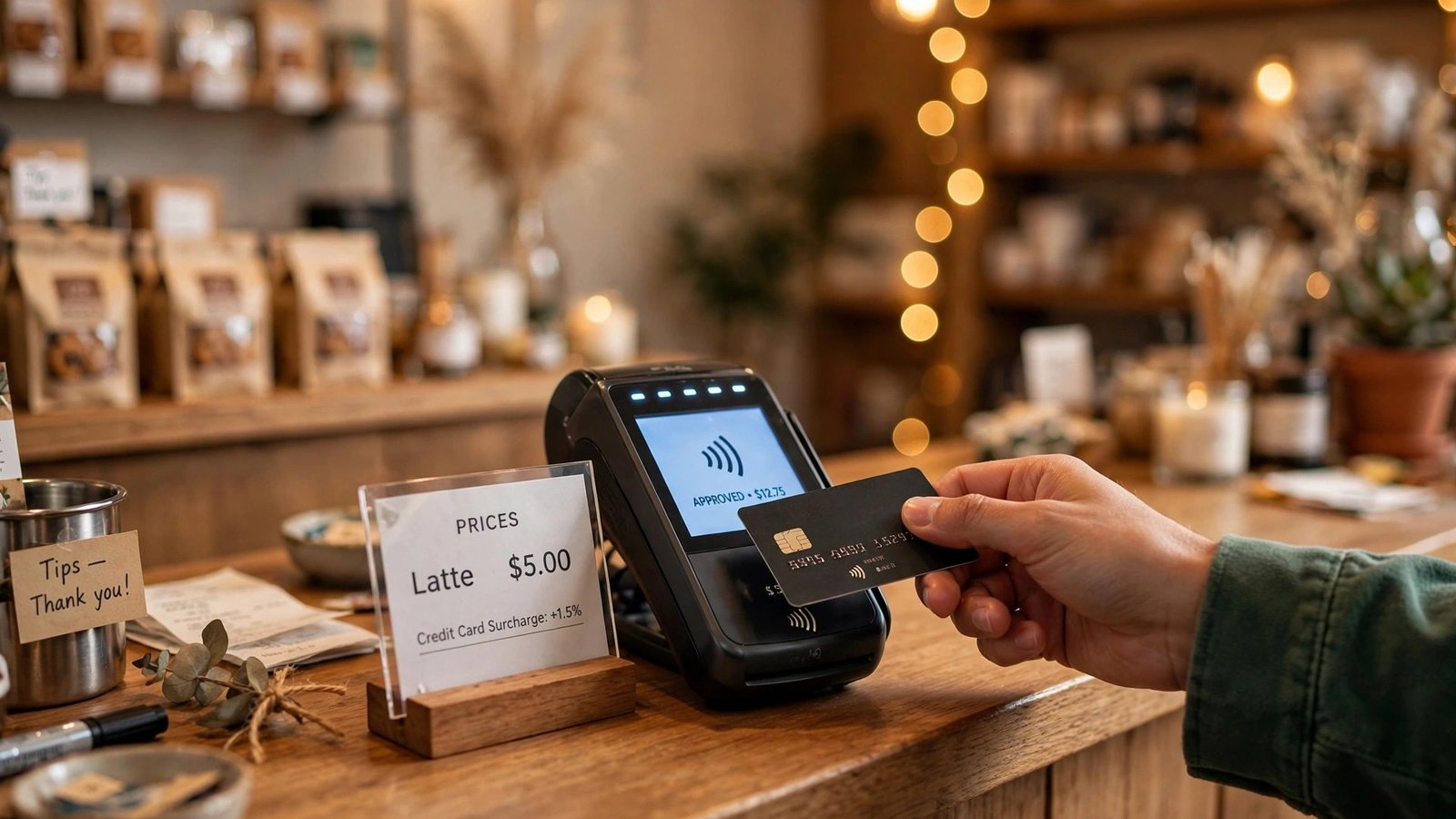
If you run a small business in the United States, you can legally add a credit card surcharge in most states in 2026 — but not in Connecticut, Massachusetts, Maine, or Puerto Rico, where state law bans surcharges outright. Illinois caps them at 1% of the transaction, Colorado at 2%, and several other states limit the fee to your actual processing cost. Everywhere else, Visa caps surcharges at 3% and Mastercard at 4%, and debit cards can never be surcharged anywhere. There is exactly one fee-passing method that works in all 50 states: a properly structured cash-discount or dual-pricing program, where you post the card price and reward cash buyers instead of punishing card buyers.
This matters because card acceptance costs real money — U.S. merchants paid an estimated $198.25 billion in swipe fees in 2025, at an average rate of 2.36%, according to the Merchants Payments Coalition. The rules below are current as of October 2026, verified against live sources for this article (a fuller disclaimer sits at the end).
The States That Ban Credit Card Surcharges Outright
Only three states — plus one territory — prohibit credit card surcharges for private businesses. If you operate in one of them, this section saves you a fine.
Connecticut. Conn. Gen. Stat. § 42-133ff prohibits surcharges on any payment method — credit, debit, and digital wallets alike. It’s one of the broadest bans in the country. Violations are treated as unfair trade practices, and the Department of Consumer Protection can assess penalties per violation on top of civil liability. Cash discounts and dual pricing remain legal here with clear, posted notice.
Massachusetts. Mass. Gen. Laws ch. 140D, § 28A bars any seller from imposing a surcharge on a customer who chooses to pay by credit card. It’s one of the oldest surcharge bans in the country and one of the most consistently enforced — the Attorney General can bring actions, and private plaintiffs can sue under Chapter 93A. Note that Massachusetts also tightened surrounding “junk fee” rules in September 2025 (940 CMR 38.00), requiring the total price a consumer will pay to be disclosed up front — so even your non-surcharge fees face extra scrutiny here.
Maine. Me. Rev. Stat. tit. 9-A, § 8-509 prohibits sellers from surcharging both credit and debit transactions. Bills to repeal or relax it keep getting introduced — including in the 2025–2026 session — and the legislature has declined each time. There is a narrow carve-out for governmental entities collecting taxes, fines, and license fees; it does not extend to private businesses. Cash discounts and dual pricing are legal in Maine when the regular (card) price is displayed.
Puerto Rico. Law 150 bans surcharges on credit and debit cards, and Puerto Rico goes further than the mainland states: a 2013 amendment removed the law’s express cash-discount allowance, the First Circuit upheld the law in 2025, and the territory’s consumer affairs department interprets it to forbid cash discounts as well. If you operate in Puerto Rico, talk to local counsel before using either method.
Notice the pattern: every state that bans surcharging expressly protects genuine cash discounts (except Puerto Rico, where even those are disputed). The distinction between a surcharge and a discount is the single most important concept in this article, and I’ll unpack it fully below.
States With Surcharge Caps and Cost Limits
Most of the country allows surcharging, but a growing number of states set their own ceilings below the card-network limits or layer on disclosure rules.
Illinois — 1% cap. Illinois limits surcharges to 1% of the transaction or your actual processing fee, whichever is lower, effective July 2026. Illinois also restricts charging interchange on the tax and gratuity portions of a transaction. If your effective rate is 2.9%, you can only pass through 1% — you eat the rest. This makes Illinois one of the most restrictive “allowed” states in the country.
Colorado — 2% cap. Colorado’s law (C.R.S. 5-2-212) lets you choose one method: up to 2% of the transaction, or up to the merchant discount fee you actually pay on that transaction. You pick the method, and each has its own required sign and online notice. The surcharge must show as a separate line on the receipt, and debit cards and gift card redemptions can’t be surcharged.
Oklahoma — 2% cap. Oklahoma’s old ban was repealed effective November 1, 2025 (SB 677), and the new law caps surcharges at 2% or your actual cost, whichever is lower. One practical gotcha: Visa’s older merchant materials still list Oklahoma as restricted, so confirm with your acquirer before relying on a processor’s default settings.
New York, New Jersey, Nevada, Nebraska, South Dakota, Georgia — cost caps. These states allow surcharging but prohibit charging more than your actual cost of acceptance. New York is the strictest of the bunch: under General Business Law § 518, you must post the total credit card price in dollars and cents wherever prices appear — a sign at the register is not enough — and violations carry fines of up to $500 per occurrence. Nevada’s law adds enforcement through consumer fraud statutes, so a misleading surcharge can become a fraud claim.
Minnesota — 5% state cap. Minnesota’s 5% state cap does not override the card networks’ 3%/4% caps or your actual cost, so the network limit still governs in practice. Minnesota also requires a no-surcharge way to pay and channel-appropriate disclosure.
California — allowed with disclosure. California long banned surcharges, but federal courts found the ban violated First Amendment protections on how merchants communicate prices. As of 2026, surcharging with proper disclosure is generally permitted. Note California’s separate “drip pricing” rules (SB 478) impose their own all-in display requirements for consumer transactions.
Check your state attorney general’s current guidance before you flip anything on.
The Full State Map: Quick-Reference Table
Here’s every state grouped by rule, current as of October 2026:
| State group | Status | Maximum surcharge |
|---|---|---|
| Connecticut, Massachusetts, Maine | Banned | No surcharges (cash discount / dual pricing still allowed) |
| Puerto Rico | Banned | No surcharges; cash discounts disputed under Law 150 |
| Illinois | Allowed with cap | 1% or actual processing cost, whichever is lower |
| Colorado | Allowed with cap | 2% (or actual cost — your choice) |
| Oklahoma | Allowed with cap | 2% or actual cost, whichever is lower (since Nov 1, 2025) |
| New York | Allowed with cost cap + strict display | Actual cost only; total card price posted in dollars and cents; $500/violation fines |
| New Jersey, Georgia, Nebraska, South Dakota | Allowed with cost cap | Actual cost of acceptance only |
| Nevada | Allowed with cost cap | Cost of acceptance; documentation required above 1.5% |
| Minnesota | Allowed with state cap | 5% state cap (network 3%/4% cap governs in practice) |
| All other states (incl. TX, FL, CA) | Allowed under card-network rules | Lower of your actual cost or the network cap (Visa 3%, Mastercard 4%), with disclosure |
The National Rules That Apply Everywhere
State law sits on top of card-network rules, and the network rules apply in every state where surcharging is legal. You agreed to them in your merchant agreement with your processor. Visa’s requirements, in plain terms:
- The cap. Your surcharge can’t exceed your actual cost of accepting that card — and never more than 3% under Visa’s rules, even if your cost runs higher.
- Credit cards only. No surcharge on debit or prepaid cards — regardless of whether the customer selects “credit” or “debit” at the terminal. Your POS must detect the card type by its Bank Identification Number (BIN) and suppress the surcharge automatically.
- Brand-level or product-level — pick one. A brand-level surcharge applies to all Visa credit transactions; product-level applies to a specific Visa card product. You can’t run both.
- Thirty days’ written notice to your acquirer. Notify the processor that handles your card payments at least 30 days before you start — and before you announce the fee publicly, for example on your website. One correction to older guides: since April 15, 2023, you no longer have to notify Visa itself, just your acquirer. Mastercard requires notice to both Mastercard and your acquirer.
- Disclosure before and after the sale. Post notices at your entrance and at the point of sale. Online, show the surcharge as a separate line item before the customer clicks pay. The surcharge must also appear as its own line on the receipt. The font size must match the surrounding text.
- Register the transaction correctly. The surcharge amount goes in a dedicated data field in the transaction message sent to Visa.
American Express requires you to treat its cards consistently with other cards, which conflicts with the debit-surcharge bans. Amex published restated merchant rules on October 23, 2026, so check the current version with your processor.
And enforcement is real. Visa can assess a $1,000 fine for a confirmed surcharge violation, escalating to $25,000 and beyond if the problem isn’t fixed within about 90 days — and the amounts are cumulative. In practice, most fines trace back to debit detection failures or a setup that drifted after a software update, not to deliberate cheating.
Why Debit Cards Can Never Be Surcharged
This deserves its own section because it’s the mistake that gets merchants fined most often. The ban on debit and prepaid surcharges comes from the card networks’ rules, which apply in all 50 states — even where credit surcharges are perfectly legal. Running a debit card as “credit” without a PIN does not change this; your terminal’s BIN detection has to catch it.
The underlying law is the Durbin Amendment (2010), which reinforced merchants’ ability to offer discounts by payment method while keeping debit protections intact. Three states — Texas, Maine, and Louisiana (Louisiana’s statute took effect August 1, 2026) — also ban debit surcharges by state law, adding statutory teeth to the network rule.
The Dual-Pricing Alternative: How It Works and Why It Survives Everywhere
Here’s the part that makes this article worth bookmarking. Cash discounting and dual pricing are legal in all 50 states (Puerto Rico excepted, as noted) and permitted by every major card network — because they’re not surcharges at all.
The distinction is about which price is the “posted” price:
- Surcharge: You post $100. A customer paying by credit card pays $103. The card price is the posted price plus a fee.
- Genuine cash discount / dual pricing: You post $103 as the regular price. A customer paying cash pays $100 — they get a $3 discount off the posted price. The card price is the posted price; nobody pays extra.
In the dual-pricing variant, you show both prices up front: “Cash: $100 / Card: $103.” Every customer sees the card price before choosing how to pay, and cash buyers get the break. The economic result is identical to a 3% surcharge — but legally it’s a discount program, which the Truth in Lending Act (15 U.S.C. § 1666f) has protected since long before any of these state laws existed.
That said, there’s a trap. Visa treats a fake cash-discount program — one where the posted price is the cash price and the terminal quietly adds a percentage when a card is used — as a surcharge, regardless of what name you put on the receipt. Then all the surcharge rules (credit only, capped, 30-day notice, signage) apply. If your “cash discount” prices things lower than the card total for everyone who doesn’t use cash, you’ve built a surcharge with a misleading label, and a processor compliance audit will treat it that way.
Why do many merchants prefer dual pricing anyway? Three reasons: it works in the ban states, it avoids the 30-day network notification process, and customers accept a “discount for cash” far more readily than a “fee for using my card.”
The Math: Surcharging vs. Dual Pricing vs. Eating the Fee
Original numbers, so you can model your own business. Take a neighborhood café — “Riverside Coffee” — doing $60,000 a month in revenue with an 80/20 card-to-cash split and a blended effective processing rate of 3.0%:
- Card volume: $60,000 × 80% = $48,000/month
- Of that, credit cards: about 70% = $33,600; debit/prepaid: $14,400
Option A: Absorb the fees. $48,000 × 3.0% = $1,440/month, or $17,280 a year. That’s your baseline cost of doing nothing.
Option B: Credit-card surcharge at 3.0%. You recover $33,600 × 3.0% = $1,008/month ($12,096/year) from credit-card customers. You still pay $14,400 × 3.0% = $432/month on debit and prepaid — you can’t surcharge those. Net annual processing cost drops from $17,280 to about $5,184. But: J.D. Power’s 2026 merchant study found about 35% of small businesses now impose surcharges, and nearly a third of those businesses say customers sometimes cancel the purchase when they see the fee. If surcharging costs Riverside even 2% of its credit-card sales, that’s $672/month in lost revenue — more than half the surcharge recovery. The fee looks free; it isn’t.
Option C: Dual pricing at cash $X / card $X + 3.5%. Suppose the menu lists a $5.00 coffee at the card price of $5.18 and the cash price of $5.00. Card buyers pay the posted card price; cash buyers save $0.18. On $48,000 of card volume at a 3.5% card-price markup, you collect roughly $1,620/month from card payers — actually more than your processing cost — while every customer saw the price they paid before they chose how to pay. In the ban states (CT, MA, ME), this is your only option. The risk to manage: set the card markup too high and it reads as a surcharge in everything but name, inviting scrutiny under state consumer-protection law.
The honest takeaway: a surcharge recovers roughly 70% of your processing bill (the credit share) but introduces cancellation risk; dual pricing can recover the full amount and works everywhere, but demands rigorous price posting. Absorbing the fee costs $17,280/year in this example — painful, but it keeps checkout friction at zero. There is no universally right answer; there is only the right answer for your card mix, your state, and your customers’ tolerance.
If you invoice clients rather than taking cards at a register, there’s a related calculation worth knowing — the exact formula for grossing up an invoice so a payment processor’s fee doesn’t eat your margin. I’ve worked through that math in detail at helpmeboss.com/stripe-paypal-reverse-fee-formula-invoice-2026/, and it’s a good companion piece if you’re deciding between surcharging and repricing.
The November 16, 2026 Settlement Hearing: What Could Change
On November 16, 2026, a federal judge in Brooklyn will hold the final-approval hearing on the revised merchant interchange settlement between a class of more than 12 million merchants and Visa and Mastercard — the case is In re Payment Card Interchange Fee and Merchant Discount Antitrust Litigation, and the court granted preliminary approval on June 9, 2026.
What the proposed deal would do, per court filings and trade-press coverage (see Payments Dive’s coverage of the final-approval push):
- Cut the combined average effective interchange rate by 10 basis points for five years
- Cap interchange on standard consumer credit cards at 1.25% for eight years
- Effectively repeal the “Honor All Cards” rule and expand merchants’ ability to surcharge by brand or product, and to discount by issuer, brand, or product
- Change digital-wallet and all-outlets rules in merchants’ favor
One caveat before you model anything on it: 978 businesses and trade associations have filed objections, and the Merchants Payments Coalition argues the savings will be modest because most spending runs on premium rewards cards, not standard cards. The judge could approve the deal, modify it, or reject it. Until that hearing happens, nothing in the settlement changes your obligations today — but it’s worth asking your processor now whether interchange cuts would pass through to you line by line or get absorbed in a flat rate.
Setting Up a Compliant Surcharge Program: The Checklist
If your state allows it and you’ve chosen surcharging over dual pricing, follow this sequence:
- Confirm your state’s current rule. Start with the table above, then verify against your state attorney general’s guidance or your processor’s published state-by-state rules — most processors maintain one because their compliance depends on it.
- Calculate your actual effective rate. Pull three to twelve months of processing statements, divide total fees by total credit-card volume. That percentage is your ceiling, even if it’s below 3%.
- Notify your acquirer in writing, 30 days out. Your processor will have a registration or notification form. If you’re announcing the fee publicly first, the 30-day clock starts before that announcement.
- Set up signage and online disclosure. Entrance, point of sale, and (for e-commerce) a notice before the checkout page — with the surcharge shown as a separate line item before the customer commits to pay.
- Configure BIN-level card detection. Your terminal or gateway must identify debit and prepaid cards and suppress the surcharge. Test it with an actual debit card before going live.
- Put the surcharge on its own receipt line. The font size must match surrounding text — no hiding it in fine print.
- Monitor quarterly. Processing costs shift as your transaction mix changes. If your effective rate drops below your surcharge, lower the surcharge — charging above your cost violates both network rules and most state caps.
Before you commit, it’s also worth pricing whether a cheaper processor would erase the need entirely — a competitive effective rate often beats a compliance-heavy surcharge program. The comparison at helpmeboss.com/paypal-business-vs-stripe-fees-for-freelancers/ walks through how the big two price for small operators, which is a useful baseline when you shop your processing.
One more practical note from the enforcement data: the most common compliance failures aren’t philosophical — they’re operational. A software update resets your surcharge settings, a new terminal can’t read BINs correctly, or a well-meaning staffer adds the fee to a debit transaction. Visa’s fines start at $1,000 and escalate. Treat compliance as an ongoing check, not a one-time setup.
For the authoritative, processor-maintained state-by-state reference (kept current through 2026), bookmark IntelliPay’s surcharge and interchange fee laws guide — it tracks the same statutes cited in this article and updates as legislatures act.
Frequently Asked Questions
Can I add a surcharge to debit card payments?
No — never. Visa and Mastercard rules prohibit surcharges on debit and prepaid cards in all 50 states, even where credit-card surcharges are legal, and running a debit card as “credit” doesn’t change that. Texas, Maine, and (since August 1, 2026) Louisiana also ban debit surcharges by state statute. Your payment system must identify debit cards at authorization and apply the surcharge to credit only.
Do I have to register my surcharge program with Visa?
Not anymore. Since April 15, 2023, Visa requires written notice to your acquirer (your processor) at least 30 days before you start surcharging — direct notification to Visa is no longer required. Mastercard requires notice to both Mastercard and your acquirer. Most processors have a standard form for this; ask yours.
What’s the difference between a surcharge and a cash discount, legally?
It’s all about the posted price. A surcharge takes the posted price and adds a fee when a card is used. A genuine cash discount posts the card price as the regular price and reduces it for cash. If your posted price is the cash price and the terminal adds a percentage for cards, Visa treats it as a surcharge no matter what label you give it — and the surcharge rules (credit only, capped, noticed, disclosed) all apply.
I run a shop in Massachusetts. Can I still pass card costs to customers?
Yes, but only through a properly structured cash-discount or dual-pricing program — surcharges are banned outright under Mass. Gen. Laws ch. 140D, § 28A. Post the card price as your regular price and offer a genuine discount for cash, with clear posted notice. Note that Massachusetts’ 2025 junk-fee rules also require up-front disclosure of the total price, so your signage has to be airtight either way.
Will the November 2026 settlement let me surcharge more freely?
Maybe — but nothing is decided. The deal would expand surcharging by brand or product and cut interchange rates, but the November 16, 2026 hearing is for final approval, not a done deal, and 978 merchants and associations have objected. Don’t restructure your pricing around a settlement that hasn’t been approved.
Do I charge sales tax on the surcharge amount?
It depends on your state. Some states treat the surcharge as part of the total sales price, meaning sales tax applies to the purchase plus the surcharge; others exclude it from the taxable base. This is genuinely jurisdiction-specific — check with your state department of revenue or a tax professional before assuming either way, because under-collecting creates a liability and over-collecting creates a refund obligation.
This article is for educational purposes and is not professional legal or financial advice. Surcharge laws change with new legislation and court decisions — verify your state’s current rules, and your card-network agreement, before implementing any fee program.