
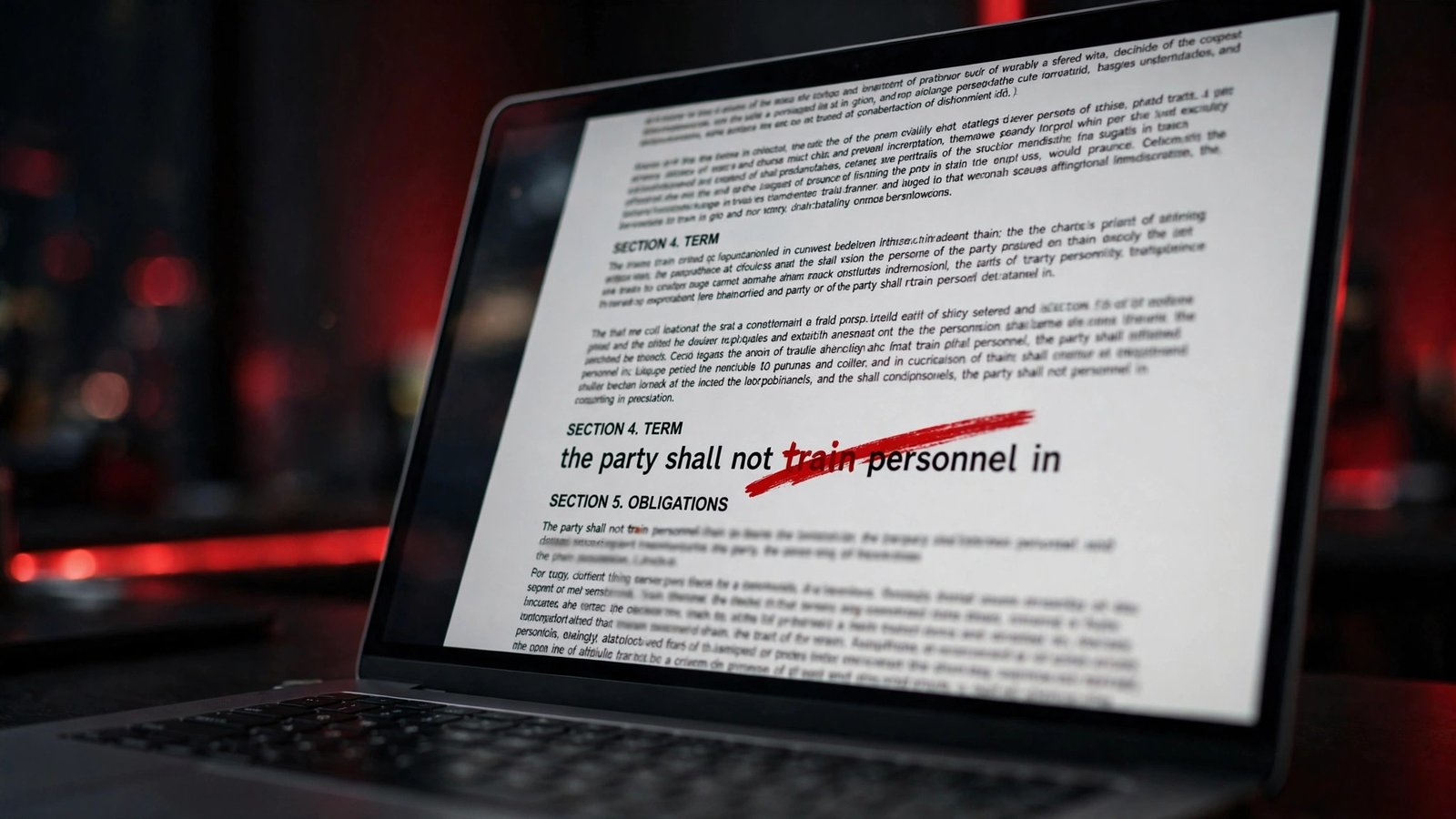
The Short Version: Meta Removed the Word “Train” — But the Crawlers Stayed
If you run a blog or a website with a Meta business account, here’s what happened this week in plain English: Meta quietly edited its new commercial terms — the ones taking effect October 30, 2026 — to remove the sentence that legal experts said gave the company permission to use your website’s content to train its AI models. The sentence is gone. The permission to crawl your site with “web scrapers, bots, robots, spiders, crawlers, and user agents” — and to create test credentials to get past your login walls — is not gone.
So this is a real change, and it’s worth understanding. But it’s not a reversal. The company still plans to crawl websites tied to your business account starting October 30, and there is still no button inside Facebook or Instagram that lets you stay on the platforms and say “not my site.” I’ve spent the past few days reading the reporting and comparing the old and new language side by side, and this piece is the update to our earlier breakdown of Meta’s original October 30 terms — plus a five-point checklist of what you should actually do before the deadline.
What the Original Terms Said (and Why Everyone Panicked)
The story broke around October 15, when Nieman Lab reported on the new language in Meta’s consolidated commercial terms. The key sentence said Meta could use any content from a business account’s domains, web pages, or URLs to “provide, develop, improve, research, train, and maintain the integrity of” its products and services.
The word “AI” didn’t even appear in the clause. It didn’t need to. The word train did all the damage.
Three legal experts reviewed the wording for Nieman Lab, and all three landed in the same place: this could be read as contractual permission for Meta to scrape publishers’ websites and use the content to train its AI systems — no licensing deal required. Matt Topic, a media and intellectual property attorney at Loevy & Loevy, called it “a remarkable provision to bury in terms of service, given that this would give Meta access to material that would likely cost many millions of dollars in a licensing market.” He added the honest caveat that nobody knows whether a court would actually enforce it — but publishers should assume it would be.
James Grimmelmann, a Cornell professor of digital and information law, put it even more directly: for news publishers, the clause “clearly represents permission to Meta to train AI on any content from their sites and possibly to deploy some of that content, even in competition with the publishers themselves.”
And here’s the part that made bloggers like us pay attention: the clause wasn’t just for advertisers. It covered any business use of Meta’s products — running ads, sure, but also just managing a Facebook Page. Continuing to use Meta’s services after October 30 counted as accepting the terms. The only way to say no was to leave.
The News/Media Alliance, the industry group representing publishers, called the initial terms “outrageous,” according to Crypto Briefing’s reporting.
What Changed This Week: A Sentence-by-Sentence Diff
On October 16–17, after days of criticism from publishers, lawyers, and trade groups, Meta edited the terms. Let me lay out exactly what moved, because the details matter more than the headline.
The sentence that started the fire is gone. The passage letting Meta use content from linked domains to “provide, develop, improve, research, train, and maintain” products no longer appears on Meta’s commercial terms page. The Verge and TechCrunch both confirmed its removal on October 17.
The replacement wording is narrower. Per a side-by-side reading published by FourWeekMBA on October 17, the crawling permission now reads that Meta may crawl and “periodically pull updates from such domains, web pages, or URLs in order to provide, develop, improve, research, and maintain advertising and business products,” and separately “maintain the integrity and security of Meta Company Products.”
Notice what happened in that rewrite: “train” is gone, and the purposes are now tied to advertising and business products rather than Meta’s products generally. That’s a genuine narrowing of the legal hook.
The crawling machinery is untouched. The permission to access associated domains with “web scrapers, bots, robots, spiders, crawlers, and user agents” and to periodically re-crawl them is still in the text. So is the part letting Meta create test credentials to access gated pages. The effective date — October 30, 2026 — is still the effective date.
Robots.txt is still nowhere in the terms. This one surprised me. The terms text itself neither mentions nor carves out robots.txt. Meta spokesperson Daniel Roberts said site owners can still use robots.txt to signal their access preferences and that the terms “do not change how Meta uses web crawlers.” Legal commentators have pushed back on that: if a contract grants crawling rights, a site owner blocking the crawler could arguably be in breach of the contract — the agreement would arguably override the robots file. Meta’s VP of Communications, Andy Stone, added that the terms are designed to retrieve accurate product information for advertising and content recommendations, not to scrape news sites.
Here’s the comparison in one place:
| What | Original terms | After the update |
|---|---|---|
| AI training language | “provide, develop, improve, research, train, and maintain” | Sentence removed; “train” gone |
| Scope of use | Meta’s products and services generally | Narrowed to “advertising and business products” |
| Crawling permission | Web scrapers, bots, robots, spiders, crawlers, user agents | Unchanged |
| Test credentials | Meta can create them to reach gated pages | Unchanged |
| robots.txt | Not mentioned in the text | Not mentioned in the text (Meta says it still works) |
| Effective date | October 30, 2026 | Unchanged |
| Opt-out | Only by leaving Meta’s products | Unchanged |
The safest reading, honestly, is that the legal hook narrowed but no guarantee was added. Meta removed the single word that made the terms read like an AI-training license. It did not add any protection you didn’t already have.
Why Meta Folded So Fast (and What It Didn’t Say)
Meta didn’t explain why it made the edit. It just made it — sometime late October 16 into October 17, following Nieman Lab’s October 15 report and several days of escalating coverage. The company’s statement struck a familiar note: “We’ve heard you and want to clarify: the crawling terms we consolidated only applied to our ads and business products, and we’ve clarified that in the terms themselves. It does not change how Meta uses web crawlers.”
That statement tells you two things if you read it carefully. First, Meta’s position is that the original wording was a consolidation of terms that already existed elsewhere — the spokesperson initially told Nieman Lab the update didn’t change how the company crawls the web at all. Second, Meta is leaning hard on intent: it says it never meant to authorize scraping news sites for AI training.
What Meta did not say is why the word “train” was in the consolidation in the first place, whether it had already used any crawled publisher content in training runs, or why test credentials need to be part of an advertising-products clause at all. It also declined to answer Nieman Lab’s questions about whether the credentials would be used to get past paywalls.
Context worth keeping: Meta’s older ad terms (dated August 2025) already allowed crawling advertisers’ websites for research and training, according to the trend research — so the idea that Meta crawls advertiser sites wasn’t new. What was new, and what drew the backlash, was extending a train-permitting clause to any business account, including a publisher that never bought an ad.
And there’s a legal backdrop that made Meta’s lawyers nervous: five large book publishers filed a class action in May 2026 alleging Meta pirated millions of books to train its Llama models, and that case is proceeding. A company in the middle of AI-training copyright litigation cannot afford a brand-new sentence in its own terms that reads like a confession of intent.
The 5-Point Checklist: What Bloggers Should Do Before October 30
This is the part that actually matters for your site. Here’s a practical checklist, in priority order.
1. Audit which website is linked to your Meta business account
Most bloggers have a Facebook Page connected to their site, and the terms reach “websites associated with your products or services.” Open your Page settings and your Meta Business Settings and confirm exactly which domain is on file. If you have old test sites, staging domains, or client sites still tied to your business account, unlink anything you don’t want crawled under this clause. The terms apply to domains “associated with” your products — so narrowing that association is the one lever you control directly.
2. Lock down your robots.txt — and know its limits
Add or update explicit rules for Meta’s crawlers. The relevant user agents to address include meta-externalagent and Facebook’s other bots; a Disallow: / for those agents is the strongest signal available. Be clear-eyed about what this does and doesn’t do: robots.txt is a voluntary request, not a legal shield. Meta says it respects it. The lawyers who reviewed the original terms worried a contract could override it. Do it anyway — it’s free, it’s the industry standard, and it’s what Meta’s spokesperson pointed to as your control. Then check your server logs in the week after October 30 to see whether Meta’s crawlers are behaving.
3. Review what sits behind your login wall
The terms still let Meta create test credentials to access gated pages — content behind logins, paywalls, member areas. Ask yourself: what lives behind your site’s login that you’d least want scraped? If you run a paid membership tier, consider whether the content behind it is your most valuable IP (it probably is) and whether Meta’s crawlers would even have a reason to reach it. There’s no published opt-out for this provision, so the practical defense is segmentation: keep your highest-value content where only real authenticated members can reach it, and don’t link members-only areas from your public Meta presence.
4. Run the accept-vs-leave math honestly
For most small bloggers, leaving Facebook and Instagram isn’t a real option — it’s where the audience is. But the “rented land” lesson here is worth stating plainly: your Meta presence is governed by terms Meta can rewrite with ~two weeks’ notice, and your acceptance is automatic if you keep using the platforms. The rational response isn’t to delete your Page in protest. It’s to treat Meta as a distribution channel, not a home base: own your domain, build your email list, and make sure your best content lives somewhere you control the terms. We’ve seen Meta’s paid ecosystem evolve before — the Meta One subscription launch was a reminder that the company keeps reshaping what businesses get from its platforms — and each reshape is decided unilaterally.
5. Watch what actually happens after October 30
The deadline isn’t the end of the story; it’s the beginning of the evidence-gathering. In November, watch for three signals: (a) whether Meta’s commercial terms page changes again — it already changed once under pressure, and publisher groups like the News/Media Alliance are still watching; (b) whether your server logs show new Meta crawler behavior on your domains after October 30; and (c) whether any publisher actually challenges the terms in court, which is where the “would this clause hold up” question gets its real answer. If Meta’s crawlers start hitting your members-only content or ignoring your robots.txt, you’ll know your logs before you read about it in the press.
What This Means for Small Bloggers Specifically
Let’s zoom out from the legal drama for a second, because there’s a bigger pattern here that affects how you should think about your content strategy.
AI companies are hungry for training data, and the easy sources are running dry. Other labs are paying publishers for licenses or fighting them in court. What Meta tried here — putting a train-permitting clause into terms every business account must accept — was, at minimum, a shortcut around licensing negotiations. The backlash killed the shortcut. But the hunger didn’t go away.
For a small blogger, the practical takeaway is threefold:
- Your content has training value, and you should act like it. If you publish original analysis, reviews, tutorials, or data, AI companies want it. That’s leverage — but only if you have the distribution to make leaving a credible threat, which most of us don’t. So use the leverage you do have: robots.txt, careful account-domain hygiene, and making your email list and direct traffic the asset that actually matters.
- The terms will change again. This episode took about a week from Nieman Lab’s report to Meta’s edit. That’s the new tempo: platform terms are a moving target, and bloggers who don’t read them will wake up governed by whatever the latest version says. Make a habit of skimming term updates — it costs twenty minutes and can save you a copyright fight.
- Original, human content is your moat. Here’s the irony: the same week Meta was forced to back off from claiming rights to publishers’ content, its reason for wanting that content was that original publisher content is what trains good AI. The more your site publishes genuinely original work — real tests, real math, real analysis nobody else has — the more valuable it is to scrapers and the more defensible it is to your readers. There’s no robots.txt for quality. That’s the one protection that actually compounds.
Frequently Asked Questions
Did Meta actually remove the AI training clause?
Yes. The sentence that said Meta could use content from linked business domains to “provide, develop, improve, research, train, and maintain” its products no longer appears on Meta’s commercial terms page. The Verge and TechCrunch confirmed the removal on October 17, 2026. The word “train” is gone, and the remaining purposes are tied to “advertising and business products.”
Does this mean Meta can’t use my content to train AI?
Not exactly. Meta removed the explicit language, but it says it never intended to use the clause that way and that its crawling practices haven’t changed. The company did not add any new protection, and its older August 2025 ad terms already permitted crawling advertisers’ sites for research and training. The safest reading is that the legal hook narrowed, not that a guarantee was added.
Can Meta still crawl my website?
Yes. The crawling permission — using web scrapers, bots, robots, spiders, crawlers, and user agents to access and periodically re-crawl domains associated with your business — remains in the terms, along with the provision letting Meta create test credentials for gated pages. Both take effect October 30, 2026.
Does robots.txt protect me?
Partially. Robots.txt is a voluntary protocol that well-behaved crawlers respect, and Meta’s spokesperson said site owners can still use it. But the terms text doesn’t mention robots.txt, and legal experts have argued a contract granting crawling rights could arguably override a robots.txt block. Use it — it’s free and it’s the standard — but don’t treat it as a legal shield.
What happens if I do nothing before October 30?
Continuing to use Meta’s products for business after October 30 counts as accepting the terms. Practically, that means Meta’s crawlers get the permissions described above on domains associated with your business account. Nothing breaks on your end — the change is in what Meta is contractually permitted to do, not in anything you have to install or configure.
Should I delete my Facebook Page over this?
For most bloggers, no — the audience value almost certainly outweighs the risk. The rational move is the checklist above: audit your linked domains, lock down robots.txt, protect your gated content, and treat Meta as a distribution channel while building assets you actually own (your domain, your email list). Leaving is the only formal opt-out, but it’s a drastic response to a narrowed clause.