
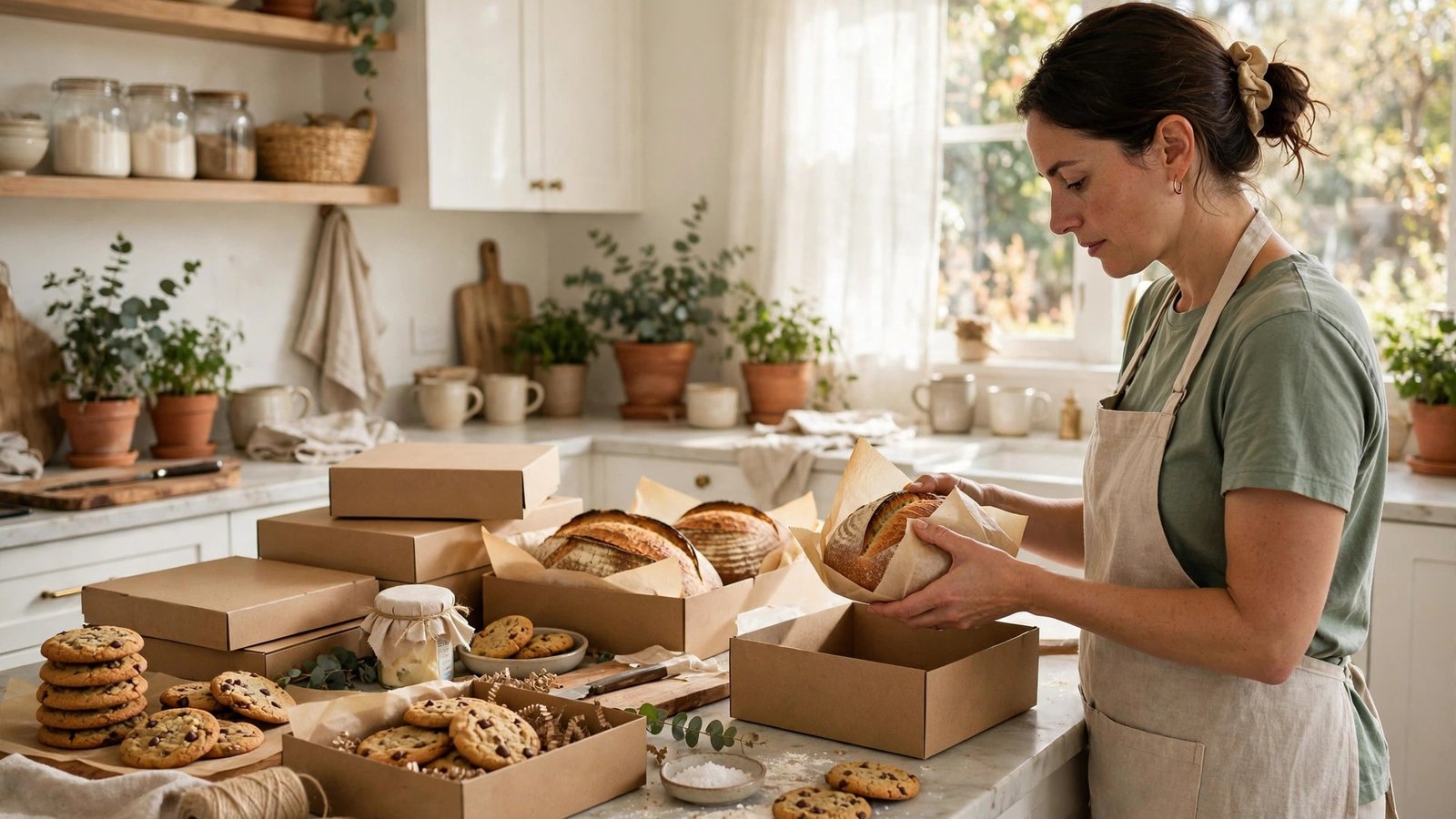
Here is the short answer up front: cottage food laws let you sell homemade, shelf-stable food — bread, cookies, jams, candy, dried goods — from your home kitchen without renting a commercial kitchen or passing a health inspection. But the rules are set state by state, and they differ wildly. Sales caps range from $250,000 a year in Florida to no cap at all in states like Alabama, Idaho, and Montana, and 2026 brought big changes: Maryland doubled its cap to $100,000, Michigan doubled its cap and opened up online sales, and Virginia finally let home producers sell over the internet.
If you have ever thought about turning your baking hobby into a side hustle, this is the lowest-cost legal way to start. This guide covers what you can sell, the caps and sales channels in every kind of state, the 2026 changes that matter, the labeling rules people get wrong, and the real money math — so you can start selling without accidentally breaking the law.
What cottage food laws actually let you do
A cottage food law is a state exemption. Normally, selling food to the public requires a licensed, inspected commercial kitchen. Cottage food laws carve out an exception for low-risk, homemade food produced in a home kitchen: no commercial kitchen, no routine inspection, no food-manufacturer license — as long as you stay inside your state’s limits on what you sell, how much you sell, and where you sell it.
The key word is exemption, not deregulation. You still have rules: an allowed-foods list, a sales cap, labeling requirements, and limits on sales channels.
Cottage food is also not the same thing as a food truck, a restaurant, or a wholesale bakery. It is a starting rung. The whole point is to let you test a food business with almost no upfront cost — your existing kitchen, a few hundred dollars of ingredients and packaging — and grow into a licensed operation if demand shows up.
What you can and cannot sell
In most states, the rule is: shelf-stable, non-TCS foods only. TCS means “time/temperature control for safety” — food that needs refrigeration to stay safe. The typical allowed list includes:
- Baked goods that do not need refrigeration: breads, rolls, biscuits, cakes, pastries, cookies, pies
- Candy, chocolates, fudge, and other confections
- Jams, jellies, preserves, and fruit butters
- Dried herbs, herb and seasoning blends, dry mixes
- Dehydrated fruits, vegetables, and herbs
- Cereals, granola, trail mix, popcorn, coated and uncoated nuts
- Vinegar, pickles, and (in some states) fermented or acidic foods
The typical prohibited list is just as consistent: anything with meat, poultry, or seafood; dairy products that require refrigeration; custard-filled or cream-filled pastries; cream cheese frostings; raw sprouts; low-acid canned goods (like home-canned green beans); cut melons and cut tomatoes; and products with CBD or THC. The logic is food safety: if it can grow dangerous bacteria at room temperature, it does not belong in an uninspected home kitchen.
Two states broke the mold in the last two years, and they show where the trend is heading. Texas switched in September 2025 from a “what you CAN sell” list to a “what you CAN’T sell” list — under its current law you can sell almost any food, including refrigerated items like cheesecakes and banana pudding, as long as you register and follow safe-handling labeling. Indiana’s HB 1424, effective July 1, 2026, shifted to a broader food-freedom model that newly allows time/temperature-control foods under new rules. Everywhere else, assume the shelf-stable rule applies unless your state says otherwise.
One more trap: cottage food products almost always have to be prepackaged, and in most states you cannot sell them wholesale to stores or restaurants — you sell directly to the consumer. Texas and California are notable exceptions, covered below.
The 2026 changes that matter
Cottage food law is moving fast, and 2026 was one of the busiest years yet. These are the changes that actually affect what you can earn:
Maryland — cap doubled. HB 535 raised Maryland’s cottage food revenue ceiling from $50,000 to $100,000 a year, effective October 1, 2026 — doubling how much a home producer can earn before losing the exemption.
Michigan — cap doubled, online sales opened. HB 4122 took effect March 24, 2026. The annual cap rose from $25,000 to $50,000 per operator (or $75,000 for operators with at least one product priced at $250 or more), with inflation adjustments starting October 1, 2026. Online, mail-order, and third-party delivery sales within Michigan are now allowed after direct producer-consumer interaction by phone, email, website, or social media.
Virginia — online sales finally allowed. HB 402, effective July 1, 2026, lets Virginia cottage food producers sell over the internet or by phone and ship or deliver to customers by mail or delivery service. Before that, sales had to be in person. Products still cannot be sold out of state or in retail food establishments.
Indiana — food freedom expansion. HB 1424, effective July 1, 2026, moved Indiana to a much broader food-freedom model, newly allowing time/temperature-control foods under new rules. If you are in Indiana, read the new rules carefully — the old “shelf-stable only” summary no longer applies.
West Virginia — a real cottage food section, at last. SB 44 created a dedicated cottage food section in the state code for the first time, replacing the patchwork of farmers-market rules that governed home producers before.
Texas — the 2025 overhaul is now the baseline. SB 541 (effective September 1, 2025) tripled the Texas cap from $50,000 to $150,000 a year with inflation adjustment, allowed wholesale through registered cottage food vendors, and added registration for operators selling refrigerated foods and for vendors. If you are researching Texas from an older guide that says $50,000, it is out of date.
Colorado — change coming in 2027. Colorado’s expanded law takes effect January 1, 2027, with a $150,000 cap and inflation adjustments, plus annual registration and labels using a state registration number. If you are in Colorado, plan for the new paperwork now.
New York — a bill to watch. New York’s proposed Homegrown Foods Act (A5836) would add a $12,500 annual cap where home producers currently operate without one. It was re-referred to committee in January 2026. A cap where none existed is a restriction dressed up as a framework — worth watching if you sell in New York.
Sales caps by state: the big picture
Caps are the number everyone asks about, and they are the number most often quoted wrong, because they change every legislative session. Treat every figure here as a 2026 snapshot and verify your own state before you sell. With that caveat, here is the verified landscape:
| State | Annual sales cap (2026) | Notes |
|---|---|---|
| Florida | $250,000 | Highest cap in the country; no permit required |
| Texas | $150,000 | Indexed to inflation; wholesale via registered vendors |
| California | $88,878 (Class A) / $177,756 (Class B) | Class B adds indirect retail sales |
| Maryland | $100,000 | Doubled Oct 1, 2026 |
| Minnesota | $78,000 | Inflation-adjusted |
| Michigan | $50,000 (or $75,000 for $250+/unit products) | Doubled Mar 2026 |
| Oregon | $51,200 | Baked-goods exemption figure |
| Mississippi | $35,000 | Simple setup, no registration |
| Vermont | $30,000 | — |
| Alabama, Idaho, Montana, Ohio | No cap | No dollar ceiling, but product and channel rules still apply |
| Arizona | No cap | Sales allowed “to the maximum extent allowed by federal law” |
A few things to notice in that table. First, a high cap does not mean a free-for-all: Florida’s $250,000 cap still comes with no-wholesale rules and strict labeling. Second, a low cap can still support a real side hustle: $30,000 in Vermont is $2,500 a month, which is meaningful money for a part-time operation. Third, several states with no cap still restrict what you can sell and where — the cap is only one of four levers.
What counts toward the cap also matters. In most states, the cap counts gross sales of cottage food products. Related income — like teaching decorating classes — generally does not count toward a baking cap, because it is a separate business activity, but check your state’s definition: the safest approach is to keep separate records for product sales and teaching income so you can prove the split if anyone asks.
Where you can sell
Sales channels are the second lever, and they changed more in 2026 than caps did.
- Direct to consumer (everywhere): from your home, at farmers markets, farm stands, bake sales, and public events. This is the baseline every state allows.
- Online and mail order (most states now): Michigan, Virginia, Texas, Florida, Ohio, and many others allow internet and mail-order sales within the state. Virginia only joined this group in July 2026.
- Interstate sales (almost never): cottage food products generally cannot be sold across state lines. If a customer in another state wants your jam, the cottage food exemption does not cover that shipment.
- Retail and wholesale (a few states): California’s Class B permit allows indirect sales through retail shops and restaurants. Texas allows sales through registered cottage food vendors — grocery stores, restaurants, farmers markets, gift shops. Massachusetts offers a wholesale tier with added requirements. Most other states ban wholesale entirely.
The practical takeaway: if your plan is “sell at the farmers market and take orders on Instagram,” you are covered in most states. If your plan is “get my cookies into local coffee shops,” you need to check whether your state allows indirect sales — and if it does not, you need a different license.
Labels: the part everyone gets wrong
Labeling is where home sellers get tripped up most, because the requirements look fussy until you realize they are mostly the same five things plus one disclaimer. A typical cottage food label must include:
- Producer name and address (your home address, unless your state lets you use a registration number instead)
- Product name
- Ingredients in descending order by weight, including sub-ingredients
- Net weight or volume, in both customary (oz/lb) and metric (g) units
- Allergen statement — the nine major allergens: milk, eggs, fish, crustacean shellfish, tree nuts, peanuts, wheat, soy, sesame
- The required disclaimer, in at least 10-point contrasting type. Florida’s version reads: “Made in a cottage food operation that is not subject to Florida’s food safety regulations.” Ohio’s shorter version reads: “This product is home produced.” The exact wording is set by your state — copy it verbatim.
The address-privacy question comes up constantly, because nobody loves printing their home address on every cookie bag. Several states now offer a fix: Texas lets registered producers use a DSHS ID number instead of their home address. Michigan offers optional free MSU Extension registration that lets you use a registration number. Maryland lets producers use a state ID number plus name and phone number. If your state does not offer that option, a P.O. Box is usually not a substitute — check before you print.
Labels also carry the dates and handling notes some states require: Texas requires a “date made” on products sold through cottage food vendors, and registered TCS sellers need safe-handling labels. When in doubt, add more information rather than less — nobody has ever been fined for a label that was too clear.
Do you need training, a permit, or an inspection?
It depends on the state, and the range is wide:
- No permit, no inspection (most states): Florida, Texas (for standard non-TCS foods), Michigan, Ohio, and others require no permit, no registration, and no routine inspection. Inspections happen only if a complaint is filed or an illness is linked to your food.
- Food handler training: Texas requires an accredited food-safety (food handler) course before you sell — typically about two hours and $10 to $15, valid for two years. Several other states require or strongly recommend similar training.
- Registration or permit: Connecticut requires registration with the Department of Consumer Protection. California requires county registration and a permit, with Class A for direct sales and Class B for indirect sales. Massachusetts requires a local health permit, a home inspection, and food safety manager plus allergen awareness certifications — one of the strictest setups in the country.
- Kitchen inspection: rare under cottage food law, but Massachusetts inspects, and some states inspect for specific tiers.
Beyond the food rules, do not forget the ordinary business paperwork: a DBA (“doing business as”) filing if you sell under a name other than your own, a sales tax permit if your state taxes what you sell (in Texas, plain baked goods sold to-go are usually not taxable, but candy and confections are), and separate bookkeeping for your cottage income. If you formalize as an LLC, keep your compliance filings in order — our guide to BOI reporting for U.S. companies covers who has to file. And if you plan to sell on a marketplace as well as in person, run the fee math first — our Etsy fee breakdown for digital sellers shows how platform fees eat into margins.
Also check your local zoning and HOA rules before you start. Some cities restrict home-based food businesses, and some HOAs ban commercial activity outright. State law may preempt local permit requirements (Texas law does), but a zoning fight is a headache you do not need in month one.
The money math: what a cottage food side hustle actually earns
Let us get concrete, because “follow your passion” is not a business plan.
A real first-year example: sourdough baker Sarah, writing on her own blog, reports $37,000 in first-year revenue as a cottage baker — $13,000 wholesale, $9,000 from porch pickups, and $15,000 from workshops — with about $12,000 reinvested into a bigger mixer, a bread oven, and a fridge, and profit margins around 75% on baked goods (even higher for workshops). She started by baking 10 to 15 loaves a week and giving them away, then took a wholesale order from a small market, then added porch pickups through her Hotplate page. The workshops — teaching other people to bake — ended up as her highest-margin line, and they did not count against her baking cap.
Another real example: Joanna Walesiewicz, a 26-year-old in the San Diego area, left her social media marketing job to run a home-based micro-bakery, reporting roughly $354 a week in revenue including tips from farmers markets, pre-orders, and brand partnerships, according to the Economic Times. That is about $18,000 a year — a solid side income, not a replacement salary, and a realistic picture of what a one-person bakery looks like in year one.
Now run your own numbers. A simple pricing formula:
Price = (ingredients + packaging + market fees) + (hours × your target hourly rate) + a margin for reinvestment
If a loaf costs $1.80 in ingredients and packaging, takes 20 minutes of hands-on time, and you value your time at $25 an hour, your floor price is about $10.10 before margin — call it $12. Then check the cap math: at $12 a loaf, a $50,000 cap means 4,167 loaves a year, or about 80 a week. That is a lot of baking for one person. At a $250,000 cap, the constraint is not the law — it is your oven, your time, and your customer base.
The honest lesson from both real examples: the product gets you started, but the add-ons — workshops, classes, custom orders — are often where the profit lives. Plan for that from the beginning.
Starting checklist: seven steps
- Read your state’s cottage food page. Start with your state agriculture or health department, not a blog. Confirm the allowed foods, cap, channels, and label wording. The Institute for Justice’s homemade food tracker is a useful cross-check for how your state’s rules compare.
- Pick three to five products. Start with your best sellers, not a huge menu. Test them on brutally honest friends before you sell.
- Complete any required training. Texas food handler course, Massachusetts certifications, or your state’s equivalent.
- Design a compliant label. Include every required element and the exact disclaimer wording. Print a small batch first — you will find typos.
- Price with the formula above. Calculate all costs including ingredients, packaging, market fees, and your time. Do not compete on price with grocery stores; compete on quality and story.
- Choose your first channel. Farmers market, porch pickup, or online orders — one channel done well beats three done badly.
- Track sales against your cap from day one. A simple spreadsheet with date, product, quantity, and revenue keeps you legal and shows you when it is time to grow.
When you outgrow cottage food
Cottage food is a starting rung, not a ceiling. The signs you have outgrown it: you are bumping against your state’s cap, stores want your products wholesale and your state does not allow it, customers want refrigerated items your state bans, or you need employees and a bigger kitchen.
The usual next steps, in order of cost: a licensed domestic kitchen (your home kitchen, inspected and licensed, as Oregon offers), a home bakery license (Ohio’s program for TCS bakery items and broader wholesale), a shared commercial kitchen or food incubator (hourly rental, licensed facility, no build-out), and finally your own commercial space or a co-packer who produces your recipes at scale. Each step trades more paperwork and cost for more freedom. The cottage food phase exists so you can prove demand before you spend that money.
Mistakes that get home sellers shut down
- Selling across state lines. Cottage food exemptions stop at the state border.
- Selling banned foods. Meat, dairy that needs refrigeration, custard fillings, and low-acid canned goods are the usual violations.
- Skipping the disclaimer or allergen statement. The most common labeling violation, and the easiest to fix.
- Ignoring local zoning or HOA rules. State preemption does not cover everything.
- Forgetting sales tax. If your state taxes candy, confections, or prepared foods, get the permit before you sell.
- Treating the cap as a suggestion. Track gross sales monthly. If you are going to exceed the cap, stop and upgrade your license — do not quietly blow past it.
Cottage food law in 2026 is the best deal in small business: near-zero startup cost, a real legal framework, and a genuine path from kitchen hobby to full-time business. Read your state’s page, label everything properly, price like a business, and start with three products you are proud of. The farmers market is waiting.
This article is general information, not legal advice. Cottage food laws change frequently — verify the current rules with your state agriculture or health department before you sell.
Frequently Asked Questions
Do I need a license to sell homemade food from home?
In most states, no — cottage food laws exempt you from the commercial-kitchen license as long as you sell only allowed shelf-stable foods, stay under your state’s sales cap, and follow its labeling and channel rules. Some states, like California and Massachusetts, do require registration or a permit, so check your state’s page first.
What foods can I sell under cottage food laws?
Typically, shelf-stable foods that do not require refrigeration: breads, cookies, cakes, pastries, candy, jams, jellies, dried goods, granola, and similar items. Meat, seafood, dairy that needs refrigeration, custard or cream fillings, and low-acid canned goods are prohibited in most states. Texas and Indiana have broader rules that allow some refrigerated items.
What is the cottage food sales cap in my state?
It varies widely: Florida caps at $250,000, Texas at $150,000, Maryland at $100,000 (doubled October 2026), Michigan at $50,000 (or $75,000 for $250+/unit products), while Alabama, Idaho, Montana, and Ohio have no cap. Caps change often — verify your state’s current figure with the state agency before you sell.
Can I sell cottage food online?
In most states, yes — within your own state. Michigan, Texas, Florida, and Ohio allow online and mail-order sales, and Virginia joined them in July 2026 under HB 402. Interstate sales are generally not covered by cottage food exemptions.
Can I sell cottage food to stores or restaurants?
Usually no — most states limit cottage food to direct-to-consumer sales. Exceptions include California’s Class B permit (indirect retail sales) and Texas’s registered cottage food vendor program (wholesale through registered vendors). If your state bans wholesale, you need a different license to supply stores.
What has to be on a cottage food label?
At minimum: producer name and address (or state registration number where allowed), product name, ingredients in descending order by weight, net weight or volume, an allergen statement, and your state’s exact disclaimer — for example, Florida’s “Made in a cottage food operation that is not subject to Florida’s food safety regulations” in at least 10-point type.