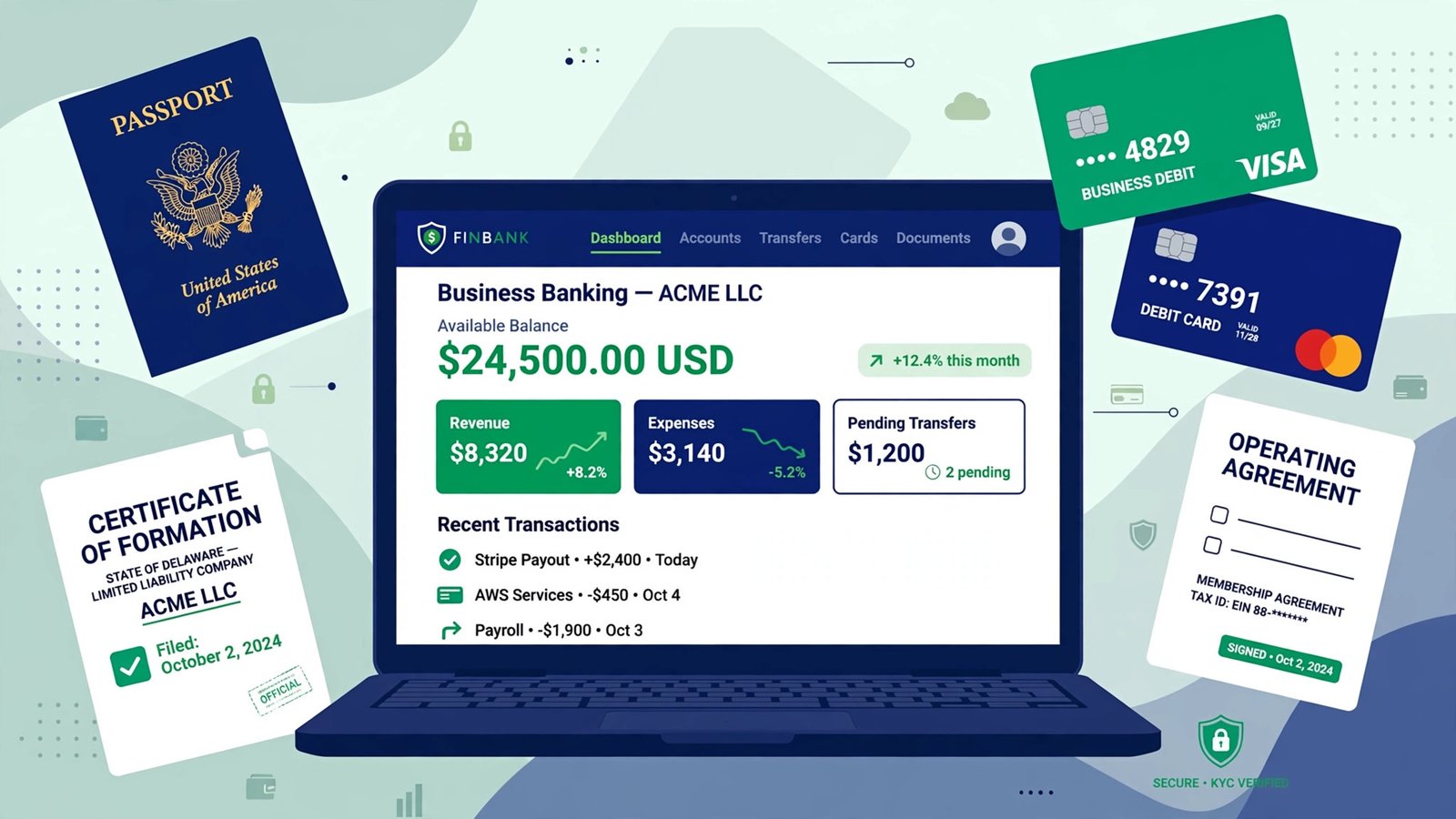
Running a US LLC without a Social Security Number used to mean one thing: no US bank account. That’s changed. A handful of virtual banks and fintech platforms now let LLC owners open real US business accounts with nothing more than a foreign passport and an EIN from the IRS.
But not every platform accepts every founder, and approval is never guaranteed. Here’s an honest, up-to-date look at the best options in 2026 — what each one asks for, who it’s best for, and how to avoid getting rejected.
Quick note: this is general information, not financial advice. Banking rules change often — always check each provider’s current terms before you apply.
The Short Answer: Top Picks
| Provider | Best for | SSN/ITIN needed? | Monthly fee |
|---|---|---|---|
| Mercury | Startups & online businesses | No (passport + EIN) | $0 |
| Relay | Agencies & bookkeeping nerds | No (passport + EIN) | $0 |
| Wise Business | Multi-currency freelancers | No | $0 |
| Brex | Fast-growing startups | Varies | $0 |
| Airwallex | Global payments & FX | Varies | Free plan available |
If you want the fastest path: get your EIN first, then apply to Mercury or Relay. If you mainly need to hold and convert multiple currencies, start with Wise Business.
What You Actually Need (No SSN Required)
No legitimate US banking platform will open a business account with zero documentation. Here’s what the SSN-free options typically ask for:
- A US-registered LLC or corporation. The entity has to exist in state records before you apply.
- An EIN from the IRS. This is your business’s tax ID. Non-residents can get one without an SSN by applying by phone or fax with Form SS-4 — we’ve covered how to get an EIN without an SSN step by step.
- A valid passport. A government-issued photo ID from any country works at the major platforms.
- Proof of your foreign address. A utility bill or bank statement from your home country, usually.
- Formation documents. Articles of Organization and sometimes an Operating Agreement.
- A real business description. “Software development for US SaaS clients” passes compliance review. A vague “consulting” often doesn’t.
One more thing worth knowing: Mercury, Relay, and similar platforms are fintech companies, not banks themselves. Your deposits are held at partner banks and covered by FDIC insurance through those partnerships. That’s standard in this space — just understand who actually holds your money.
1. Mercury — Best Overall for Online Businesses
Mercury is the name that comes up first in almost every non-resident founder conversation, and for good reason. It lets non-US founders apply with a foreign passport and an IRS-issued EIN — no SSN, no US address visit, no in-person anything. The whole process happens online.
What you get: no monthly fees, no minimum balance, no domestic wire fees, virtual and physical debit cards, and deep integrations with Stripe, PayPal, Shopify, QuickBooks, and Xero. The dashboard is genuinely pleasant to use, which matters when you’re managing money across time zones.
The catches: Mercury restricts applicants from certain countries, and its compliance review can be strict — a thin website or vague business description gets rejected. Mercury also occasionally closes accounts with little explanation, so don’t keep your entire operating cash in one place. And remember, approval depends on your entity, business activity, and the countries involved. An LLC and an EIN don’t guarantee acceptance.
Best for: tech founders, SaaS, e-commerce sellers, and agencies that live online.
2. Relay — Best for Bookkeeping and Cash Organization
Relay is the bookkeeping-friendly alternative. It accepts non-resident founders with a US LLC or C-corp plus an EIN — no SSN or ITIN required — and the application is fully remote, typically decided in a day or two.
Relay’s killer feature is structure: up to 20 separate checking accounts under one login, so you can run a profit-first setup (taxes here, operating expenses there, profit over there) without spreadsheets. It partners with Thread Bank, an FDIC-insured institution, with a sweep program covering deposits. The standard account is free with no monthly fees or minimums; a $30/month Pro tier adds same-day ACH, faster wires, and accounting integrations.
The trade-off: Relay doesn’t offer credit cards or lending products, so you can’t build business credit through it. And like Mercury, it restricts applicants from certain regions — check current eligibility before you get your hopes up.
Best for: agencies, consultants, and freelancers who want their books organized by design.
3. Wise Business — Best for Multi-Currency
Wise isn’t a bank either — it’s a money transfer platform with multi-currency account details. But for freelancers and small businesses getting paid in several currencies, it’s often the most practical tool in the stack.
You get local USD account details (routing + account number), can hold 40+ currencies, and convert at the mid-market rate with a transparent percentage fee. Receiving money is typically free; you pay when you convert. Availability is broader than Mercury or Relay, which makes Wise the fallback when a founder’s country is restricted elsewhere.
The limitation: Wise is for moving and holding money, not full business banking. No checks, limited debit card features compared to the others, and no sub-accounts for profit-first budgeting. Most serious founders pair Wise with Mercury or Relay rather than replacing them.
Best for: freelancers and businesses juggling USD, EUR, and GBP income. If you’re choosing between payment rails, our Wise vs Payoneer breakdown walks through the fee math.
4. Brex — Best for Funded Startups
Brex targets startups with bigger ambitions: corporate cards, expense management, and banking in one package. Eligibility rules are stricter and change more often than the others — Brex has historically focused on venture-backed or high-growth companies — so it’s not the first stop for a solo freelancer. But if your LLC is scaling fast and you want credit products alongside checking, it’s worth a look.
Best for: startups that want cards, credit, and cash management together.
5. Airwallex — Best for Global Payments
Airwallex combines multi-currency accounts with payment infrastructure: invoicing, corporate cards, and FX at competitive markups. It’s strong for businesses paying suppliers or receiving revenue across many countries. Expect a more thorough onboarding — a live website and a business-domain email (not Gmail) are typically required.
Best for: e-commerce and SaaS businesses with genuinely global money movement.
How to Improve Your Approval Odds
Banking platforms run automated compliance checks before a human ever looks at your file. Here’s what actually moves the needle:
- Have a real, finished website. Crawlers check it. “Under construction” pages, lorem ipsum, or missing contact info trigger rejections. Include a privacy policy and terms page.
- Use your real physical address where asked. Virtual offices, mail-forwarding addresses, and registered-agent addresses in the “physical address” field get flagged.
- Describe your business specifically. Name your customers, your service, and where revenue comes from.
- Apply with your CP 575 in hand. That’s the IRS letter confirming your EIN — banks ask for it.
- Don’t apply to five platforms on the same day with inconsistent details. Keep your entity name, address, and description identical everywhere.
Watch-Outs Before You Apply
- Country restrictions are real and shifting. A platform that accepted your country last year might not today. Always check the current restricted-country list on the provider’s support pages.
- No platform guarantees approval. Every application goes through risk review. Rejection usually comes with a vague reason — fix what you can (website, documents, description) and try again or try elsewhere.
- Keep a backup. Even approved accounts occasionally get closed. Splitting operating cash between two providers isn’t paranoia; it’s basic risk management.
- Fintech ≠ bank. Your money sits with partner banks. Understand the FDIC pass-through arrangement and its limits before parking large balances.
Frequently Asked Questions
Can I really open a US business bank account with no SSN and no ITIN?
Yes — with the right platform. Mercury and Relay both accept non-resident founders using a foreign passport plus an EIN, with no SSN or ITIN required. Wise Business also works without either. You’ll still need a registered US entity, formation documents, and proof of address.
Do I need an ITIN instead of an SSN?
No. An ITIN is for filing US personal tax returns, not for opening a business bank account. Your LLC’s EIN is the identifier banks care about. Some founders get an ITIN for tax reasons, but it’s not a banking requirement at these platforms.
Is Mercury a real bank?
Mercury is a fintech company, not a chartered bank. Customer deposits are held at partner banks and covered by FDIC insurance through those partnerships (pass-through coverage). The same model applies to Relay (partner: Thread Bank) and most other names on this list.
How long does approval take?
It varies. Relay often decides in 1-2 business days. Mercury can take a few days to over a week depending on review volume. Wise Business is usually the fastest — often same-day for straightforward cases. Having all documents ready before you start is the biggest speed factor.
What if my country is restricted by Mercury and Relay?
Wise Business has the broadest availability and is the usual fallback. Airwallex is another option depending on your business profile. And country lists change — a restriction today may lift later, so it’s worth rechecking periodically.
Will a virtual bank account work with Stripe and PayPal?
Yes. Mercury and Relay both provide real US routing and account numbers that connect to Stripe, PayPal, and similar platforms. Wise’s USD account details also work for receiving ACH payments in most cases.
The Bottom Line
For most LLC owners without an SSN or ITIN, the practical shortlist is short: Mercury for a full-featured online business account, Relay for organized bookkeeping, and Wise Business for multi-currency flexibility. Get your EIN sorted first, put together a real website and clean documents, and apply with consistent details. Banking as a non-resident founder takes a bit more paperwork than it does for US citizens — but in 2026, it’s absolutely doable.